
Boss Of The Week
The Award Winning Life of BUA Boss, Abdulsamad Rabiu


By Eric Elezuo
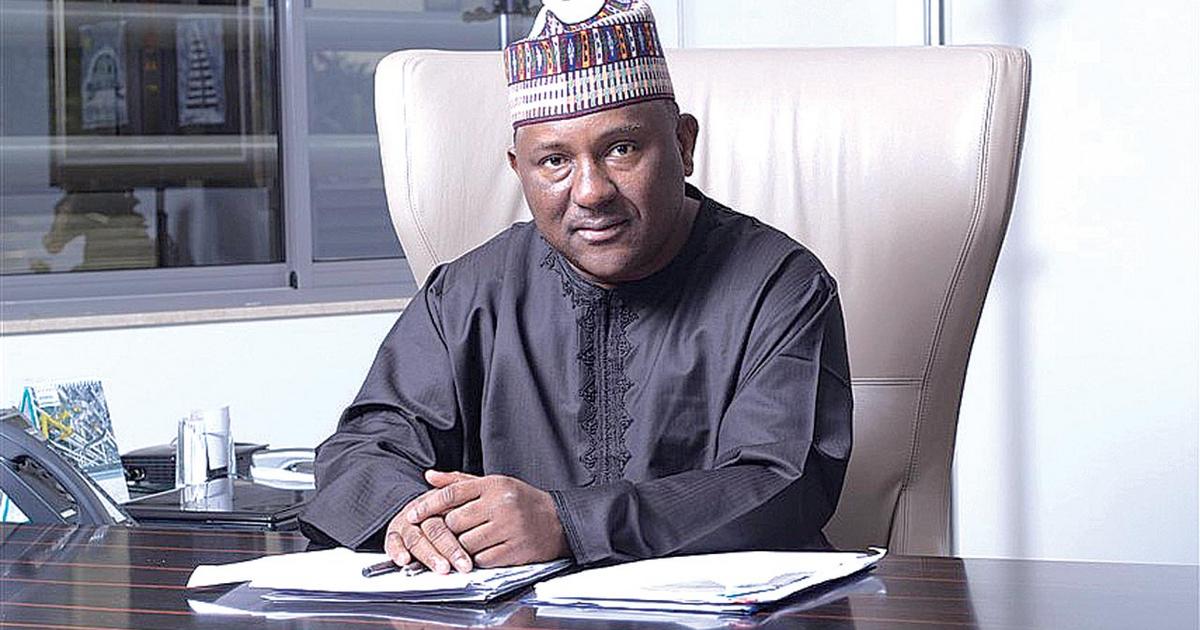
On November 4, 2023, Africa’s accomplished industrialist and billionaire businessman, Abdulsamad Rabiu, the ebullient Chairman of BUA Group, will step out in style to be bestowed with the prestigious Leadership Excellence Awards (LEEX Awards), which he has just won as The Man of the Year.
The LEEX Awards was endorsed in 2020 by the African Union Economic, Social and Cultural Council (AU-ECOSOCC), and in 2021 by the African Union Film Institute (AFI).
The award, the fifth in a row, and organised annually by IgbereTV, recognises and honours the outstanding impacts of leaders across both the public and private sectors in Nigeria as well as promotes outstanding leaders and personalities, whose impacts have been felt in Nigeria’s political, social and economic spheres.
Abdulsamad Rabiu’s consistent climb on the ladder of success has become phenomenal. The unassuming Chairman at Bua Group has become a study in entrepreneurial discipline, craft, philanthropy and intentional sacrifice. But what can actually be said of a man, who has steadily evolved as one of Africa’s biggest investors, in fact, the biggest in the order of reckoning in Nigeria Exchange. He has graciously used his BUA Foundation and the phenomenal Abdul Samad Rabiu Africa Initiative to not only affect lives, but ensured that the people of world, especially his native Nigeria, live in defined comfort. He is Chairman/Chief Executive Officer, Bua Group, makers of quality cement, sugar among other wonderful household items.
The BUA chairperson polled a total of 568,247 votes to defeat other nominees. The polls were monitored by News Agency of Nigeria (NAN).
Rabiu’s surge in wealth can be attributed to the remarkable growth in the market value of his stake in his unified food business, BUA Foods. The company currently ranks fifth most valuable on the Nigerian Exchange as at the last month.
Additionally, Rabiu owns a 92.6-percent stake in BUA Foods, which is currently worth $3 billion, bringing the total value of his holdings to $6.01 billion.
The company reported an impressive profit growth of 77.1 percent in the first quarter of 2023, with profits rising from N22.84 billion ($47.6 million) to N4046 billion ($87.58 million).
In May 2023, Rabiu dusted South African billionaire Nicky Oppenheimer, who currently has a net worth of $8.4 billion to hit third richest man position in Africa, with $8.6 billion. Abdul Samad Rabiu’s net worth has risen by over $3.7 billion in the past year, from $4.9 billion. He is a consistent achiever.
Early in 2022, he supervised the opening of a three million metric tonnes per annum BUA Cement Sokoto Line 4 Factory or 3MPTA BUA cement, line 4 cement plant, in Sokoto, which the then president, Muhammadu Buhari, commissioned, describing him as the biggest investor in Nigeria’s northwest region.
A thoroughbred stickler to excellence, Rabiu ensured that the BUA Cement Sokoto Line 4 was built to the following specifications: three million metric tonnes per annum capacity; 6,000 TPD ILC with the highest energy efficiency and latest pollution abating equipment; 48 MW dual fuel power Plant and so on. The Line 5 is already in the works.
Rabiu’s friends and colleagues in the industry, have not minced worlds as they have described as an entrepreneur who knows his onions as well as an industrialist of importance. His continuous feature on the Forbes list of billionaires in the world,is as a result of his inclination to creating millionaires through the provision of veritable employment opportunities, with special focus on those of his northwest origin. Today, he is the third richest man in Africa, and the richest investor in Nigeria Exchange.
THE INVINCIBLE ABDULSAMAD RABIU
Born August 4, 1960, in Kano, to one of Nigeria’s foremost industrialists in the 1970s and 1980s, Khalifah Isyaku Rabiu, Abdul Samad Isyaku Rabiu CON is a perfect combination of many things in one.
It was in his native Kano that he kick started his academic pursuit, carousing through elementary education with ease as a gifted child, and obtained his First School Leaving Certificate. He was later admitted into the Federal Government College, Kano, where he had his secondary education, and gradually with honours.
With a combination of fate, brilliance and determination, Abdulsamad was catapulted to Capital University in Columbus, Ohio, where he studiously studied Economics, and acquired his tertiary education before returning to Nigeria, all before his 24th birthday, to oversee his family business. He was that much sort after, and highly brilliant, and considered capable of holding fort for his father, who was being detained by the administration of General Muhammadu Buhari over matters concerning import duties.
In 1988, just after learning the ropes of entrepreneurial excellence, Abdul Samad Rabiu established BUA International Limited, for the sole purpose of commodity trading. The company followed after the footsteps of his father, and imported rice, edible oil, flour, and iron and steel.
In 1990, having exhibited the character worthy of a world class entrepreneur, and the ability to execute classical projects, Rabiu’s BUA was invited by the government, which owned Delta Steel Company to supply its raw materials in exchange for finished products. This provided a much-needed leverage for the young company, and consequently expanded further into steel, producing billets, importing iron ore, and constructing multiple rolling mills in Nigeria.
Rabiu’s dexterity showed further a few years later, when the company acquired Nigerian Oil Mills Limited, the largest edible oil processing company in Nigeria, and there erupted the company’s and BUA’s influence and care over the people in the provision of affordable edible oil. His passion to see people excel in comfort has continued to make him churn out one great tiding after another, and endearing him in the hearts of the generality of the public.
A man with a vision for tomorrow, Rabiu, in 2005, started two flour-milling plants, in Lagos and in Kano, and by 2008, had broken an eight-year monopoly in the Nigerian sugar industry by commissioning the second-largest sugar refinery in sub-Saharan Africa. This was a feat only a bravest of hearts could wroth. As a result, in 2009 the company went on to acquire a controlling stake in a publicly-listed Cement Company in Northern Nigeria and began to construct a $900 million cement plant in Edo State, completing it in early 2015. Rabiu’s passion for expansion is unequalled.
BUA Group has since concentrated and excelled in manufacturing, infrastructure and agriculture and producing a revenue in excess of $2.5 billion. This is in addition to being the chairman of the Bank of Industry (BOI).
The Group, in 2019, announced plans to merge its privately owned Obu Cement with the publicly traded Cement Company of Northern Nigeria Plc (CCNN), to create Nigeria’s second largest cement producer thereby consolidating the grip on the cement market and breaking its monopolistic status.
It is worthy of note that Cement Company of Northern Nigeria PLC in which Rabiu owned more than 97% was producing two million metric tons of cement per annum (Mtpa) while Obu Cement has an annual production capacity of 6Mtpa. The move is in line with the company’s resolve to deepen the Nigerian capital markets and enhance the growth of the cement industry.
Rabiu’s expansion strides cannot be complete without a mention of his extraordinary philanthropic gestures.
In April 2020, he made a whopping donation towards the fight to contain the spread of the Coronavirus pandemic presently ravaging the country.
In a letter dated April 24, 2020, he personally signed and addressed to The Presidential Task Force on COVID-19, the billionaire businessman, congratulated the duo of the Task Force and the Nigeria Centre for Disease Control (NCDC) for doing a good job while observing that much as so much has been done, there was still need to do a lot more, as the disease continued to make inroads into many parts of the country, especially Lagos and Kano states.
“I view with deep concern, the increased rate of spread of the Coronavirus, especially in Kano and Lagos states despite concerted collective efforts to curb the spread and effects of the virus in Nigeria,” he said.
With sincere reference to ‘what is going on, especially in Kano at the moment’ the philanthropist, who had earlier donated N1 billion to the private sector led CACOVID and other states, announced the release of another N3.3 billion ‘grant to the working group made up of the Presidential Task Force, NCDC and other stakeholders in equipping two existing permanent facilities in Kano and Lagos states’.

He said: “To this end, I am immediately committing and making available – through the Bua Foundation two grants of Two Billion Naira for the Kano-based intervention and One Billion Naira for Lagos State being the two epicentres of this virus in Nigeria.”
Rabiu also informed that “a sum of N300 million will also be made available immediately in cash to the Presidential Task Force to assist with logistical and operational activities of the taskforce. This grant is in addition to BUA’s earlier contributions to the private sector led CA-COVID coalition and donations to other states.”

Rabiu’s BUA had in March through a confirmed funds transfer to the COVID-19 relief fund account with the Central Bank of Nigeria redeemed its pledge of N1billion ($2.6m) to the fight against COVID-19. In addition, the company also announced another donation of N300 million to Sokoto, Edo and Ogun States to assist in galvanizing a coordinated response and adequate preparedness in the fight against the COVID-19 pandemic in this states. The donations to Sokoto and Edo States were on behalf of its Cement subsidiary, BUA Cement which has its major operations in those states whilst Ogun was also selected as a beneficiary due to its proximity to Lagos which had been the epicenter of the virus in Nigeria.
In total, Rabiu and his group donated N4.6 billion to the fight against the dreaded pandemic in a addition to other incentives, making them the single highest donor as at date.
Rabiu has constantly used his BUA Foundation for his philanthropic activities. Some of them include the construction of a 7,000-square-meter paediatric ward at the Aminu Kano Teaching Hospital and the construction of the Centre for Islamic Studies at Bayero University Kano amongst several others.
He is known to have signed several major deals with French companies in recent times, from Axens as technical partner to his new refinery, to a 300tn plasterboard factory deal with French construction giant St Gobain. He followed it up with listing a segment of his business empire on the Lagos Stock Exchange.
In June 2021 therefore, when French President Emmanuel Macron inaugurated the France-Nigeria Business Council, a private sector initiative to enhance business relations between the two countries, Abdul Samad Rabiu, was appointed its inaugural President. He had earlier been appointed Chairman of the France Nigeria Investment Club. These appointments drew encomiums from high places including President Muhammadu Buhari.
The BUA founder recently came to the aid of the Nigerian educational system with a 5.5 billion naira grant for infrastructural development to 22 universities and other tertiary institutions. The grant came under the ASR Tertiary Education Grants Scheme.
Practically every woman’s dream, Abdul Samad is married to his beautiful wife, and they are blessed with children, among whom are Isyaku Rabiu, Junaid Rabiu, Rukkayah Rania Rabiu and Khadijah Rabiu. He has 42 siblings including Nafiu Rabiu and Rabiu Rabiu, the chairman of IRS Airlines.
Rabiu’s abilities are compared only with the best. He is a force to reckon with in the field of enterprise and human capacity building. He is quite a gift to Nigeria, and the world.
Attesting to Rabiu’s business ingenuity is not rocket science. Here is a man, who has taken his family-business practically to the next generation. It is a feat of no mean value considering that he is thriving in a country where businesses die with their founding fathers.
Once again, congratulations sir, and wishing you many more grounds to conquer.
By Eric Elezuo
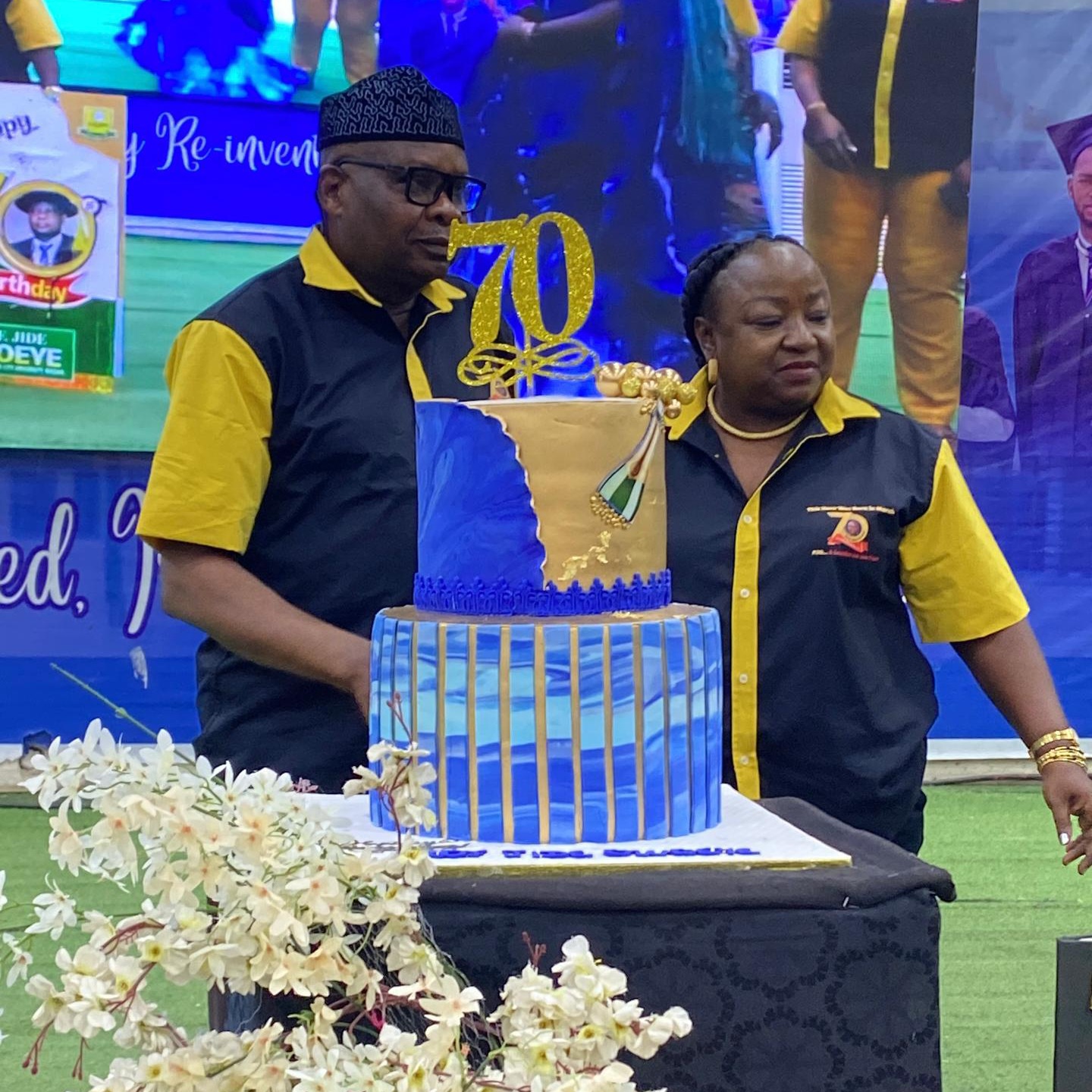
It was a gathering of distinguished egg heads, prolific intellectuals and ardent academics at the Adeline Hall of the Lead City University, Ibadan, when notable and celebrated Chairman of Council and Pro-Chancellor of the Institution, Professor Jide Owoeye, marked his entry into the septugenarian circle.
The event, a multiple-in-1 classic, featured tribute session, a panel session, books presentation and reading as a well as a defined colloquium. Among topnotch individuals that graced the event were delectable heads of higher institutions of learning including the Vice Chancellor, Edo State University, Uzairue, Sheldrake O. Akindele; the Vice Chancellor, Chrisland University, Abeokuta, Oyedunni S. Arulogun; Vice Chancellor of Crescent University, Abeokuta, Ibrahim Gbajabiamila, and the Deputy Vice Chancellor, Ajayi Crowther University, Oyo, Muyiwa Popoola, who were members of the panel session that discussed critical mechanisms that enhance and safeguard the future of education in the country.


The panelists leveraged on the theme, Nigeria Higher Education and Private Sector Involvement: Navigating the Path, Confronting the Challenges, Exploring Opportunities for the Future. The lead discussant was the Vice Chancellor, Federal University, Katherine, Gombe State, Umaru Pate.
Speaker after speaker, the academic giants celebrated the unequaled legacies of Prof Owoeye’s 70 years of impressive existence, especially his scholarly contributions to the standardization of not only learning, but also academic environment in Nigeria with the establishment of Lead City University in 2005.
The ceremony was punctuated with various genres of entertainment including cultural dances, touch of saxophone, talking drum display, drama presentation by students of the institution, and a host of others.

Among the books presented at the ceremony were Asia in World Politics and Knowledge in the Emerging Global Order.
The highpoint of the gathering was the cutting of the birthday cake with various presentations of full size portraits and other gifts items from colleagues, students and staff.


Othe dignitaries who graced the occasion were Chairman, Ovation Media Group, Chief Dele Momodu, General Secretary, Pan African Writers Association (PAWA), Wale Okediran, Oyo State Commissioner of Lagos among others.
Speaking on his achievements, a long time friend from the University of Ife days, Chief Momodu, noted that Prof Owoeye has always been a man of letters, who has carved a niche for himself, adding that Nigeria and Africa are proud of him.
Distinguished in every ramifications, and an authority in International politics and relations, with bias to Asia, Owoeye has transverse all areas and degrees of the academic environment, terminating at the professorial level, and capping it all with the establishment of topnotch private university as the icing on the cake of his academic pursuit and inclination. He boasts of bachelor’s, masters and doctorate degrees in different fields of international studies.
For Owoeye, reaching the peak of his profession was when he became a professor of International Relations at OAU in the year 2000.


Born on March 1, 1956, Prof. Jide Owoeye is a teacher, and a very proud one at that, who would not miss any opportunity to introduce learning and exchange of knowledge. That practically explains why his 70th birthday celebration was tailored towards a colloquium and book presentation status.
Owoeye began his schooling at the OLMC Demonstration School, Ibadan, where he spent the period between 1962 and 1967 acquiring elementary or foundational knowledge of education.
Afterwards in 1968, he attended Olivet Baptist High School, Oyo, for his school certificate, and left in 1972 before attending Government College Ibadan, for his Higher School Certificate, from 1973 to 1974.


He was admitted into the University of Ife, now Obafemi Awolowo University, for his first degree.
On graduation, he was employed as Insurance Officer at Akin George & Company, Lagos, as he decided to try his hands in circular career. His stint at the firm lasted between 1979 and 1980.
Thereafter, he made a daring turn into the word of teaching, becoming Lecturer II at the Department of Government, OSCAS, Ile-Ife, from 1980 to 1982. He briefly worked as Administrative Officer at the Obafemi Awolowo University, Ile-Ife, afterwards in 1983 before landing the position of Senior Lecturer at the Department of International Relations, Obafemi Awolowo University.
Then, there was no turning back from the academic world. He was made a Visiting Senior Research Fellow at the Nigerian Institute of International Affairs, Lagos, from 1992 to 1993, and then, Associate Lecturer, Foreign Policy Academy, at the Ministry of Foreign Affairs, International Centre for Asian Studies.


In a 2019 interview he granted The Punch, Owoeye noted as follows as to what propelled his desire to establish his own university: “I have been in the university system for almost 37 years and 24 of those years were spent in the public university system. I was a professor at the Obafemi Awolowo University, Ile Ife, Osun State, and I noticed then that if one has passion for education, one should have seen some of the lapses (in the system), and some of those lapses one discovered can only be corrected if one is the head of the institution. I believe if you aspire to have a better university system, it is either you head the institution or you look for avenues to help create one where you can impact upon. That was what brought about the passion to work towards establishing a private university where the quest for excellence can actually be attained.”
Owoeye’s rich trajectory in the world of education is common knowledge, leading to his hold several high-profile positions in Obafemi Awolowo University.


Owoeye is married to his lovely wife, Emuleomo, whom he wedded in 1982, and they are blessed with three children; a son and two daughters.
Meanwhile, a special birthday soiree has been scheduled for March 1, his day of turning 70 proper, at Adeline Hall of the university. It promises to be the mother of all celebrations.
Having spent a lot of energy paying attention to education, Owoeye would love to be remembered as somebody who contributed to quality education (at the tertiary and non-tertiary levels) in this country.
Happy 70th birthday sir!
Photos: Tunde Bolarinwa
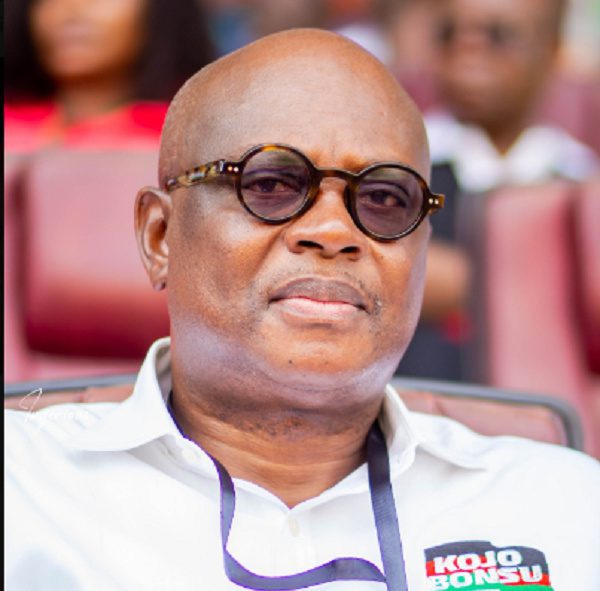
Schooled in varioius areas of human endeavour and administration, Mr Kojo Bonsu is an asset, not only to the Republic of Ghana, but the world in general. He has by every standard paid his dues to the development of his country, serving as the current Ambassador to the Peoples Republic of China, and having served in many other diverse areas including sports administration and entrepreneurship.
Presently, the face of the Republic in China has taken it upon himself to recreate the investment platform of Ghana in China, mandating the media to begin as a matter of urgency, to make Ghana the subject of focus in their reporting.
In other words, the Ambassador has appealed to the Chinese media to use their medium to promote Ghana. A call that resonate the general mantra of the government of President John Dramani Mahama
According to Bonsu, Ghana boasts of several business opportunities, therefore if the Chinese media take keen interest in Ghanaian issues, it would help attract investors from China to Ghana.
He insisted that the door of the Ghana Embassy in China is wide open to Chinese journalists, especially those who want to positively project Ghana.
Bonsu made the remarks while hosting a press soiree in Beijing, on behalf of the Ghana Embassy, which was graced by a number of prominent media institutions in China.
The programme was mainly used to promote Ghana’s upcoming 69th independence anniversary celebrations and also highlight investent opportunities in the country.
Kojo Bonsu, who is a former Kumasi Mayor, said Ghana is the safest, friendly and best country for any investor to do business, urging Chinese businessmen to heed his advice.
“The Chinese media institutions should henceforth partner with the Ghana Embassy in promoting trade and investment opportunities in both of our sister countries for growth.
According to him, Ghana is a democratic nation, which has conducive atmosphere for businesses to flourish, stressing his desire to work and improve Ghana-China relations.
“Ghana is committed to strengthening ties with China. My country is a stable democracy, has business-friendly environment and rich cultural heritage,” Kojo Bonsu stated.

A native of Offinso, a town in the Ashanti Region of Ghana, Michael Kojo (Mensa) Bonsu, thoroughbred professional, both in politics and administration, was born to a respected Offinso Queen Mother and a military officer, among eight other siblings.
He had his Ordinary Level education at the Tamale Secondary School, between 1974 and 1979, where he developed the knack, desire and dream of becoming a football administrator.
Thereafter, he was admitted into the Drayton School in London, but could not immediately assume studies because of the several businesses he was handling at the time. However, between 1985 and 1990, when Bonsu joined giant sports kit manufacturers, Adidas, he enrolled into their football Business Unit at Herzogenaurach, Germany, and in the process obtained a Diploma in Sports Business and Marketing. Presently, he holds a Master’s Degree in International Relations.
After completing his training in sports Business and marketing, Bonsu worked with Adidas and became their first representative in West Africa and served as an Assistant Marketing Officer. He rose to become the kit maker’s manager in Ghana and the whole of West Africa. Within which period he brokered deals between the company and the Ghana football Association specifically the Ghana football national team.
Bonsu’s dexterity in all the things he has laid his hands, including the oil sector, on earned him a citation of honour in 2015 by Managing Director of GOIL, Mr Patrick A.K. Akorli as follows; “You were the key advocate on the board when the monumental decision to rebrand GOIL was taken – the results of which have seen GOIL being propelled to the number one position (retail) among oil marketing companies in Ghana”.
He served as the Managing Director of GOIL from July 2011 to February 2012.
In addition to his legacy of achievements, Bonsu is a director of Tamale-based club Real Tamale United. He was also an executive member of Asante Kotoko.
In 2003, he launched a bid to be the Ghana Football Association’s President. He went against former president of the GFA Kwesi Nyantakyi, politician and executive member of Accra Hearts of Oak, Vincent Odotei Sowah, a former FA vice-chairman, Joseph Ade Coker and former executive council chairman, Y.A Ibrahim. He subsequently lost to Kwesi Nyantakyi in the elections in December 2005.
An ardent supporter of Asante Kotoko and Premier side Tottenham Hotspur, in 2001, he founded and published Agoo Magazine, an African lifestyle magazine.
In January 2010, Bonsu was appointed board chairman of the National Sports Authority then a council under the Ministry of Youth and Sports. He is known and respected for spearheading the re-branding of the sports council until it subsequently became a sports authority.
In 2013, President Mahama nominated him for the position of Metropolitan Chief Executive for the Kumasi Metropolitan Assembly. He resigned in July 2016, following an issue with the Kumasi Traditional Council.
Among many other landmarks, Bonsu would be remembered building the first ever recreational facility, the Kumasi Rattray Park, and organizing the second largest event as part of the celebration of Ghana at 50, dubbed “Ghana As One Gala Night” at Ghana’s Black Star Square with International artists including The Whispers, Shalamar, Pat Thomas, AB Cresntil, Gyedu Blay Amboley, Paapa Yankson and Ola Williams.
It is also on record that in 2014, he secured a loan facility from the Deutsche Bank UAE through parliamentary approval to build the largest modern market in West Africa, the Kejetia Market, called the “Kejetia Dubai,” completed in 2017. He also built the Asawase market, Tafo market, and Atonsu-Agogo market. He renovated the Kumasi Prempeh Assembly Hall. Bonsu’s strides speak volumes.
Bonsu tried his hands at the presidency of Ghana in 2024, but could not win the ticket of his party as Mahama was the preferred choice.
Bonsu continues to exhibit great strides as a distinguished administrator, businessman and political juggernaut.
By Eric Elezuo
The University community of the prestigious Afe Babalola University, Ado Ekiti (ABUAD), buzzed with renewed vigour during the end of last week, when the renowned founder, who doubled as a distinguished Academic and Legal luminary, Prof Afe Babalola, was honoured with the Pan African Writers Association’s (PAWA) top award.
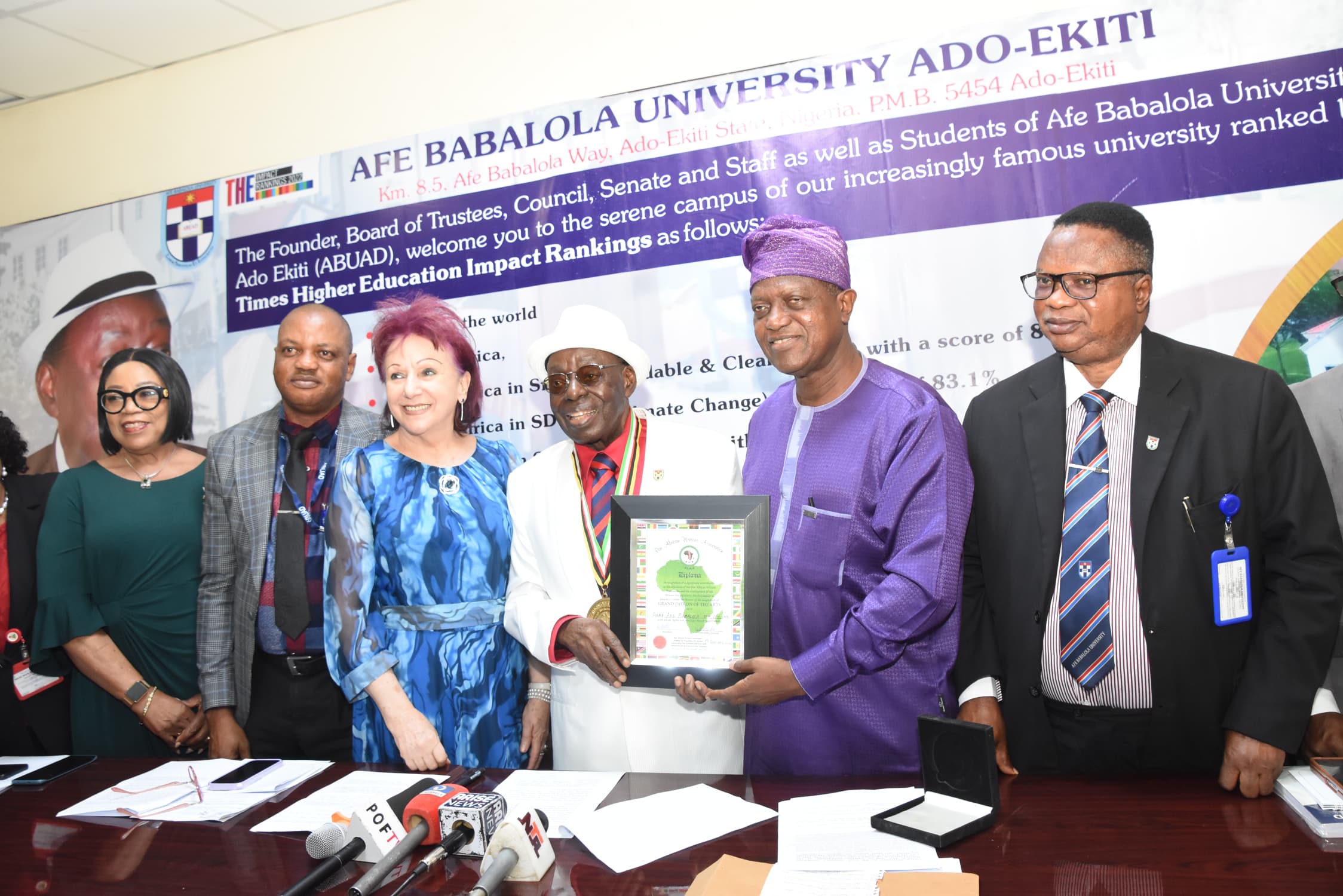
Early on D-day, the 5th of February, 2026, members of the university community, media practitioners, friends and well wishers gathered at the premises of the academic landmark for the all-important conferment of the Nobel Patron of the Arts Award to the distinguished Nigerian Legal Practitioner, Educationist and Writer, Aare Afe Babalola.

The event, which took off with a tour of the gigantic and expansive setting, saw guests representing PAWA, Authors Association of Nigeria, management and staff of the university, expressing heartfelt wow at the luxury that greeted every section and department of the institution, including the medical facility and the farm. Everyone unanimously agreed that the school merits its Time Higher Education (THE) Impact ranking as at 2025 as the 84th in the world, 3rd in Africa and 1st in Nigeria.
Babalola, at 96, and who has not shown any sign of slowing down in his pursuit of rendering academic assistance and nurturing the real leaders of tomorrow through purposeful education, followed in the footsteps of other great Africans, who had been recipients of the prestigious PAWA award. Some of them are former President of Ghana Jerry John Rawlings, former President of Nigeria, Dr. Goodluck Jonathan, immediate Past President of Ghana, Nana Akufo-Addo, and former President of Somaliland, Musa Bihi Abdi.


Others are President Mahmoud Abbas of Palestine, President Ismail Omar Guelleh of Djibouti and President Abdelmadjid Tebboune of Algeria. The award, according to the leader of the delegation and General Secretary of PAWA, Dr. Wale Okediran, is reserved for top world leaders, who have contributed immensely to the development of the arts.
Lending credence to the contributions of Prof Babalola in the academic and legal world, leading to the establishment of the world class University, the crowd of attendees representing the 54-African nations strong PAWA, ANA among others, were already in the huge conference room, venue of the elaborate ceremony, before the recipient made his grand entry into the hall.
Acknowledging reverence and accolades, Babalola, who was dressed in pure white suit, with red shirt and tie to match, and complimented with his signature (white) hat, made his way to his seat, guided by the Vice Chancellor of the University, Prof Smaranda Olarinde, who momentarily anchored the event.


Other professionals, who graced the occasion with their presence were members of PAWA, ably led by Dr Okediran, members of the Association of Nigerian Authors (ANA) led by the National President, Dr Usman Ladipo Akanbi.
In her welcome address, the Vice Chancellor, Prof Olarinde, extended a hand of fellowship to the delegates, and thanked PAWA for deeming it fit to honor Prof Babalola who has distinguished himself in several areas of life especially as the Founder of a magnificent University with world class facilities.
In his opening remarks, Dr. Okediran lauded the landmarks contributions of Prof Babalola, noting that none other deserve the award at a time like this like the ABUAD founder.
The PAWA Secretary, who has served six years, with just two more years to go, noted that PAWA is not just a run-off-the-mill group, but renowned in all 54 Africa counties, with headquarters in Accra, Ghana, where the secretariat resides. He further stressed that awards emanating from the group is acknowledged worldwide.

Dr Okediran further emphasized that PAWA’s decision to honor Chief Babalola was based on his track record of scholarship, service and devotion to education and mentorship.
Among the many intimidating qualities of the recipient, is his influence in the literary world, having authored many educational and literary books, established a distinguished law firm, “Emmanuel Chambers” dating back to 1965, and also groomed an impressive array of senior members of the bar and the bench.
After his meritorious service as the Pro Chancellor of the University of Lagos, he established the ABUAD, a non profit University in 2009.


With the formalities concluded, Okediran went ahead to decorated the recipient with the golden medal of award, and complimented it with a presentation of certificate of merit as the Grand Patron of the Arts mid loud applause from the audience and a convivial atmosphere.
One of the fireside activities of the occasion was the presentation of his book, Medicine and Literature without Borders to the Vice Chancellor and the Founder. It is worthy of note that Dr Okediran is a qualified medical doctor, who diversified into literal writing. He also runs a writing retreat resort, Ebedi International Writers Residency, Iseyin, Oyo State.
Responding in a speech laced in achievement, Babalola thanked PAWA for the honour done to him, flaunting prowess in the world of awards and honours. He reiterated that he is also a recipient of nine honorary doctorates including one from his alma mater, the University of London, noting that the honor will spur him to do more for Nigeria and Africa as a whole.
The Noble Patron of The Arts Award is a prestigious recognition from the Pan African Writers Association reserved for distinguished personalities, who have excelled in their areas of endeavors.
THE MAN, AARE AFE BABALOLA SAN

Below is the life and times of the accomplished legal icon, educational mentor and philanthropist, as lifted from his personal website, afebabalola.com
Aare Afe Babalola SAN is one of the most distinguished legal luminaries of his generation, renowned both in Africa and globally for his profound contributions to the legal profession and the advancement of education. With over five decades of uninterrupted legal practice, Aare Babalola’s career is a testament to exceptional dedication, strategic advocacy, and visionary leadership.
A highly accomplished advocate, he has led some of the most celebrated cases in Nigerian legal history, representing high-profile clients, including government institutions, multinational corporations, and individuals. His advocacy spans domestic and international courts, including contributions as a consultant to the Federal Government of Nigeria, World Bank, and various conglomerates. His extensive experience includes his role in arbitration, both locally and internationally, where he remains a respected authority. Aare Babalola has appeared in numerous landmark cases, shaping Nigerian jurisprudence and establishing himself as one of the nation’s most formidable legal minds.


His influence goes beyond the courtroom. As the Founder of Afe Babalola & Co. (Emmanuel Chambers), one of Nigeria’s leading law firms, Aare Babalola has trained over 300 lawyers, including 14 Senior Advocates of Nigeria (SANs), judges, and attorneys-general, making his chambers one of the most significant contributors to the legal profession in Nigeria. His exceptional litigation skills and legal acumen earned him the prestigious title of Senior Advocate of Nigeria (SAN) in 1987, cementing his place at the pinnacle of legal practice in the country.
A renowned scholar and author, Aare Babalola has authored several authoritative legal texts, including Injunctions and Enforcement of Orders and Law and Practice of Evidence in Nigeria. His contributions to legal education extend to teaching at the Nigerian Institute of Advanced Legal Studies and delivering lectures at prestigious universities such as the University of Lagos and the University of Ibadan. His popular column, YOU AND THE LAW, published in the Nigerian Tribune, reflects his commitment to educating the public on legal matters.
Beyond his legal practice, Aare Babalola has made extraordinary strides in education. His experience as Pro-Chancellor and Chairman of the Governing Council of the University of Lagos (2001-2007) exposed him to the declining standards of education in Nigeria, spurring him to establish Afe Babalola University, Ado-Ekiti (ABUAD).


ABUAD has quickly become a beacon of academic excellence, setting new standards in Nigeria’s educational system. His efforts in education have been recognized globally, with numerous honorary degrees from universities, including the University of London, University of Lagos, and Ekiti State University.
Aare Babalola’s leadership in academia and law has earned him numerous accolades, including the Officer of the Federal Republic (OFR), Commander of the Order of the Niger (CON), and international recognition such as the Queen Victoria Commemorative Award at the Socrates Awards in Oxford, UK. He was named Africa Man of the Year on Food Security and awarded an Honorary Doctor of Management by the Federal University of Technology, Akure. His groundbreaking achievements continue to inspire generations of lawyers and leaders across Africa and beyond.
In addition to his legal and educational contributions, Aare Babalola remains a committed philanthropist and advocate for reform in various sectors. His vast experience, unmatched expertise, and unwavering commitment to excellence make him not only a legal icon but also a trailblazer in the fight for quality education and justice.
Key Achievements:
- Senior Advocate of Nigeria (SAN), 1987.
- Officer of the Federal Republic (OFR).
- Commander of the Order of the Niger (CON).
- Pro-Chancellor and Chairman of the Governing Council, University of Lagos (2001-2007).
- Founder and Chancellor, Afe Babalola University, Ado-Ekiti (ABUAD).
- Queen Victoria Commemorative Award winner, Oxford UK.
- Fellow, Nigerian Institute of Advanced Legal Studies.
- Honorary Doctor of Laws from the University of London, Ekiti State University, University of Lagos, and more
From all of us at the Ovation Media Group, we wish the revered professional many more years of accomplishments and honours.




Tinubu Nominates Oyedele As Minister of State for Finance, Moves Anite-Uzoka to Budget Ministry

Defection: Atiku’s Son, Adamu, Resigns As Adamawa Commissioner

Senate Rescinds Resolution Seeking Sack of Magaji As CAC Registrar-General

Israel Declares Hezbollah Leader Marked Target

DSS Nabs Man over Assassination Attempt on Peter Obi

NELFund Extends Deadline for Student Loan Applications Nationwide

Saudi Arabia Shuts Down One of World’s Largest Oil Refinery after Iran’s Drone Strike

Prof Jide Owoeye: When a Distinguished Academic Turns 70

Many Killled, Houses Torched As Terrorists Unleash Deadly Attacks on Adamawa Communities

The Oracle: Entertainment is the Next Hope for Nigeria After Oil (Pt. 2)

Iran’s Supreme Leader Khamenei Cut Off from Contact, Fate Unknown

Fubara Appoints New SSG, Chief of Staff

Opposition Parties Reject 2026 Electoral Act, Demand Fresh Amendment

Friday Sermon: Reflections on Ramadan 2: The Taraweeh Conundrum
-
 Boss Of The Week3 days ago
Prof Jide Owoeye: When a Distinguished Academic Turns 70
-
 Featured5 days ago
Many Killled, Houses Torched As Terrorists Unleash Deadly Attacks on Adamawa Communities
-
 The Oracle4 days ago
The Oracle: Entertainment is the Next Hope for Nigeria After Oil (Pt. 2)
-
 Middle East3 days ago
Iran’s Supreme Leader Khamenei Cut Off from Contact, Fate Unknown
-
 News5 days ago
Fubara Appoints New SSG, Chief of Staff
-
 Headline5 days ago
Opposition Parties Reject 2026 Electoral Act, Demand Fresh Amendment
-
 Islam5 days ago
Friday Sermon: Reflections on Ramadan 2: The Taraweeh Conundrum
-

 Opinion3 days ago
Beyond the Vision: The Alchemy of Turning Ideas into Execution