Connect with us

Headline

Ekiti Decides: Fayemi, Fayose Renew Rivalry

Published

on

By Eric Elezuo

The stage is set across the 16 local government areas of Ekiti as about 16 governorship aspirants are jostling for the revered of the seat state’s number one citizen. The 16 hopefuls are in a battle of no return to outdo one another and grab the lion share of the only about 749,065 available votes that will elect the next governor of the state. The figure, according to the Independent National Electoral Commission (INEC) is the number of registered voters who had, as at Monday, June 13, 2022, collected their permanent voter cards out of the total 988,923 registered voters in the state.

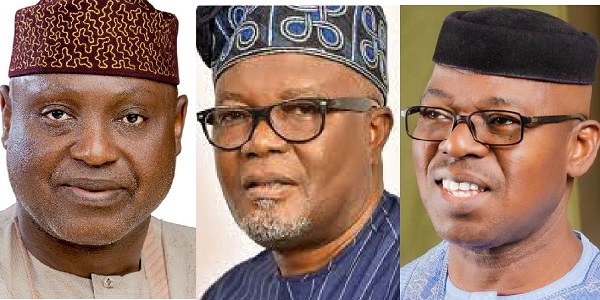
Among the 16 candidates, only three can be said to have a chance in the contest as a result of the political parties they belong to, and to an extent the strength of their political sagacity and individual influence. The three include Biodun Oyebanji of the ruling All Progressives Congress (APC), Bisi Kolawole of the Peoples Democratic Party (PDP) and Segun Oni, who is flying the flag of the Social Democratic Party (SDP). But political observers have insisted that the likes of Wole Oluyede of the African Democratic Congress (ADC) should not be written off as a result of his former association with the APC.

Others are Reuben Boye Famuyibo – Accord (A), Ajagunigbala Moses Olajide – African Action Congress (AAC), Elebute-Halle Josephine Kemi – Action Democratic Party (ADP), Benjamin Olufemi Obidoyin – All Progressive Grand Alliance (APGA), Fagbemi Peter Adegbenro – Allied Peoples Movement (APM), Christiana Modupe Olatawura – Action Peoples Party (APP), Daramola Rowland Olugbenga – Labour Party, Fatomilola Oladosu Abiodun – New Nigeria People Party (NNPP), Iyaniwura Tope Ifedayo – National Rescue Movement (NRM), Agboola Olaniyi Ben — Peoples Redemption Party (PRP), Adebowale Oluranti Ajayi – Youth Progressive Party (YPP), Adeolu Kolade Akinyemi – Zenith Labour Party (ZLP).

While the contest is a straight battle among the candidates of the APC, the PDP and the SDP, it is imperative to understudy the fact that two major political elements, who had governed the state in the past, are the cynosure of all eyes as the voters make their choices. They are the incumbent governor, Dr. Kayode Fayemi and the immediate past governor, Mr Ayodele Fayose. While reports have it that the flagbearer of the APC is the anointed of the governor, the PDP candidate has the signature of Fayose written all over him. As the two heavyweights slug it out, it should not be forgotten that Oni of the SDP has once had a taste of the Ekiti State government house as the number one citizen before he was booted out.

It is worthy of note that Ekiti has a peculiarity to its politics, and no ruling party has been able to retain control of the state for a long spell, not even incumbents gunning for a second term could achieve such.

Can Oyebanji arrest the waving loyalty of the people of the state to political parties and lead APC to win two consecutive governorship elections in Ekiti?

But on their individual strengths, the 16 candidates would have to go the extra mile to wrest a chunk of the 749,065 available votes to their names to be declared the landlord of the state for the next four years.

BIODUN OYEBANJI

Returning from a damaging rumour of disqualification from the race, Biodun Oyebanji, who is the immediate past Secretary to the State Government (SSG) is 54 years, and believed to have the backing of the outgoing governor, Kayode Fayemi.

Polling a total of 101,703 votes at the controversial primaries to beat other aspirants, some of whom withdrew including Senator Opeyemi Bamidele as a result of claims of manipulation by the electoral committee supposedly filled with Fayemi’s loyalists, Oyebanji received the oil to carry the APC into the contest. He is believed to be foisted on the party by the governor.
The singular assertion is capable of seeing him through to government house as the ruling power broker can pave the way for him, or face the wrath of aggrieved party members, who may work against him underground.


BISI KOLAWOLE

On his own part, the PDP candidate, a former chairman of the party in the state, Bisi Kolawole is said to enjoy the direct support of former governor, Ayodele Fayose, helping him to defeat Segun Oni to emerge victorious in the primaries.

Like Oyebanji’s election, Kolawole’s was also not without skirmishes as the likes of  Biodun Olujimi pulled out from the contest, protesting irregularities, adding that the party disenfranchised her.


SEGUN ONI

One of the shortest serving governors, Segun Oni sacked by the courts, and thrown out of office in 2010 after the appeal court ruled that the 2007 election that brought him into power had been rigged. He was replaced by Fayemi, who was then with the defunct Action Congress of Nigeria (ACN). Ever since, Oni has unsuccessfully plotted to return to power. In his quest to return to return to power at all cost, Oni has practically held the membership card of all major parties in existence, pitching his tent with the SDP after losing out to Kolawole in the PDP exercise.

His downsides notwithstanding, he has remained a political heavyweight in the state ever since, often switching allegiance between parties.

A serial defector no doubt, Oni still has a significantly strong base that puts him in an advantage to win the 2022 Ekiti guber election, if properly harnessed.

Since 1999, the PDP and APC have rotated power in the state after a term of four years. The SDP has never had a shot at power in the state.

Meanwhile, the police deployed 17,374 personnel, the Nigeria Civil Defence and Security Corps deployed 9,747 personnel, in addition to the heavy deployment of men of the Nigerian Army. The Federal Fire Service also brought into the state men and fire-fighting trucks for the election. All to ensure a hitch free elections.

It’s either going to be Oyebanji, Kolawole or Oni as the dice is cast.

Continue Reading
Click to comment

Leave a Reply

Your email address will not be published. Required fields are marked *

Headline

Israeli Ambassador Accuses Iran of Spreading Terror, Sponsoring Extremist Activities in Nigeria

Published

on

By

Israeli Ambassador to Nigeria, Michael Freeman, has accused Iran of sponsoring extremist activities in Nigeria and other parts of the world, alleging that Tehran supports groups aimed at destabilising countries while pursuing its hostility against Israel.

Freeman made the remarks on Friday while speaking during an interview on The Morning Show on Arise News.

The envoy claimed that Iran is the only country within the United Nations that openly expresses a desire to destroy another sovereign state, referring to repeated threats against Israel.

According to him, the Iranian government has, over several decades, supported militant groups and terror organisations around the world in pursuit of that objective.

Freeman alleged that Iran has backed groups such as Hamas and Hezbollah, adding that Tehran was also behind the October 7 attack carried out by Hamas against Israel.

He further claimed that Iranian activities aimed at spreading instability have been observed across several regions, including Europe, Australia, and parts of Africa.

Speaking specifically about Nigeria, the Israeli ambassador alleged that the Islamic Movement of Nigeria receives backing from the Iranian government.

According to Freeman, statements of support from Iran’s leadership, including posts by Ali Khamenei on social media, have openly indicated such ties.

He said: “The issue here is about Iran. Iran is the only country in the world, in the United Nations, who expressly desires to wipe another country off the face of the earth. Iran has stated its very policy is to destroy Israel. Is to wipe Israel off the map is to make sure they kill every single person and no regime, no country that has an express desire to destroy Israel, and it’s not only an expressed desire.

“We’ve seen over 47 years, they’ve taken all the actions they can in order for that to happen. We’ve seen them sponsor terror organizations. They were behind October the seventh massacre of Hamas. We’ve seen them sponsoring Hezbollah. We’ve seen them acting in Europe. We’ve seen them acting in Australia. We’ve seen them acting in Nigeria.

“We’ve seen these people acting all across the world in order to spread disturbance for them to try and carry out their aim of destroying Israel, and Israel will not allow another country to have nuclear weapons when they’ve expressly stated they want those weapons to destroy Israel”.

“I think that it is well documented. We know that there are certain movements, for example, the Islamic movement of Nigeria is sponsored and is backed by the Iranian regime. This is not me saying this, we’ve seen that documented by the Iranian regime.

The Supreme Leader posted on X his support and his backing there. So that’s very open. And there are other areas as well that Iran is working for, destabilizing, not only Nigeria, but all of West Africa.”

Continue Reading

Headline

Why Nigerians Must Reject INEC’s Revised Timetable – ADC

Published

on

By

By Eric Elezuo

The Independent National Electoral Commission (INEC), during the week, released a fresh elections timetable, with major amendments to accommodate the just passed and signed Electoral Act 2026 by the National Assembly and President Bola Tinubu respectively.

Following the repeal of the Electoral Act, 2022 and the enactment of the Electoral Act, 2026, which introduced adjustments to statutory timelines governing pre-election and electoral activities, the Commission has reviewed and realigned the Schedule to ensure full compliance with the new legal framework.

Accordingly, the Commission has resolved as follows:

  1. Presidential and National Assembly Elections will now hold on Saturday, 16th January 2027 as against the earlier stated February 20, 2027
  2. Governorship and State Houses of Assembly Elections will now hold on Saturday, 6th February 2027 as against the former date of March 6, 2027

Also in accordance with the approved Schedule of Activities, the electoral bidy noted in the revised timetable that:

Conduct of Party Primaries, including resolution of disputes arising from primaries, will commence on 23rd April 2026 and end on 30th May 2026.

Presidential and National Assembly campaigns will commence on 19th August 2026.

Governorship and State Houses of Assembly campaigns will commence on 9th September 2026.

As provided by law, campaigns shall end 24 hours before Election Day. Political parties are strongly advised to adhere strictly to these timelines. The Commission will enforce compliance with the law.

But in a swift reaction, the opposition coalition, African Democratic Congress (ADC), rejected the revised 2026–2027 general election timetable, describing it as a politically biased schedule designed to favour the re-election agenda of President Bola Tinubu, and calling on all Nigerians to speak up enmasse to reject the revised timetable.

The ADC, in a statement by its National Publicity Secretary, Bolaji Abdullahi, on Friday argued that the new deadlines and compliance requirements under the Electoral Act 2026 create near-impossible hurdles for opposition parties seeking to field candidates.

On February 13, INEC initially scheduled the 2027 Presidential and National Assembly elections for February 20, 2027, while the Governorship and State Houses of Assembly elections were fixed for March 6, 2027.

The timetable, however, faced objections from some Muslim stakeholders who noted that the dates coincided with the 2027 Ramadan period.

Following the concerns, the National Assembly amended Clause 28 of the Electoral Act Amendment Bill, reducing the required election notice period from 360 to 300 days, allowing INEC to adjust the election dates.

Subsequently, INEC released a revised schedule on Thursday, signed by its Chairman, Joash Amupitan, moving the Presidential and National Assembly elections to January 16, 2027, and the Governorship and State Houses of Assembly elections to February 6, 2027.

Reacting, the ADC said the requirement that political parties submit a comprehensive digital membership register by April 2, 2026, effectively bars opposition parties from participating.

The party stated: “The African Democratic Congress rejects the updated 2026–2027 electoral timetable released by the Independent National Electoral Commission. What has been presented as a routine administrative schedule of the upcoming general elections is, in fact, a political instrument carefully structured to narrow democratic space and strengthen the incumbent administration ahead of the 2027 general elections.

“According to the timetable, party primaries are to be conducted between April 23 and May 30, 2026, just 55 to 92 days from today. However, more significant is that, pursuant to Section 77(4) of the Electoral Act 2026, political parties are required to submit their digital membership registers to INEC not later than April 2, 2026.

“That is only about 34 days away. Section 77(7) further provides that any party that fails to submit its membership register within the stipulated time shall not be eligible to field a candidate. These are not routine administrative rules but are deliberately constructed barriers designed to exclude the opposition from participating in the election.”

The party further noted that Section 77(2) of the Electoral Act 2026 requires the digital register of members to contain name, sex, date of birth, address, state, local government, ward, polling unit, National Identification Number (NIN) and photograph in both hard and soft copies, while Section 77(6) prohibits the use of any pre-existing register that does not contain the specified information. It warned that failure to meet these requirements would lead to disqualification.

The ADC questioned the fairness of the digital membership requirement, noting that the ruling All Progressives Congress began its registration process in February 2025, long before the requirement became mandatory.

“It is not a product of foresight but insider advantage. They knew what was coming. They therefore had one full year to carry out an exercise that other political parties are expected to complete in one month, during which they must collect, process, collate and transmit large volumes of digital data to INEC under the threat of exclusion. This is practically impossible.

“Democratic competition is based on a level playing field that does not give any contestant an undue advantage. A system where one party exploits incumbency to gain a one-year head start on a requirement that other parties only became aware of when it was nearly too late is a rigged system.”

The ADC said it has joined other opposition parties in rejecting the Electoral Act 2026, adding that the INEC timetable is equally rejected as it appears designed to serve what it described as a self-succession agenda.

“Let it be clear that ADC will not take any action that appears to confer legitimacy on a fraudulent system. We are reviewing our options and will make our position known in the coming days,” the party said.

The party also called on civil society organisations, democratic stakeholders and Nigerians to scrutinise the timetable and demand fairness, stressing that democracy cannot survive when electoral rules are structured to produce predetermined outcomes.

The party has consistently accused the Tinubu-led All Progressives Congress (APC) of scheming to silence the opposition as the 2027 General Elections draw closer, citing his manipulation of state governors and Assembly members from jumping ship, and settling with the ruling party.

Presently, the president’s party has a total of 31 out of 36 states governors, more than majority of the national and states Houses of Assembly.

A frontline publisher and chieftain of the ADC, Chief Dele Momodu, has warned that Tinubu is gradually transforming into full-blown dictatorship, stressing that his second term in office would turn state governors into ‘total slaves’.

Continue Reading

Headline

Second Term for Tinubu Will Turn Governors into Total Slaves, Dele Momodu Warns

Published

on

By

Chairman, Ovation Media Group, and former presidential aspirant, Aare Dele Momodu, has expressed strong concern over what he described as growing political support for President Bola Ahmed Tinubu among state governors across the country.

Speaking during an interview on News Central TV, Momodu said he was shocked by the level of backing the president is reportedly receiving, warning that Nigeria’s democracy could face serious risks if the current political trend continues.

The media entrepreneur cautioned that allowing Tinubu to secure a second term in 2027 could, in his view, lead to excessive concentration of power. He particularly criticized what he described as a growing wave of opposition figures aligning with the ruling All Progressives Congress> (APC).

Momodu referenced reports of opposition governors, including Ahmadu Umaru Fintiri, allegedly moving closer to the ruling party, describing the development as politically troubling.

According to him, some governors are allegedly competing to demonstrate loyalty to the president ahead of future elections.

“The governors are fighting to ensure Tinubu wins a second term, fighting to be the biggest thug for him. If a man in his first term can capture the bodies and souls of Nigerians this way, imagine what he would do with a second term. It will be a full-blown dictatorship, and the governors will regret it as they become total slaves to him,” Momodu said.

He concluded by urging Nigerians to remain vigilant and actively protect democratic institutions, warning that unchecked consolidation of political power could threaten the nation’s democracy and future stability.

Gistmania

Continue Reading

Trending