By Eric Elezuo
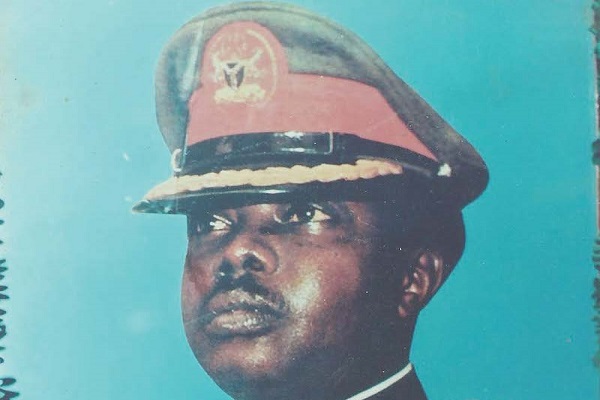
For five decades since 1976, the memory of Nigeria’s former head of state, has remained a mixture of evergreen and restraint. He was a leader many has come to reckon with as a result of impact. He is noted as the first person to use the popular military catch phrase ‘fellow Nigerians’, and popularised it among subsequent coup leaders, who had used it in all coup situations. He was Murtala Ramat Muhammad GCFR, Nigeria’s third military Head of State, who was murdered in cold blood in a failed military coup on February 13, 1976, less than eight months after he assumed office. Today marks exactly 50 years of his gruesome death.
Murtala Mohammed was a complete soldier; he led bloody coups, and was killed in a bloody coup, led by Lieutenant Colonel Bukar Suka Dimka.
Born on November 8, 1938, Mohammed is believed to have led the 1966 Nigerian counter-coup that overthrew, and brutally murdered General Johnson Aguiyi-Ironsi, then then military Head of State, and featured prominently during the Nigerian Civil War and thereafter ruled over Nigeria from 30 July 1975 after the overthrow of General Yakubu Gowon, until his assassination on that fateful February 13, 1976 morning.
He was born in Kano, into a ruling-class religious family, Murtala served in the Nigerian Army as a cadet in the Royal Military Academy, Sandhurst. He later served in Congo; eventually rose through the ranks to become Brigadier General in 1971, aged 33, becoming one of the youngest generals in Nigeria. Three years later Murtala became the Federal Commissioner for Communications in Lagos.
As a conservative and federalist, Murtala regretted the overthrow of the First Republic and the promulgation of Aguiyi Ironsi’s unification decree of 1966. He was devastated by the assassination of Sir Ahmadu Bello, and for a time said to seriously consider the secession of Northern Nigeria. His career redoubled after Chukwuma Kaduna Nzeogwu and the young majors orchestrated the first military coup in Nigeria of 1966 coup empowering him to lead the mutiny of the night of 29 July 1966 in Abeokuta. Murtala was briefly considered as Supreme Commander before the appointment of Yakubu Gowon. He also masterminded the July 1966 counter coup, which evidently, sparked the Nigerian Civil War.
During the war, he commandeered Nigeria’s second infantry division which was responsible for the death of civilians and much of the rebels. His command’s use of veteran soldiers, no quarter, and scorched earth strategies led to between 10,000 and 30,000 deaths. Combined with the total wartime death toll of three million making the civil war one of the deadliest in modern history. Three years later the Federal military government declared victory which bolstered Murtala’s image over Nigeria and in particular the north as a military leader through the post-war era of “reconciliation, reconstruction, and rehabilitation”. In post-civil-war Nigeria, Murtala ruled with more power than any Nigerian leader before or since, and developed a charismatic authority and cult of personality. During the Cold War, he maintained Nigerian neutrality through participation in the non-aligned movement, but supported the Soviet Union — during the latter’s effort in the Angolan Civil War
Nigeria under Murtala presided over a period of rampant economic prosperity. At the same time, his regime transitioned from being authoritarian into consensus decision-making with Murtala the leader of a military triumvirate, alongside Generals Olusegun Obasanjo and Theophilus Danjuma. The dictatorship softened and Murtala unveiled plans for the demilitarization of politics. In February 1976, barely seven months into his nascent rule, Murtala without having time to see his plans implemented was assassinated in a failed coup d’ètat attempt, being succeeded by Olusegun Obasanjo as Head of State, who, in turn, led the Nigerian transition to democracy with the Second Nigerian Republic.
The legacy of Murtala in Nigerian history remains controversial as the nature of his rule changed over time. His reign was marked by both brutal repression, and economic prosperity, which greatly improved the quality of life in Nigeria. His dictatorial style proved highly adaptable, which enabled wide-sweeping social and economic reform, while consistent pursuits during his reign centered on highly centralised government, authoritarianism, federalism, national Federalism, and pan-Africanism.
Murtala Muhammed was born on November 8, 1938 in Kano. His father, Muhammed Riskuwa, was from the Fulani Genawa clan, who had a history of Islamic jurisprudence as both his paternal grandfather Suleman and paternal great-grandfather Mohammed Zangi served as Chief Judges in Kano Emirate and held the title of chief Alkali of Kano. His father worked in the Kano Native Authority and was related to Aminu Kano, Inuwa Wada, and Aminu Wali. He died in 1953, his mother, Uwani Rahamatu, was from the Kanuri and Fulani Jobawa clan, the Jobawa clan members include the Makama of Kano and Abdullahi Aliyu Sumaila, his maternal grandfather Yakubu Soja a World War I veteran was from Dawakin Tofa while his maternal grandmother Hajiya Hauwau (Aya) was from Gezawa, he was educated at Cikin Gida Elementary School which was inside the emir’s palace.
He then transferred to Gidan Makama primary school in Kano which was just outside the palace. He then proceeded to Kano Middle School (now Rumfa College, Kano) in 1949, before attending the famous Government College (now Barewa College) in Zaria, where he obtained his school certificate in 1957. At Barewa College, Muhammed was a member of the Cadet Corps and was captain of shooting in his final year. In 1957, he obtained a school leaving certificate and applied to join the Nigerian army later in the year.
Murtala Muhammed joined the Nigerian Army in 1958. He spent short training stints in Nigeria and Ghana and then was trained as an officer cadet at Sandhurst Royal Military Academy in England. After his training, he was commissioned as a second lieutenant in 1961 and assigned to the Nigerian Army Signals that same year, later spending a short stint with the No. 3 Brigade Signals Troop in Congo In 1962, Muhammed was appointed aide-de-camp to M. A. Majekodunmi, the federally-appointed administrator of the Western Region.
In 1963, he became the officer-in-charge of the First Brigade Signal Troop in Kaduna, Nigeria. That year he traveled to the Royal Corps of Signals at Catterick Garrison, England for a course on advanced telecommunications techniques. On his return to Nigeria in 1964, he was promoted to major and appointed officer-commanding, 1st Signal Squadron in Apapa, Lagos. In November 1965, he was made acting Chief of Signals of the Army, while his paternal uncle, Inuwa Wada had recently been appointed Defense Minister.
Mohammed’s coup in 1966 led to the installation of Lieutenant-Colonel Yakubu Gowon as Supreme Commander of the Nigerian Armed Forces, despite the intransigence of Muhammed who wanted the role of Supreme Commander for himself. However, as Gowon was militarily his senior, and finding a lack of support from the British and American advisors, he caved in. Gowon rewarded him by confirming his ranking (he had been an acting Lt. Colonel until then) and his appointment (Inspector of Signals).
In June 1968, he relinquished his commanding position and was posted to Lagos and appointed Inspector of Signals. In April 1968, he was promoted to colonel. The actions of the division during this period, mostly in Asaba became a subject of speculation. In a book published in 2017, S. Elizabeth Bird and Fraser Ottanelli document the 1967 mass murder of civilians by troops of the 2 Division under General Muhammed’s command. They also discussed the events leading up to the massacre, and its impact on Asaba and on the progress of the war, as well as other civilian massacres carried out by soldiers of the 2nd Division at Onitsha and Isheagu.
Between 1970 and 1971, he attended the Joint Service Staff College in England, his supervisor’s report attributed him to having ”a quick agile mind, considerable ability and common sense. He holds strong views which he puts forward in a forthright manner. He is a strong character and determined.
However, he finds it difficult to moderate his opinions and finds it difficult to enter into debate with others whose views he may not share”. After the war, he was promoted to brigadier-general in October 1971. Between 1971 and 1974, Muhammed was involved in routine activities within the signals unit of the army. However, he also disagreed with some of the policies being pursued by Gowon.
On 7 August 1974, the head of state, General Yakubu Gowon appointed him as the new Federal Commissioner for Communications, which he combined with his military duties as Inspector of Signals at the Army Signals Headquarters in Apapa, Lagos. On 7 August 1974, General Yakubu Gowon appointed Muhammed as the Federal commissioner (position now called Minister) for communications to oversee and facilitate the nation’s development of cost effective communication infrastructures during the oil boom. After the war and after he took power as head of state, Muhammed started the reorganization and demobilization of 100,000 troops from the armed forces. The number of troops in the armed forces decreased from 250,000 to 150,000.
On 29 July 1975, General Yakubu Gowon was overthrown while attending the 12th summit of the Organisation of African Unity (OAU) in Kampala, Uganda. Muhammed took power as the new Military Head of State. Brigadiers Obasanjo (later Lt. General) and Danjuma (later Lt. General) were appointed as Chief of Staff, Supreme HQ and Chief of Army Staff, respectively.
In the coup d’état that brought him to power he introduced the phrases “Fellow Nigerians” and “with immediate effect” to the national lexicon. In a short time, Murtala Muhammed’s policies won him broad popular support, and his decisiveness elevated him to the status of a folk hero.
However his highly popular, often televised “with immediate effect” style of governing, also gained some criticism amongst the countries top civil servants – some of which were Nigeria’s top intellectuals. His ad-hoc Presidential proclamations left his civil service often unprepared, lacking details or even funding to implement his ideas, and his administration led to the dismissal of thousands of civil servants. Over 10,000 civil servants, government employees were dismissed without benefits; reasons stated were age, health, incompetence, or malpractice. The removal of such a large amount of public officials affected the public service, the judiciary, the police and armed forces, the diplomatic service, public corporations, and university officials. Quite a few officials were tried on corruption charges, and an ex-military state governor was executed for gross office misconduct.
Muhammed took federal control of the country’s two largest newspapers – Daily Times and New Nigerian; all media in Nigeria was now under federal control. He also took federal control of the remaining state-run universities. On February 3, 1976, the Military Government of Murtala Muhammed created new states and renamed others, the states he created include: Bauchi, Benue, Borno, Imo, Niger, Ogun, and Ondo. This brought the total number of states in Nigeria to nineteen in 1976.
As head of state, Muhammed put in place plans to build a new Federal Capital Territory due to Lagos being overcrowded. He set up a panel headed by Justice Akinola Aguda, which chose the Abuja area as the new capital ahead of other proposed locations. On February 3, 1976, Muhammed announced that the Federal Capital would in the future move to a federal territory location of about 8,000 square kilometres in the central part of the country.
Towards the end of 1975, the administration implemented a mass purge in the Nigerian civil service. The civil service was viewed as undisciplined and lacking a sense of purpose. A retrenchment exercise was implemented as part of a strategy to refocus the service.
Source: Wikipedia