Connect with us

Opinion

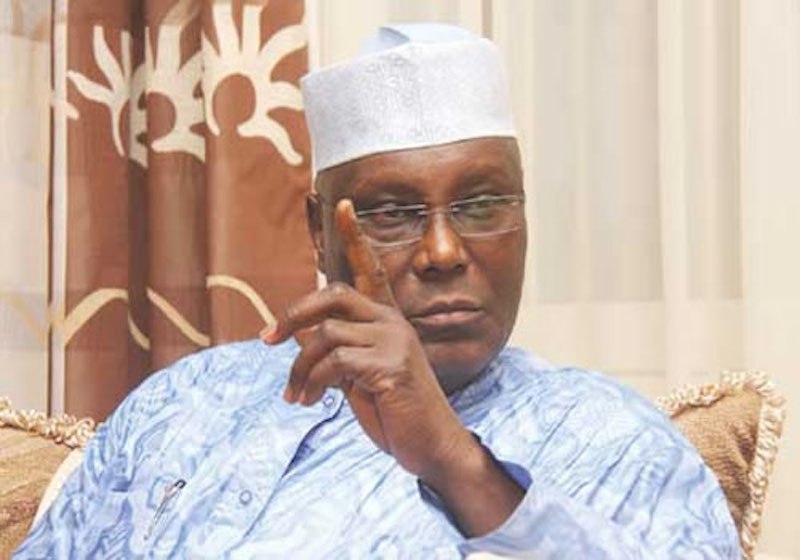
An Open Letter to His Excellency Atiku Abubakar, GCON

Published

on

By Dr. Sani Sa’idu Baba

“…Every Cloud Has a Silver Lining…”

Your Excellency,

I bring you good tidings, sir. At this pivotal moment in Nigeria’s democratic journey, I write to commend your efforts and unwavering resolve in leading the emerging coalition of opposition voices ahead of the 2027 general elections. Indeed, it is both timely and necessary. History often remembers those who dared to unite for a common good, not those who bowed to pressure or fled at the sound of resistance.

Your excellency, despite my strong conviction in your visionary leadership, the unfortunate developments within our party, the PDP in recent times have left me deeply depressed and increasingly hopeless, especially with each disheartening event like the recent defection of the former Governor of Delta State His Excellency Ifeanyi Okowa who was your running mate in your 2023 presidential contest. These moments have shaken my faith in the party’s unity and future. However, every time I listen to Chief Dele Momodu passionately defend you and articulate what you truly stand for, I quickly regain my hope. His words reignite my optimism and remind me why I believe in your vision and leadership.

Sir, in your long years of service and sacrifice for Nigeria, you have displayed rare courage and consistency in your pursuit of a better and more inclusive Nigeria. Now, as you bring together like-minded leaders, parties, and civil society actors in the spirit of national redemption, I urge you to remain focused irrespective of what others might see as a setback. Let the distractors talk; their strategy is to sow doubt and division, to derail this noble effort before it gains momentum. But remember Sir, noise is often loudest when a threat is real.

History is on your side. Across Africa and beyond, coalitions have emerged as powerful tools to reclaim democracy and build people-centered governments. In 2013, the merger of the ACN, CPC, ANPP, and a faction of APGA under your then-rival, now former President Muhammadu Buhari, demonstrated how diverse interests can align for national progress. That coalition defeated an incumbent, proving that unity is strength when driven by purpose and commitment. Sir, I have no iota of doubt that you are both purposeful and committed.

We’ve seen similar examples across the continent:

In Kenya, the National Super Alliance (NASA) and earlier the Jubilee Alliance reshaped the electoral map by significantly altering the political landscape via consolidating regional and ethnic support into broad-based coalitions. These alliances redefined electoral competition, shifting focus from individual parties to powerful blocs capable of influencing national outcomes.

In South Africa, opposition parties joined forces to challenge the African National Congress (ANC) dominance through coalitions to challenge its longstanding dominance, particularly in strategically important provinces.

In Zimbabwe, the MDC Alliance in 2018 posed a serious challenge to ZANU-PF’s decades-long grip on power since 1980, signifying a shift in their political landscape.

In Israel, a broad coalition even unseated a long-time prime minister, showing how powerful political unity can be when rooted in a shared vision.

Your coalition, sir, must be more than a platform to win elections. It should be a movement, one that gives hope to the youth, inspires the forgotten middle class, and empowers the marginalized. The SABUWAR TAFIYA should therefore be a MOVEMENT and a unstoppable tsunami that will wipe away the self-centred politicians, or simply our oppressors.

Sir, your experience and network, combined with younger voices and fresh perspectives, can offer that leadership that will bring about the long anticipated change in our dear country, this time around, a change for the better.

As you forge ahead, permit me to offer some heartfelt advice:

(1) Your Excellency Sir, to effectively form a strong and strategic coalition, it is vital to base your decisions on thorough and credible research. By leveraging data, you can identify regions where support is weak, understand public sentiment, and pinpoint areas needing improvement. Research will provide the clarity and direction necessary to build alliances that resonate with the people and strengthen your path to national leadership.

(2) Avoid internal sabotage at all costs. Many coalitions fail not from external attacks, but internal egos. Not everyone joining the movement should be received with open arms.

(3) Your Excellency, it is also crucial to approach the leadership challenges within the PDP with strategic care and inclusive dialogue, both at the national level and, most importantly, at the grassroots. Neglecting the grassroots at this sensitive time risks alienating the party’s foundational support base, weakening mobilization capacity, and creating openings for opposition influence. A stable, united front built on transparent leadership structures and empowered local stakeholders will not only restore confidence but also strengthen the PDP’s chances in future electoral contests.

(4) At this critical juncture, it is essential to clearly state your position regarding the party platform your coalition intends to adopt. Many of your supporters are currently uncertain and directionless, which creates a dangerous vacuum that the ruling party could easily exploit to weaken your base. Providing clarity now will unify your allies, energize your followers, and ensure strategic alignment ahead of any political realignment.

To wrap it all up your Excellency, you have nothing left to prove but everything left to give. If this coalition succeeds, it will not be a personal victory, it will be a generational breakthrough for Nigeria. So keep your eyes on the goal. Do not be distracted by propaganda or detractors. Nigeria is watching. And many are silently hoping that this time, unity will not be a fleeting dream but a lasting reality.

Sir, there will be more defections coming sooner or later, but always remember this:
The removal of wound debris after an injury is undeniably painful, yet it is a necessary step, so that true healing can begin. Without it, the wound festers with it, though the pain is sharp, the path to restoration is made clear.

Stay strong, Your Excellency.

With utmost respect,

Dr. Sani Sa’idu Baba, a Concerned Nigerian Citizen, writes from Kano

Continue Reading
Click to comment

Leave a Reply

Your email address will not be published. Required fields are marked *

Opinion

Give What, to Gain What? Reflections on the 2026 International Women’s Day Theme

Published

on

By

By Oyinkansola Badejo-Okusanya

At first glance, the theme of this year’s International Women’s Day celebration sounded a little odd to me.

Last year’s theme, Accelerate Action, was clear enough. You read it and immediately understood it as a call to move faster, push harder, do more, close the gaps. It was energetic, direct and unambiguous.

But “Give To Gain”? Give what? To whom? And to gain what, precisely? How is giving a pathway to gender equity? In the legal profession, and in leadership generally, we are trained to think in terms of advantage. What do I gain? What do I secure? What do I protect? But the more I reflected, the more I realised that perhaps that reflection was the point. Because my reflection took me to some of the most defining moments in my professional journey, and they did not come from what I took. They came from what someone chose to give.

A colleague who gave me insights instead of indifference, a leader who gave me visibility in a room where my voice would have been overlooked, a mentor who gave me honest feedback when flattery or a comfortable silence would have been easier.

None of those acts diminished them. They did not lose relevance, influence, or authority. If anything, their giving expanded their impact. Sometimes, some of us act as though giving someone else room to rise somehow shrinks our own space. But leadership does not weaken when it is shared wisely. It deepens.

That is the quiet power behind “Give To Gain”, and the paradox at the heart of this year’s theme. “Give To Gain” is not a call to diminish ourselves. It is a call to invest in one another because when we give from strength, we gain strength. So give respect.
give access. Give honest evaluation. Give opportunity without prejudice. And you will gain trust, loyalty and potential. Give mentorship and gain contunuity, give equal footing and gain the full measure of talent available. That kind of giving multiplies gain.

So perhaps the theme is not so odd after all. In a world that often asks, “What do I stand to lose?” this year’s International Women’s Day asks instead, “What could we stand to gain, if we were all willing to give?”

In the context of gender equity, the theme becomes even more compelling. Giving equal footing is not about doing women a favour; it is about acknowledging merit. When barriers fall, capacity rises to the surface. When access expands, talent flourishes. When women thrive professionally, institutions gain.

Against this backdrop, I began to think about the remarkable women who embodied this principle long before it became a theme. Women who gave intellectual rigour to complex situations and gained distinction. Women who gave courage and resilience in the face of resistance or in rooms where they were the only one, and gained respect. Women who gave mentorship to younger women and gained a legacy that cannot be erased.

Women who gave integrity to public service and the private sector and gained trust and admiration that cannot be manufactured.
Women whose boldness did not ask for permission to contribute. They did not lower their standards to fit expectations.

They gave of their intellect, their discipline, their time and their resilience, and in doing so they expanded the space for others. That is the spirit I want to honour this IWD month.

Beginning tomorrow, on International Women’s Day and continuing through all the remaining days of March, I will be celebrating a female icon who exemplifies this principle. Women who have given and gained. Each day, one story. One journey.

One example of boldness in action. Not to romanticise their journeys or suggest that their paths were easy, but to illuminate them and show what is possible when you dare to try.

Each profile will tell a story of contribution and consequence, of how giving strengthens, and how excellence, when sustained with integrity, inevitably earns its place.

My hope is that other women will read these stories and recognise themselves in them. That men also will read them and see leadership, not limitation. And that we will all be reminded that progress is rarely accidental. It is built, often quietly, by those willing to give more than is required.

If this year’s theme “Give To Gain” means anything to me, it means that we must intentionally amplify the inspiring examples that prove what is possible when women are bold.

Because inspiration and visibility are forms of giving. And sometimes, the simple act of telling a story is the spark that lights ambition in someone who was unsure where or whether she belonged.

This March, I choose to give inspiration and visibility and honour where it is so richly deserved.

And I trust that in doing so, we will gain a stronger world, a clearer sense of direction and possibility and another generation of women bold enough to step forward without apology.

Now the theme no longer seems strange. Now I understand that when we give boldly, we gain collectively. And that is a theme worth celebrating.

Oyinkansola Badejo-Okusanya, SAN FCIArb

Continue Reading

Opinion

Beyond the Vision: The Alchemy of Turning Ideas into Execution

Published

on

By

By Tolulope A. Adegoke PhD

History is littered with the skeletons of great ideas that never saw the light of day. In boardrooms and basements across the world, concepts with the power to reshape industries lie dormant, suffocated not by a lack of merit, but by a lack of execution. We live in an era that venerates the “light bulb moment,” yet the painful truth, as articulated by venture capitalists and historians alike, is that ideas are a dime a dozen; it is execution that is richly rewarded . The journey from the spark of imagination to the tangible reality of a finished product, a profitable corporation, or a thriving nation is an alchemical process. It requires the transformation of abstract thought into concrete action—a discipline that separates the dreamer from the builder. This evolution of an idea into reality is not a mystical event but a replicable process, best understood through the distinct exemplars of visionary individuals, resilient corporations, and transformative nations.

The Individual: The “Thinker-Doer” Synthesis

The romantic notion of the genius lost in thought, sketching blueprints while others do the heavy lifting, is a seductive myth. The reality, as demonstrated by history’s most impactful figures, is that the major thinkers are almost always the doers. Steve Jobs, a figure synonymous with innovation, famously articulated this principle by invoking the ultimate Renaissance man, Leonardo da Vinci. Jobs argued that the greatest innovators are “both the thinker and doer in one person,” pointing out that da Vinci did not have a separate artisan mixing his paints or executing his canvases; he was the artist and the craftsman, immersing himself in the physicality of his work . For Jobs, this synthesis was the guiding doctrine of Apple. He understood that abstract ideation is sterile without the feedback loop of hands-on mastery. The refinement of the Mac’s typography, the feel of a perfectly weighted mouse, the intuitive interface of the iPhone—these were not born from pure theory but from an obsessive, tactile engagement with the building process. The “doer” digs into the hard intellectual problems precisely because they are engaged in the act of creation.

This principle is further illuminated by the career of Elon Musk. While often perceived as a master inventor, Musk’s greatest genius may lie in his ability to execute existing ideas at a scale and speed previously thought impossible. He was not a founder of Tesla on day one, but he stepped in to spearhead its execution, transforming an electric vehicle concept into a global automotive powerhouse. At SpaceX, he inherited the age-old idea of space travel but revolutionized its execution by challenging fundamental cost structures and vertically integrating manufacturing. Musk embodies the “thinker-doer” by immersing himself in the engineering details, sleeping on the factory floor, and distilling complex challenges down to their fundamental physics. Both Jobs and Musk validate the venture capital adage that investment is placed not in ideas, but in the people capable of navigating the treacherous path from Point B to Point Z—the messy, unglamorous grind where visions are either realized or abandoned.

“In the architecture of achievement, ideas are merely the blueprints; execution is the foundation, the steel, and the mortar. A blueprint without a builder is just a dream drawn on paper” – Tolulope A. Adegoke, PhD

The Corporation: Engineering the Culture of Execution

For corporations, the evolution of an idea into reality is not a one-time event but a cultural imperative. It demands a structure and a philosophy that bridges the notorious gap between strategy and outcome. Procter & Gamble (P&G), a consumer goods giant, provides a master-class in adapting its execution model to survive and thrive. Despite investing billions in internal research and development, P&G recognized that its traditional closed-door approach was failing to meet innovation targets. The company evolved its idea-generation process by embracing “Connect + Develop,” opening its innovation pipeline to external inventors, suppliers, and even competitors. This shift in mindset was merely the idea; the reality was the rigorous, internal execution that vetted, integrated, and scaled those external concepts—like the Mr. Clean Magic Eraser, which was discovered as a prototype in Japan and flawlessly executed by P&G’s operational machine. The company’s success hinges on what researchers call “imaginative integrity”—the ability to make an imagined future so tangible that the entire organization can build toward it.

Similarly, UPS stands as a testament to the power of “creative dissatisfaction.” For over a century, UPS has operated not on bursts of pure invention, but on the relentless engineering and re-engineering of its systems. Founder Jim Casey instilled a culture where the status quo was perpetually questioned—from testing monorail-based sort systems to optimizing delivery routes with algorithmic precision. The idea was not merely to deliver packages, but to create the pinnacle of logistical efficiency. The execution involved tens of thousands of employees “pulling together” to transform the organization repeatedly, embracing changes that ranged from entering the common carrier business in the 1950s to mastering e-commerce logistics in the 1990s. These companies succeed because they build what management experts call the “five bridges” to execution: the ability to manage change, a supportive structure, employee involvement, aligned leadership, and cross-company cooperation. At Costco, this is embodied by CEO James Sinegal, whose Spartan office and relentless focus on in-store details align leadership behavior with the company’s razor-thin margin strategy, proving that execution is modeled from the top down.

The Nation: The Political Economy of Progress

The evolution of ideas into reality scales beyond individuals and firms to the very level of nations. The economic trajectories of countries are determined by their ability to adapt foreign concepts and execute them within local contexts. The post-war rise of Japan is perhaps the most powerful example of this phenomenon. In the early 20th century, Japan was exposed to American ideas of scientific management, but the devastation of World War II left its industrial base in ruins. The idea that saved Japan was quality control, imported through lectures from American scholars W. Edwards Deming and Joseph Juran. The genius of Japan, however, was not in the adoption of the idea, but in its adaptation. Private organizations like the Union of Japanese Scientists and Engineers (JUSE) took the lead, transforming foreign theories into the uniquely Japanese practice of Total Quality Management (TQM) and the grassroots phenomenon of Quality Control circles. This was not government-mandated execution; it was a national movement of “thinker-doers” on the factory floor, relentlessly refining processes. The evolution of this idea rebuilt a nation, turning “Made in Japan” from a byword for cheap goods into a global standard for reliability.

In contrast, Singapore represents a different model of national execution: the state as a strategic architect. Upon independence, Singapore possessed few natural resources and a uncertain future. The government, however, possessed a clear-eyed vision of industrial development. It actively sought external assistance from the United Nations and Japan, but crucially, the Singaporean authorities acted as the “agent of adaptation” . They did not passively accept advice; they made decisive judgments about what was relevant to their unique circumstances and demanded specific adaptations. This disciplined, top-down execution of economic strategy—from building world-class infrastructure to enforcing rigorous education standards—evolved the idea of a “sovereign nation” into the reality of a first-world entrepôt. The contrast with nations like Tunisia, where external donors took the lead due to a lack of domestic policy clarity, highlights a fundamental truth: ideas flow freely across borders, but the ability to execute them is a domestic condition, cultivated through leadership and institutional will.

Conclusion: The Integrity of the Build

Ultimately, the evolution of an idea into reality demands what can be termed “imaginative integrity”—the unwavering commitment to binding the vision to the execution. It is a concept that applies equally to the Renaissance painter mixing his own pigments, the CEO sleeping on the factory floor, and the nation-state meticulously adapting foreign technology. The world is full of “crude ideas” that lack the refinement of execution; even a brilliantly designed structure like MIT’s Stata Center can falter if the craftsmanship of its realization is flawed.

The journey from “A to Z” is long, and the gap between strategy and outcome is the graveyard of potential. To traverse it, one must recognize that thinking and doing are not sequential acts but concurrent disciplines. The doers are the major thinkers, for they are the ones who test hypotheses against reality, who adapt to feedback, and who possess the grit to push through the inevitable obstacles. Whether it is a nation reshaping its economy, a corporation reinventing its logistics, or an individual defying the limits of technology, the lesson remains constant: the future belongs not just to those who can dream it, but to those who can build it.

Vision sees the path; execution walks it, blisters and all. The distance between a dream and a legacy is measured only by the courage to begin the work.

History does not remember the whisper of a thought, but the echo of its impact. To think is human, but to execute is to leave a mark on time.

Dr. Tolulope A. Adegoke, AMBP-UN is a globally recognized scholar-practitioner and thought leader at the nexus of security, governance, and strategic leadership. His mission is dedicated to advancing ethical governance, strategic human capital development, and resilient nation-building, and global peace. He can be reached via: tolulopeadegoke01@gmail.comglobalstageimpacts@gmail.com

Continue Reading

Opinion

How an Organist Can Live a More Fulfilling Life

Published

on

By

By Tunde Shosanya

It is essential for an Organist to live a fulfilling life, as organ playing has the capacity to profoundly and uniquely impact individuals. There is nothing inappropriate about an Organist building their own home, nor is it unlawful for an Organist to have a personal vehicle. As Organists, we must take control of our own futures; once again, while our certificates hold value, organ playing requires our expertise. We should not limit ourselves to what we think we can accomplish; rather, we should chase our dreams as far as our minds permit. Always keep in mind, if you have faith in yourself, you can achieve success.

There are numerous ways for Organists to live a more fulfilling and joyful life; here are several suggestions:

Focus on your passion. Set an example, and aim for daily improvement.

Be self-reliant and cultivate harmony with your vicar.

Speak less and commit to thinking and acting more.

Make choices that bring you happiness, and maintain discipline in your professional endeavors.

Help others and establish achievable goals for yourself.

Chase your dreams and persist without giving up.

“Playing as an Organist in a Church is a gratifying experience; while a good Organist possesses a certificate, it is the skills in organ playing that truly matter” -Shosanya 2020

Here are 10 essential practices for dedicated Organists…

1) Listen to and analyze organ scores.

2) Achieve proficiency in sight reading.

3) Explore the biographies of renowned Organists and Composers.

4) Attend live concerts.

5) Record your performances and be open to feedback.

6) Improve your time management skills.

7) Focus on overcoming your weaknesses.

8) Engage in discussions about music with fellow musicians.

9) Study the history of music and the various styles of organ playing from different Organists.

10) Take breaks when you feel fatigued. Your well-being is vital and takes precedence over organ playing.

In conclusion, as an Organist, if you aspire to live towards a more fulfilling life in service and during retirement, consider the following suggestions.

1) Plan for the future that remains unseen by investing wisely.

2) Prioritize your health and well-being.

3) Aim to save a minimum of 20 percent of your monthly salary.

4) Maintain your documents in an organized manner for future reference.

5) Contribute to your pension account on a monthly basis.

6) Join a cooperative at your workplace.

7) Ensure your life while you are in service.

8) If feasible, purchase at least one plot of land.

9) Steer clear of accumulating debt as you approach retirement.

10) Foster connections among your peers.

Continue Reading

Trending