Connect with us

Headline

Who Is the Boko Haram Commander?

Published

on

By Eric Elezuo

A former Deputy Governor of the Central Bank of Nigeria and Presidential Candidate of the African Democratic Party (ADP) in the 2019 general elections, Dr Mailafia Obadiah, buzzed the Nigerian political and security landscape penultimate Tuesday, when he alleged during a live radio interview that a serving Northern governor is the commander and sponsor of the dreaded Boko Haram sect.

There are 19 known northern governors, and so the question, who is Dr. Obadiah referring to? Who is the commander of the Boko Haram sect.

Founded in Maiduguri in 2002 by Mohammed Yusuf, who was killed in 2009, Boko Haram, a deadly organisation, known for it guerrilla war-like activities has since been led by Abubakar Shekau and recently by Abu Musab Al-Barnawi after a splinter group supposedly emerged.

According to Wikipedia, when Boko Haram was first formed, their actions were nonviolent. Their main goal was to purify Islam in northern Nigeria. However, after the death of Yusuf, the group became violent and highly radicalised with increasingly sophisticated attacks, initially against soft targets, but progressing in 2011 to include suicide bombings of police buildings and the United Nations office in Abuja. The group is credited with the deaths of tens of thousands of people, displacement of about 2.3 million others, mass abductions including the Chibok saga of April 2014 where over 276 school children were taken.

Since March 2015, the group has been aligned with the Islamic State of Iraq and the Levant, and was at one time the world’s deadliest terror group according to the Global Terrorism Index. In September of the same year, the Director of Information at the Defence Headquarters announced that all Boko Haram camps had been destroyed, much as attacks from the group continued unabated, in addition to President Muhammadu Buhari’s declaration in 2019 of the group being “technically defeated”. The attacks have not ceased however, but have escalated to a wider proportion.

In the midst the terrorism, speculations have been rife about who is behind the terror group just as accusing fingers have been pointed at some key personnel. Earlier, a former Anglican clergyman, Stephen Davis, blamed a former governor of Borno State, Ali Modu Sheriff, saying he initially supported them, but no longer needed them after the 2007 elections and stopped funding them. There is also Senator Ali Ndume, who was accused. Both men however denied the accusations.

Presently, the likes of Kaduna State governor, Mallam Nasir El-Rufai, have come under fire over alleged fraternity with the terror group. The suspicion placed on Rufai was made manifest owing to his revelation in 2016 that he paid herdsmen to stop the killings in Southern Kaduna. He explained that the perpetrators of the killings foreign herdsmen who suffered losses during the post 2011 election crisis. According to him, they came back for revenge, and at the end of the day demanded compensation, for which he paid.

Fast forwarding to present, Obadiah’s allegation opened yet another can of worms. Reports did not substantiate his claims with the names of the supposed sponsor of the sect. However, he narrowed his accusation to 19 men including: Aminu Masari (Katsina), Abdullahi Ganduje (Kano), Aminu Tambuwal (Sokoto), Simon Lalong (Plateau), Abubakar Bello (Niger), Bala Mohammed (Bauchi), Babagana Zulum (Borno), Samuel Ortom (Benue), Yahaya Bello (Kogi), Abdulrahman Abdulrasaq (Kwara), Atiku Bagudu (Kebbi), Nasir El-Rufai (Kaduna), Inuwa Yahaya (Gombe), Mohammed Badaru Abubakar (Jigawa), Abdullahi Sule (Nasarawa) Darius Ishaku (Taraba), Ahmadu Fintiri (Adamawa), Mai Mala Buni (Yobe) and Bello Matawalle.

The case, according to a human rights activist, who craved anonymity, is like the case of someone will betray the Lord, and the twelve disciples are confused among themselves, asking “Lord, is it I?”

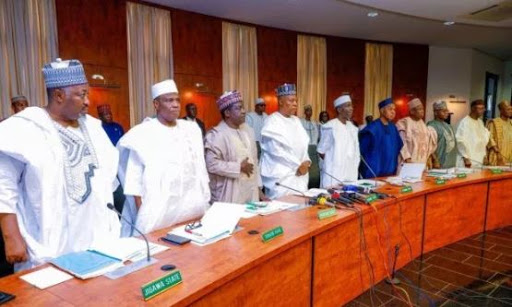
The jittery governors, who is believed to have a Judas, have described the allegation as ‘weighty’, asking the security operatives to immediately carry out investigations.

In a statement signed by Makut Macham, Director of Press and Public Affairs to the Governor Lalong, who is the forum’s chairman, the group noted thus:

“The forum, which has been working with the federal government, security agencies, community, civil society, traditional and religious leaders as well as development partners to defeat terrorism, banditry and other forms of criminality in the region finds the allegation by Dr. Mailafia very weighty, which deserves further investigation.

“We, as Northern governors, have met severally to discuss insecurity in the region and the nation at large where we did not only condemn the activities of terrorist groups such as Boko Haram, bandits and other criminals but also engaged the President and all heads of security agencies in finding solutions to the problem.

“To now say that one of our members is leading Boko Haram is a serious allegation that cannot be swept under the carpet. We demand an immediate and thorough investigation.”

The Boss reported how Obadiah was invited by the Department of State Security, and drilled for over six hours. The former CBN executive however, did retract his statement, maintaining that he was sure that of his utterances during the live interview with Nigeria Info 95.1 FM in Abuja.

He said: “During the lock-down, the insurgents were moving and distributing arms and ammunition across the country. We have met with some of their repentant high commanders, they have sat down with us not once, not twice.”

The Federal Government, in July had reintegrated about 601 ex-Boko Haram terrorists including 14 foreign nationals from Cameroon, Chad and Niger into the society, a move that attracted condemnation more than applause.

Here are some of the 19 governors in the eye of the storm:

MALLAM NASIR EL-RUFAI

The two term Governor of Kaduna State, Nasir Ahmad el-Rufai was born on February 16, 1960 to a Fulani family in Daudawa. He lost his father at the age of eight, and was sponsored through his early education by an uncle in Kaduna.

He was educated in Barewa College at a time when former President Umaru Yar’Adua was the house captain of his dormitory. In 1976, he graduated at the top of his class, winning the “Barewa Old Boys’ Association Academic Achievement” Trophy. El-Rufai attended Ahmadu Bello University in Zaria, where he received a bachelor’s degree in Quantity Surveying with first class honours.

In 1984, he received a Master of Business Administration from Harvard Business School. He has since attended several professional and post-graduate programs, including the Georgetown School of Foreign Service of Georgetown University in Washington, D.C and programs on privatization and leadership.

El-Rufai has been battling albeit, unsuccessfully the one sided killings in the state where the Christian dominated Southern Kaduna has suffered casualities from Fulani herdsmen.

AMINU BELLO MASARI

A former Speaker of the House of Representatives, Aminu Bello Masari, who is serving his second term as the governor of Katsina state, was born on May 29, 1950. He is a native of Masari village of Kafur Local Government Area.

Masari’s Katsina, which incidentally is the home state of President Muhammadu Buhari, has become the centre point of banditry in recent times with many deaths recorded.

AMINU WAZIRI TAMBUWAL

The Governor of Sokoto State, who also serving his second term, was born on born January 10, 1966. He also served as the 10th Speaker of the House of Representatives.

Tambuwal is a product of the Usman Dan Fodio University, Sokoto, where he studied Law, graduating with an LLB (Hons) degree in 1991. He completed his one-year compulsory legal studies at the Nigerian Law School, Lagos, obtained his BL and was called to the Bar in 1992.

Besides studying for his law degree, he attended several courses abroad including: Telecoms Regulatory Master Class–Bath UK, 2004; Lawmaking for the Communications Sectors –BMIT, Johannesburg, South Africa, 2004; and Regulating a Competitive Industry-UK, Brussels, 2005.

Tambuwal has had his own fair share of skirmishes in the fight against terrorism, banditry and herdsmen.

BABAGANA UMARA ZULUM

Zulum is a first term governor of Borno State, who a cross section of stakeholders believe is making efforts at leadership. A professor of Soil and Water Engineering, Zulum was born on August 26, 1969.

He studied at the University of Maiduguri, where he obtained a degree in Agriculture Engineering. He proceeded to the University of Ibadan from 1997 to 1998, where he obtained a master’s degree in Agriculture Engineering. In 2005, he enrolled for a PhD in Soil and Water Engineering with the University of Maiduguri which he completed in 2009.

MAI MALA BUNI

Yobe State governor, Mala Buni was (born on November 11 1967. He is the current caretaker chairman of the All Progressives Congress. He was previously the national secretary of the APC.

YAHAYA ADOZA BELLO 

Born on June 18, 1975, Kogi State governor, a businessman turned politician, is in his second term as governor. The youngest of six siblings, Bello studied at Kaduna State Polytechnic Zaria in 1995 and obtained an accounting degree from Ahmadu Bello University ABU Zaria in 1999. Yahaya Bello further enrolled for a Masters program in Ahmadu Bello University in Zaria where he obtained Masters in Business Administration (MBA) in 2002. Bello became a chartered fellow of the Association of National Accountants of Nigeria in 2004.

He was privileged to become governor after Abubakar Audu, who originally won the election died before the results were officially announced.

ABDULLAHI UMAR GANDUJE OFR

The Kano governor was born on December 25, 1949. He served as two term deputy governor to Rabiu Kwankwaso before emerging governor in 2015.

In addition to Qur’anic education, Ganduje attended Advanced Teachers’ College, Kano between 1969 and 1972 before attending Ahmadu Bello University, where he graduated with a Bachelors in Science Education in 1975. He also obtained a master’s degree in applied educational psychology from Bayero University Kano in 1979 and later returned to Ahmadu Bello University from 1984 to 1985 for a Master of Public Administration degree. He received his doctorate in Public Administration from University of Ibadan in 1993.

With many others toeing the line, Nigerians are desirous of knowing who the Boko Haram commander is.
Continue Reading
Click to comment

Leave a Reply

Your email address will not be published. Required fields are marked *

Headline

Threat Against Nigeria’s Multi-Party Democracy: Atiku, Obi, George, Others Accuse Tinubu of Plot to Annihilate Opposition

Published

on

By

By Eric Elezuo

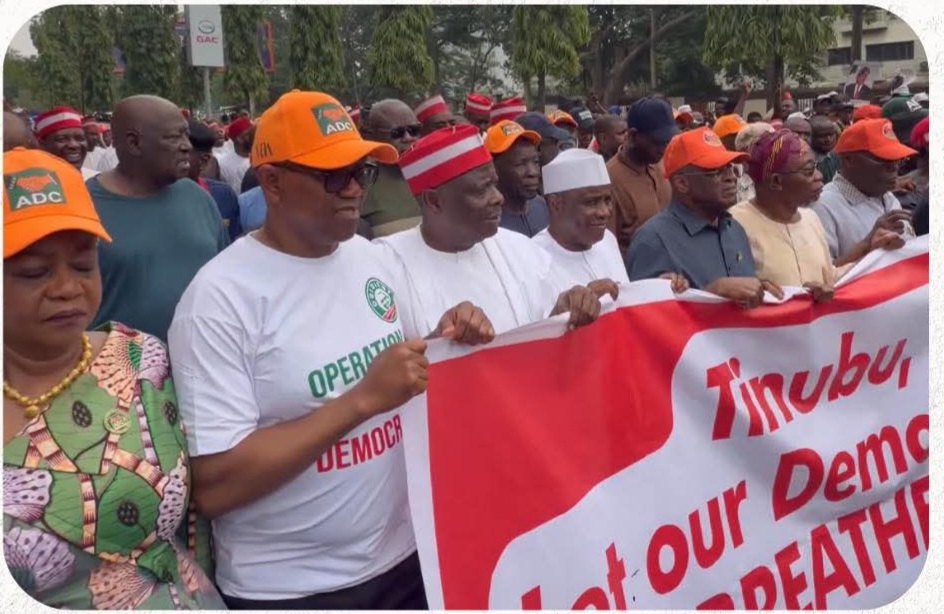
Major opposition leaders in the country have raise the alarm over threat against Nigeria’s Multi-Party Democracy, accusing President Bola Tinubu of plot to annihilate opposition.

In a letter signed a group of major opposition and opinion leaders including Alhaji Atiku Abubakar, Mr. Peter Obi, Chief Bode George, Chief John Odigie-Oyegun, Alhaji Lawal Batagarawa and Senator David Mark, the group demanded an independent review body to examine public accounts of federal, state, LGs from 2015 to 2025, the embedding of anti-graft operatives directly into government payment, expenditure processes at all levels among others

Titled “Anti-Corruption, Not Anti-Opposition: A Joint Statement by Opposition Leaders on the Growing Politicisation of State Institutions for Persecution of the Opposition”, the statement frowned at the state of the nation, lamenting the “unfortunate and gradual slide of our country into a state where key national institutions – particularly the Economic and Financial Crimes Commission (EFCC); The Nigeria Police; The Independent Corrupt Practices and Other Related Offences Commission (ICPC) are increasingly perceived as tools of political intimidation, selective justice and systematic persecution of opposition leaders.”

The statement in full:

We are compelled by duty to nation and conscience to issue this statement to alert our compatriots and the international community to the unfortunate and gradual slide of our country into a state where key national institutions – particularly the Economic and Financial Crimes Commission (EFCC); The Nigeria Police; The Independent Corrupt Practices and Other Related Offences Commission (ICPC) are increasingly perceived as tools of political intimidation, selective justice and systematic persecution of opposition leaders.

Across our nation, there are mounting concerns that state power is being deployed not for prevention of economic crimes, but for persecution of perceived political adversaries, with the ultimate aim of weakening opposition voices and dismantling Nigeria’s multiparty democracy.

A Dangerous Agenda Unfolding

More than ever before in our democratic experience, Nigerians have witnessed what many now describe as a covert, undemocratic agenda: to ensure that all state governments fall under the control of the President’s party – not through transparent electoral contests, but by secretly intimidating opposition governors via the anti-corruption apparatus until they succumb and defect. Recent defections of opposition governors into the ruling party have reinforced public suspicion that political pressure, not ideological or personal persuasion, is driving this realignment. This pattern forms part of a broader project that targets not only elected leaders but also key opposition figures perceived as architects of emerging coalitions ahead of the 2027 general election. We must warn that this project, if allowed to continue unchecked, poses a grave danger to Nigeria’s democratic future.

Weaponisation of the EFCC

There is a discernible pattern of persecution of the opposition by the EFCC with the sole objective of weakening same for the benefit of the ruling APC. This disturbing pattern mirrors a long-standing sentiment openly expressed years ago by a former National Chairman of the ruling APC, Adams Oshiomhole, who declared when receiving defectors from the PDP: “Once you have joined APC, all your sins are forgiven.” Whether intended as political rhetoric or not, this statement has come to symbolise a troubling reality: allegations against members of the ruling party are routinely perceived to be overlooked, while even unsubstantiated accusations against opposition figures are vigorously pursued and subjected to media trial.

A few recent examples reinforce this perception. Months ago, a minister was implicated in a financial scandal so blatant that only sustained public outrage forced her resignation. Yet, long after stepping down, she has neither been charged nor arraigned by the EFCC and is now actively involved in the President’s re-election campaign. Similarly, another minister remained in office despite the university he claimed to have attended publicly denying his academic certificate. He, too, resigned only after intense public pressure, Months later, no charges have been filed.

Such selective enforcement undermines the legitimacy of anticorruption efforts and erodes public trust. Furthermore, Nigerians are not blind to the sudden empowerment of certain political actors, including individuals appointed to federal executive positions after crossing from the opposition but still claim to be members of opposition party – whose unstated mandate, in the public’s eyes, appears to include the systematic destabilisation of opposition parties through the creation of factions, inducement and the exploitation of judicial processes, allegedly funded by state resources.

Erosion of EFCC’s Independence

The EFCC is a critical national institution, created to safeguard Nigeria’s economic integrity.

Yet today, many Nigerians fear that its independence is steadily being eroded. An agency designed for prevention and accountability risks becoming an instrument of political persecution, undermining both justice and democracy. The President must recognise that evident social and political injustice could snowball into mayhem as the nation approaches another election cycle. This trend must be halted immediately if the nation must be spared a major catastrophe.

OUR DEMANDS
• Depoliticise EFCC: The operations of the EFCC must be urgently shielded from political interference and must not serve the whims and caprices of any President, party or political faction.

• Return EFCC to Its Statutory Mandate: The Commission must refocus on genuine detection and prevention of economic crimes across board, not selective prosecution, media trials or intimidation of opposition figures. For the avoidance of doubt, the Functions and Powers of the Commission are expressly provided for under Sections 6 & 7 respectively.

• Defend Multiparty Democracy: Nigerians must remain eternally vigilant to ensure that the President does not transform the country into a de facto one-party state – as witnessed in Lagos over the last 25 years, where opposition leaders were silenced, coerced or induced into irrelevance.

• Embed Preventive Anti-Corruption Mechanisms: Relying on the Supreme Court ruling on the powers of the EFCC over all public accounts, for true prevention of financial crimes, anti-graft operatives should be embedded in all the payment processes of governments at all levels to ensure compliance with rules of transparency, accountability and probity in public financial transactions. Put differently, the EFCC must recognise and exercise their function as covering both pre and post expenditure. operatives must also be held accountable for any unreported but later detected economic and financial infractions in their respective areas of oversight. To further strengthen the EFCC, we propose that the EFCC Act should be amended for this purpose.

• Establish an Independent Review Body: We call on the Attorney General, in consultation with the National Assembly, to set up an independent review body which should be granted full access to the public accounts of the federal, all states and all local governments covering from 2015 to 2025, with a mandate to conduct a transparent, comprehensive review of financial transactions and publish its findings. Such a review will expose the EFCC’s pattern of selective prosecution of opposition figures and reveal that many current officials of the federal government—and those of ruling-party-controlled states—should have long been prosecuted for economic and financial crimes, but were shielded due to their political affiliation. Based on its findings, the independent body should also propose amendments to EFCC’s enabling law to strengthen the agency for more effective and efficient prevention of financial crimes.
This proposed body is to be chaired by an eminent judge, and composed of the following:
– Representatives from civil society organisations
– Representatives of the Nigerian Bar Association
– Representatives of Institute of Chartered Accountants of Nigeria
– Representatives of Institute of Chartered Bankers
– The Nigerian Financial Intelligence Unit
– Representatives of anti-graft agencies
– Representatives of the Police
– Representatives of the DSS
– Representatives of the Armed Forces
– Representatives of all political parties with a seat in the National Assembly.

A Call to Defend Nigeria’s Democracy

We call on all patriotic Nigerians across party lines, professions, regions and faiths to stand firm. Our democracy is under threat through the deliberate and systematic weakening of opposition forces, with the EFCC as the central instrument in this troubling strategy.

In the coming weeks, we will provide more details, and also engage foreign partners of Nigeria’s anti-graft agencies and diplomatic missions, including United States, UK, Canada, EU, World Bank Office, United Nations, to express our deep concern about the EFCC increasingly becoming a willing tool in a broader scheme to weaken opposition in Nigeria, and also demand a reform of the anti graft agency.

Nigeria’s democracy demands our vigilance, courage and unity, as Edmund Burke, an Anglo-Irish statesman and philosopher, warned: “The only thing necessary for the triumph of evil is for good men to do nothing”.

We are equally guided by the enduring words of Martin Luther King Jnr: “Silence in the face of evil is itself evil ……In the end we shall remember not the words of our enemies, but the silence of our friends.” Now is the time for all of us to rise in defence of our cherished multiparty democracy, and indeed, in defence of the very soul of our nation.

We must make a deliberate choice not to be remembered by posterity for our Silence.
Nigeria belongs to all of us – not to a single party or a single leader.

Signed,
Sen. David Mark, GCON
Alh. Atiku Abubakar, GCON
Mallam Lawal Batagarawa
Chief Bode George
Mr. Peter Obi, CON
Chief John Odigie-Oyegun

Continue Reading

Headline

Corruption! Tinubu Tackles ‘Buhari Boys’

Published

on

By

By Eric Elezuo

With the recent clamping in prison custody of a former governor of Anambra State and former Minister of Labour and Productivity, Dr. Chris Ngige, it appears that these are not the best of times for most political office holders during the eights tenure of former President Muhammadu Buhari, who unfortunately died on July 11 at the age of 83.

Two and half years since he left office, and five months after his death, Buhari’s loyalists have faced untold clampdown by the government of President Bola Tinubu as the Economic and Financial Crimes Commission (EFCC) has consistently spread its dragnet, capturing as many that it deems have served under alleged questionable circumstances. While many are facing trials, many others are under investigation, in what many analysts and observers claim is a clampdown on the ‘boys’ of former President Buhari. These group, observers believe, may not have exhibited genuine support for the emergence of Tinubu prior to the All Progressives Congress (APC) presidential primaries up to the 2023 Presidential Election. They believe it’s payback time for the government of Tinubu against the Buhari loyalists, who thinks little or nothing of Tinubu, and recently of his presidency.

Among the ‘Buhari Boys’ either under trial or under investigation are former Attorney General and Minister of Justice, Abubakar Malami; former Minister of Labour and Productivity, Chris Ngige; former Minister of Aviation, Hadi Sirika; Minister of Communication, Isa Patami; Minister of State for Petroleum, Timipre Sylva; former Minister of Power, Saleh Mamman and former Central Bank of Nigeria governor, Godwin Emefiele, who was not a minister.

DR. CHRIS NGIGE

The arrest of Ngige is one clampdown that took many by surprise, prompting not a few persons to relive the 2020 incident between the former Labour Minister and one of Tinubu’s croonies, Hon Faleke.

During a House Hearing, Ngige and Faleke had fallen out, and Ngige was quoted as making reference to Tinubu. He told Faleke that it was actually his boss (referring to Tinubu) who could stand up to him cause, according to him, both of them were contemporaries, having occupied same positions in their political careers including being governors and senators. Ngige also hinted that he has been a minister while Tinubu hasn’t.

Some believe that the Tinubu camp has kept this altercation in mind till this day.

As a result, the EFCC has arraigned Ngige, before Justice Mariam Hassan of the Federal Capital Territory (FCT) High Court, Gwarinpa, on eight count charge of corruption allegations totalling N2.2 billion.

In the eight-count charge, marked: FCT/HC/CR/726/2025, the former minister was the sole defendant.

According to the charge dated October 31 and filed on December 9 by a team of lawyers, led by Mr Sylvanus Tahir (SAN), Mr Ngige was alleged to have committed the offences while serving as Minister of Labour under the ex-President Muhammadu Buhari.

In one of the counts, Ngige was alleged to have, between September 2015 and May 2023, while being the supervising Minister of the Nigeria Social Insurance Trust Fund (NSITF), used his position to confer an unfair advantage upon Cezimo Nigeria Limited, a company whose MD/CEO and alter ego, Ezebinwa Amarachukwu Charles, is his associate.

Mr Ngige, who was committed to prison till resumption of trial, or pending when bail conditions are met, was said to have awarded seven contracts for consultancy, training, and supply by the NSITF to the said company to the tune of ₦366,470,920.68 (Three Hundred and Sixty Six Million, Four Hundred and Seventy Thousand, Nine Hundred and Twenty Naira and Sixty Eight Kobo).

ABUBAKAR MALAMI

Last week, the EFCC invited Malami over transactions linked to the recovery of part of the Abacha loot but released him after several hours, though was later reinvited, and still in custody.

The Commission revealed that Malami is to be arraigned in court for alleged misappropriation of funds.

The former minister has denied any wrongdoing in the matter and said he was innocent.

A source in the commission said that “first, he has been granted an administrative bail but he’s with us because he’s yet to perfect his bail conditions. The documents he submitted for bail are still being scrutinised. Once that is done, he will go.

“Secondly, he would be arraigned in court as soon as we conclude our investigation. Charges are already being compiled against him. We’re not bittered. This is not persecution, we’re just doing our job,” the source said.

TIMIPRE SYLVA

The former Minister of State for Petroleum Resources, beyond having questions to answer, was also declared wanted over an alleged case of conspiracy and dishonest conversion of US$14,859,257.

In a public notice, the EFCC said the funds were provided by the Nigerian Content Development and Monitoring Board for Atlantic International Refinery and Petrochemical.

The notice read in part, “The public is hereby notified that Timipre Sylva, a former Minister of State, Petroleum Resources, and former Governor of Bayelsa State, whose photograph appears above is wanted by the Economic and Financial Crimes Commission (EFCC) in an alleged case of conspiracy and dishonest conversion of $14,859,257-part of funds injected by the Nigerian Content Development and Monitoring Board (NCDMB) into Atlantic International Refinery and Petrochemical Limited for the construction of a refinery.

HADI SIRIKA

In April, 2024, the EFCC took the former Minister of Aviation, Hadi Sirika, into custody in connection with an ongoing investigation related to money laundering amounting to N8,069,176,864.00.

GODWIN EMEFIELE

The former Governor of the Central Bank of Nigeria (CBN), Godwin is another right-hand man of former President Buhari, who apart from his alleged corruption, has a typical bone to grind with the current president.

Emefiele was instrumental to the withdrawal of cash during the 2023 election; a move the Tinubu camp believed it was solely targeted at their campaign train and endeavors.

Emefiele was first arrested in 2023 shortly after the end of the Buhari administration. He was charged for alleged abuse of office and large-scale financial impropriety during his tenure.

In 2024, a Federal High Court in Lagos ordered the interim forfeiture of over $4.7m, ₦830m, and several properties allegedly linked to him, while another court later granted the final forfeiture of assets valued at more than ₦12bn.

In 2025, EFCC announced that the Lagos State Special Offences Court in Ikeja has admitted additional evidence in the ongoing trial over an alleged $4.5bn fraud.

Emefiele, who appears to be the landlord of all offences allegedly committed under the Buhari administration, is facing a 19-count charge filed by the Economic and Financial Crimes Commission, accusing him of soliciting and receiving illegal gratifications.

He has been in custody since 2023.

So far, and in as much as Nigerians are divided as regards the reasons behind the clampdown, none of them has been found guilty. While a cross section of Nigerians believe the former officers have a case to answer, some others are of the opinion that a sort of vendetta exercise is in the works. This is because no visible Buhari official except Festus Keyamo, made it to the Tinubu era in ad much as both leaders were in the same political party.

More on these cases will come to light in the coming days as trials resume.

Continue Reading

Headline

Senate Approves Tinubu’s Request to Deploy Troops to Benin Republic

Published

on

By

The Senate has approved President Bola Tinubu’s request to deploy troops to Benin Republic over botched coup in the West African nation, about 72 hours after Nigeria Airforce took control of Benin airspace, following the sitting president’s request for assistance.

Tinubu’s request was conveyed in a letter read by the Senate President Godswill Akpabio during plenary on Tuesday, December 9.

The president said the action was based on Section 5(5) of the 1999 Constitution, which requires presidential consultation with the Senate before sending the armed forces on combat missions outside the country.

“Pursuant to Section 5 (5) Part 2 of the Constitution of the Federal Republic of Nigeria 1999 as amended, I seek, further to consultation with the National Defence Council, the consent of the Senate for the deployment of Nigerian troops to the Republic of Benin,” he wrote.

He noted that the request followed an urgent appeal from President Patrice Talon, who sought immediate air support to repel an attempted unconstitutional seizure of power.

Tinubu further urged the lawmakers to act swiftly, citing the close relationship between Nigeria and Benin and the collective security obligations under ECOWAS.

“This request is made further to a request received from the Government of Benin Republic for the exceptional and immediate provision of air support by the Armed Forces of the Federal Republic of Nigeria.

“The distinguished Senate may wish to note that the Government of the Republic of Benin is currently faced with an attempted unconstitutional seizure of power and disruption and destabilisation of democratic institutions,” he stated.

He stressed that the situation in Benin required urgent external support to stabilise democratic institutions.

“The situation, as reported by the Government of Benin, requires urgent external intervention. The distinguished Senate considers the close ties of brotherhood and friendship which exist between Nigeria and the Republic of Benin, as well as the principles of collective security upheld within ECOWAS.

“It is our duty to provide the support as requested by the Government of the Republic of Benin. While it is my hope that the Senate will consider and approve this request expeditiously, please accept, distinguished Senate President, distinguished senators, the assurances of my highest consideration and personal regards,” he added.

The Senate consequently approved the request.

On Sunday, December 7, a group of soldiers appeared on Benin’s state television. They seized power and declared that they had dissolved the government in what appeared to be another coup in West Africa.

Identifying themselves as the Military Committee for Refoundation, they announced the ousting of the president and the dissolution of all state institutions, adding that Pascal Tigri, a lieutenant colonel, had been named as the head of the committee.

The mutiny triggered hours of tension across the country as loyal security forces worked to restore order and secure key state institutions. Authorities say several of the coup plotters were arrested, while others were being hunted.

Reacting to the development, Tinubu praised the Nigerian Armed Forces for their rapid intervention, which aided loyalist forces to dislodge the soldiers who had taken over the national television station and declared Talon’s ouster.

According to a statement signed by Tinubu’s Special Adviser on Information and Strategy, Bayo Onanuga, the Beninese government formally sought Nigeria’s military support through two separate communications after the coup plotters announced the suspension of democratic institutions.

Tinubu, said while acting on the request, he ordered Nigerian Air Force fighter jets to take control of Benin’s airspace and assist in flushing out the mutineers from strategic locations, including the national broadcaster and a military camp.

Talon, who has been in office since 2016, had been expected to leave office next April – 2026, at the end of his second term in 2026 – the maximum allowed by the constitution, after the upcoming presidential election.

The attempted coup adds to a troubling pattern of political instability in West Africa, where Niger, Burkina Faso, and Guinea-Bissau have all recently experienced military takeovers or attempted uprisings.

Following the increasing coups in the West African sub-region, the Economic Community for West African States (ECOWAS) declared a state of emergency on political situations in the region on Tuesday.

The President of the ECOWAS Commission, Omar Touray, made the declaration during the 55th session of the Mediation and Security Council, at the ministerial level in Abuja.

Source: ICIR

Continue Reading

Trending