By Eric Elezuo
It appears the ruling All Progressives Congress (APC) is fast becoming a victim of it own machinations and traps against dissenting voices and opposition. Just like in the game of football when strikers of a team launch out deep into the opponents goal area, leaving their own back unattended to. There’s always a tendency that there a fast break, and the attacking opponent will be attacked.
This is the scenario that has been painted in the affairs of the APC since the July 2 emergence and adoption of the African Democratic Congress (ADC) as the preferred platform of the coalition of parties and likeminds to actualize their 2027 political ambition.
Beyond the rhetorics and propaganda that have trailed the public pronouncement from members of the two parties, the speech of the Vice President, Senator Kashim Shettima, at the launch of a book, by former Attorney General of the Federation, Mohammed Bello Adoke, titled “OPL 245: The Inside Story of the $1.3 Billion Oil Block,” appears to a lot observers and stakeholders as an own goal. A product of a house ostensibly divided against itself.
Observers say the speech, and it’s intended and unintended innuendo appear to have created a crevice in the fragile unity of the ruling party.
In apparent stand to discredit former President Goodluck Jonathan, and appreciate his long-term friend, Adoke, Shettima had recalled how the former AGF saved his office, maintained his stand and told the then President that he has no power to remove an elected governor from office. This was in the hay days of the Boko Haram menace in the North, especially the North East. The comments gained instant traction on the social media space as interpretations of all kinds flew across boards, the major among them being that the Vice President has indicted his principal, President Bola Tinubu for removing the governor of Rivers State, Siminalayi Fubara and other elected officials.
According to Shettima in the remark, which was obviously unscripted, and which he spoke extempore, “in the final four years of President Jonathan’s government, I was the most demonised person in the country. I was public enemy number one,” he said.
The VP claimed that a plan to unseat him was discussed at high-level meetings involving key government figures, including the President, Vice President, Senate President, and Speaker of the House of Representatives.
“At one of those meetings, former President Jonathan suggested removing me as Borno governor. Aminu Tambuwal, then Speaker of the House, boldly told him, ‘Mr. President, you do not have the powers to remove an elected councillor, let alone a governor,’” Shettima recounted.
The idea was later raised again at a Federal Executive Council meeting but was dismissed as unconstitutional by then AGF Adoke.
“Adoke stood firm and told the President that he lacked the constitutional power to remove a sitting governor,” Shettima said.
They even sought the opinion of another Senior Advocate of Nigeria, Kabiru Turaki, who agreed with Adoke. That was how the matter ended.”
He noted that the incident forged a lasting bond between him, Adoke, and Tambuwal. Shettima praised Adoke for standing by legal principles and commended his ability to move past old political tensions.
The remarks of the VP touched many spots, and caused a chain reaction with many linking it to President Bola Tinubu’s suspension of Governor Fubara.
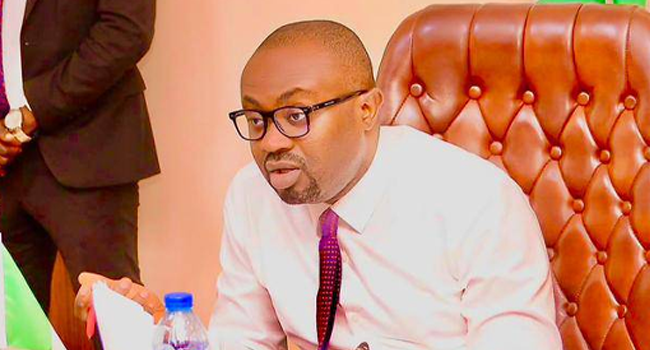
But in a swift reaction, the Senior Special Assistant to the President on Media and Communications (Office of the Vice President), Stanley Nkwocha, said Shettima’s comment was misinterpreted.
In a lengthy statement, Nkwocha clarified as follows:
No Link Between VP Shettima’s Remarks At Book Launch And Certain Online Reports
The Office of the Vice President has noted with serious concern the gross misrepresentation of remarks made by His Excellency, Senator Kashim Shettima
@officialSKSM, Vice President of the Federal Republic of Nigeria, during the public presentation of the book “OPL 245: The Inside Story of the $1.3 Billion Oil Block” by Mohammed Bello Adoke (SAN), held at the Yar’Adua Centre, Abuja, on Thursday, July 10, 2025.
Certain online news outlets and individuals have distorted the Vice President’s comments in pursuit of a mischievous agenda, twisting his account of how the administration of former President Goodluck Jonathan considered removing him from office—then as Governor of Borno State—at the height of the insurgency in the North East region.
This sensational reporting, which strips the Vice President’s remarks of their proper context, ventures into fiction by drawing false equivalence between his personal experience and the state of emergency declared in Rivers State, as well as the subsequent suspension of Governor Siminalayi Fubara by His Excellency, President Bola Ahmed Tinubu
@officialABAT
, GCFR, President and Commander-in-Chief of the Armed Forces of the Federal Republic of Nigeria.
We wish to state categorically that Vice President Shettima’s comments were made within the context of acknowledging the author’s professional conduct during his tenure as Attorney General of the Federation—a tribute to his public service record. His remarks were historical references to events during the Jonathan administration and were intended as a discourse on Nigeria’s constitutional evolution. They served to highlight how complex federal-state tensions have been managed through legal mechanisms and the country’s progress in that regard.
For the avoidance of doubt, President Tinubu did not remove Governor Fubara from office. The constitutional measure implemented was a suspension, not an outright removal. This action, along with the declaration of a state of emergency, was taken in response to the grave political crisis in Rivers State at the time. The situation was unprecedented, with the State House of Assembly complex under demolition and the Governor facing a looming threat of impeachment by aggrieved members of the legislature. No objective observer can deny that this decisive intervention by the President brought stability and calm to Rivers State.
This situation is not comparable to that of the North East under the Jonathan administration, where violent non-state actors were directly challenging the sovereignty of the Nigerian state, demanding unified action by both federal and state authorities to confront terrorism. In contrast, President Tinubu acted strictly within constitutional limits and in consultation with relevant stakeholders to preserve democratic institutions and restore order in Rivers State.
Nigeria’s laws provide a clear framework for addressing such matters. Section 305(3)(c) of the Constitution authorises extraordinary measures when there is “a breakdown of public order and public safety in the federation or any part thereof to such extent as to require extraordinary measures to restore peace and security.”
The situation in Rivers State clearly met this constitutional threshold, with persistent politically motivated violence, systematic attacks on federal institutions, and near-complete paralysis of governance—conditions intolerable in any democratic society. According to credible security reports, these acts even escalated into attacks on national assets.
President Tinubu acted with constitutional fidelity. His proclamation invoking Section 305(2) was ratified by an overwhelming bipartisan majority in the National Assembly, as required by Section 305(3).
This cross-party consensus in suspending the government of Rivers State, led by Sim Fubara, reflects a shared understanding among our elected representatives that the situation had reached a point of constitutional necessity, requiring immediate federal intervention.
Clearly, without mincing words, the action of President Tinubu in suspending Mr Fubara and others from exercising the functions of office averted the Governor’s outright removal. To conflate suspension with removal is misleading. Therefore, interpreting Senator Shettima’s remarks as commentary on current events is either a wilful misrepresentation or a deliberate neglect of constitutional context.
The Vice President, speaking extemporaneously, focused on the importance of public officials documenting their stewardship and on the enduring principle of accountability in public service. His historical references were made to illustrate the principled stands taken by past public servants, as well as his personal ties to Mohammed Bello Adoke and former Speaker Aminu Waziri Tambuwal. His remarks were not in any way a criticism of President Tinubu’s actions, which the Vice President and the entire administration fully support and stand by without reservation.
Vice President Shettima stands in loyal concert with President Tinubu in implementing these difficult but necessary actions to safeguard our democracy. We urge media organisations and political actors to desist from the destructive practice of wrenching statements from context in order to fabricate nonexistent conflicts.
Long before now, unconfirmed stories have continued to find their ways into the media space, claiming that all is not well with the relationship of Tinubu and Shettima, a situation the preaidency has denied, and continued to deny.
Tinubu removed Fubara and the Rivers state legislators on March 18, 2025, following a long drawn political upheaval in the state, between the governor, and his predecessor; the Minister of the Federal Capital Territory, Nyesom Wike, which defied all logical reconciliation. The suspension, according to Tinubu, who claimed he invoked section 305 of constitution, is for an initial six months.








 Voice of Emancipation4 days ago