Connect with us

Featured

Celebrating the Legacy of Massad Boulos’s Leadership at SCOA Nigeria

Published

on

By Magnus Onyibe

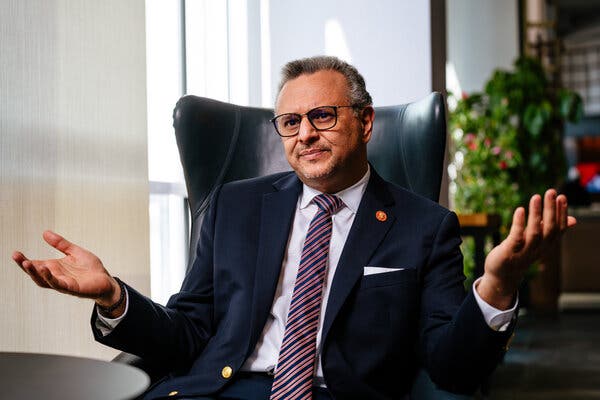
Recent media criticisms questioning the breadth of experience and business acumen of Mr. Massad Boulos, the incoming Senior Adviser on Arab and Middle East Affairs to U.S. President-elect Donald Trump, are not only misguided but also dismissive of the remarkable track record of both the man and the companies he has been instrumental in nurturing.

For instance, SCOA Nigeria PLC, where Mr. Boulos serves as Managing Director/CEO, is far from being just another company. It is a formidable force in Nigeria’s industrial and economic landscape. With roots spanning over four decades, it holds the distinction of being the first European automotive assembly plant in Nigeria.

In the 1970’s, SCOA Nigeria PLC made a name for itself by assembling Peugeot 404 and then 504 pickup trucks at its assembly plant at Apapa, Lagos and service center at its Lapal House facility on Lagos Island. Today, the company continues this proud legacy, assembling, distributing, and marketing M.A.N trucks and buses, power generators, tractors, agricultural equipment, industrial equipment and other heavy-duty construction and mining machinery critical to Nigeria’s key sectors.

SCOA Nigeria PLC’s clients include some of the most prominent and respected names in Nigeria’s construction industry, such as Julius Berger—widely regarded as the nation’s leading construction firm—Lafarge Africa PLC, a major cement producer, the Chagoury Group, renowned for developing the prestigious Banana Island, a premier residential enclave in Lagos, the DANGOTE Group, and many others.

Beyond trucks, SCOA Nigeria PLC is a trusted supplier of concrete, road construction and mining equipment, partnering with leading infrastructure companies to drive Nigeria’s development. For example, Julius Berger relies heavily on SCOA’s equipment for large-scale projects, including the 376km Abuja-Kaduna-Zaria-Kano highway and the 43.6km Lagos-Shagamu stretch of the Lagos-Ibadan Expressway and the Abuja-Kano Highway.

Similarly, Hi-Tech Construction, currently working on the 700km Lagos-Calabar Coastal Highway and the Lagos-Badagry-Sokoto road network, depends significantly on SCOA PLC for the machinery and technology required to execute these ambitious projects, aimed at enhancing connectivity and trade across Nigeria’s southern, central, and northern regions.
Similarly,SCOA PLC has also been instrumental in the development of Eko Atlantic City, a groundbreaking urban project built on reclaimed land from the Atlantic Ocean. This visionary initiative, designed to address Lagos’s urbanization challenges and promote sustainable development, has been made possible in part by state-of-the-art machinery supplied by SCOA. Notably, Eko Atlantic City is set to host the United States Embassy, projected to be the largest of its kind globally upon completion, further underscoring the strategic importance of this landmark project.

In fact, SCOA Nigeria PLC’s impact extends beyond Nigeria’s shores. As a member of the FADOUL Group – one of the largest and most successful family-owned businesses in Africa – its influence spans across West and Central Africa. The FADOUL Group, established in 1966, operates numerous successful enterprises, employs over 20,000 people, and is valued at over $1 billion, with hundreds of millions of USD in assets. This legacy highlights the scale and scope of the operations under Mr. Boulos’s leadership.

Contrary to unfounded claims in certain media outlets, the suggestion that Mr. Boulos is not a billionaire is both baseless and misleading. As President-elect Donald Trump rightly described, Mr. Massad Boulos is a “deal-maker,” a characterization grounded in fact. His proven ability to negotiate and execute complex international transactions has facilitated significant partnerships between Nigerian, German, and French businesses, delivering substantial value and mutual benefit.
As a Non-Executive Independent Director of SCOA Nigeria PLC since 2012, I have witnessed firsthand Mr. Boulos’s instrumental role in driving the company’s success. His ability to navigate the complexities of international commerce, exemplified by the supply of a significant fleet of trucks to Lafarge Africa through a tripartite arrangement between a logistics firm, GPC and Union bank plc, has earned him widespread recognition and respect.

Mr. Boulos’s leadership has not only been vital to SCOA PLC’s achievements but also to the broader international business successes of the FADOUL Group. This is precisely the kind of experience and strategic vision he brings to his new role as Senior Adviser on Arab and Middle East Affairs to President-elect Trump.

As noted in a press release by Karoline Leavitt, Trump-Vance Transition Spokeswoman, attempts to smear Mr. Boulos’s reputation are part of a broader effort by opposition elements to undermine President-elect Trump’s nominees. The truth remains that Mr. Boulos played a pivotal role in mobilizing the Arab-American and Middle Eastern-American vote, contributing significantly to the Trump-Vance victory—an achievement that underscores his political and organizational acumen.

Efforts to denigrate Mr. Boulos’s qualifications and achievements are not only futile but also a disservice to the facts. Mr. Boulos’s expertise and accomplishments are well-suited for his new role, where he will undoubtedly deliver impactful results on behalf of President-elect Trump and the United States.

Magnus Onyibe is a Non-Executive Independent Director and Chairman of Audit Committee, SCOA Nigeria PLC

Continue Reading
Click to comment

Leave a Reply

Your email address will not be published. Required fields are marked *

Featured

Why I Visited Nnamdi Kanu in Prison – Alex Otti

Published

on

By

By Eric Elezuo

Governor Alex Otti of Abia State has explained the reasons behind his much talked about visit to the leader of the Indigenous Peoples of Biafra (IPOB), Mazi Nnamdi Kanu, in Sokoto Correctional Centre.

Nnamdi Kanu was found guilty of all the seven count charges of terrorism brought against him by the Federal Government, and sentenced to life imprisonment, by Justice James Omotosho of the Federal High Court, Abuja, on November 20.

The governor also declared his intention to retire from partisan politics after serving as governor of the state.

Governor made these remarks in Umuahia while reacting to a viral video in which an individual berated him for visiting the IPOB leader in Sokoto Correctional Centre recently and alleged that the visit was aimed at positioning him (Otti) for either the presidential or vice presidential ticket. Otti however, denied having any presidential or vice presidential ambition after his governorship role.

According to him, he would not even contest for the senatorial position after serving as governor of Abia State.

Criticisms, he said, are part of democracy, adding that everyone is free to hold an opinion, even as he acknowledged that some criticisms, especially undue ones, are far from being the truth.

His words, “In the first place, that is the beauty of democracy. So, people should hold their opinions, and we respect people’s opinions. And that you hold a different opinion doesn’t mean you are right.

“One of the things he talked about was my ambition after being governor. And I had said it before, and I want to say it again, that by the time I’m done with governorship, I will retire.

“So, I don’t have presidential ambition, nor vice-presidential ambition. I also don’t have senatorial ambition. So, when I finish with the governorship, I’ll retire.

“I came for a mission. And when I deliver that mission, I will give way to younger people. So, he was talking of Igbo presidency. I don’t even understand what that means.

“So, I think if his thesis is based on that assumption, the assumption has collapsed, because he won’t see me on the ballot.

The Abia governor argued that it is important for a political office holder to know when to quit, especially when the politician has done what he is asked to do.

“When you have done what you have been asked to do, you clear, give way for other people. We’ve seen people here, after being governor who went to serve as Local Government Chairman. That’s not what we are. We are not cut out for those kinds of things.

Otti used the forum to explain why he visited Mazi Nnamdi Kanu at the Sokoto prison.

He said, “The second point is about Nnamdi Kanu. And I don’t want to put this matter in the public space so that it doesn’t jeopardise the discussions that I’m having.

“The truth about it is that exactly 24 months ago, I opened up discussions at the highest level on Nnamdi Kanu.

“And going to see him is the right thing to do, because he comes from my state. In fact, he comes from this local government (Umuahia North – the state capital).

“And there are always ways to solve a problem. I don’t believe that the way to solve a problem is to ignore it. And I had written extensively, even about Nnamdi Kanu and Operation Python Dance, I think in 2017 or 2018. And I condemned it.

“And I still condemn it. And some of the recordings that the gentleman put in his video, I cannot vouch for the veracity of that recording.”

Governor Otti maintained that he knows that when an issue has been approached from the legal point of view, there is also another window called the administrative point of view, stressing that, that is where he (the governor) is coming from.

“I’m not a lawyer. And if the judiciary says the man has been condemned to life imprisonment, that is the judiciary. Even that is not the end, because that’s the court of first instance. There is still an opportunity to appeal and then an opportunity to even go to the Supreme Court.

“But what we are trying to do is to intervene. I’m not a supporter of the disintegration of Nigeria.

“So, my position is that it would be insensitive of me to sit here and say one of our own who has been convicted should die when we have an opportunity to discuss, negotiate, and sue for peace. So, that is my position,” he said.

Continue Reading

Featured

How Glo Network Became the Lifeline That Saved Two Lives: A True Story from Sallari

Published

on

By

By Dr. Sani Sa’idu Baba

It was one of those calm, bright mornings in Sallari, a town in Tarauni Local Government Area of Kano State. I had gone to visit my longtime friend and colleague, Dr. Muhammad Umar Abdullahi, at his private facility, Rauda Clinic and Maternity. We were in his office discussing research, the usual challenges of medical practice, and other issues when the sound of hurried footsteps and anxious voices broke the calm. A young man rushed in, calling for the doctor.

Without hesitation, Dr. Muhammad sprang into action. I followed him instinctively. Within moments, two people burst through the gate, one man carrying a weak, heavily pregnant woman in his arms. Her breathing was shallow and wheezy, her face pale, and her body trembling between labor contractions and an asthma crisis. The scene was intense, we both knew that every second counted.

The team quickly moved her to the emergency bed. The Chief Medical Director Dr. Muhammad and his nurses worked swiftly to stabilize her breathing and monitor the baby. Oxygen was connected, IV lines were set, and within minutes, her breathing began to steady. The baby’s heartbeat was strong. After a short but tense period, she delivered a healthy baby girl. Relief filled the room like a gentle wind.

At that moment, I couldn’t help but admire the efficiency and dedication of Rauda Clinic and Maternity. The facility operated with the precision and compassion of a modern hospital. Every member of the team knew their role, every piece of equipment was in place, and the environment radiated calm professionalism. It reminded me that quality healthcare is not only about infrastructure, but about commitment and readiness when it truly matters. Rauda Clinic stood out that day as a quiet pillar of excellence and hope for patients and families alike.

The following day, I placed a call to Dr. Muhammad to ask about the condition of the woman who had been brought in the previous morning. He sounded cheerful and relieved. “Both mother and baby are fine now,” he said. Then, with deep reflection in his voice, he narrated the extraordinary story behind their survival, a story that showed how a single phone call, made at the right moment, became the bridge between life and death. As I listened to him recount the events, I couldn’t help but marvel at how sometimes, survival depends not only on medicine but also on connection.

Her name was Amina, a mother of three. That morning, she was alone at home, her husband was in Dutse, the capital of Jigawa state where he works, and her children had already gone to school. The first wave of pain came suddenly, followed by a tightening in her chest. Within minutes, she was gasping for air, her asthma worsening with every breath. She reached for her phone to call her husband, but the call wouldn’t go through. She tried again and again, each time, “Network error.”

Her strength was fading fast. She tried to reach her neighbors, but again, no connection. Alone, frightened, and struggling to breathe, she said she felt her end was near. Then, a thought crossed her mind, her maid had left her phone in the sitting room that morning. Gathering the last of her strength, Amina crawled toward the television stand where the phone lay.

When she reached it, she noticed the green SIM icon, it was a Glo line. Hope flickered. But when she tried to make a call, she saw there was no airtime. That could have been the end until she remembered Glo’s Borrow Me Credit service. With trembling fingers, she dialed the Glo borrow me code and she got the credit instantly, and that small credit became her lifeline.

Her first attempt to reach her husband failed. Then she dialed her younger brother, Umar. This time, the call went through immediately. Interestingly, Umar is a Glo user too. Without delay, Umar and his wife rushed to her house, found her collapsed on the floor, and carried her into their car.

On their way, Umar called ahead to alert the doctor, and again, the call went through clearly. By a remarkable coincidence, Dr. Muhammad was also using a Glo line. That seamless connection meant the hospital team was fully prepared by the time they arrived. Within minutes, Amina was stabilized, and both she and her baby were safe.

The next morning, Dr. Muhammad told me that Amina had smiled faintly and said to him, “Doctor, when every other network failed me, Glo answered. If that call hadn’t gone through, I wouldn’t be here today.”

Her words carried a truth that stayed with me. It wasn’t just a patient’s gratitude, it was a testimony about the power of reliable connection. At that moment, Glo wasn’t just a telecommunications network, it was the bridge between life and death, between despair and hope.

In today’s world, a simple phone call can determine whether someone lives or dies. That day reminded me that technology, when dependable, is not just about data speed, it’s about human connection at its most critical. Glo proved to be that connection: steady, available, and trustworthy when it mattered most.

Before she was discharged, she laughed and told the doctor she had already chosen a nickname for her baby “Amira Glo.” They both laughed, but deep down, Dr. Muhammad understood the meaning behind that name. It symbolized gratitude, faith, and survival.

As I ended the call with Dr. Muhammad that day, I felt a quiet pride. I had witnessed not just the miracle of life, but the harmony of medicine, compassion, and reliable technology. Through Rauda Clinic and Maternity, I saw what true service means, dedication without boundaries, and connection that saves.

Amina’s story isn’t an advert, but living proof that sometimes, when every other signal fades, Glo stands firm, and when every other facility seems far away, Rauda Clinic and Maternity remains a beacon of care and excellence.

For patients, families, and health workers alike, Glo is proven to be a network of necessity. It connects life to hope, when every second truly counts…

Dr. Sani Sa’idu Baba writes from Kano, and can be reached via drssbaba@yahoo.com

Continue Reading

Featured

Delta Govt Confirms Death of Senator Nwaoboshi at 68

Published

on

By

Senator Peter Onyelukachukwu Nwaoboshi, the former lawmaker who represented Delta North Senatorial District in the National Assembly, has passed away. He was 68.

Reports said that Nwaoboshi died on Friday in Abuja following a brief illness.

His demise was confirmed in a condolence statement issued by the Delta State governor, Rt. Hon. Sheriff Oborevwori.

Expressing sorrow, the governor described Nwaoboshi’s passing as a monumental loss to Delta State, the Anioma nation, and the Nigerian federation.

In the statement by his Chief Press Secretary, Sir Festus Ahon, Governor Oborevwori hailed the late Senator as a “fearless advocate” of the Anioma cause whose contributions to nation-building remain indelible.

The governor recalled Nwaoboshi’s impactful tenure in the Red Chamber, particularly his role as Chairman of the Senate Committee on Niger Delta Affairs.

He noted that Nwaoboshi’s consistent advocacy for the development of the oil-rich region distinguished him as a passionate and committed leader.

“On behalf of the government and people of Delta State, I mourn the passing of my dear friend, Senator Peter Onyelukachukwu Nwaoboshi,” the governor said.

“I extend my heartfelt condolences to his immediate family, the people of Anioma nation, members of the All Progressives Congress (APC), and all those whose lives he touched. I pray that Almighty God grant his soul eternal rest.”

Before his elevation to the Senate in 2015, he served meritoriously as a two-term Chairman of the Peoples’ Democratic Party (PDP) in Delta State, where he was instrumental in consolidating the party’s grip on the State.

Continue Reading

Trending