Connect with us

Entertainment

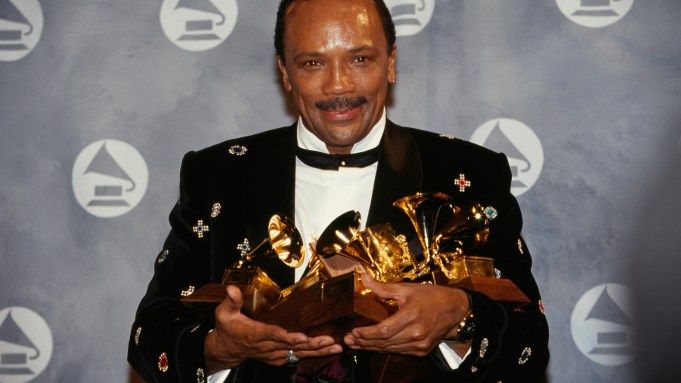
Producer Par Excellence, Quincy Jones, Dies at 91

Published

on

Quincy Jones, the multi-talented music titan whose vast legacy ranged from producing Michael Jackson’s historic “Thriller” album to writing prize-winning film and television scores and collaborating with Frank Sinatra, Ray Charles and hundreds of other recording artists, has died at 91.

Jones’ publicist, Arnold Robinson, says he died Sunday night at his home in the Bel Air section of Los Angeles, surrounded by his family.

“Tonight, with full but broken hearts, we must share the news of our father and brother Quincy Jones’ passing,” the family said in a statement. “And although this is an incredible loss for our family, we celebrate the great life that he lived and know there will never be another like him.”

Jones rose from running with gangs on the South Side of Chicago to the very heights of show business, becoming one of the first Black executives to thrive in Hollywood and amassing an extraordinary musical catalog that includes some of the richest moments of American rhythm and song. For years, it was unlikely to find a music lover who did not own at least one record with his name on it, or a leader in the entertainment industry and beyond who did not have some connection to him.

Jones kept company with presidents and foreign leaders, movie stars and musicians, philanthropists and business leaders. He toured with Count Basie and Lionel Hampton, arranged records for Sinatra and Ella Fitzgerald, composed the soundtracks for “Roots” and “In the Heat of the Night,” organized President Bill Clinton’s first inaugural celebration and oversaw the all-star recording of “We Are the World,” the 1985 charity record for famine relief in Africa.

Lionel Richie, who co-wrote “We Are the World” and was among the featured singers, would call Jones “the master orchestrator.”

In a career which began when records were still played on vinyl at 78 rpm, top honors likely go to his productions with Jackson: “Off the Wall,” “Thriller” and “Bad” were albums near-universal in their style and appeal. Jones’ versatility and imagination helped set off the explosive talents of Jackson as he transformed from child star to the “King of Pop.” On such classic tracks as “Billie Jean” and “Don’t Stop ‘Til You Get Enough,” Jones and Jackson fashioned a global soundscape out of disco, funk, rock, pop, R&B and jazz and African chants. For “Thriller,” some of the most memorable touches originated with Jones, who recruited Eddie Van Halen for a guitar solo on the genre-fusing “Beat It” and brought in Vincent Price for a ghoulish voiceover on the title track.

“Thriller” sold more than 20 million copies in 1983 alone and has contended with the Eagles’ “Greatest Hits 1971-1975” among others as the best-selling album of all time.

“If an album doesn’t do well, everyone says ‘it was the producers fault’; so if it does well, it should be your ‘fault,’ too,” Jones said in an interview with the Library of Congress in 2016. “The tracks don’t just all of a sudden appear. The producer has to have the skill, experience and ability to guide the vision to completion.”

The list of his honors and awards fills 18 pages in his 2001 autobiography “Q”, including 27 Grammys at the time (now 28), an honorary Academy Award (now two) and an Emmy for “Roots.” He also received France’s Legion d’Honneur, the Rudolph Valentino Award from the Republic of Italy and a Kennedy Center tribute for his contributions to American culture. He was the subject of a 1990 documentary, “Listen Up: The Lives of Quincy Jones” and a 2018 film by daughter Rashida Jones. His memoir made him a best-selling author.

Born in Chicago in 1933, Jones would cite the hymns his mother sang around the house as the first music he could remember. But he looked back sadly on his childhood, once telling Oprah Winfrey that “There are two kinds of people: those who have nurturing parents or caretakers, and those who don’t. Nothing’s in between.” Jones’ mother suffered from emotional problems and was eventually institutionalized, a loss that made the world seem “senseless” for Quincy. He spent much of his time in Chicago on the streets, with gangs, stealing and fighting.

“They nailed my hand to a fence with a switchblade, man,” he told the AP in 2018, showing a scar from his childhood.

Music saved him. As a boy, he learned that a Chicago neighbor owned a piano and he soon played it constantly himself. His father moved to Washington state when Quincy was 10 and his world changed at a neighborhood recreation center. Jones and some friends had broken into the kitchen and helped themselves to lemon meringue pie when Jones noticed a small room nearby with a stage. On the stage was a piano.

“I went up there, paused, stared, and then tinkled on it for a moment,” he wrote in his autobiography. “That’s where I began to find peace. I was 11. I knew this was it for me. Forever.”

Source: APnews

Continue Reading
Click to comment

Leave a Reply

Your email address will not be published. Required fields are marked *

Entertainment

Tribute to Jimmy Cliff: Last Lion of Reggae Crossed the Rivers

Published

on

By

By Prince Adeyemi Shonibare

The wind blows soft across the hills of Jamaica, and the world feels it — a tremor of sorrow, a sigh of history, as Jimmy Cliff, the last Lion of the Reggae Mountains, crossed the great river at eighty-one.
He was the troubadour who sang survival into existence. The freedom-fighter who turned melody into movement. The dreamer who taught the world that:
“You can get it if you really want, but you must try, try and try.”
And try he did — from Somerton to Kingston, from Kingston to the world.

THE JOURNEY — FROM SOMERTON TO THE SUMMIT

Born James Chambers, a young boy humming tunes to the morning breeze, Jimmy Cliff stepped into Kingston with nothing but ambition and spirit. He recorded “Hurricane Hattie” at sixteen, and the island took notice.
He rose like sunrise — slow, steady, unstoppable. Reggae, ska, rocksteady — he touched them all, carving a golden road across Jamaica’s musical skyline.

Then came the explosion that stamped his immortality.

“THE HARDER THEY COME” — A REVOLUTION ON SCREEN

With the 1972 classic The Harder They Come, Jimmy Cliff did more than act; he preached struggle and hope for the entire world.
His voice cried out: “The harder they come, the harder they fall.” Oppressed people everywhere heard their story.
In “Many Rivers to Cross,” he poured a lifetime of pain, faith, and yearning:
“Many rivers to cross, but I can’t seem to find my way over.”
Yet he always crossed — and showed humanity how.

THE MAN WHO SANG FOR HUMANITY

Jimmy Cliff lived with the soul of a pilgrim, a man who believed that peace could ride on melody. He travelled far, performed wide, raised children with pride, held philosophies that blended faith and freedom.

He sang of unity in “Wonderful World, Beautiful People,” reminding humanity:
“There is a place where love is flowing freely.”
His life proved that music could make nations kinder and people braver.

AWARDS, HONOURS, AND ETERNAL RESPECT

Jimmy Cliff earned the world’s applause:

Rock and Roll Hall of Fame

Grammy Awards

Jamaica’s Order of Merit

Worldwide tours and universal reverence
A catalogue woven into the soundtrack of global culture
But his deepest legacy lies in the millions who found hope in his voice, who stood tall because he sang:
“I can see clearly now, the rain is gone.”

THE LAST LION OF THE REGGAE GENERATION

With Marley gone, with Toots, Peter, Bunny, and Gregory gone, Jimmy Cliff stood as the final elder — the last lion roaring from reggae’s original pride.
He carried the flame when others dimmed. He carried the memory. He carried the movement. He carried the message.
And now he has crossed the last river — the one his own lyrics foresaw.

TRIBUTES FOR A TITAN

“Jimmy Cliff was a bridge between struggle and joy — a global treasure.” — Jamaican Prime Minister
“He sang the world into courage.” — Global Entertainment Guild
“Reggae has lost its last first-born. The music will never forget.” — International Music Legends Alliance

Though gone in body, the stage curtain remains open for the last lion who crossed all the many rivers after finally finding his way.

Jimmy Cliff is gone. But Jimmy Cliff can never die.His voice lives in street corners where youth gather, in radios crackling across African markets, in festivals, in freedom rallies, in every soul that ever felt hope rise from a song.

His own words now carry him across eternity:
“There’s a river that must be crossed, and I must cross it.”

He has crossed. The Lion rests. But his roar echoes forever.

One love. One legend. One Jimmy Cliff.

Continue Reading

Entertainment

Globacom-Sponsored African Voices Changemakers Features BBN Host, Ebuka Obi-Uchendu

Published

on

By

Nigerian media personality and Big Brother Naija host, Ebuka Obi-Uchendu, is the guest on CNN International’s acclaimed magazine show, African Voices, this week. The 30-minute show, sponsored by telecommunications leader, Globacom, gives viewers an in-depth look at Ebuka’s journey and impact.

Born on July 14, 1982, Ebuka first entered the spotlight as a contestant on the inaugural edition of Big Brother Naija in 2006. Since then, he has become the show’s longest-serving host, captivating audiences with his charisma and style.

A Law graduate of the University of Abuja, Ebuka also holds a Master’s degree in Law from the Washington College of Law at American University, Washington, where he specialized in Intellectual Property. Beyond reality TV, he has anchored notable programs including Rubbin’ Minds on Channels Television and the Glo Show.

The episode highlights Ebuka’s impressive fashion collaborations with designer Mai Atafo, the cultural stories behind his signature style, and his passionate advocacy for young boys across Nigeria.

The show which runs on Saturday on DSTV Channel 401 at 8:30 a.m. and 12.00 noon is  repeated on Sunday at 4.30 a.m. and 7 p.m. The repeats continue on Monday at 4 on the morning belt and at 6.45 p.m. the same day and at 6.45 p.m. on Tuesday. The edition will be repeated next weekend at the same time slots.

Continue Reading

Entertainment

My Character in “Sinnners” Reflects Deep Ancestral Reverence, Connection – Starlet Wunmi Mosaku

Published

on

By

By Samantha Ofole-Prince
She received a British Academy of Film and Television Arts award (BAFTA) for playing a grieving matriarch in the heartbreaking drama “Damilola, Our Loved Boy.” She captivated audiences as Ruby Baptiste in the horror-drama series “Lovecraft Country” and was the sidekick to Idris Elba’s character in the fifth series of the BBC crime drama “Luther.”
Wunmi Mosaku’s latest role as a spiritual healer and Hoodoo conjurer is earning her rave reviews.
In “Sinners,” the supernatural horror film directed by Ryan Coogler, Mosaku, who is known for her roles in “Loki” and “Deadpool & Wolverine” and the film “His House” is much more than just the estranged wife of Elijah “Smoke” Moore (Michael B. Jordan).
“Annie is Smoke’s protection, his comforter. She’s his mother, his teacher, his friend and his lover,” says the Nigerian-born British actress whose performance has been widely praised for its emotional arc and authenticity. In playing Annie, she steeped herself in research ensuring she not only perfected the Southern American accent required but arduously rehearsed with Jordan as their on-screen relationship is central to the film’s core.
“We had a couple of weeks of rehearsal and shared our story, our lives, our hopes, our dreams, our fears, the things most precious to us. And so, we built a level of trust and openness and safety to really explore that love, that grief, the differences. I think that’s kind of the fastest way to get to trusting your scene partner and being free is just to open up, and that’s what we did.”
An original tale that takes place in a single day, “Sinners” follows identical twin brothers, Smoke and Stack (both played by Michael B. Jordan), who return to their Mississippi hometown to open a juke joint. While they plan to start a new life, they soon find themselves battling a group of vampires who attack their establishment, forcing the survivors to learn how to fight and defeat them.
​Her character’s expertise in Hoodoo proves crucial in helping her companions tackle the vampires. She provides spiritual and intellectual guidance for the group. It’s a role which also allowed Mosaku, who was born in Zaria, to explore her own heritage as ​a Hoodoo expert ​Dr. Yvonne Patricia Chireau, an authority on Africa based religions and spiritual traditions served as a consultant on the film.
“There is this reverence for our people, who we are and where we’re from, and I was excited by the depth and the quality of the writing when I read the script, and I learned so much from Annie. The onset conversations Michael and I had, and those I had with the community, truly inspired me. I hope the film reminds people to stay connected with their ancestors.”
With music, humor, drama, suspense and history, director Ryan Coogler (“Creed,” “Black Panther,” and “Black Panther: Wakanda Forever”), who also wrote the screenplay, has created a modern cinematic masterpiece.
Samantha Ofole-Prince is a U.S. based journalist and movie critic who covers industry-specific news that includes television and film

Continue Reading

Trending