Connect with us

Africa

AfreximBank Inaugurates Kigali’s Office of Fund for Export Development in Africa

Published

on

By Dolapo Aina

On Wednesday, the 20th of March 2024, The African Export Import Bank (Afreximbank)’s Fund for Export Development in Africa inaugurated its’ Kigali office with a keen eye on addressing Africa’s $110 billion equity financing shortfall. The bank unveiled its Fund for Export Development in Africa (FEDA) office in Kigali, capital of Rwanda.
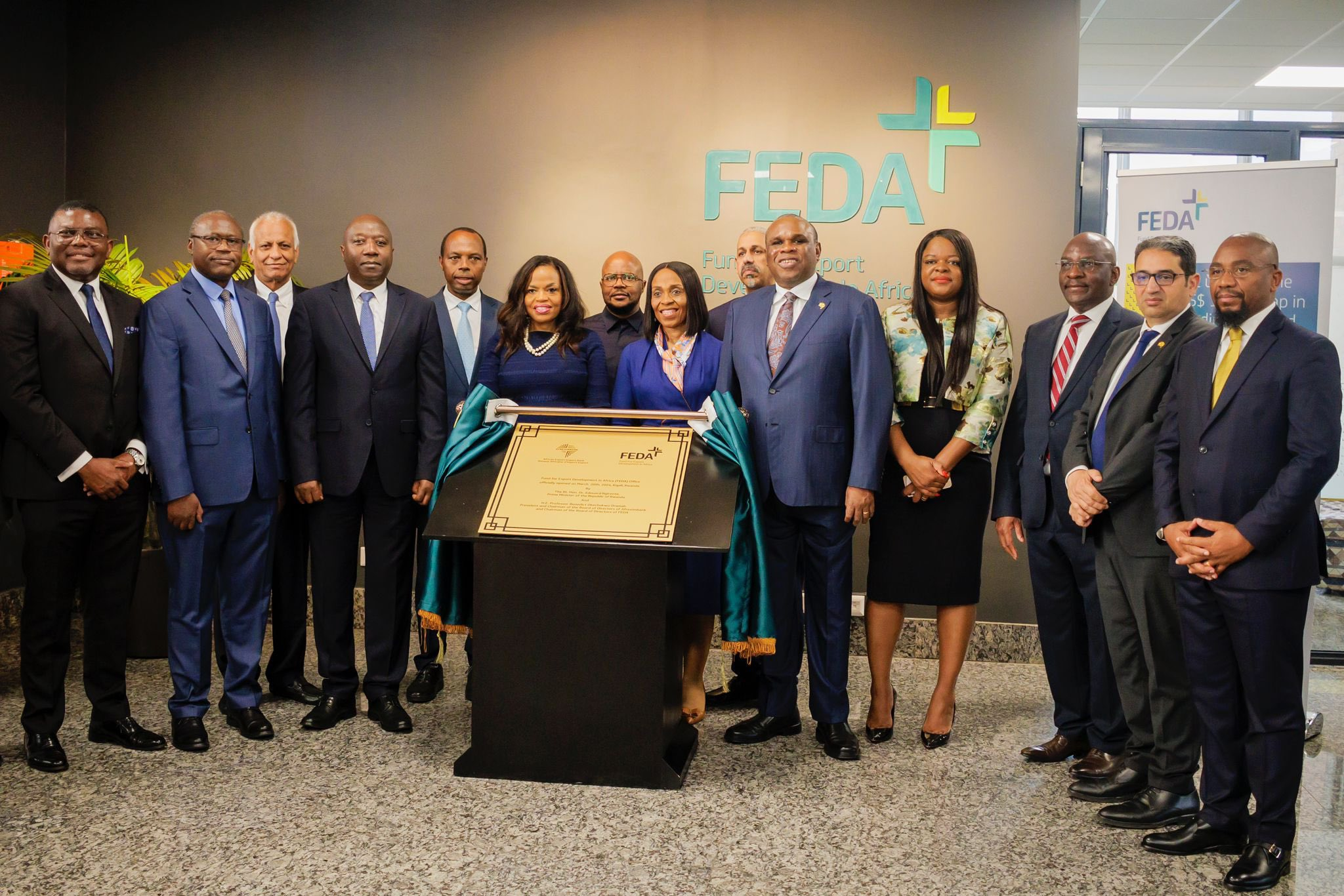
While the Fund for Export Development in Africa (FEDA) became the Fund Manager of the US$1 billion AfCFTA Adjustment Fund in 2023, it is noteworthy to state that the Fund for Export Development in Africa is the impact investment subsidiary of Afreximbank set up to provide equity, quasi-equity, and debt capital to finance the multi-billion-dollar funding gap especially in equity which are needed to transform the trade sector on the African Continent.
According to an official statement by Afreximbank, FEDA pursues a multi-sector investment strategy along the intra-African trade, value-added export development, and manufacturing value chain which includes financial services, technology, consumer and retail goods, manufacturing, transport and logistics, agribusiness, as well as ancillary trade enabling infrastructure such as industrial parks.

The statement by Afreximbank further stated that FEDA was established to tackle Africa’s US$110 billion financing gap for intra-African trade, value-added export development, and industrialisation value chains, with Rwanda being the first among fifteen African nations to ratify its establishment agreement.

The event had in attendance Dr. Edouard Ngirente, the Prime Minister of the Republic of Rwanda’ President and Chairman of the Board of Directors of Afreximbank, Professor Benedict Oramah; Executive Vice Presidents of Afreximbank, members of the Board of Directors of FEDA including Ms. Marlene Ngoyi, who is the Chief Executive Officer of FEDA; officials from the Rwandan Government; representatives from the business and diplomatic communities in Rwanda; just to name a few.
Rwanda’s Prime Minister Dr. Ngirente stated: “The establishment of FEDA in Rwanda reflects Rwanda’s commitment to not only fostering economic development within our borders but also to playing a pivotal role in the economic transformation of our continent. This initiative is a step closer to the realisation of the goals outlined in the Agenda 2063 of the African Union which lays great emphasis on the transformation of African economies and acceleration of economic growth on the continent.” The Prime Minister of Rwanda highlighted the fact that despite Africa’s significant resource endowments and contiguous markets, the continent had the lowest level of intra-regional trade in the world, adding that the continent’s share of value created remained the lowest across many products and commodities due to sub-optimal value addition.

President of Afreximbank, Professor Benedict Oramah in his speech stated that: “FEDA adds to the pool of institutions helping Africa to create its own capital base for development. With a focus on providing long-term, patient capital targeting all segments, from SMEs to corporates, and cutting across dynamic sectors of value-addition, services, and technology, FEDA is positioned to drive Africa’s development under a new vision of de-commoditised, growth-oriented pathways underpinned by a dynamic private sector. We all share the view that the goals of the African Continental Free Trade Agreement (AfCFTA) will be a mirage, and its benefits will accrue to others unless tangible steps are taken to create tradable goods and services for the continental market. We also do recognise that the benefits of the Free Trade Agreement will not be evenly shared among all Participating States if pragmatic steps are not taken to equip all economies, especially small and fragile economies, with the capacity to produce goods or provide essential services necessary for the conduct of trade within the continent.”

Professor Benedict Oramah went further: “Less than four years since the commencement of operations, the evidence of the strategic importance of this institution is beginning to show as it has started to leave impactful footprints across the continent. Funds Under Management under different strategies amount to about 800 million US dollars. FEDA is using some of these funds to create and mobilise additional funds and is currently a co-promoter of a 500 million US dollar Africa Credit Opportunity Fund (ACOF). With seed funding provided by Afreximbank, it is also creating a 100 million US dollar Venture Capital Fund to focus on start-ups and SMEs. In 2023, FEDA became the Fund Manager of the 1 billion US dollar AfCFTA Adjustment Fund. Thanks to the equity and supporting debt instruments offered by Afreximbank, industrial complexes are emerging across Africa. The Fund has supported the emergence of Special Economic Zones in Gabon, Benin, and Togo. These Industrial Zones have changed the profiles of the countries from commodity-exporting countries to exporters of value-added or manufactured goods, attracting multiple times the values gained from commodity exports, helping to achieve economic diversification, creating dynamic local economies with strong domestic supply chains and, above all, jobs and stable incomes for the people. Similar investments are spreading and are expected to reach at least twenty countries, including Rwanda, Malawi, Cote d’Ivoire, Nigeria, Kenya, Congo Democratic Republic, the Republic of Chad, and Zambia, by year-end.”

On Rwanda, Professor Benedict Oramah posited in his speech that “Rwanda is also poised to benefit significantly. On the heels of the various supports provided by Afreximbank to Rwandan public and private sector entities, FEDA has progressed a significant deal pipeline in Rwanda. A number of investments are being processed across many sectors and industries, ranging from transport and trade logistics, manufacturing, agro-processing, and power generation. These equity investments, amounting to about 50 million US dollars, when concluded, will complement the over 300 million US dollars disbursed to Rwandan entities by Afreximbank in the past 5 years, boost local industrial actives, create domestic value chains, and elevate Rwanda’s preparedness to harness the benefits of the AfCFTA.”

Continue Reading
Click to comment

Leave a Reply

Your email address will not be published. Required fields are marked *

Africa

Loyal Soldiers Foil Military Coup in Benin Republic

Published

on

By

Benin’s government said on Sunday its armed forces had foiled a coup attempt after a group of soldiers in the West African nation claimed on national television to have seized power.
The attempted coup was the latest threat to democratic rule in the region, where militaries have in recent years seized power in Benin’s neighbours Niger and Burkina Faso, as well as in Mali, Guinea and, only last month, Guinea-Bissau.
At least eight soldiers, several holding weapons, went on state television on Sunday morning to announce that a military committee led by Colonel Tigri Pascal had taken over and was dissolving national institutions, suspending the constitution and closing air, land and maritime borders.
“The army solemnly commits to give the Beninese people the hope of a truly new era, where fraternity, justice and work prevail,” said a statement read by one of the soldiers.
A few hours later, Interior Minister Alassane Seidou said the West African country’s armed forces had thwarted the attempted coup.
“Therefore, the government urges the population to go about their business as usual,” he said.
A government spokesperson, Wilfried Leandre Houngbedji, said that 14 people had been arrested in connection with the coup attempt as of Sunday afternoon, without providing details.
Foreign Minister Olushegun Adjadi Bakari had earlier told Reuters that “a small group” of soldiers had attempted to overthrow the government but that forces loyal to President Patrice Talon were working to restore order.
He said the coup plotters had only managed to take control of state television, which was cut after the soldiers read out their statement. It resumed broadcasting shortly afterwards, allowing the interior minister to read his statement saying the coup bid had been foiled.
West Africa’s regional bloc ECOWAS and the African Union condemned the coup attempt.
The coup attempt came as Benin was preparing for a presidential election in April that would mark the end of the tenure of incumbent Talon, in power since 2016.
In their TV statement, the soldiers mentioned the deteriorating security situation in northern Benin “coupled with the disregard and neglect of our fallen brothers-in-arms.”
Talon has been credited with reviving the economy, but the country has also seen an increase in attacks by jihadist militants that have wreaked havoc in Mali and Burkina Faso.
In April, the government said that 54 soldiers were killed in an attack in the north by an affiliate of Al Qaeda.
Last month, Benin adopted a new constitution creating a Senate and extending the presidential mandate from five to seven years, in what critics said was a power grab by the ruling coalition, which has nominated Finance Minister Romuald Wadagni to be its candidate.
The opposition Democrats party, founded by Talon’s predecessor Thomas Boni Yayi, saw its proposed candidate rejected because of what a court ruled was insufficient backing from lawmakers.
Benin experienced several military coups and coup attempts in the first decades after independence from France in 1960. But there has not been a power grab by force in the country since it held multi-party elections in 1991.
Source: Reuters

Continue Reading

Africa

Soldiers Strike in Benin Republic, Removes Talon, Takes over Govt

Published

on

By

Military personnel in Benin on Sunday announced that they had ousted President Patrice Talon, although his entourage said he was safe and the army was regaining control.

Soldiers calling themselves the “Military Committee for Refoundation” (CMR), said on state television that they had met and decided that “Mr Patrice Talon is removed from office as president of the republic”.

The announcement follows two coups in Madagascar and Guinea-Bissau in as many months. Benin is bordered in the north by Niger and Burkina Faso, which have also seen military takeovers.

The French Embassy said on X that “gunfire was reported at Camp Guezo” near the president’s official residence in the economic capital.

It urged French citizens to remain indoors for security.

But Talon’s entourage said Talon, who has been president of the west African nation for 10 years and is due to step down in April, was safe.

“This is a small group of people who only control the television. The regular army is regaining control. The city and the country are completely secure,” his office told AFP.

Benin’s political history has been marked by several coups and attempted coups.

Talon, who came to power in 2016, is due to reach the end of his second term in 2026, the maximum allowed by the constitution.

The main opposition party has been excluded from the race to succeed him, and instead the ruling party will vie for power against a so-called “moderate” opposition.

Talon, a 67-year-old former businessman dubbed the “cotton king” of Cotonou, has been praised for bringing economic development to Benin but is regularly accused by his critics of authoritarianism.

AFP

Continue Reading

Africa

World’s Oldest President, Paul Biya, Wins Cameroon Election at 92

Published

on

By

Cameroon ’s top court on Monday declared incumbent Paul Biya, the world’s oldest president, the winner of the Oct. 12 election. Clashes with security forces left at least four protesters dead ahead of the announcement as opposition supporters rallied to demand credible results.

Biya, 92, has led the central African nation since 1982. The Constitutional Council said he received 53.66% of votes while former ally-turned-challenger Issa Tchiroma Bakary got 35.19%. The turnout was 57.7%.

In a social media post after the declaration, Tchiroma said that there was gunfire directed at civilians and two people were shot dead in his hometown in Garoua.

He said: “Toll of their attack: two dead. I wonder what will be said this time? Shooting point-blank at your own brothers — I can’t help but wonder if you’re mercenaries. Kill me if you want, but I will liberate this country by any means necessary. What blatant impunity.”

The four protesters were shot dead in Douala, the economic capital, on Sunday, as hundreds of people stormed streets in several cities. Tchiroma had claimed victory days before Monday’s announcement, citing results he said were collated by his party. Biya dismissed the claim.

According to Samuel Dieudonne Ivaha Diboua, governor of the Littoral Region that includes Douala, several members of the security forces were injured by protesters. He said at least 105 protesters were arrested.

Videos online showed protesters clashing with security forces, who fired tear gas and tried to disperse people barricading major roads in Douala and other cities, including Garoua and Maroua in the north.

Dozens of opposition supporters, activists and leaders have been arrested in recent days. Paul Atanga Nji, minister of territorial administration, said on Saturday the government arrested several people plotting violent attacks.

One protester, Oumarou Bouba, a 27-year-old trader in Maroua, said: “I am ready to stake my life to defend my vote. I voted for Tchiroma because I want change.”

Following the announcement of the results, Sani Aladji, a 28-year-old who works in a hotel in Maroua, said: “Nothing will change. I expected that Issa Tchiroma would bring change, which is why I voted for him. There’s rampant corruption under Biya’s regime. We are tired of that. We don’t have roads.”

Biya has ruled Cameroon longer than most of its citizens have been alive. Over 70% of the country’s almost 30 million population is below 35. The election has been the latest dramatic example of tension between Africa’s youth and the continent’s many aging leaders.

He first came to power in 1982 following the resignation of Cameroon’s first president and has ruled the country since then, later benefiting from a constitutional amendment that abolished term limits.

Critics accuse Biya of leading Cameroon from a period of relative stability into one of crisis and conflict. The country in recent years has faced attacks by Boko Haram militants in the north and a secessionist insurgency in the country’s English-speaking North West and South West regions.

That crisis, triggered by the government’s attempts to impose French in English-speaking schools and courts, has killed nearly 7,000 people, displaced more than one million more internally and sent thousands fleeing to neighboring Nigeria.

Despite Cameroon being an oil-producing country that is experiencing modest economic growth, young people say the benefits have not trickled down beyond the elites. According to World Bank data, the unemployment rate stands at 3.5%, but 57% of the labor force aged 18 to 35 works in informal employment.

“Many young people across the country and in the diaspora had hoped for change, but that their hopes have been dashed. It feels like a missed opportunity,” said Dr Emile Sunjo, a senior lecturer in international relations at the University of Buea. “Cameroon could potentially slide into anarchy.”

Source: AP

Continue Reading

Trending