By Dolapo Aina
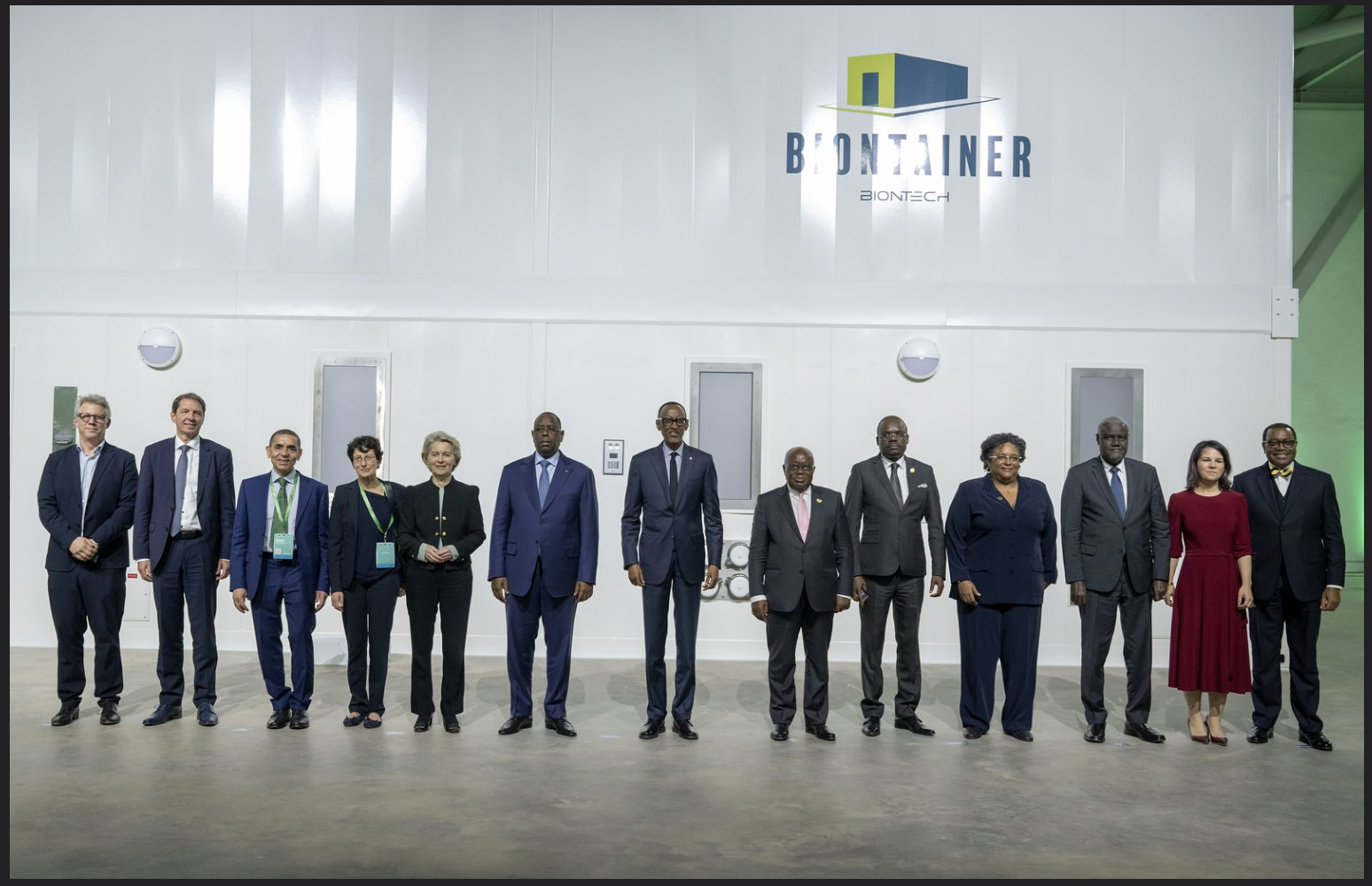
On Monday, December 18, 2023, according to Biopharmaceutical New Technologies (better known as BioNTech, which is a next-generation immunotherapy company pioneering therapies for cancer and other serious diseases, the corporation reached the next milestone in building mRNA production capacity with the inauguration of the company’s site in the Special Economic Zone in Kigali, Rwanda.
According to the corporation in a statement: “The inauguration takes place on the occasion of the establishment of the first production unit called BioNTainer. This is one of several BioNTech initiatives aimed at building a sustainable and resilient African vaccine ecosystem and supporting equitable access to innovative medicines worldwide: This includes research and development, clinical trials, manufacturing and training of specialists Location.”
The statement went further: “At a day-long conference titled “Collaborating to Promote Equitable Vaccine Supply in Africa,” which preceded the site’s inauguration, BioNTech met with representatives from the World Health Organization (“WHO”), the Coalition for Epidemic Preparedness Innovations (“CEPI”) ), Africa Centers for Disease Control and Prevention (“Africa CDC”), the Rwanda Food and Drug Administration (“Rwanda FDA”), the Health Emergency Preparedness and Response Authority (“HERA”), the Bill and Melinda Gates Foundation and the South African Health Products Regulatory Authority to discuss opportunities and challenges in building a sustainable and resilient vaccine ecosystem in Africa. At the invitation of His Excellency Paul Kagame, President of the Republic of Rwanda, heads of state and government from all over the world, leading representatives of the African Union, the European Union as well as the WHO and CEPI took part in the inauguration ceremony of the BioNTech site. The company’s manufacturing facility in Kigali could become the first commercial-scale mRNA production facility on the continent.”
The system is based on the company’s digital, modular high-tech production units, the so-called BioNTainers. They are designed to produce a range of mRNA-based vaccines. The BioNTainers are also designed so that they can be further developed regularly in order to remain one of the most advanced mRNA production facilities in the world in the long term. The production facility will initially be equipped with two BioNTainers. The containers for the first BioNTainer, which was recently installed in the production hall and will be used to produce mRNA as an active ingredient, arrived in Kigali in March 2023. The second BioNTainer unit will be used to produce ready-to-fill batches of the formulated active ingredient and will be ready for transport to the Rwandan site in the first quarter of 2024.
Most importantly, the production facility in Kigali has so far been fully financed by BioNTech. The company expects a total investment of approximately $150 million to build the site, including production units. The entire site is around 35,000 square meters in size and will employ around 100 people once it is fully operational. BioNTech plans to complete all buildings on the site in 2024, including a warehouse, offices and quality control laboratories, as well as qualifying on-site specialist staff.
Manufacturing of mRNA-based vaccine batches required for process validation is expected to begin in 2025. The facility will produce vaccines tailored to the needs of African Union members. Production capacity depends on the mRNA product to be produced and various factors such as dosage and formulation. For example, BioNTech could produce up to 50 million doses annually of a product whose RNA production process is similar to that of the Pfizer-BioNTech COVID-19 vaccine.
Also important is to note that to meet the needs of the continent and partner countries, BioNTech could establish additional production facilities in Africa following the successful validation of the Kigali facility, which serves as a flagship project. Compared to the Kigali facility, additional facilities could be larger facilities that could provide more commercial-scale manufacturing capacity in Africa, or smaller facilities that could be specialized in producing batches for clinical evaluation of product candidates.
On the sidelines of the event, Prof. Dr. Ugur Sahin, CEO and co-founder of BioNTech, His Excellency Macky Sall, President of the Republic of Senegal, met to discuss a possible research partnership between the Institut Pasteur de Dakar and BioNTech that could focus on infectious diseases relevant to the African continent.
Several global dignitaries spoke at the inauguration ceremony such as President Macky Sall, President of the Republic of Senegal who stated that: “This is a special day for Africa. BioNTech has taken an important step towards greater equity in vaccines and is a great example of a company that acts with great social responsibility. I fully support what BioNTech is doing in Rwanda and look forward to advancing a research partnership in Senegal with the Institut Pasteur in Dakar.”
President Ursula von der Leyen, President of the European Commission went thus: “The opening of BioNTech’s first African site in Kigali is an important step towards African vaccine sovereignty. The local production of vaccines based on mRNA technology in Africa for the African population can play a crucial role in the fight against diseases and pandemics. The EU is proud to work with Rwanda and BioNTech to develop a dynamic biopharmaceutical industry on the continent. The European Global Gateway initiative is investing in vaccine production in Africa and in providing the necessary skills, jobs and capacity to drive health innovation across the continent.”
Quoting HE Moussa Faki Mahamat, who is the Chairman of the African Union Commission: “This is an important day for Africa. The African continent is working to improve access and quality of urgently needed vaccines and other medicines for all Africans. This is also the aim of the African Medicines Agency (AMA), which is based here in Kigali. We are convinced that the BioNTech production facility and the AMA will make a decisive contribution to this shared vision of a self-determined Africa. Creating a high-quality regulatory environment and ensuring vaccine independence are key to our future ability to prepare for, respond to and recover better from pandemics. Working together to advance vaccine equity for Africa remains our priority.”
Foreign Minister Annalena Baerbock, Federal Minister of Foreign Affairs of the Federal Republic of Germany stated: “The path to a fair international health architecture is not a short-distance run, but a team marathon. That’s why Team Europe supports the goal of Africa’s own vaccine production – from the concept to the cannula: Today only one in 100 of the vaccine doses vaccinated in Africa is also produced in Africa, by 2040 the number is expected to be sixty times more. Global Gateway is making this possible with 1.2 billion euros by 2027, with 550 million euros coming from Germany alone. BioNTech’s opening of Africa’s first mRNA vaccine factory in Rwanda is not yet the finish line – but it is a real milestone and hope for millions.”
Whilst Dr. Jean Kaseya, Director-General, Africa Centers for Disease Prevention and Control (Africa CDC) stated: “The local production agenda represents Africa’s second independence and the inauguration of the BioNTainer production facility is an important milestone in our joint efforts to increase vaccine production capacity to strengthen health security and improve access to life-saving vaccines across the African continent.”
Prof. Dr. Ugur Sahin, CEO and co-founder of BioNTech posited that: “We are committed to building a sustainable mRNA vaccine ecosystem in Africa. We focus on the development of mRNA vaccines against infectious diseases with high medical needs as well as high-end technology solutions for on-site production. Today’s inauguration of the first BioNTainer module for mRNA production is an important milestone on this path. Together with our partners, we are making progress towards our first commercial mRNA facility in Africa. It is a cornerstone of our shared vision of a sustainably healthier future. I would like to thank our local and international partners for their contributions to this shared task, as well as the entire BioNTech team for their commitment and passionate work that made this inauguration possible.”
Furthermore, Dr. Sierk Poetting, Chief Operating Officer of BioNTech started that: “The system based on BioNTainers goes beyond a purely physical structure. It represents the idea of revolutionizing the production of medicines through the combination of digital technology and standardized mRNA production. The BioNTainers are designed to provide consistent manufacturing processes that can be applied worldwide and tailored to regional needs. We have set up the BioNTainers so that they can be further developed regularly in order to remain one of the most modern mRNA production facilities in the world in the long term.”
President Paul Kagame’s speech reads:
We are very proud of the entire team from BioNTech who have worked tirelessly to deliver this project. This facility is designed to be among the most advanced in the world. Most of the staff are from Africa, including the site manager, an engineer from Nigeria. The quality is exactly the same as you would find anywhere else. Vaccine inequity hit Africa hard during the pandemic.
We found ourselves knocking on every door in search of doses. The situation was intolerable and the African Union came together to make a firm commitment that we would not allow ourselves to be in that position, ever again. That is how Rwanda, Senegal, South Africa, Ghana, came to be the pilot countries for vaccine manufacturing. Others have also joined and we have all made solid progress working together. Africa CDC has coordinated the Partnership for African Vaccine Manufacturing, led by Dr Jean Kaseya. The African Medicines Agency was created with its future headquarters here in Kigali.
I commend Chairperson Moussa Faki for his steadfast support and being a force behind all these efforts, as well as the African Union special envoys, who helped steer us through very uncertain times. You may remember that the consensus at first was that mRNA vaccines could not even be administered in Africa. It was said to be too complicated for our health systems. Then, when we embarked on this journey to manufacture these vaccines on our continent, we were told that it would take a minimum of 30 years. That was all wrong. It is possible. And because it is possible, it is also necessary.
What BioNTech’s partnership with Africa demonstrates is that vaccine technology can be democratized. But we could not have reached this point without a wider set of partnerships. The world mobilized, quickly and effectively, to support the African initiatives. President Ursula von der Leyen, I want to personally thank you for your personal involvement. Working together with other partners and the European Union, you became instrumental in initiating the collaboration with BioNTech. And the European Commission has provided crucial support to Rwanda to build our regulatory capacity, support skills and training, and fund research, as did the European Investment Bank.
Many individual partner countries stepped up as well, but today, allow me to single out Germany, which immediately put in place an extensive cooperation program. The World Health Organization has supported Rwanda’s regulator to work toward ML-3 status, in record time. The African Development Bank took the lead in establishing the African Pharmaceutical Technology Foundation, which will also be based here in Kigali. We thank the African Development Bank. And the International Finance Corporation has been with us from the beginning helping Rwanda to map out the long-term vision for our pharmaceutical ecosystem.
I am pleased to announce that Rwanda is moving into a new phase of collaboration with IFC to ensure that BioNTech’s investment is just the first of many. If time permitted, I would highlight many other contributions, such as those of Gavi, CEPI, and the Global Fund. The reason I wanted to mention all of this is because the real success factor in today’s milestone is trust and cooperation. And we will need more of that if we want to ensure that Africa is ready and resilient no matter what happens in the future. The presence here of our sister, Prime Minister Mia Mottley of Barbados, signals that the concern for health equity extends beyond our continent. Rwanda and Barbados have been advising and supporting each other closely on pharma manufacturing. We would like to see much deeper cooperation between Africa and the Caribbean, especially with respect to pooled procurement, to make our industries sustainable.
Adversity is often the starting point of great success. In the end, we all have something to offer each other.
President Akinwumi Adesina’s speech reads:
I wish to thank you President Kagame for inviting us to this event. It is an event that I would never miss. That is because it is the culmination of the power of vision, commitment and resoluteness to secure the lives of Africans. When Covid-19 hit, Africa suffered the most. A continent of 1.4 billion people was left exposed and vulnerable. Africa was at the bottom of the supply chains. Africa’s needs were not prioritized! We all said: Never again. Never again will the health security needs of Africa be outsourced to the benevolence of others. That is why the African Development Bank launched a $3 billion program to revamp the pharmaceutical industry in Africa. The Bank also launched the African Pharmaceutical Technology Foundation, with President Kagame and former German Chancellor Angela Merkel as co-Chairs of its Eminent Advisory Council. The Foundation will support ecosystems and partnerships for pharmaceutical companies such as BioNTech to thrive in Africa. And BioNTech must thrive.
I was there in Germany in 2021 during the G20 Compact with Africa in Berlin, with Chancellor Angela Merkel, when Prof. Dr. Ugur Sahin announced that his company, BioNtech, had a solution for Covid-19: mRNA technology. All eyes lit up in the room. There was enthusiasm. A solution had been found! Now, Africa needed it! Several Heads of State and Government signed up with BioNTech to provide them with access to the m-RNA technology. Among them were Rwanda, Senegal and Ghana. Today, we see the realization of this vision, with the inauguration of the BioNTech manufacturing facility.
I therefore applaud you, President Kagame for your foresight. I applaud BioNTech for prioritizing the needs of Africa, with its revolutionary BioNTainers that will be used to manufacture at least 50 million vaccine doses for phase 1. BioNtech will also deploy the m-RNA technology to tackle some of Africa’s diseases such as malaria and tuberculosis.
Since my dear sister Mia Mottley is here from the Caribbean, let me remind us of what the great Jimmy Cliff said: “I can see clearly now the rain is gone.” Never again will Africa be left behind. Thank you, President Kagame. Thank you BioNTech. Congratulations! Africa is proud of you!
The inauguration was attended by HE Paul Kagame, President of the Republic of Rwanda; HE Macky Sall, President of the Republic of Senegal; HE Nana Akufo-Addo, President of the Republic of Ghana; HE Mia Amor Mottley, Prime Minister of Barbados; HE Ursula von der Leyen, President of the European Commission; Moussa Faki Mahamat, Chairman of the Commission of the African Union; Minister Annalena Baerbock, Federal Minister of the Foreign Office of the Federal Republic of Germany; and Minister Dr. Mathume Joseph Phaala, Minister of Health of the Republic of South Africa. Dr. Akinwumi Adesina, President of the African Development Bank, and Gelsomina Vigliotti, Vice President of the European Investment Bank, were also in attendance amongst other dignitaries.










 Featured5 days ago