Connect with us

Africa

Burkina Faso, Mali Warn ECOWAS, Others Against Military Intervention in Niger

Published

on

Coup-hit Niger’s neighbours, Burkina Faso and Mali, have warned that any military intervention against Niamey would be considered a “declaration of war” against their nations.

The two countries, which are both ruled by military-backed governments, issued the warning in joint statements read out on their national broadcasters on Monday, days after West African leaders threatened to use force to reinstate Niger’s deposed President Mohamed Bazoum.

“The transitional governments of Burkina Faso and Mali express their fraternal solidarity… to the people of Niger, who have decided with full responsibility to take their destiny in hand and assume the fullness of their sovereignty before history,” the two countries said.

“Any military intervention against Niger would be tantamount to a declaration of war against Burkina Faso and Mali,” they warned, adding that such a move could result in “disastrous consequences” that “could destabilise the entire region”.

The two neighbours also said they “refuse to apply” the “illegal, illegitimate and inhumane sanctions against the people and authorities of Niger”.

The coup in Niger on July 26 has sent shockwaves across West Africa, pitting the country’s former Western allies and regional bodies against other military leaders in the region.

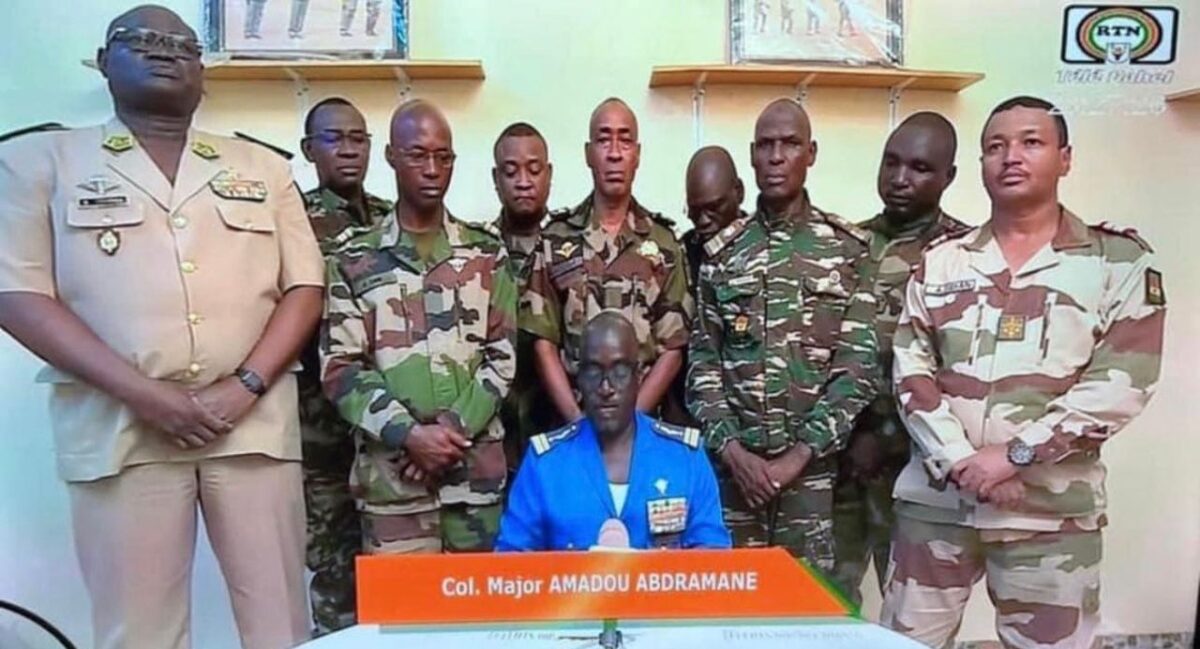
Niger’s coup leaders, who have named General Abdourahamane Tchiani, the former presidential guard chief, as head of state, said they overthrew Bazoum over poor governance and discontent with the way he handled security threats from groups linked to al-Qaeda and ISIS (ISIL).

The power grab – which marks the seventh military takeover in less than three years in West and Central Africa – drew immediate condemnation from the African Union, the United States, the United Nations, the European Union and other powers.

Regional bloc ECOWAS has imposed sanctions, including a halt in all financial transactions and a national assets freeze. It also said it could authorise force to reinstate Bazoum, who observers believe is being held at his house in the capital Niamey.

In addition to Burkina Faso and Mali, Guinea’s President Mamady Doumbouya – whose government was also the result of a coup – has also expressed “disagreement with the sanctions recommended but ECOWAS, including military intervention”.

In a social media post on Monday, Doumbouya’s office said the sanctions “are options that would not be a solution to the current problem but would lead to a humanitarian disaster whose consequences could extend beyond the borders of Niger”.

Doumbouya’s office also said it had “decided not to apply these sanctions, which it considers illegitimate and inhumane”, and urged ECOWAS to “reconsider its position”.

The expressions of support from Burkina Faso, Mali and Guinea came as Niger’s military attempted to consolidate its coup by arresting top officials of the toppled government. The mines minister, oil minister and head of the ruling party were among those taken into custody on Monday, according to Bazoum’s PNDS party.

The coup leaders had previously arrested the interior minister, transport minister and a former defence minister, the party said.

Meanwhile, a US official on Monday said the coup had not been fully successful and that there was still an opportunity to reinstate Bazoum, who was the first Nigerien president to be democratically elected through a peaceful transition of power.

France, Niger’s former colonial ruler, and Germany echoed those comments.

The first photos of Bazoum since the coup appeared on Sunday evening, sitting on a couch smiling beside Chad’s President Mahamat Deby, who had flown in to mediate between the government and military.

Deby is yet to comment publicly on his discussions in Niamey.

Source: Al Jazeera

Continue Reading
Click to comment

Leave a Reply

Your email address will not be published. Required fields are marked *

Africa

Loyal Soldiers Foil Military Coup in Benin Republic

Published

on

By

Benin’s government said on Sunday its armed forces had foiled a coup attempt after a group of soldiers in the West African nation claimed on national television to have seized power.
The attempted coup was the latest threat to democratic rule in the region, where militaries have in recent years seized power in Benin’s neighbours Niger and Burkina Faso, as well as in Mali, Guinea and, only last month, Guinea-Bissau.
At least eight soldiers, several holding weapons, went on state television on Sunday morning to announce that a military committee led by Colonel Tigri Pascal had taken over and was dissolving national institutions, suspending the constitution and closing air, land and maritime borders.
“The army solemnly commits to give the Beninese people the hope of a truly new era, where fraternity, justice and work prevail,” said a statement read by one of the soldiers.
A few hours later, Interior Minister Alassane Seidou said the West African country’s armed forces had thwarted the attempted coup.
“Therefore, the government urges the population to go about their business as usual,” he said.
A government spokesperson, Wilfried Leandre Houngbedji, said that 14 people had been arrested in connection with the coup attempt as of Sunday afternoon, without providing details.
Foreign Minister Olushegun Adjadi Bakari had earlier told Reuters that “a small group” of soldiers had attempted to overthrow the government but that forces loyal to President Patrice Talon were working to restore order.
He said the coup plotters had only managed to take control of state television, which was cut after the soldiers read out their statement. It resumed broadcasting shortly afterwards, allowing the interior minister to read his statement saying the coup bid had been foiled.
West Africa’s regional bloc ECOWAS and the African Union condemned the coup attempt.
The coup attempt came as Benin was preparing for a presidential election in April that would mark the end of the tenure of incumbent Talon, in power since 2016.
In their TV statement, the soldiers mentioned the deteriorating security situation in northern Benin “coupled with the disregard and neglect of our fallen brothers-in-arms.”
Talon has been credited with reviving the economy, but the country has also seen an increase in attacks by jihadist militants that have wreaked havoc in Mali and Burkina Faso.
In April, the government said that 54 soldiers were killed in an attack in the north by an affiliate of Al Qaeda.
Last month, Benin adopted a new constitution creating a Senate and extending the presidential mandate from five to seven years, in what critics said was a power grab by the ruling coalition, which has nominated Finance Minister Romuald Wadagni to be its candidate.
The opposition Democrats party, founded by Talon’s predecessor Thomas Boni Yayi, saw its proposed candidate rejected because of what a court ruled was insufficient backing from lawmakers.
Benin experienced several military coups and coup attempts in the first decades after independence from France in 1960. But there has not been a power grab by force in the country since it held multi-party elections in 1991.
Source: Reuters

Continue Reading

Africa

Soldiers Strike in Benin Republic, Removes Talon, Takes over Govt

Published

on

By

Military personnel in Benin on Sunday announced that they had ousted President Patrice Talon, although his entourage said he was safe and the army was regaining control.

Soldiers calling themselves the “Military Committee for Refoundation” (CMR), said on state television that they had met and decided that “Mr Patrice Talon is removed from office as president of the republic”.

The announcement follows two coups in Madagascar and Guinea-Bissau in as many months. Benin is bordered in the north by Niger and Burkina Faso, which have also seen military takeovers.

The French Embassy said on X that “gunfire was reported at Camp Guezo” near the president’s official residence in the economic capital.

It urged French citizens to remain indoors for security.

But Talon’s entourage said Talon, who has been president of the west African nation for 10 years and is due to step down in April, was safe.

“This is a small group of people who only control the television. The regular army is regaining control. The city and the country are completely secure,” his office told AFP.

Benin’s political history has been marked by several coups and attempted coups.

Talon, who came to power in 2016, is due to reach the end of his second term in 2026, the maximum allowed by the constitution.

The main opposition party has been excluded from the race to succeed him, and instead the ruling party will vie for power against a so-called “moderate” opposition.

Talon, a 67-year-old former businessman dubbed the “cotton king” of Cotonou, has been praised for bringing economic development to Benin but is regularly accused by his critics of authoritarianism.

AFP

Continue Reading

Africa

World’s Oldest President, Paul Biya, Wins Cameroon Election at 92

Published

on

By

Cameroon ’s top court on Monday declared incumbent Paul Biya, the world’s oldest president, the winner of the Oct. 12 election. Clashes with security forces left at least four protesters dead ahead of the announcement as opposition supporters rallied to demand credible results.

Biya, 92, has led the central African nation since 1982. The Constitutional Council said he received 53.66% of votes while former ally-turned-challenger Issa Tchiroma Bakary got 35.19%. The turnout was 57.7%.

In a social media post after the declaration, Tchiroma said that there was gunfire directed at civilians and two people were shot dead in his hometown in Garoua.

He said: “Toll of their attack: two dead. I wonder what will be said this time? Shooting point-blank at your own brothers — I can’t help but wonder if you’re mercenaries. Kill me if you want, but I will liberate this country by any means necessary. What blatant impunity.”

The four protesters were shot dead in Douala, the economic capital, on Sunday, as hundreds of people stormed streets in several cities. Tchiroma had claimed victory days before Monday’s announcement, citing results he said were collated by his party. Biya dismissed the claim.

According to Samuel Dieudonne Ivaha Diboua, governor of the Littoral Region that includes Douala, several members of the security forces were injured by protesters. He said at least 105 protesters were arrested.

Videos online showed protesters clashing with security forces, who fired tear gas and tried to disperse people barricading major roads in Douala and other cities, including Garoua and Maroua in the north.

Dozens of opposition supporters, activists and leaders have been arrested in recent days. Paul Atanga Nji, minister of territorial administration, said on Saturday the government arrested several people plotting violent attacks.

One protester, Oumarou Bouba, a 27-year-old trader in Maroua, said: “I am ready to stake my life to defend my vote. I voted for Tchiroma because I want change.”

Following the announcement of the results, Sani Aladji, a 28-year-old who works in a hotel in Maroua, said: “Nothing will change. I expected that Issa Tchiroma would bring change, which is why I voted for him. There’s rampant corruption under Biya’s regime. We are tired of that. We don’t have roads.”

Biya has ruled Cameroon longer than most of its citizens have been alive. Over 70% of the country’s almost 30 million population is below 35. The election has been the latest dramatic example of tension between Africa’s youth and the continent’s many aging leaders.

He first came to power in 1982 following the resignation of Cameroon’s first president and has ruled the country since then, later benefiting from a constitutional amendment that abolished term limits.

Critics accuse Biya of leading Cameroon from a period of relative stability into one of crisis and conflict. The country in recent years has faced attacks by Boko Haram militants in the north and a secessionist insurgency in the country’s English-speaking North West and South West regions.

That crisis, triggered by the government’s attempts to impose French in English-speaking schools and courts, has killed nearly 7,000 people, displaced more than one million more internally and sent thousands fleeing to neighboring Nigeria.

Despite Cameroon being an oil-producing country that is experiencing modest economic growth, young people say the benefits have not trickled down beyond the elites. According to World Bank data, the unemployment rate stands at 3.5%, but 57% of the labor force aged 18 to 35 works in informal employment.

“Many young people across the country and in the diaspora had hoped for change, but that their hopes have been dashed. It feels like a missed opportunity,” said Dr Emile Sunjo, a senior lecturer in international relations at the University of Buea. “Cameroon could potentially slide into anarchy.”

Source: AP

Continue Reading

Trending