
Headline
A Battle for Supremacy: Rotimi Amaechi vs Hadiza Bala-Usman


By Eric Elezuo
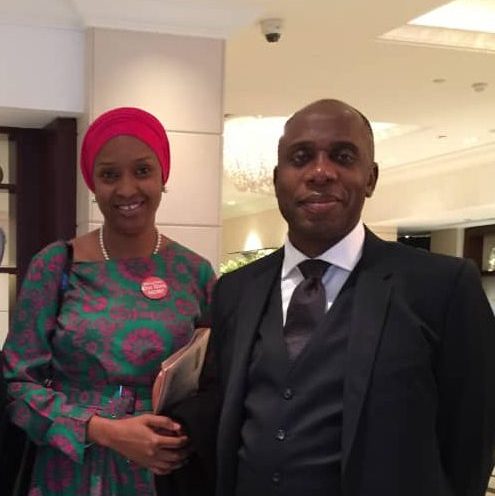
What exactly is happening at one of Nigeria’s most lucrative cash cows, the Nigerian Ports Authority (NPA)? Something is obviously amiss and insiders have revealed that the whole brouhaha is linked to a supremacy battle between Minister of Transportation, Mr. Rotimi Chibuike Amaechi and NPA’s suspended Managing Director, Hadiza Bala-Usman.
Interestingly, both were the best of friends when they strategised to pull down the Jonathan Presidency in 2015, enthroned Buhari in the same year and worked towards his reelection in 2019. Today, the cookie has crumbled and the war of attrition is deep.
Insiders have revealed that the NPA saga is actually a monumental war between Amaechi and Kaduna Governor, Mallam Nasir El-Rufai and their supporters.
The allegation is that the whole brouhaha is for the soul of the ruling All Progressives Congress (APC) and who controls the party ahead of the 2023 Presidential election.
Though the palaver has been simmering for sometime now, the shit hit the fan on Thursday, May 6, 2021 when a letter from the Presidency, signed by President Muhammadu Buhari’s Senior Special Assistant on Media and Publicity, Mallam Shehu Garba became public.
The terse letter read: PRESIDENT BUHARI APPROVES PANEL OF INQUIRY ON NPA, ASKS MD, HADIZA USMAN TO STEP ASIDE
“President Muhammadu Buhari has approved the recommendation of the Ministry of Transportation under Rt. Hon. Rotimi Amaechi for the setting up of an Administrative Panel of Inquiry to investigate the Management of the Nigerian Ports Authority, NPA.
“The President has also approved that the Managing Director, Hadiza Bala Usman step aside while the investigation is carried out. Mr. Mohammed Koko will act in that position.
The panel is to be headed by the Director, Maritime Services of the Ministry while the Deputy Director, Legal of the same ministry will serve as Secretary. Other members of the panel will be appointed by the Minister”
Hadiza Bala-Usman’s suspension came as a rude shock as she has been running the dollar-denominated agency with full powers like a Super Woman, her word was law and no one dared confront her over any issue. Little wonder an industry expert told The Boss “I don’t understand why a Finance Director will be told to take over when the issue in contention is unremitted funds,”
We gathered that everyone was surprised that the whole NPA Board which was allegedly hand-picked by the Minister, Rotimi Amaechi, was left in place and only the Managing Director was suspended. That is why many believe that there is more than the presidency statement revealed.

THE GENESIS
Those in the know revealed that it was former Rivers State Governor, Rotimi Amaechi that nominated Hadiza Bala-Usman, the former Chief of Staff to Governor el-Rufai as Managing Director. The 2016 nomination was a signal that both officers were in very good terms as she worked at the secretariat of the APC presidential campaign the previous year when Amaechi was the Director-General of the Buhari Campaign Organisation.
We recall that both were in the inner caucus of the campaign and were among the few chosen to accompany then Presidential candidate Muhammadu Buhari to Chatham House in February 2015.
Sources have hinted that over the years, the relationship between Amaechi and Bala-Usman began to degenerate concerning matters of procurement, contract awards among others in the ministry. Not only was she allegedly treating the Executive Directors with utmost disdain, The Boss understands that the suspended MD was going solo in affairs of the agency to the chagrin of the Minister.
We were told that the pair had a major fallout over the matter with INTELS, the ports logistics company which had enjoyed a monopoly in the oil and gas cargo business for years.
NPA terminated the company’s pilot monitoring and supervision agreement over non compliance with Presidential Directive on Treasury Single Account (TSA) and refusal to remit $145 million.
The Minister had directed that the matetr be handled differently, but he was ignored even the new instruction for court cases to be dropped is yet to be implemented.
That was not all, there is also the issue of impunity and an alleged penchant to “fight to finish” leveled against the suspended Managing Director.
Critics also point to her face off with Ocean Marine Services Limited where she cancelled the company’s Secure Anchorage Agreement and later wrote a petition to the Senate President that she was attacked at the NASS Chamber by hoodlums sponsored by the company.
Despite the presentation by OMSL that it had acted with integrity, probity and even shown its years of commitment and contribution to the economy and the intervention of the Senate Committee, Bala Usman was obstinate.
Though she was applauded for many innovations, her alleged sins blighted them all.

THE FIRST BLOW
On March 2, 2021, the Budget Office, in a letter signed by the Director-General, Ben Akabueze, outlined shortages in remittances from the NPA. The letter was in response to a letter of February 19, 2021 by the Transportation Ministry, and signed by Mr. Amaechi, seeking to know the extent of remittances from the Port Authority. The shortages in the remittances prompted the Transportation Ministry to petition the President.
In the letter dated March 4, 2021, addressed to The President, Federal Republic of Nigeria, and titled REMITTANCE OF OPERATING SURPLUS TO THE CONSOLIDATED REVENUE FUND ACCOUNT (CRF) BY THE NIGERIAN PORTS AUTHORITY FROM 2016 – DATE, Hon Amaechi’s Ministry of Transport accused the NPA leadership of withholding One Hundred and Sixty Five Billion, Three Hundred and Twenty Million, Nine Hundred and Sixty Two Thousand, Six Hundred and Ninety Seven Naira only (N165, 320, 962, 697.00) in five years, and therefore, should be investigated.
The letter signed by Hon Amaechi prayed the presidency to “approve that the account and remittances of NPA in the period of 2016 – 2020 be audited to account for the gross shortfall of remitted public funds.”
The letter reads: “It has been observed from the records submitted by the Budget Office of the Federation that the yearly remittances of operating surpluses by the Nigerian Ports Authority from year 2016 to 2020 has been far short of the amount due for actual remittance
“In view of the above, I wish to suggest that the Financial account of the activities of Nigerian Ports Authority be investigated for the period 2016 to 2020 to ascertain the true financial position and the outstanding unremitted balance of One Hundred and Sixty Five Billion, Three Hundred and Twenty Million, Nine Hundred and Sixty Two Thousand, Six Hundred and Ninety Seven Naira only (N165, 320, 962, 697.00)”
As a follow up, on March 17, 2021, the prayers were granted as minuted on the letter sighted by The Boss with the signature of President Buhari. On the same day, the decision of Mr. President was communicated to Hon Amaechi in a letter signed by the Chief of Staff to the President, Prof. Ibrahim Gambari. The letter of approval however, got to the Transport Ministry on March 30.
Again, on April 6, 2021, the Transportation Ministry, in a letter signed by the Permanent Secretary, Dr, Magdalene Ajani, communicated to the Auditor-General of the Federation the approval of the President to audit the accounts of NPA. It hinted that the “financial activities including but not limited to the remittances of operating surpluses of Nigerian Ports Authority for the period 2016 – 2020 be holistically and comprehensively investigated and audited.”
It went further to recommend five audit firms to chose from, or in the alternative authorise the ministry to advertise and select a suitably qualified firm to conduct the exercise. The Auditor-General however, turned down the request for fresh auditors as the office can boast of qualified auditors to conduct the exercise, saying there is “no justification for the Ministry to advertise and select qualified Audit firms to conduct the exercise”.

In the response dated April 16, the Auditor-General of the Federation, Adolphus Aghughu, said the NPA accounts had already been audited by external auditors up to 2019 — which is up to date in the cycle.
Aghughu also said his office conducted periodic checks for the years 2016-2018 and issued “periodic checks reports” along with comments on their annual accounts and auditor’s reports.
ANOTHER SOUR POINT
While the Administrative Probe panel is getting ready to begin work, that may not be the only headache Hadiza Bala Usman has to contend with according to a report by Per Second News.
The publication stated that a report by Auditor General’s Office revealed that NPA’s financial records were riddled with so many bookkeeping deficiencies, irregularities, and errors that a reliable audit was simply impossible.
Highlights of the report include the alleged refusal of the MD to remit VAT deductions running into billions of naira and in foreign currency denomination to the Federal Inland Revenue Service.
For instance, the query highlighted unremitted deduction to Federal Inland Revenue Service (FIRS) to include N3,667,750,470. $148,845,745.04, Euro 4,891,449.50 and £252,682.14.
The NPA under Hadiza Bala Usman was also accused of ” excessive increase in administrative operational expenses” extra budgetary expenditures on hotel accommodation and under disclosure of expenditures on hotel expenses”, Corporate Social Responsibility Projects, diversion of funds through the Nigerian Port Today, to the sponsorship of National Assembly Programmes, amongst other.
The queries which covered over 100 issues, also alleged asked Hadiza Bala Usman to make various refunds to government, especially in instances where such expenditures could not be justified.
Investigation also uncovers that the Audit team reviewed NPA’s policy on implementation of Corporate Social Responsibility Projects/ Programmes and discovered that records relating to CSR fell short of the level of compliance with the Public procurement Act 2007.
In 2016, the NPA spent N286,412,628.00 on CSR while in 2017, the figure rose to N2,496,248,775.00 and N5billion in 2018. The Audit team found out that “beneficiary needs were not properly assessed or identified before the implementation of CSR projects/ programmes.
The Audit team observed to its shock that there was no evidence of compliance with public procurement Act and that most of the CSR projects/ programmes were allegedly inflated and accordingly ordered that the “sum of N5.18 billion should be recovered from the Managing Director of NPA, being the value of, inflated amount under her watch.
The committee also observed that delivery of CSR items were not accompanied with delivery letters and that in some cases, there was no evidence of actual items delivered and who signed for them.
For instance while a contract with Ref. HQ/GM/PROC/CON/C.11/PBT/16/322 dated 16/10/17 was awarded in favour of Messrs Ecomaxx Engineering Projects Ltd for the supply of items to the old people’s Home Yaba, Lagos to the tune of N19,760,460.00 which was paid vide invoice no HQ/CS/0711 dated 01/06/17 there was no documentary evidence that the items were indeed delivered to the Home.
In the same vein, the contract for supply of items to Yaba children’s orphanage followed the same pattern.
For instance, whilst a contract awarded in favour of Trans-secure Ltd was N19,467,000.00 the survey conducted by the audit team found out that N6,520,500.00 was the actual market price.

The Auditor-General also noted “It was observed that total expenditure by the Authority increased astronomically by 128% from N87.47 billion in 2016 to N198.98 billion in 2017. Of particular concern was the administrative expenses which increased by 72% from N26.126 billion in 2016 to N44.93 billion in 2017.
Again, whereas in 2016 N22.16 billion was expended on revenue monitoring, the amount rose to a whopping N1.06 billion in 2017, an increase of over 4,689%. Similarly, overseas training rose from N20.48 million in 2016 to N470 million, an increase of over 2194%.
Also, whereas N15.31 million was spent on vessels / craft in 2016, the amount rose to N117.4 million in 2017, an increase of 666%.
The excessive expenditure of pollution control also attracted the scrutiny of the auditors as N4.2 billion was spent in 2017 as against N29 million in 2016, an increase of 14,310 %. Other over bloated increase in expenditure include local and foreign medical expenses, legal fees, Corporate souvenirs and expenditure on other government agencies which rose from N50.29 million in 2016 to N338.59 million in 2017, a 573 per cent rise.
The Audit also flagged the N369.71 million spent through the Nigerian Ports Today” the official in-house magazine of the NPA. “Payments to Nigerian Ports Today were reviewed to confirm whether they were properly initiated, authorised processed, documented and paid in line with the Public Procurement Act 2007,” the report said.
Findings revealed the sum of N369,718,130.82 was paid to Nigerian Ports Today, a Limited liability company that is fully owned and controlled by NPA during the period under review. There was no evidence of contractual relationship in the form of award of contract to the company nor was there anything to show the company rendered services to the Authority to justify these payments and concludes that the Authority paid the company without a contract and thereby contravening the Public procurement Act 2007, and that this was viewed as a means to divert public funds,” the report alleged.
The Audit query also took serious exceptions to various expenditure incurred by the NPA on behalf of the Minister of Transportation, Rotimi Amaechi for which a whopping $604,598.95 was paid without supporting documents.
I AM INNOCENT – HADIZA FIRES BACK
In her response documented in a letter dated May 5, 2021, and addressed to the Chief of Staff to the President, Prof. Ibrahim Gambari, Bala-Usman faulted the allegations about NPA’s refusal to make remittances to the Consolidated Revenue Fund.She affirmed that the Authority had remitted what is due in full.
The letter titled RE: REQUEST FOR THE RECORD OF REMITTANCE OF OPERATING DURPLUS TO THE CONSOLIDATED REVENUE FUNDS ACCOUNT BY THE NIGERIAN PORTS AUTHORITY and signed by her as Managing Director/CEO read “The attention of the Authority has been drawn to a letter conveying Mr. President’s approval for the Ministry of Transportation (FMoT) to conduct an audit of the accounts of the Authority and its remittances to the Consolidated Revenue Fund (CRF). This arose from a correspondence between the Budget Office of the Federation (BOF) and the Ministry of Transpotation where the Budget Office conveyed to the FMoT an observed shortfall of the Authory’s remittances to CRF
“We wish to state that the Authority’s basis for arriving at the operating Surplus on which basis the amount due for remittances to the CFR is guided by the Fiscal Responsibility Act 2007 as amended and further based on statutory mandate whereby the Fiscal Responsibility Commission issued a template for the computation of operating surplus for the purpose of calculating amount due for remittance…”
She noted that the “figures provided by the Budget Office as Operating Surplus for the respective years on which basis they arrived at the shortfalls are derived from submission of budgetary provision not the actual amounts derived following the statutory audit of the Authority’s financial statements
She went on to state that in 2017 and 2018, NPA’s operating surpluses was N76.782 billion and N71.480 billion respectively as against N133.084 billion and N88.79 billion as arrived from the budgetary submission.
She noted that in line with the FRC template, NPA remitted N40.873 billion and N34.065 billion for the two years.
The Managing Director also noted that though the Audit of the Financial Statement has been completed and awaiting consideration by NPA Board, the Authority has so far made remittance of N31.683 billion for 2019 and N51.049 billion for 2020.

She then went on to clarify thus:
“The Authority’s computation of its remittances to the CFR are concluded arising from numbers from Audited Financial Statements using the template forwarded to the Authority from the Fiscal Responsibility Commission as herewith attached and not budgetary provision
“That the Authority has remitted the FULL AMOUNT due to CFR for the periods 2017 and 2018arising from the Operational Surplus derived from the Audited Financial Statement for the period totaling N76.384 billion as evidenced in the attached treasury receipts.
“That the Authority has remitted a total of N82.687 billion for the period 2019 and 2020 pending the audit for the financial statement at which point the amount so computed arising from the value of the Operating Surplus in the audited financial statement will be remitted to the CFR.
She rounded off with these words “We wish to request that the Chief of Staff requests the Office of the Accountant General of the Federation who are the statutory custodian of the status of payment to the CFR to provide clarification on the above so as to establish the true position of the Authorities remittances to the CFR.”
THE DUE PROCESS ANGLE
Advocates of due process have risen staunchly in support of the suspended Hadiza Bala Usman, they are stating that Minister Amaechi and indeed the Federal Government has breached its own approved procedures.
A Government Circular in our possession with Ref No: SGF/OP/1.S.3/T/163 signed by the Secretary to the Government of the Federation, Mr. Boss Mustapha highlighted approved disciplinary procedure against Chief Executive Officers of Federal Government Parastatals, Agencies and Departments.
The circular dated May 19, 2020, and copied to Chief of Staff to the President,
Deputy Chief of Staff to the President, Honourable Ministers/Ministers of State
Secretary to the Government of the Federation, Chairmen of Commissions/ Extra-Ministerial Departments, Head of the Civil Service of the Federation, Permanent Secretaries
National Security Adviser, Special Advisers/Senior Special Assistants, Chief of Defence Staff
Service Chiefs (Army, Navy, Air Force), Governor, Central Bank of Nigeria, Clerk of the National Assembly, Chief Registrar, Supreme Court of Nigeria,
Secretary, National Judicial Council, Secretary, Federal Judicial Service Commission,
Directors – General and Chief Executives of Parastatals/Agencies,
Auditor-General for the Federation and Accountant – General of the Federation
Stated thus:
“Government has observed with concern, the arbitrary removal of Chief Executive Officers and its impact on stability and service delivery.
“Accordingly, Mr. President has approved the following streamlined procedure for the discipline of Chief Executive Officers of Government Parastatals, Agencies and Departments in accordance with the Public Service Rules (PSR).
“The following procedure shall therefore apply whenever a Chief Executive Officer (CEO) is to be subjected to disciplinary action:
“When an act bordering on Serious Misconduct against a Chief Executive Officer is reported, it shall be the duty of the supervising Minister through the Permanent Secretary to refer the matter to the Governing Board for necessary action in line with the relevant provisions of the Establishment Act and the principles guiding Chapters 3 and 16 of the Public Service Rules;
“The Board shall in line with due process, issue him/her a query requesting an explanation with respect to the specific act(s) complained about;
“The Board shall forward its findings and recommendations to the Minister for further consideration and necessary action;
“In the event that the Governing Board is the initiator of the report on the alleged serious misconduct, the Minister on the advice of the Permanent Secretary ensures that sub-paragraphs (ii) & (iii) above have been complied with, fully;
“Where the Chief Executive is also the Chairman of the Board, the Minister, on the advice of the Permanent Secretary, shall apply the principles under sub-paragraph (ii) above;
“The Minister, after due consideration of the submission from the Board, shall on the advice of the Permanent Secretary, forward the Ministry’s position along with the recommendations of the Board and the explanation of the Chief Executive Officer to the Secretary to the Government of the Federation (SGF) for processing to Mr. President, for a decision;
“Upon receipt of the submission from the Minister, the Secretary to the Government of the Federation (SGF) shall without delay cause an independent investigation and advise Mr. President on the appropriate course of action, including interdiction or suspension in accordance with principles guiding Sections 030405 and 030406 of the Public Service Rules, pending the outcome of the independent investigations;
“It shall be the responsibility of the Secretary to the Government of the Federation (SGF) to further advise Mr. President on the next course of action, based on the outcome of the final investigation;
“In the absence of a Board, the Minister shall, with the support of the Permanent Secretary, function in that capacity in accordance with the provisions of the Public Service Administrative Guidelines; and
“The Secretary to the Government of the Federation shall implement and/or convey the approval and directives of Mr. President on every disciplinary case against Chief Executive Officers in the Public Service.
“Without prejudice to the content, it is expected that this Circular should be acted upon conjunctively with the provisions of the following extant Service Wide Circulars and publication:
i. Ref. SGF/OP/I/S.3/T.1/132- 2nd August, 1999 Guidelines on the relationship between parastatals/State owned Companies and their Supervising Ministries;
ii. Ref. No. SGF./OP/1/S.3/T-23rd November, 2017 Re: Procedure for Appointing Chief Executives and Heads of Parastatals, Government -Owned Companies, Agencies and Institutions;
iii. Ref. No.SGF.50/S.II/C.2/268-4th December, 2017
End of tenure processes for Heads of Extra-Ministerial Departments, Directors General/Chief Executive Officers of Parastatals, Agencies, Commissions and Government-owned Companies and Succession Guidelines; and
iv. Federal Government Publication on Guidelines to Administrative Procedures in the Federal Public Service Chapter 7.
And it ended thus: “This procedure shall serve as a mandatory guide and all Ministers of the Federal Republic of Nigeria and any other Public Officer in similar supervisory position, are enjoined to strictly abide by its content. For emphasis, on no account shall a Minister of the Federal Republic unilaterally or arbitrarily remove a serving Chief Executive Officer, without recourse to the procedure contained in this Circular”
NEXT STEP
Bala Usman’s supporters reveal that she is strongly pushing the due process angle, as she has insisted that she was never queried by the Ministry of Transport or her Board and that till date, she is yet to receive any suspension letter from either the Ministry, NPA Board or the SFG.
But this argument of procedural breach in asking Hadiza Bala Usman to step aside is completely wrong, an insider told The Boss.
We were told that ” Constitutionally, the President has the power to hire or fire any of his appointees at any point in time. In this case, she wasn’t even fired. She was just asked to step aside for an investigation to take place. And this was done by the President and not the Minister”
But we gathered that the suspended MD apart from using this due process argument, has also dug into the trenches and all manner of arsenals will be thrown into the fray in the coming days.

And just as we were rounding off this story, The Boss got pictures of an all white mansion allegedly owned by the former Governor and Minister outside Nigeria.
In our usual authoritative style, our Publisher immediately contacted the Minister, Rotimi Amaechi who gave a swift and emphatic response “ I have no property overseas and I dare anybody”
Without a shadow of doubt, this NPA saga is certainly far from over.







The Boss Newspaper Welcomes Folu Adebayo into Its League of Columnists

Justice Segun-Bello vs The Condes: Couple Appeals to Nigerians over Injustice, Intimidation

The Oracle: The New Digital Colonialism: Navigating AI Policy Under Foreign Tech Dominance (Pt. 2)

Operation Epic Fury: I’m No Longer Interested in Nobel Peace Prize, Says Trump

World Cup 2026: Iran Tackles Trump, Says No One Can Exclude Us

Rescue Effort Underway As Fueling Aircraft Crashes in Iraq – US Military

Friday Sermon: Reflections on Ramadan 4: Empathy and Compassion

International Women’s Day: The Boss Celebrates 100 Influential Nigerian Women

Iran Confuses Israel As Missile Splits into Multiple Warheads in Tel Aviv

Tenure Policy: India, Others Reject Tinubu’s Ambassadors

Voice of Emancipation: Yoruba Sovereignty is Inevitable

Former Super Eagles Coach, Festus Onigbinde is Dead

South African Actress, Nomzamo Mbatha, Tells Success Story on Glo-Sponsored African Voices

Adenuga, Dangote, Otedola, Rabiu Make 2026 Forbes Africa Billionaires List
-
 Boss Picks5 days ago
International Women’s Day: The Boss Celebrates 100 Influential Nigerian Women
-
 Middle East5 days ago
Iran Confuses Israel As Missile Splits into Multiple Warheads in Tel Aviv
-
 Headline3 days ago
Tenure Policy: India, Others Reject Tinubu’s Ambassadors
-
 Voice of Emancipation5 days ago
Voice of Emancipation: Yoruba Sovereignty is Inevitable
-
 Sports4 days ago
Former Super Eagles Coach, Festus Onigbinde is Dead
-
 Entertainment5 days ago
South African Actress, Nomzamo Mbatha, Tells Success Story on Glo-Sponsored African Voices
-
 Headline4 days ago
Adenuga, Dangote, Otedola, Rabiu Make 2026 Forbes Africa Billionaires List
-

 Featured3 days ago
Business Series: UBA to Spotlight Africa’s New Generation of Female Leaders