Connect with us

Featured

Cut in Bank Charges: CBN Lists Penalties for Defaulters

Published

on

The Central Bank of Nigeria (CBN) on Sunday reduced all bank charges, with some getting more than 50 per cent cut, with effect from January 1, 2020.

According to the apex bank, the decision, which came amid public outcry against multiplicity and value of the charges, is aimed at making financial services more accessible and affordable to various stakeholders in the economy.

The reviewed charges and fees for banking services are contained in the new “Guide to Charges by Banks, Other Financial and Non-bank Financial Institutions,” which now supersedes the 2017 version.

The CBN said the new charges were “arrived at after extensive consultations with stakeholders and the action is expected to enhance flexibility, transparency, and competition in the Nigerian banking industry.”

The guide stipulates a penalty of N2million per infraction or as may be determined by the CBN as a guard against excess, unapproved or arbitrary charges by banks and other financial institutions.

Besides, failure by any bank to comply with the CBN’s directive in respect of any infraction shall also attract a further penalty of N2million daily or as may be determined by the apex bank, until the directive is complied with.

To emphasise the seriousness of the new rule, the Director of Corporate Communications Department, CBN, Isaac Okorafor, said the banks had been directed to henceforth log every complaint received from their customers into the Consumer Complaints Management System (CCMS).

Additionally, they are to generate a unique reference code for each complaint lodged, which must be given to the customer.

“Failure to log and provide the code to the customer amounts to a breach and is sanctionable with a penalty of N1million per breach,” he said.

According to him, “this is the time financial services providers and their customers alike have to acquaint themselves with the provisions of the guide and be guided accordingly.”

Specifically, for cards linked to a savings account, the maintenance fee has been reduced to a maximum of N50 per quarter from N50 per month amounting to only N200 per annum instead of N600.

The guide has removed Card Maintenance Fee (CAMF) on all cards linked to current accounts. It also pegged a maximum of N1 per mile for customer-induced debit transactions on current accounts to third parties and transfers or lodgments to the customers’ current accounts in other banks.

There is now a reduction in the amount payable for cash withdrawals from other banks’ Automated Teller Machines (ATMs), known as Remote-on-Us, from N65 to N35.

Other reductions include Advance Payment Guarantee (APG), which is now pegged at a maximum of one per cent of the APG value in the first year and 0.5 per cent for subsequent years on contingent liabilities.

For all debit cards, a one-off charge at N1,000 applies to the issuance, irrespective of card type- regular or premium. The same one-off charge of N1,000 applies for the replacement of debit cards at the customer’s instance for loss, damage or expiry. Conversely, no charge shall be required for pre-paid card loading/unloading.

Okorafor explained that the current NIBSS Instant Payment charges applied to the use of Unstructured Supplementary Service Data (USSD), as purchase with cash-back will attract a charge of N100 per N20,000, subject to cumulative N60,000 daily withdrawal.

“There will be no more charges for reactivation or closure of accounts such as savings, current and domiciliary accounts, while status inquiry at the request of the customer (like confirmation letter, letter of non-indebtedness and reference letter) will now attract a fee of N500 per request.

“CBN carried out the review of the guide, which also prescribes charges permissible for other financial institutions and non-bank financial institutions, to align with market developments,” he added.

The Guardian

Continue Reading
Click to comment

Leave a Reply

Your email address will not be published. Required fields are marked *

Featured

Tinubu Nominates Oyedele As Minister of State for Finance, Moves Anite-Uzoka to Budget Ministry
Published

on

By

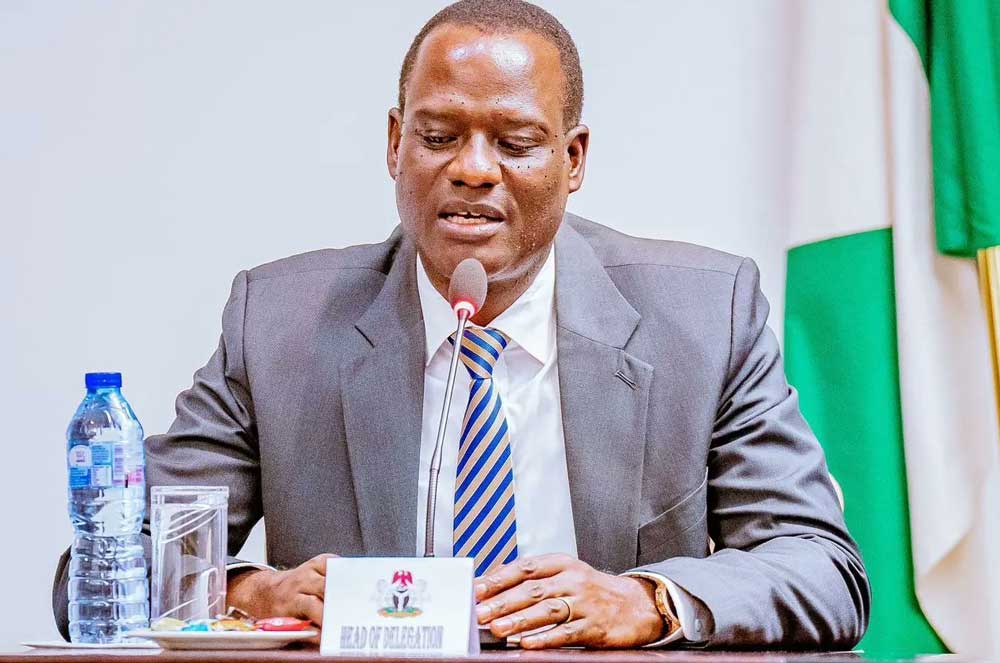
A statement signed by the Special Adviser to the President on Information and Strategy Bayo Onanuga, has announced that “President Bola Tinubu has nominated Taiwo Oyedele as the minister of state for finance, replacing Doris Anite-Uzoka.

“Mrs Anite-Uzoka will now move to the Ministry of Budget and National Planning, as the Minister of State, her third portfolio in the administration.

“President Tinubu has today conveyed the nomination of Mr Oyedele to the Senate for confirmation in a letter to the Senate President, Godswill Akpabio.

“Until President Tinubu nominated him as a minister, Mr Oyedele from Ikaram, Akoko, Ondo State, was the chairman of the Presidential Committee on Fiscal Policy and Tax Reforms, which overhauled Nigeria’s tax system.

“Mr Oyedele, 50, is an economist, accountant and public policy expert.

“He attended Yaba College of Technology, where he obtained a Higher National Diploma (HND) in accountancy and finance. He attended Oxford Brookes University and earned a BSc in applied accounting.

“He also completed executive education programmes at the London School of Economics, Yale University, the Gordon Institute of Business Science, and the Harvard Kennedy School.

“Mr Oyedele spent 22 years of his working career at PwC, joining in 2001 and rising to become the Fiscal Policy Partner and Africa Tax Leader.

“Mr Oyedele is also a professor at Babcock University in Ogun State and a visiting scholar at the Lagos Business School.”

Continue Reading

Featured

Defection: Atiku’s Son, Adamu, Resigns As Adamawa Commissioner

Published

on

By

Adamu Abubakar, the first son of former Vice-President Atiku Abubakar, has resigned as Adamawa State’s commissioner for works and energy development, days after Governor Ahmadu Fintiri defected from the Peoples Democratic Party to the All Progressives Congress.

Abubakar’s resignation letter, dated 2 March 2026, was addressed to the governor through the Secretary to the State Government. He gave no reason for his departure.

The timing is pointed. Fintiri announced his defection to the APC in a statewide broadcast last Friday, saying his cabinet and the PDP’s state structure had moved with him. Within 24 hours, 22 commissioners and special advisers publicly announced they were following suit. Abubakar, whose father remains one of the PDP’s most prominent national figures, was not among them.

In a statement issued Monday night, Abubakar’s media aide Abdulaziz Jauro said the former commissioner thanked the governor for the opportunity to serve and pledged continued loyalty to the administration’s developmental agenda. He also expressed gratitude to his father “for granting him the moral support and blessing to serve the people of Adamawa State” — a line that, read in context, suggests Atiku was consulted on the decision.

Abubakar said his resignation was not a withdrawal from public life. “This does not mark the end of his commitment to public service,” the statement read, “but rather the beginning of new avenues for developmental collaboration.”

The resignation leaves unresolved the question of whether it reflects a political break with the governor over his defection or a personal decision unconnected to the broader party realignment now reshaping Adamawa’s political landscape.

Continue Reading

Featured

DSS Nabs Man over Assassination Attempt on Peter Obi

Published

on

By

Nigeria’s Department of State Services (DSS) has detained a man in connection with the recent attack and alleged assassination threats targeting Labour Party’s 2023 presidential candidate, Peter Obi.

According to AIT, the shooting incident took place on February 24, 2026, in Benin City, Edo State, during a political gathering attended by Obi and several figures from the African Democratic Congress (ADC). The meeting was hosted by former APC National Chairman, John Oyegun. Gunmen reportedly opened fire at the venue, causing panic and forcing attendees to disperse for safety.

According to security sources, shortly after the attack, an individual identified as Udeme Monday Stephen allegedly took to social media claiming responsibility and issuing additional threats against Obi, warning of further violence.

Intelligence officials reportedly initiated swift investigations, employing digital tracing and forensic tools that led to the arrest of the 26-year-old suspect in Rivers State. He is said to be a teacher at a private secondary school in the Eliozu area of Obio-Akpor Local Government Area.

The suspect remains in DSS custody and is expected to face prosecution. The agency reiterated its commitment to responding to credible threats and safeguarding lives and national interests without bias.

Continue Reading

Trending