
Business
FirstBank: Much More than a Brand


By Eric Elezuo
In 1894, a brand was not just created; a brand was given birth to for the sole function of taking over the leadership of not only the financial world but the entire corporate business inclusion. The process was tailored through the provision of custom made quality services that beat the imaginations of competitors and would-be rivals. That brand is FirstBank, Nigeria’s primus inter pares in corporate business.
The invincibility of FirstBank cuts across the African sub regions towards achieving for itself continental and global accolade. Consequently, for 125 years and counting, the brand has remained one indivisible brand with no record of ever being acquired merged or put on hold for any period. It has maintained unbroken and uninterrupted service delivery and never changing its name. It was birthed in 1894 as FirstBank, and today is still FirstBank with a conglomeration of subsidiaries which gave it the impetus to be addressed in the superlative as first among equals.
Among many of the qualities that set First Bank of Nigeria Limited aside and make it the premier Bank in West Africa, is its ability to provide first class banking services solutions in Nigeria, a task it has performed effortlessly for 125 uninterrupted years.
It is therefore not a fluke that the brand boasts of about 15 million customer accounts, to whom it provides a comprehensive range of retail and corporate financial services in well over 750 business locations across the globe.
Over the years, the Bank has evolved, consequent upon unimaginable beneficial services to all and sundry, and developed subsidiaries through which it has developed wholesome international presence. These subsidiaries include but not limited to FBN Bank (UK) Limited in London and Paris, FBNBank in the Republic of Congo, Ghana, The Gambia, Guinea, Sierra-Leone and Senegal, as well as a Representative office in Beijing.
The hallmark of FirstBank’s ingenuity since its advent in 1894 lies in its ability to consistently build relationships with customers focusing on the fundamentals of good corporate governance, strong liquidity, optimised risk management and leadership.

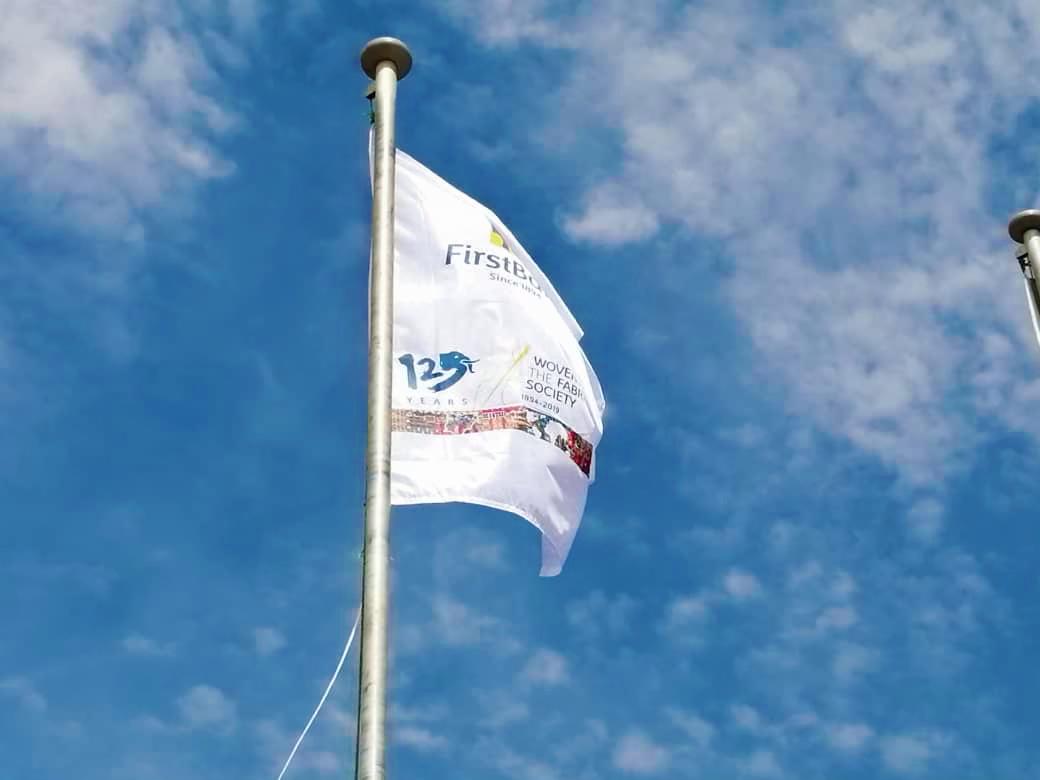
The high flying FirstBank flag
It is worthy of note that over the years, the Bank has led the financing of private investment in infrastructure development in the Nigerian economy by playing key roles in the Federal Government’s privatisation and commercialisation schemes. With its global reach, it provides prospective investors wishing to explore the vast business opportunities that are available in Nigeria, an internationally competitive world-class brand and a credible financial partner. Little wonder the only financial institution on the lips of investors and business oriented minds is FirstBank.
The bank, over the years has been blessed with splendid leadership that has stood the test of time, exhuming confidence far from intimidation, corrupt practices and anti-welfarism. Some of this leaders include Emir Sanusi Lamido Sanusi who from the stable of the bank became the Central Bank of Nigeria’s governor and went ahead to sit on the reverred stool of Kano Emirate. There is also Joseph Sanusi, who also became the Central Bank governor as well as the immediate past Managing Director of the bank, Mr. Bisi Onasanya; these men portray a brand discipline and professionalism which only FirstBank can bestow.
FirstBank’s domineering efforts has not escaped the eagle eyes of industry watchers, and the entity has on six consecutive occasions been named “Most Valuable Bank Brand in Nigeria” (2011 – 2016) by “The Banker Magazine” of the Financial Times Group, a renowned global outfit.
Furthermore, it won Best Retail Bank in Nigeria for seven consecutive years (2011 – 2017) as presented by the Asian Banker International Excellence in Retail Financial Services Awards, and followed it up wit “Best Bank in Nigeria” award by Global Finance for 15 years.
FirstBank, as a brand has no other mission other than to always put customers, partners and stakeholders at the heart of its endeavour. Primarily speaking, the customers are the centrepoint of the Bank’s local and international relations.
Noted for so many firsts, the bank in 1996, distinguished itself with the highly celebrated Century II transformation project which made it rise heads and shoulders above its peers. Consequently, It has continuously transformed and projected for the future by reinventing, re-engineering and creating value for customers by rethinking next generation solutions ahead of others in the industry.
This is a bank strategically positioned to always put the Customers current and future needs at the core of its business.
In 2016, the bank floated PR1MUS, a Brand name for it’s new Enterprise Transformation program. This has articulated an ambitious strategy to maintain position as undisputed industry leaders through profitable growth by leveraging technology to drive innovation.
The project cuts the brand away from a culture of silos and manual operations while aligning with the basic strategic pillars of business objectives in a more structured and targeted way. The following are some of intentions of the scheme:
• More deliberate and aligned business objectives and strategic initiative.
• More collaborative engagements with stakeholders across all levels.
• And finally, embarking on projects and initiatives with clear set and well defined objectives with a new set of ambitious end goals in sight.
Not resting on its oars, FirstBank is working tiredlessly to standardise customer experience and excellence in financial solutions across sub-Saharan Africa, in consonance with the brand vision.
Moving assiduously to a common goal, FirstBank’s wholesome ambition is to be the partner of first choice in building the future of anyone who comes in contact with it, promising to always deliver the ultimate “gold standard” of value and excellence.
What else can anyone say… FirstBank in 125 years, has really lived up to its billing as ‘truly the first’.




Akinwumi Adesina Celebrates Obasanjo at 89

IGP Disu Removes Benjamin Hundeyin As FPRO

Assets Declaration: Court Dismisses NDLEA’s Case Against Abba Kyari

I Dey kampe, Not Dying Anytime Soon, Obasanjo Declares at 89

Give What, to Gain What? Reflections on the 2026 International Women’s Day Theme

140 Missing As US Submarine Sinks Iran’s Warship in Indian Ocean

NDLEA Nabs UK-wanted Drug Lord after 15-Year Hunt

Prof Jide Owoeye: When a Distinguished Academic Turns 70

Beyond the Vision: The Alchemy of Turning Ideas into Execution

Iran’s Supreme Leader Khamenei Cut Off from Contact, Fate Unknown

NELFund Extends Deadline for Student Loan Applications Nationwide

Federal Government Issues Travel, Safety Warning for Nigerians in Iran, Gulf States

Iran Confirms Supreme Leader Ali Khamenei Dead after US-Israeli Attacks

Ag. IGP Olatunji Disu: The Rise of a Diligent Officer
-
 Boss Of The Week5 days ago
Prof Jide Owoeye: When a Distinguished Academic Turns 70
-
 Opinion6 days ago
Beyond the Vision: The Alchemy of Turning Ideas into Execution
-
 Middle East6 days ago
Iran’s Supreme Leader Khamenei Cut Off from Contact, Fate Unknown
-
 News3 days ago
NELFund Extends Deadline for Student Loan Applications Nationwide
-
 National5 days ago
Federal Government Issues Travel, Safety Warning for Nigerians in Iran, Gulf States
-
 Middle East5 days ago
Iran Confirms Supreme Leader Ali Khamenei Dead after US-Israeli Attacks
-
 Boss Picks6 days ago
Ag. IGP Olatunji Disu: The Rise of a Diligent Officer
-

 Headline6 days ago
Why Nigerians Must Reject INEC’s Revised Timetable – ADC