Connect with us

Featured

Elections: EU Observers Raise Issues of Lack of Transparency, Incumbency Advantage, Says System Needs Serious Reforms


Published

on

The European Union Election Observation Mission (EU EOM) to Nigeria has concluded that while there were operational improvements in the governorship and State House of Assembly elections on 9 March, these were overshadowed by systemic failings, including a lack of transparency, incumbency advantage and a troubling electoral security environment. The problems demonstrate the need for an inclusive national discussion on electoral reform.

Presenting the mission’s preliminary statement in Abuja, EU Chief Observer, Maria Arena, said that, on election day, polling procedures were assessed more positively by EU observers compared to the 23 February election day. However, the EU EOM condemned the violence and intimidation, including against election officials and voters, and also referred to the obstruction of citizen observers by the military and security agents on election day. Observers, including EU observers, were denied access to collation centres in Rivers.

Overall, the elections were competitive with freedom to campaign. However, there was misuse of incumbency, including on state-owned state media, which prevented a level playing field. In the two weeks leading up to the state elections, EU observers saw some misuse of state offices, as well as institutional websites being used for campaigning by both APC and PDP incumbent governors.

State-level media broadcast political debates in 21 states, giving voters the opportunity to directly compare candidates. However in 12 states, incumbents or their main challengers refused to participate. All nine state-owned radio stations monitored by the EU Election Observation Mission served the interests of incumbent governors. The mission also noted pressure on local media outlets and journalists before and on election day.
“The systemic problems evident in the 2019 electoral process show the need for an inclusive national discussion on reform for greater electoral integrity and participation,” said the Chief Observer, Maria Arena.

“We echo the view of leading civil society organisations that say that there is an urgent need to restore faith in the electoral process. We encourage a national conversation on electoral reform and strongly believe that it would meaningfully contribute to Nigeria’s democratic development,” she added.

On election day, 73 EU observers followed opening, voting and closing processes at 223 polling units, and the collation of results at 81 centres across 22 states. Most polling units visited opened on time or less than 30 minutes late, and the procedures for the accreditation of voters were significantly improved. The counting of ballots was overall transparent. Positively, in almost all cases, party agents received copies of the results forms.

The EU EOM also presented its assessment of the collation process for the presidential and National Assembly results. It concluded that inconsistent numbers, lack of clear checks and explanations, and insufficient public information undermined confidence in the integrity of process. The mission emphasised the need for better training of collation staff, improved data management and, in particular, more information and explanation from INEC on this important phase of the election process.

The mission will continue to observe the collation process for the state elections, the announcement of results, as well any petitions. It will remain in Nigeria for the coming weeks. A final report, including recommendations for future elections, will be published approximately two months later.

Continue Reading
Click to comment

Leave a Reply

Your email address will not be published. Required fields are marked *

Featured

Tinubu Nominates Oyedele As Minister of State for Finance, Moves Anite-Uzoka to Budget Ministry
Published

on

By

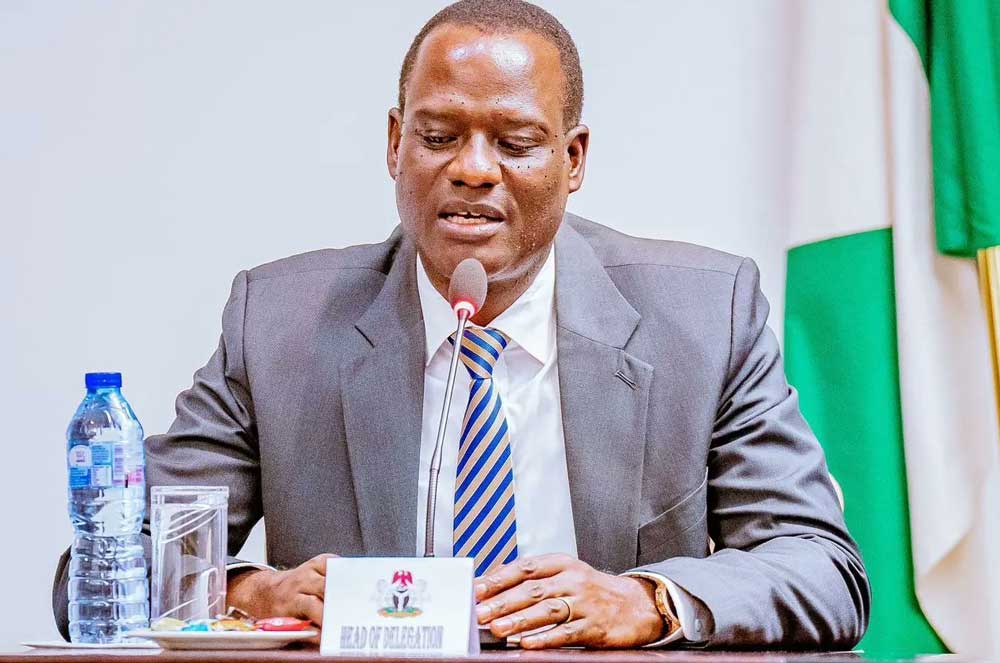
A statement signed by the Special Adviser to the President on Information and Strategy Bayo Onanuga, has announced that “President Bola Tinubu has nominated Taiwo Oyedele as the minister of state for finance, replacing Doris Anite-Uzoka.

“Mrs Anite-Uzoka will now move to the Ministry of Budget and National Planning, as the Minister of State, her third portfolio in the administration.

“President Tinubu has today conveyed the nomination of Mr Oyedele to the Senate for confirmation in a letter to the Senate President, Godswill Akpabio.

“Until President Tinubu nominated him as a minister, Mr Oyedele from Ikaram, Akoko, Ondo State, was the chairman of the Presidential Committee on Fiscal Policy and Tax Reforms, which overhauled Nigeria’s tax system.

“Mr Oyedele, 50, is an economist, accountant and public policy expert.

“He attended Yaba College of Technology, where he obtained a Higher National Diploma (HND) in accountancy and finance. He attended Oxford Brookes University and earned a BSc in applied accounting.

“He also completed executive education programmes at the London School of Economics, Yale University, the Gordon Institute of Business Science, and the Harvard Kennedy School.

“Mr Oyedele spent 22 years of his working career at PwC, joining in 2001 and rising to become the Fiscal Policy Partner and Africa Tax Leader.

“Mr Oyedele is also a professor at Babcock University in Ogun State and a visiting scholar at the Lagos Business School.”

Continue Reading

Featured

Defection: Atiku’s Son, Adamu, Resigns As Adamawa Commissioner

Published

on

By

Adamu Abubakar, the first son of former Vice-President Atiku Abubakar, has resigned as Adamawa State’s commissioner for works and energy development, days after Governor Ahmadu Fintiri defected from the Peoples Democratic Party to the All Progressives Congress.

Abubakar’s resignation letter, dated 2 March 2026, was addressed to the governor through the Secretary to the State Government. He gave no reason for his departure.

The timing is pointed. Fintiri announced his defection to the APC in a statewide broadcast last Friday, saying his cabinet and the PDP’s state structure had moved with him. Within 24 hours, 22 commissioners and special advisers publicly announced they were following suit. Abubakar, whose father remains one of the PDP’s most prominent national figures, was not among them.

In a statement issued Monday night, Abubakar’s media aide Abdulaziz Jauro said the former commissioner thanked the governor for the opportunity to serve and pledged continued loyalty to the administration’s developmental agenda. He also expressed gratitude to his father “for granting him the moral support and blessing to serve the people of Adamawa State” — a line that, read in context, suggests Atiku was consulted on the decision.

Abubakar said his resignation was not a withdrawal from public life. “This does not mark the end of his commitment to public service,” the statement read, “but rather the beginning of new avenues for developmental collaboration.”

The resignation leaves unresolved the question of whether it reflects a political break with the governor over his defection or a personal decision unconnected to the broader party realignment now reshaping Adamawa’s political landscape.

Continue Reading

Featured

DSS Nabs Man over Assassination Attempt on Peter Obi

Published

on

By

Nigeria’s Department of State Services (DSS) has detained a man in connection with the recent attack and alleged assassination threats targeting Labour Party’s 2023 presidential candidate, Peter Obi.

According to AIT, the shooting incident took place on February 24, 2026, in Benin City, Edo State, during a political gathering attended by Obi and several figures from the African Democratic Congress (ADC). The meeting was hosted by former APC National Chairman, John Oyegun. Gunmen reportedly opened fire at the venue, causing panic and forcing attendees to disperse for safety.

According to security sources, shortly after the attack, an individual identified as Udeme Monday Stephen allegedly took to social media claiming responsibility and issuing additional threats against Obi, warning of further violence.

Intelligence officials reportedly initiated swift investigations, employing digital tracing and forensic tools that led to the arrest of the 26-year-old suspect in Rivers State. He is said to be a teacher at a private secondary school in the Eliozu area of Obio-Akpor Local Government Area.

The suspect remains in DSS custody and is expected to face prosecution. The agency reiterated its commitment to responding to credible threats and safeguarding lives and national interests without bias.

Continue Reading

Trending