Connect with us

News

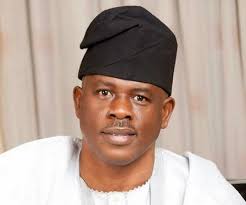
I Feel Pained Testifying against Fayose – Obanikoro

Published

on

The criminal trial of the former Ekiti State governor, Ayo Fayose, before a Lagos Division of the Federal High Court continued Monday with Musiliu Obanikoro continuing his evidence against the defendant.

Mr Obanikoro, a former minister of state for defence, at the last court sitting narrated how he was asked to pay millions of dollars of public funds to Mr Fayose.

The Economic and Financial Crimes Commission is accusing Mr Fayose and his company, Spotless Limited, of receiving millions of dollars from the office of the former National Security Adviser, Dasuki Sambo. The monies are believed to have been meant for the prosecution of the war against Boko Haram.

Continuing his evidence on Monday, the former minister said his past relationship with Mr Fayose made him a reluctant witness against the former governor.

“Yes, it is painful for me to give evidence against him,” Mr Obanikoro, who is now a member of the All Progressives Congress, said during cross-examination.

“I’m trying to restrain myself from saying things that will further damage our relationship.”

Mr Obanikoro said he was in Ado Ekiti during the 2014 governorship election in Ekiti State to do the bidding of the Peoples Democratic Party, as a leader of the party.

“I was in Ado Ekiti in pursuance of his (Mr Fayose) ambition as governor in Ekiti.”

The cross-examination which lasted for about four hours saw Mr Obanikoro clarifying some of the roles he played during the Ekiti 2014 election including as it relates to disbursement of funds from the federal government.

He denied that his properties had been seized by the EFCC during the early days of his interrogation before he agreed to appear as the prosecution witness, describing the story as a means for the media to “sell their papers.”.

“At no point was any of my property confiscated during the investigation to the best of my knowledge,” Mr Obanikoro said.

“The newspaper reports on confiscation of my properties can be said to be wrong. They were selling their papers.”

He, however, admitted that he forfeited some funds to the EFCC.

On his activities for Sylvan Mcmanara, a company he was said to have paid monies to for contracts that were never executed by the NSA in 2016, Mr Obanikoro said he does not have any relationship with the company other than the “supervisory role” he played.

“I was the one who introduced the company to the NSA when the need arose and approval was given.”

He also told the court that prior to the NSA paying the sum of N200 million to the company’s account, the account balance of Sylvan Mcmanara as at May 31, 2014, was N74,299.

The company’s statement of account read before the court showed that prior to 2014 when monies were paid by NSA into the account, Gbolahan Obanikoro, Mr Obanikoro’s son, had made a payment of N20,000 and N5 million on the May 18th, 2012, and in September 2012 respectively to the account. Mr Obanikoro, himself, also made deposits to the account.

When asked questions about the purpose of the funds sent out of the Sylvan Mcmanara account after N200 million naira was paid into it on the 5th of June 2014 and who authorised the payouts; Mr Obanikoro said he was sure it was done for the benefit of Mr Fayose.

While reading from a statement he made to the EFCC in 2016, Mr Obanikoro said he converted some of the funds to dollars at the instance of Mr Fayose.

“We had a dollar content to the amount given to Fayose and naira content. I can’t recall piece by piece how we came by the dollar. I said it earlier that when sourcing for forex, what we look at is the credibility and not the name of the company.”

On why he agreed to refund N200 million to the EFCC, Mr Obanikoro said it was a “reluctant agreement because I even said in the statement (to the EFCC) that I deserve a medal for successfully protecting Lagos.

“It is not correct to say that I used the N200 million the way it ought not to and that’s why I agreed to a refund because it was disbursed with the intention of securing Lagos which is also stated in my statement.”

Mojisola Olatoregun, the judge, adjourned the trial till February 5 (today) for the continuation of cross-examination.

Continue Reading
Click to comment

Leave a Reply

Your email address will not be published. Required fields are marked *

News

IGP Disu Orders Ban on Illegal Checkpoints Nationwide

Published

on

By

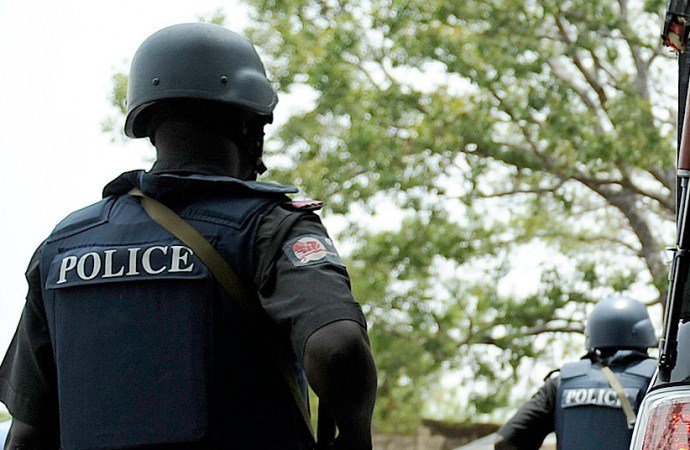
The Inspector-General of Police (IGP), Olatunji Disu, has issued a sweeping directive to Commissioners of Police nationwide, ordering an immediate end to extortion, illegal checkpoints, harassment of citizens and other misconducts.

He declared that restoring public confidence in the Nigeria Police Force is now a top operational priority.

The order was contained in a signal to members of the police management team including Commissioners of Police (CP) and other operational commanders.

In the marching order, the IGP acknowledged the deep mistrust many Nigerians feel toward officers, describing it as “painful” and unacceptable.

He said citizens now fear encounters with the police as much as they fear criminals, warning that such a reputation cannot continue under his leadership.

According to him, the directive marks the beginning of a determined effort to rebuild discipline within the police and re-establish its legitimacy in the eyes of the public.

The order specifically outlawed the routine collection of money from motorists on highways, the operation of unauthorised checkpoints, and the practice of arresting citizens and forcing them to withdraw cash from Automated Teller Machines (ATMs) or Point of Sale (PoS) devices.

The IGP also condemned the use of officers for private duties in homes and businesses, describing such deployments as abuse of authority and a violation of existing presidential directives on VIP protection.

Officers were further directed to comply strictly with approved dress codes, remain clean-shaven and adhere to established uniform regulations.

The police boss warned that harassment of citizens in any form would no longer be tolerated, stressing that the Nigerian public is not the enemy of the Force but the reason for its existence. At the same time, he assured officers that the institution would equally defend them against intimidation or disrespect from members of the public, noting that the dignity of the uniform must be protected on both sides.

Holding command leaders directly accountable, the IGP said Commissioners of Police would henceforth be responsible for misconduct within their jurisdictions.

He ordered them to demonstrate measurable improvements in discipline within seven days or face formal queries and possible transfers where lapses persist.

He emphasised that supervisory failure would no longer be ignored at any level of leadership. To ensure compliance, the directive introduced new oversight measures, including independent monitoring of field operations and public reporting channels through which citizens can lodge complaints directly with Force Headquarters.

A Citizens Commendation System will also be established to recognise officers who demonstrate professionalism, with monthly honours to be drawn from public nominations across commands.

Describing the directive as a decisive turning point, the police chief said Nigerians have grown weary of promises and now expect visible change. He ordered all commanders to brief personnel under their authority within 72 hours and confirm compliance in writing, declaring that the process of cleaning up the Force has begun and will be sustained until public trust is restored.

Continue Reading

News

Osun 2026: INEC Planning to Recruit APC Members As Electoral Officials, Lawmakers Allege

Published

on

By

The Osun State House of Assembly members have accused the Independent National Electoral Commission of planning to compromise the August 15 governorship election by making use of the members snd loyalists of the All Progressives Congress as electoral officials.

A majority 24 out of the 26 lawmakers, under the ruling Accord Party, made this allegation while addressing journalists at the Assembly complex in Osogbo.

This is also as the legislators linked the sudden redeployment of Resident Electoral Commissioner in Osun, Mutiu Agboke, to the influence and pressure by the Minister of Marine and Blue Economy, Gboyega Oyetola.

Addresing the media, the Speaker of the House, Adewale Egbedun, demanded free and fair election, noting that the legislative arm would not tolerate any form of electoral manipulation.

“It has come to our notice that there has been a sudden redeployment of the Resident Electoral Commissioner of the Independent National Electoral Commission in Osun State. We also have credible information that further deployments of interested people are being planned and may extend to other key officials, including the Administrative Secretary, Electoral Officers, Assistant Electoral Officers, and ICT personnel across the State.

We are particularly concerned by a deliberate pattern of actions aimed at influencing the electoral process in Osun State.

It is instructive to note that Ekiti State, which precedes Osun in the electoral calendar, has not witnessed such widespread deployments of electoral officials. This raises serious and legitimate questions. Why Osun State?,” Egbedun wondered.

Insisting that Agboke’s removal was facilitated by Oyetola, the Speaker said, “We state clearly that we have credible information linking these developments to the actions and influence of Mr Gboyega Oyetola.”

He warned, “Let it be clearly stated that no amount of administrative changes or deployments of interested officials will override the will of the people of Osun State.

These calculated efforts, no matter how structured, cannot alter the resolve of our people. The people of Osun State are politically conscious, vigilant, and determined to ensure that their votes count and reflect their true choice.”

Alleging of plans to recruit APC loyalists as INEC officials ahead of the poll, Egbedun stated, “We have also received credible reports that in parts of the State, particularly within the Ife Ijesa Senatorial District, there are plans to compromise the process through the use of APC members in critical electoral roles such as returning officers and supervisors. This is unacceptable and will not be tolerated. We are placing the public on notice.”

The lawmakers further warned that the deployment of a new REC to Osun would be in accordance with the law, adding, “Let it be made unequivocally clear that whoever is deployed to conduct elections in Osun State must do so in strict accordance with the Constitution and the law. The election must be free, fair, and credible. Anything short of this will be firmly resisted by Osun people.”

They also called the attention of the international community, development partners, and all observers of democratic governance to these developments in Osun State as they unfold, saying, “We speak as representatives of the people of Osun State. All we ask for, and all we insist on, is a free, fair, and credible election.

Let it be known that Osun State is politically aware, vigilant, and deeply committed to democratic values. The people of this State will not accept any action, from any quarter, that undermines the credibility of the electoral process.”

The All Progressives Congress and the New Nigeria Peoples Party had petitioned the National Chairman of INEC, Joash Amupitan against Agboke, accusing him of partisan conducts ahead of the August 15 governorship election in the state.

Continue Reading

News

Terrorists Kill Nigerian Brigadier-General – AFP Report

Published

on

By

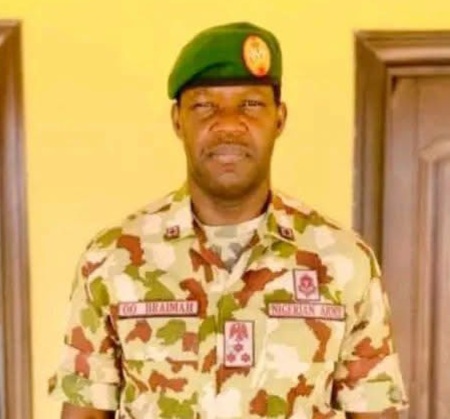
Terrorists in northeast Nigeria killed a brigadier general in an assault on a military base, a local government chairman told AFP on Thursday, the second killing of a high-ranking officer in five months.

Africa’s most populous country has been fighting a terrorist insurgency for 17 years, since Boko Haram’s 2009 uprising, which has seen the emergence of powerful splinter groups, including Islamic State West Africa Province.

In an overnight attack, unidentified terrorists killed at least 18 soldiers and torched vehicles at a base in Benisheikh, about 75 kilometres from Borno state capital Maiduguri, an intelligence source told AFP.

“Unfortunately, the brigade commander, Brigadier General O.O. Braimah, lost his life,” Kaga Local Government Chairman Zannah Lawan Ajimi told AFP in a phone interview.

Two intelligence sources confirmed Braimah’s death to AFP.

His death follows the killing of Brigadier General Musa Uba by ISWAP in November. He was the highest-ranking military official to die in the long-running conflict since 2021.

“They overran the brigade,” one of the intelligence sources said, giving the death toll as “at least” 18.

The second intelligence source said that “the terrorists killed several troops” and “burnt vehicles and buildings before they withdrew,” without giving a toll.

The army and Nigeria’s Defence Headquarters did not immediately respond to a request for comment.

– Rising terrorist violence –

Researchers have warned of an uptick of violence since 2025.

Borno capital Maiduguri has seen two suicide bombings since December — the type of bloody, urban attacks reminiscent of the insurgency’s peak a decade ago.

On Wednesday, the US State Department said in a notice it was authorising “non-emergency US government employees” to leave Abuja “due to the deteriorating security situation”.

While the insurgency is concentrated in the northeastern countryside, terrorists from Nigeria and the neighbouring Sahel have made inroads western Nigeria, where organised crime gangs known as “bandits” have been raiding villages and extorting farmers and artisanal miners for years.

Gunmen killed at least 90 people across several remote villages in northwest Nigeria this week, according to an AFP tally of tolls given by local and humanitarian sources.

Among the attacks was an assault in Kebbi state that police blamed a local terrorist group known as Mahmuda, which is affiliated with Al-Qaeda.

Kebbi sits on Nigeria’s border with Benin and Niger and since 2025 has been targeted by a rising number of terrorist attacks.

Conflict monitor ACLED says there has been a surge in violence in the area carried out by militants affiliated with Al-Qaeda and the Islamic State group.

In nearby Kwara state, in October, fighters from the Al-Qaeda-affiliated JNIM claimed an attack after years of researchers warning that the terrorist conflict ravaging the Sahel risked spreading south towards coastal West African states.

In December, the United States, with Nigerian assistance, bombed northwest Sokoto state, targeting Islamic State Sahel Province fighters usually found in neighbouring Niger, along with Mali and Burkina Faso.

AFP

Continue Reading

Trending