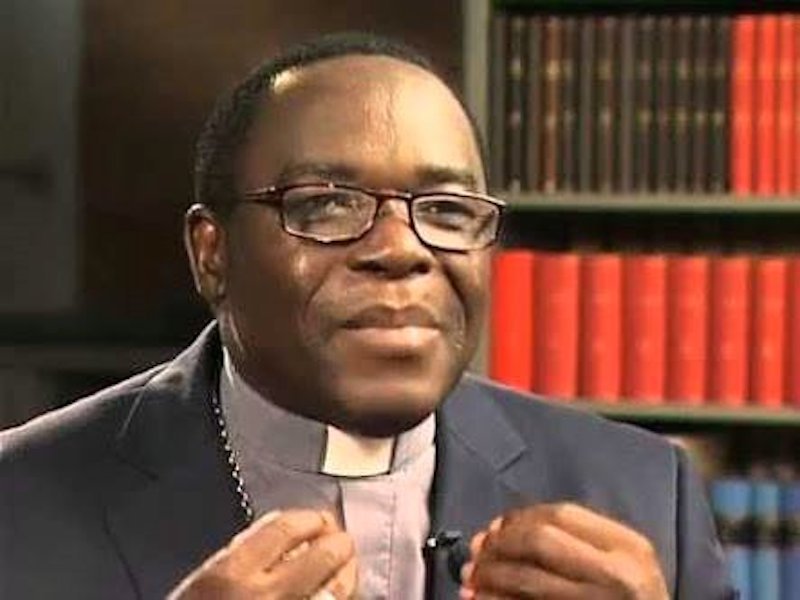
The Catholic Bishop of Sokoto Diocese, Matthew Hassan Kukah, has urged the United States not to re-designate Nigeria as a Country of Particular Concern over religious freedom, arguing that the decision would “hurt ongoing efforts” to promote dialogue, national healing, and interfaith understanding under the Bola Tinubu administration.
Speaking at the launch of the Aid to the Church in Need (ACIN) 2025 World Report on Religious Freedom in the World at the Augustinianum Hall in Vatican City, Bishop Kukah said although Nigeria remains deeply troubled by violence, discrimination, and insecurity, there are encouraging signs of progress that should be strengthened, not punished.
“Re-designating Nigeria a Country of Concern will only make our work in the area of dialogue among religious leaders even harder,” Kukah said.
“It will increase tensions, sow doubt, open windows of suspicion and fear, and simply allow the criminals and perpetrators of violence to exploit. What Nigeria needs now is vigilance and partnership, not punishment.”
Nigeria has sinned and fallen short, but progress is visible
The cleric, long recognised as one of Nigeria’s leading voices on human rights and interfaith relations, acknowledged that the country had failed in many respects to protect citizens’ rights to worship freely.
He said that under former President Muhammadu Buhari, religious persecution, particularly against Christians, “was visible and egregious,” marked by exclusionary policies and the capture of federal power by northern Muslims.
“The Buhari administration marked the worst phase in the history of interfaith relations in Nigeria,” Kukah said.
“That government gave oxygen to jihadists through policies that overtly favoured Islam and northern Nigeria.”
However, he said the Tinubu administration has so far shown “a willingness to listen and to act inclusively.”
He cited the appointment of Christians to strategic national positions — including the Chief of Defence Staff, the Director of the State Security Service, the INEC Chairman, and the National Chairman of the ruling party — as “confidence-building measures that inspire a sense of belonging.”
Kukah also commended President Tinubu for visiting Benue State after the recent Yelwata killings, describing the visit and his empathy for victims as “a departure from Buhari’s silence and indifference.”
Religious persecution remains real, but not total
While acknowledging that Christian minorities in northern Nigeria still face discrimination — including denial of land for church buildings, refusal to rebuild destroyed places of worship, and restricted access to religious education — the bishop said Nigeria’s reality cannot be simplified as state-backed religious oppression.
“We are not dealing with people going around wielding machetes to kill me because I am a Christian,” he said.
“I live in Sokoto, in the womb of Islam, and I move freely in my regalia. The Sultan of Sokoto himself attended our events and provided support for our work. This is not to say there are no problems, but the daily realities of interfaith life in Nigeria are far more complex.”
He said while terrorists and extremist groups have targeted Christians, they have also attacked Muslims who reject their ideology, turning large parts of Nigeria into “a tragic killing field.”
The bishop warned against the simplistic labelling of Nigeria as a country of religious oppression, arguing that such narratives overlook the multifaceted nature of its crisis — one driven by weak governance, poverty, ethnicity, and organized crime as much as by religion.
Kukah urged global institutions to recognise the complexity of Nigeria’s struggle and assist in rebuilding trust among its diverse communities.
He recalled that the United States had previously placed Nigeria on the “Countries of Particular Concern” list under the Donald Trump administration but later removed it under President Joe Biden. While acknowledging the role of international watchdogs, he said another designation now would only “undermine fragile interfaith efforts.”
“Nigeria must stand before the mirror and decide how to create a country of common citizenship,” he said. “The goal should be to help us reform, not to stigmatize. We need encouragement to build peace, not labels that isolate us.”
The bishop appealed for constructive international engagement, including support for Nigeria’s military to combat jihadists and bandits. He accused the Barack Obama administration of having “blocked Nigeria’s access to weapons” under President Goodluck Jonathan, saying that decision “pushed back” the fight against Boko Haram.
“I appeal to President Donald Trump, who is already working hard for peace in the Middle East, to lift the restrictions and help Nigeria access the tools it needs to defeat terror,” he said.
A window of hope under Tinubu
Despite Nigeria’s concerning human rights record, Kukah expressed optimism that the current government’s inclusiveness and the symbolic interfaith makeup of the First Family — with the President as a Muslim and the First Lady a Pentecostal pastor — offer “a window of hope.”
He called on the Tinubu government to deepen reforms, enforce constitutional secularism, and challenge the adoption of Sharia law by 12 northern states, which he described as unconstitutional and dangerous.
“The President should go to court to have the adoption of Sharia law declared unconstitutional,” Kukah said.
“This is the only way to end mob justice and restore confidence in Nigeria’s secular State.”
Concluding his address, Kukah urged religious and political leaders to seize the moment to restore national harmony.
“Despite our challenges, Nigeria can still make a great contribution to world peace if we rid our country of religious extremism,” he said.
“We should be supported and encouraged, not punished.”
He described the ACIN report, which shows that 5.4 billion people globally live without full religious freedom, as “a wake-up call,” not a verdict of condemnation.
“Let Nigeria be judged not only by its wounds, but by its willingness to heal,” Kukah said.
The trigger for Kukah’s remarks
In recent months, US Senator Ted Cruz and a group of Republican lawmakers have renewed pressure on the US State Department to redesignate Nigeria as a “Country of Particular Concern” (CPC) under the International Religious Freedom Act.
They argue that Nigerian authorities have tolerated or failed to stop widespread persecution of Christians by extremist groups and that officials who enable such violence should face sanctions.
Senator Cruz’s proposed Nigeria Religious Freedom Accountability Act of 2025 seeks to make the CPC status mandatory and impose penalties on officials complicit in religiously motivated killings or the enforcement of blasphemy and Sharia laws.
Nigeria was first placed on the CPC list in 2020 under the Trump administration but removed in 2021 by Secretary of State Antony Blinken.
The new congressional campaign follows inaccurate of ongoing attacks on churches and faith-based communities, with Cruz claiming, without evidence, that more than 50,000 Christians have been killed since 2009. Supporters of the move say it would compel Nigeria to uphold religious freedoms, while critics, including rights monitors, note that much of the country’s violence stems from terrorism, banditry, and communal conflict rather than state-sponsored persecution.
The Nigerian government has strongly rejected the accusations, insisting that it does not persecute any religious group and that the crisis is rooted in insecurity and governance failures, not faith-based repression.
The Minister of Information and National Orientation, Muhammed Idris, and the House of Representatives have dismissed the American lawmakers’ proposal as an “unfair and misleading” depiction of Nigeria’s situation, warning that it undermines national sovereignty and ongoing efforts at interfaith dialogue. Nigerian officials say both Christians and Muslims have been victims of extremist violence.









 Opinion3 days ago