
Opinion
The Odyssey of Professor Amidu Sanni in Arabic-Islamic Scholarship


By Toyin Falola
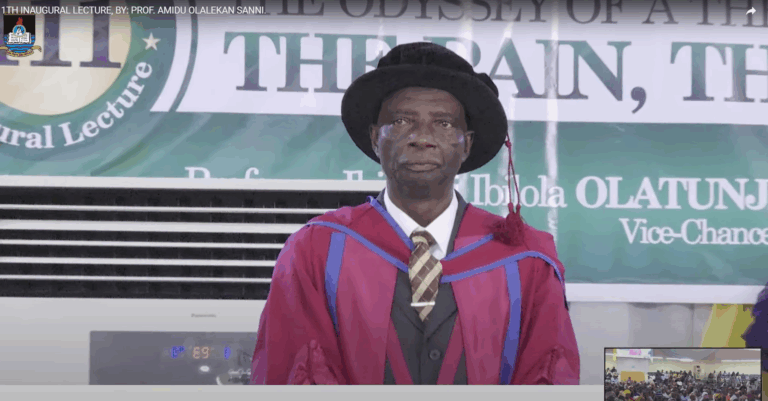
On September 16, 2025, the ambience in the Lagos State University auditorium had a different turn than usual. Naturally, it is expected that Inaugurals are usually ceremonial and conducted in an atmosphere that speaks of academics and celebration. Instead, the atmosphere was contemplative as guests and well-wishers all gathered at the Buba Marwa Auditorium for a lecture that had been long overdue with anticipation. Unlike the usual, this edition was not just another episode of academic ritual, but an encompassing trajectory of a lifetime expanded in defending a discipline often treated less seriously. On this day, Distinguished Professor Amidu Olalekan Sanni, a renowned Arabist and cultural historian, took to the podium for his professorial inaugural lecture titled “The Odyssey of a Theorist In Arabic-Islamic Scholarship: The Pain, The Gain, and the Twain.” I was one of the privileged ones to have received an advance copy.

It is not an exaggeration to say that Professor Sanni’s lecture towers above any mountains scaled, so far, because it has been long overdue, in the past six decades of devoted service to academia and scholarship. Notwithstanding, it came, and one presumes with measured grace and a palpable sense of satisfaction. To the discerning, it was more than a lecture. What ensued after the recitals and rollcall of the presenting Don, which encapsulated and interpreted over the years, was more than an exegesis of those studies; it was a purposeful unfolding of a layered itinerary of memory, language, culture, and nationality by one who has, through his life, enacted the history of Arabic studies in Nigeria. With emphasis, Professor Sanni’s lecture was truly a journey through memory. The lecture started with insights into personal and ancestral history. Just like many others, Professor Sanni’s sojourn into Arabic was premeditated by circumstances that proved beneficial in the end. His transition into Arabic and Islamic scholarship was not an academic convenience. Instead, it was born out of familial conviction and premeditated thoughts by generations before him. This is evidenced by his grandfather’s conversion to Islam during World War I, his vow to transmit the baton of Islamic scholarship to his protégés and then the Professor’s father who insisted that his son inherit a legacy of Arabic books instead of a career in accountancy which he believed would predispose him to financial misappropriation and greed, setting the tone for a lifetime of scholarly devotion.

During delivery, Processor Sanni recounted the defining career decision that would have allowed him a level of stability in agricultural research. Yet, he chose the uncertain, murky terrain of Arabic studies against professional advice and cultural expectations from employers, mentors, and senior colleagues. It was a challenging yet pivotal choice that demonstrated a rare willingness to venture, learn, and defend a discipline for its significant value even when clarity was still uncertain.

At the onset, it was a tedious run within the society, then going to lingering stereotypes and cultural misinterpretations. Debunking these fallacies and reengineering societal thoughts to a correct version began the core values of his work. One of the most compelling features of Professor Sanni’s lecture was her readiness to confront stereotypes plaguing Arabic studies in the country. With a keen sense of humor and bits of personal experience, he took a bold, yet gradual step in dismantling notions that Arabic is foreign or exclusively religious. For emphasis, he recalled a memory from the past with the story of a student who misheard the Arabic phrase “Arāka yā Sālim” as “Thunder killed Salem’s mother,” a far cry from the initial meaning. This was a clear display and a commentary on how poor language instruction and existing social misconceptions alter clear understanding.

Beyond humor, the professor raised salient concerns on the marriage of Arabic with Islam, which translates into the relegation of Arabic scholarship as a study interest for clerics and the failure of educational institutions to appreciate Arabic not as the language of the “Islamic world”but as a global language deeply rooted in historical African societies. Through practical examples, Professor Sanni explained how these stereotypes have played a significant role in marginalizing Arabic in mainstream curricula, despite its evident usage in law, trade, diplomacy, and cultural expression within indigenous contexts.
On this note, the Professor made a daring, bold claim, asserting that Arabic was indeed a Nigerian language. This assertion was simple yet powerful. It is central to his thesis and a careful attempt to get the message across. While maintaining the fact that Arabic is indeed not foreign to Nigeria, he went down memory lane, landing proofs from the court records of the ancient Sokoto Caliphate, the Yoruba Ajami manuscripts, the Hausa and Nupe heritages, amongst others, in affirming how Arabic has been around, shaping a part of Nigerian linguistic and intellectual history for centuries.

Before the colonial era, Arabic served as the medium for judicial documentation, interstate correspondence, and religious education. Even in present times, visible inscriptions in Arabic remain on Nigeria’s currency, and the Army’s Logo, which was credited to an Easterner who believed in the contextual meaning of the inscription for a modern military force. What these points point to in all is the quiet nod to a deep, clear, and evident heritage. At this point, the able professor called for a redirection, challenging the audience to see Arabic not as a relic of religion or colonial curiosity, but as a living language that has shaped Nigerian society tremendously. He challenged the audience to view and see the language as one with untapped potential for diplomacy, translation, literature, and global communications.

In recognition of the linguistic, historical, and emergent relationships between Arabic and African communities, Professor Sanni broadened the topic, integrating his recent work with his long-term research on Arabic literacy among enslaved Africans in the Americas. Examining the Arabic writings of Africans from both 18th-century Brazil and 19th-century North Carolina, Professor Sanni’s work has contributed new insights into the lives and writings of Alfa Rufino, an Oyo prince who composed Arabic in Portuguese America, and Omar ibn Said, the author of a slave narrative written in Arabic in the United States. Their stories were not just anecdotes but evidence of intellectual prowess and resilience for survival under harsh working conditions in the plantations of Bahia and the streets of Louisiana. Arabic at this time was more than a language. It was a tool of memory connecting enslaved people with their homelands, creating a sense of survival and dignity. Through these individuals, Professor Sanni repositioned Arabic studies as an essential component of African Diaspora studies and a testament to the fact that Africans authored their own stories long before colonial historians thought of it.

Even though the professor tailored his lecture around historical facts, he did not fail in projecting the lecture to look into the future boldly. He unequivocally pushed and advocated for the radical restructuring of Arabic studies across Nigerian learning institutions. He believed it is of no benefit if Arabic continues to be trapped within the walls of religious learning tools or clerical activities only. Instead, he posited an interdisciplinary pairing where Arabic could merge and play alongside modern learning innovations like Arabic and programming, Arabic and finance, Arabic and international studies, amongst various innovative interplays between disciplines as a way to make them relevant in a dynamic modern world.

In this regard, he lauded Lagos State University for being at the vanguard of this change. He cited the liberalized template it has set up for the study of Arabic, where all interested students of all faiths and backgrounds are welcome, without forgetting the department’s own interesting origin as having a non-Muslim as a founding donor. The professor also gave success stories of alumni who, whether Muslim or Christian, have established for themselves practical and successful careers in the multidimensional areas of diplomacy, media, local education, and as translators and interpreters in the international scene. It is this new generation, he thought, that would be the best people to portray the objectives of what it would mean to be a versatile, competent, and globally relevant speaker of Arabic.
At the same time, Professor Sanni did not fail in calling out the anomalies within the university system as an institution. He pointed out valid concerns, noting the fragile state of higher education in Nigeria. The university environment, as he mentioned, ought to be free from the inequities seen in other systems. He heavily criticized politicized promotions, inadequate research visibility, and outdated curricula. He lamented the absence of digitized archives and the absence of institutional memory across many universities.

He mentioned policy failures, particularly the futility of scrapping diploma programs in Arabic that once helped bridge the gaps for students with traditional learning backgrounds. Instead, he opted for structural reforms that allow sub-degree programs to be packaged with modern content such as entrepreneurship, digital literacy, and interdisciplinary engagement to foster inclusivity.
Even though it was never explicitly stated, the Inaugural Lecture carried the heavy weight of a reflective farewell along the way. After over four decades at LASU and six decades in the field of Arabic studies, Professor Sanni used the platform to share a teacher’s joy of seeing his former students become professors, entrepreneurs, and public figures. He reminded the audience of how success is not simply in titles, but in the legacies we cultivate—speaking so little about the long wait for his professorial inaugural, not with a heavy heart but a deep understanding of time and its essence. “Icould have been a great agriculturist,” he said quietly. “But I chose this and I have no regrets.” It was a soft declaration of a scholar often overlooked within yet revered across continents.

In the end, Professor Sanni had carved out an image on the consciousness of his listeners, of Arabic not as a dead language but as a language of opportunity, a language of the present and the future, even as it is grounded in a cultural and intellectual history, which is fully capable of meeting the challenges of a modernizing society. The final passage that he recited, a passage of poetry from the Qur’an, is an eloquent summation of epistemological affirmations of a tranquil and composed self, and a life with purpose and praise. In the end, the man who inherited his father’s books has become the guardian of languages, the linguist who does not simply safeguard a patrimony but instructs us on how to bear it.





Obi Condemns Arrest of Sheikh Ahmad Shortly after Meeting in Kaduna

Dangote Warns of Dire Consequences for Nigeria If Iran War Continues

N868m Fraud: Court Jails Ex-AGF Nwabuoku 72 Years

Trump Announces 5-Day Ceasefire on Strikes Against Iran, Opts for Talks

Open Letter to British Prime Minister, Sir Keir Starmer by Gold Emmanuel

The Travails of Nasir El-Rufai

Voice of Emancipation: President Tinubu’s State Visit to the United Kingdom

AFCON 2025: George Weah Urges CAS to Overrule CAF’s Verdict

My Dear Brother, Dele Momodu by Segun Adeyemi

The Oracle: The New Digital Colonialism: Navigating AI Policy Uunder Foreign Tech Dominance (Pt. 3)

Why Investing in People Outperforms Every Resource on Earth

2027: Peter Obi Raises Doubt About Clinching ADC Presidential Ticket

AI and Neurodiversity: The Future Must Work for Everyone
Trump Announces 5-Day Ceasefire on Strikes Against Iran, Opts for Talks
-
 Sports4 days ago
AFCON 2025: George Weah Urges CAS to Overrule CAF’s Verdict
-
 Opinion4 days ago
My Dear Brother, Dele Momodu by Segun Adeyemi
-
 The Oracle5 days ago
The Oracle: The New Digital Colonialism: Navigating AI Policy Uunder Foreign Tech Dominance (Pt. 3)
-
 Opinion4 days ago
Why Investing in People Outperforms Every Resource on Earth
-
 Headline6 days ago
2027: Peter Obi Raises Doubt About Clinching ADC Presidential Ticket
-
 Tech and Humanity5 days ago
AI and Neurodiversity: The Future Must Work for Everyone
-
 World2 days ago
Trump Announces 5-Day Ceasefire on Strikes Against Iran, Opts for Talks
-

 Featured5 days ago
TEF Entrepreneurship: Tony Elumelu Foundation Sets March 22 to Announce 2026 Cohort