Connect with us

Featured

Nothing Incriminating Found on Nnamdi Kanu, DSS Witness Tells Court

Published

on

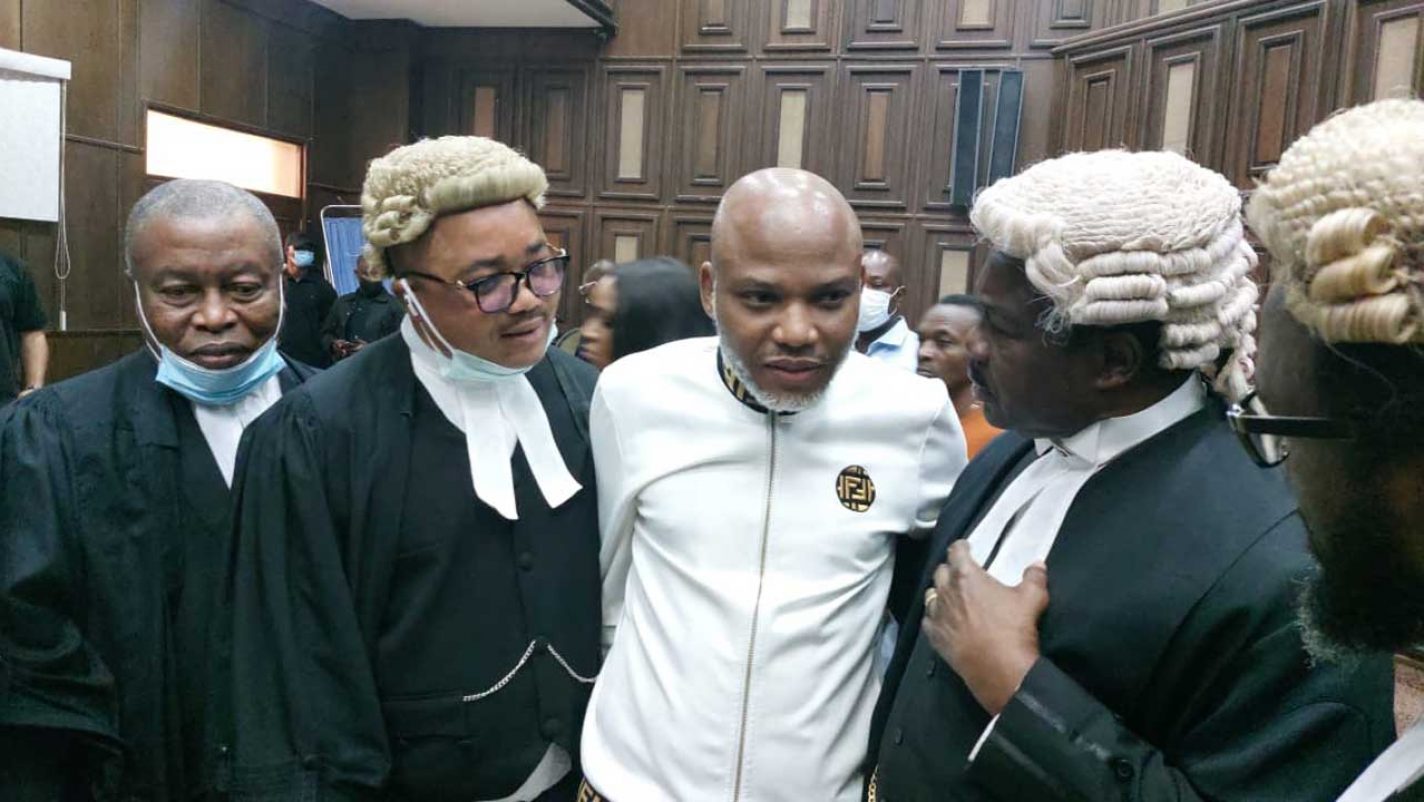
Trial of the embattled leader of the Indigenous People of Biafra (IPOB), Nnamdi Kanu, resumed on Friday before Justice James Omotosho of the Federal High Court, Abuja, with the cross-examination of principal witness, who said he did not find any instrument of terrorism on the separatist leader.

The court had granted the request of the Federal Government for witnesses to testify behind the screens.

While the prosecution counsel is Adegboyega Awomolo (SAN), a former Attorney General of the Federation, Kanu Agabi, led the defence team.

An operative of the Department of State Services, known simply as AAA, appeared as PW1.

When AAA was asked if he was the officer conducting the interview in the video played in court, he said that five officers were in the room, and that he was one of them.

He said his role in the investigation was limited to arresting the defendant, obtaining his statement, and escorting him to Abuja for onward investigation.

On the items presented in court, AAA was asked if there was anything which, on the face of it, was offensive, and he said no.

When asked if he had analysed any of the items recovered from him, he said he analysed only his phone.

He said the phone was in evidence, though there was no analysis in evidence because they considered it immaterial to the case.

When asked, “Do you agree that in the 10 years since you confiscated these items, many of them have lost their use?” AAA said, “Yes”.

AAA was asked whether there is a record of the items he claimed the DSS returned to the defendant. He said yes, but noted that he didn’t personally keep the records.

PW1 further disclosed that he did not find any instrument of violence on the lady with Kanu and did not consider her company as facilitating terrorism.

When Agabi asked the DSS witness whether he found “any instrument of terrorism on the defendant,” he said, “No.”

Replying to a question about whether he (AAA) contacted anyone whom the defendant mentioned as working with him, he said the defendant didn’t mention any names, adding that he did not know whether other people were standing terrorism trial with the defendant in this case.

“I put it to you that there’s no other person in the whole of Nigeria who is standing terrorism trial for Biafra agitation except the defendant,” Agabi told the PW1.

However, AAA said he knew some people stood trial with the defendant earlier, but didn’t know the state of those trials now.

He mentioned that he had read from social media and newspapers that the defendants had supporters, like Simon Ekpa, who also carried on with the agitation.

He also said he knew that the DSS was in the process of extraditing Simon Ekpa to Nigeria to face charges.

When ask whether the defendant was charged with damaging anybody’s property, AAA answered, “Maybe not personally and virtually”.

He said there were social media messages where the defendant was inciting violence but did not know one person who carried out any act of violence because the defendant incited him.

Kanu described Nigeria as a Zoo

PW1 further said though he could not remember whether the defendant said there is corruption, youth unemployment, and a lack of development in Nigeria, but remembers the defendant calling Nigeria a zoo.

When asked whether he remembered that the defendant said IPOB was not an armed group and does not give armed training to its members, he said he remembered the defendant saying IPOB does not bear arms.

“There have been killings in Kaduna, Zamfara, Benue, Plateau, and other parts of the North. Are those killings based on any agitation for separation?” the defence counsel asked.

“To the best of my knowledge, no,” AAA answered.

He further stated that Nigeria’s highways are safe, “to a larger extent”.

When the defence counsel asked, “Many Nigerians have been killed on their farms, in churches, in mosques, etc. Schools have been attacked, and students kidnapped or killed. Trains have been attacked, and passengers kidnapped and killed. These killings are not the product of any agitation for separation. Are they? AAA said, “No.”

The case, featuring terrorism and treasonable felony charges, was originally instituted in 2015 following Kanu’s arrest in Lagos.

Major setbacks have held the case down for almost a decade, making it impossible for the prosecution to call witnesses and present exhibits until Tuesday.

The case started with four people initially charged as Kanu’s co-defendants.

However, in February 2018, the then-trial judge, Binta Nyako, severed the trial, separating Kanu — who had fled Nigeria — from the other defendants.

The trial severance allowed the prosecution to continue proceedings against the four remaining co-defendants.

The Nigerian government re-arrested Kanu in Kenya in June 2021.

Continue Reading
Click to comment

Leave a Reply

Your email address will not be published. Required fields are marked *

Featured

Glo Wishes Christians Joyous Christmas, Urges More Compassion, Unity

Published

on

By

Nigeria’s technology and telecommunications company, Globacom, has extended warm Christmas greetings to Christians nationwide and globally as they commemorate the birth of Jesus Christ.

Globacom, in a statement on Monday, described the Yuletide as a season of reflection, urging Christians to embody the teachings of Jesus; love, humility, obedience to God, and a steadfast commitment to the welfare of all humanity.

“The noble but lowly circumstances of the birth of Christ teach salient virtues including obedience to God, humility, love for mankind, and a fastidious commitment to the good of all. We urge Christians to commit to practicing these virtues, as followers of Christ,” the company stated.

Globacom also highlighted the responsibility to care for others, noting that Jesus’ act of feeding the multitude (as recorded in the Gospels) serves as a timeless reminder to share and support one another, especially in challenging times.

It called on Nigerians to carry the spirit of Christmas beyond the festive season by reflecting the love and peace that Christ’s birth represents.

The company reassured its customers of uninterrupted, high‑quality services throughout the holidays and encouraged them to leverage its innovative products and services to stay connected and share the season’s joy with family and friends.

Continue Reading

Featured

Superiority War: I’ve Exclusive Authority to Confer Titles Across Yorubaland, Says Alaafin

Published

on

By

The Alaafin of Oyo, Oba Abimbola Akeem Owoade I, has stated that only the throne of Oyo has the authority to confer chieftaincy titles that carry the name “Yorubaland.”

The monarch made this declaration during the installation of Senator Abdul-Aziz Yari as Obaloyin of Yorubaland and Barrister Seyi Tinubu as Okanlomo of Yorubaland on Sunday at Aganju Forecourt, Aafin Oyo.

Oba Owoade emphasised that chieftaincy in Yoruba culture is not a matter of favour or decoration but a duty that comes with responsibility.

He explained that the Oyo throne has historically served as a central coordinating authority for the Yoruba people, a role recognised both during colonial administration and in post-independence governance.

The Alaafin highlighted that titles bearing the name “Yorubaland” are collective titles representing the Yoruba people as a whole, not individual towns or kingdoms, and must therefore be conferred by an authority whose reach spans the entire region.

He noted that colonial records, post-independence councils, scholarly works, and the Supreme Court of Nigeria have all affirmed this historical authority.

Oba Owoade described the newly installed titles as positions of trust requiring courage, loyalty, and service to the Yoruba people.

He added that such honours are meant to bind recipients more closely to Yorubaland and reinforce that authority, tradition, and respect for boundaries are central to sustaining Yoruba culture.

He urged the new titleholders to serve with humility and to ensure that their honours contribute to unity, dignity, and the collective good of Yorubaland.

He said: “We are gathered here today for a purpose that goes beyond celebration. We are here to witness history and to place responsibility where tradition has long placed it. Chieftaincy, in our culture, is not an act of favour. It is not decoration. It is duty, conferred only when history, authority, and responsibility align.

“From the earliest organisation of the Yoruba people, authority was never vague. Our forebears understood structure. This understanding gave Yorubaland stability long before modern governance arrived.

“The throne of Oyo emerged in that history as a coordinating authority, by responsibility. When colonial administration came, it did not invent this reality; it encountered it and recorded it. By 1914, Oyo Province had become the largest province in Southern Nigeria, covering 14,381 square miles. It was bounded in the north by Ilorin and Kontagora, in the east by Ondo and Ijebu, in the south by Ijebu and Abeokuta, and in the west by French Dahomey. This reflected recognised leadership over a wide and diverse space.

“This history explains why certain chieftaincy titles are different in nature. Titles that bear the name “Yorubaland” are not local titles. They are collective titles. They speak not for one town or one kingdom, but for the Yoruba people as a whole. Such titles must therefore proceed from an authority whose reach, by history and by law, extends across Yorubaland.

“Today, I do not speak to provoke debate. I speak to state order. Among the Yoruba, authority has never been a matter of assumption or convenience. It has always been a matter of history, structure, and law. Thrones were not created equal in function, even though all are sacred in dignity. From the earliest organization of Yorubaland, the Alaafin of Oyo occupied a central and coordinating authority – an authority that extended beyond the walls of Oyo and into the collective political life of the Yoruba people. This was not self-declared. It was recognised, enforced, and sustained across generations.

“Colonial records acknowledged it. Post-independence councils preserved it. Scholars documented it.

“And finally, the Supreme Court of Nigeria affirmed it. The law is clear. History is settled. Chieftaincy titles that bear the name Yorubaland – titles whose meaning, influence, and obligation are not confined to a single town or kingdom – fall under a singular, established authority. That authority is the throne of Oyo.”

Continue Reading

Featured

Why I Visited Nnamdi Kanu in Prison – Alex Otti

Published

on

By

By Eric Elezuo

Governor Alex Otti of Abia State has explained the reasons behind his much talked about visit to the leader of the Indigenous Peoples of Biafra (IPOB), Mazi Nnamdi Kanu, in Sokoto Correctional Centre.

Nnamdi Kanu was found guilty of all the seven count charges of terrorism brought against him by the Federal Government, and sentenced to life imprisonment, by Justice James Omotosho of the Federal High Court, Abuja, on November 20.

The governor also declared his intention to retire from partisan politics after serving as governor of the state.

Governor made these remarks in Umuahia while reacting to a viral video in which an individual berated him for visiting the IPOB leader in Sokoto Correctional Centre recently and alleged that the visit was aimed at positioning him (Otti) for either the presidential or vice presidential ticket. Otti however, denied having any presidential or vice presidential ambition after his governorship role.

According to him, he would not even contest for the senatorial position after serving as governor of Abia State.

Criticisms, he said, are part of democracy, adding that everyone is free to hold an opinion, even as he acknowledged that some criticisms, especially undue ones, are far from being the truth.

His words, “In the first place, that is the beauty of democracy. So, people should hold their opinions, and we respect people’s opinions. And that you hold a different opinion doesn’t mean you are right.

“One of the things he talked about was my ambition after being governor. And I had said it before, and I want to say it again, that by the time I’m done with governorship, I will retire.

“So, I don’t have presidential ambition, nor vice-presidential ambition. I also don’t have senatorial ambition. So, when I finish with the governorship, I’ll retire.

“I came for a mission. And when I deliver that mission, I will give way to younger people. So, he was talking of Igbo presidency. I don’t even understand what that means.

“So, I think if his thesis is based on that assumption, the assumption has collapsed, because he won’t see me on the ballot.

The Abia governor argued that it is important for a political office holder to know when to quit, especially when the politician has done what he is asked to do.

“When you have done what you have been asked to do, you clear, give way for other people. We’ve seen people here, after being governor who went to serve as Local Government Chairman. That’s not what we are. We are not cut out for those kinds of things.

Otti used the forum to explain why he visited Mazi Nnamdi Kanu at the Sokoto prison.

He said, “The second point is about Nnamdi Kanu. And I don’t want to put this matter in the public space so that it doesn’t jeopardise the discussions that I’m having.

“The truth about it is that exactly 24 months ago, I opened up discussions at the highest level on Nnamdi Kanu.

“And going to see him is the right thing to do, because he comes from my state. In fact, he comes from this local government (Umuahia North – the state capital).

“And there are always ways to solve a problem. I don’t believe that the way to solve a problem is to ignore it. And I had written extensively, even about Nnamdi Kanu and Operation Python Dance, I think in 2017 or 2018. And I condemned it.

“And I still condemn it. And some of the recordings that the gentleman put in his video, I cannot vouch for the veracity of that recording.”

Governor Otti maintained that he knows that when an issue has been approached from the legal point of view, there is also another window called the administrative point of view, stressing that, that is where he (the governor) is coming from.

“I’m not a lawyer. And if the judiciary says the man has been condemned to life imprisonment, that is the judiciary. Even that is not the end, because that’s the court of first instance. There is still an opportunity to appeal and then an opportunity to even go to the Supreme Court.

“But what we are trying to do is to intervene. I’m not a supporter of the disintegration of Nigeria.

“So, my position is that it would be insensitive of me to sit here and say one of our own who has been convicted should die when we have an opportunity to discuss, negotiate, and sue for peace. So, that is my position,” he said.

Continue Reading

Trending