
The Oracle
The Oracle: President Tinubu Cannot Legally Remove an Elected Governor of a State

Published
1 year agoon
By
Eric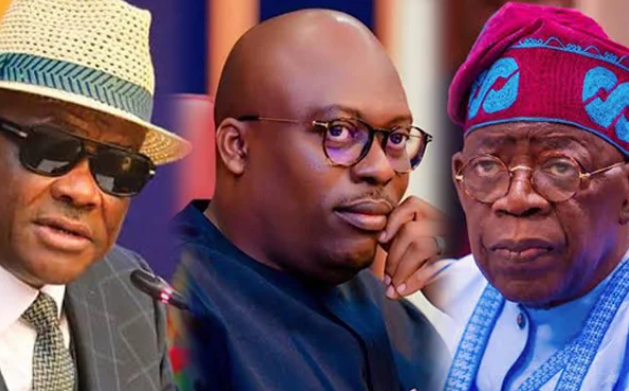

By Prof Mike Ozekhomo SAN
INTRODUCTION
In an era where democracy is supposed to reign supreme giving democracy dividends to beleaguered Nigerians, the nation has once again found itself at crossroads, a sober moment of reckoning where constitutional order is being tested in the most brazen of ways. President Bola Ahmed Tinubu, the president of the Federal Republic of Nigeria, sworn to uphold the Constitution, has taken a most unprecedented and unlawful step: the suspension of a democratically elected Governor, Deputy Governor and an entire State House of Assembly under the thin guise of emergency rule. What emergency? Nigerians and Rivers people did not see or feel any such emergency.
Let me be very firm most categorically and unequivocally that no constitutional provision, statute or any known convention grants the President the imperial and dictatorial authority to single-handedly dissolve the structures of an elected state government. That may probably have been in the locust days of military juntas; but Nigeria is today not under the firm grip of a military dictatorship.
The last time I checked, she is supposed to governed under a constitutional democracy that operates a presidential and republican form of government. The emergency provisions under Section 305 of the 1999 Constitution exist to restore order only in times of grave national crisis; certainly not to topple duly elected state officials. Lois X1V of France as an absolute dictator could not have done better and would therefore green with envy from his cold grave, having on 13th April, 1655, stood in front of parliament and imperiously exuded, “L’Etat C’est Moi” (“I am the State”).
A state of emergency does not and cannot translate to a civilian coup d’état, executed by executive fiat through a national broadcast which torpedoed elected structures and whimsically imposed a sole Administrator who would now illegally receive Rivers State allocations from the Federation account under section 162 of the Constitution contrary to the very judgement of the Supreme Court which President Bola Ahmed Tinubu pretended to be executing.
We have seen this script play out before during the infamous 2004 Plateau State emergency, where former President Obasanjo suspended Governor Dariye in what was widely condemned as a travesty of constitutional governance. Then, as now, the excuse was “exceptional circumstances”; but the reality was nothing short of executive lawlessness and overreach masked as national interest. I had criticized it in the same way I also criticized those of former Presidents Olusegun Obasanjo and Goodluck Ebele Jonathan.
And now, as Rivers State stands at the centre of this unfolding simulated constitutional debacle, one must ask: Is this the signal of a dangerous precedent for and kite-flying to Nigeria, of a looming maximum dictatorship in the offing in a one-party State? Will other “erring” Governors who refuse to align with the central government be next in line? Are we witnessing the return of a dangerous era of impunity where emergency rule becomes the bludgeon of political control rather than a tool for stability?
Let me be very clear about this for historical purposes: President Tinubu clearly lacks the power, authority and vires to suspend democratic structures, especially the removal of Governor Sim Fubara and the Rivers State House of Assembly members. His act constitutes nothing but a gross constitutional aberration and a most illegal, unlawful, wrongful and unconscionable step that has the potential of imploding Nigeria at large and Rivers State in particular. The Constitution must stand hallowed, unassaulted, or democracy will fall and perish. Although time shall tell, but time is certainly not on our side.
THE CONSTITUTIONAL FRAMEWORK FOR A STATE OF EMERGENCY
The Oxford Advanced Learner’s Dictionary, at page 379, defines “Declaration” as an official or formal statement, especially about the plans of a Government or an organization; the act of making such a statement.
Declaration or proclamation of a state of emergency therefore means proclaiming or making known a situation of emergency. What does “emergency” itself mean?
Emergency Doctrine is variously referred to as “emergency”, “imminent peril” or “sudden peril” Doctrine [Black’s Law Dictionary, 6th Edition, Page 523).
A “state of emergency” is defined in Longman Dictionary of Contemporary English (P.1620) as “when a government gives itself special powers in order to try to control an unusually difficult or dangerous situation, especially when this involves limiting people’s freedom”. “Emergency powers” are such powers as are conferred on a Government during such an unusual situation to hold the state together.
The Constitution in Section 305, of the Federal Republic of Nigeria as altered (the organic law and grund norm of the land) embraces three adjuncts of a declaration of a state of emergency: (1) Reasons for proclaiming it; (2) How it is proclaimed; (3) How it can be halted both before and after its proclamation. It also envisages two types of State of Emergency: (i) By Mr. President under Section 305 (3) (a) and (b), when the Federation is at War; or the Federation is in imminent danger of invasion or involvement in a state of war. (ii) The scenario where it is the Governor of a State who personally calls for the state of emergency under situations envisaged in Section 305 (3) (c), (d) and (e). This occurs where the threat does not extend beyond the boundaries of the State.
Section 305 of the 199 Constitution, as altered, provides:
1) “Subject to the provisions of this Constitution, the President may by instrument published in the Official Gazette of the Government of the Federation issue a Proclamation of a state of emergency in the Federation or any part thereof.
2) The President shall immediately after the publication, transmit copies of the Official Gazette of the Government of the Federation containing the proclamation including the details of the emergency to the President of the Senate and the Speaker of the House of Representatives, each of whom shall forthwith convene or arrange for a meeting of the House of which he is President or Speaker, as the case may be, to consider the situation and decide whether or not to pass a resolution approving the Proclamation.”
None of the factors envisaged in Section 305 of the Constitution has occurred at all to warrant the steps taken by the president. In present scenario the bi-camera National Assembly had not even first met, discussed and approved the president’s emergency proposals before he acted. He did it in advance (in futuro) in expectation of rubber-stamping by a pliable and malleable NASS.
I hereby call on the NASS to show class for once by roundly rejecting the President’s unconstitutional act of first declaring a state of emergency before its approval and also for acting altra vires by accompanying it with the suspension of elected democratic structures. This will place them on the right path of history. Otherwise, they should be prepared to be damnified by history.
I must emphasize that the declaration of a state of emergency does not translate into a dissolution of governance structures within the affected state. Under a state of emergency, the Governor, as the chief executive of the state, remains in office, whilst the institutions of government at the state level continue to function, unless expressly provided otherwise by law. There is no such law in Rivers State or at the national level.
The framers of the 1999 Constitution were deliberate in ensuring that the power to declare a state of emergency is not an avenue for executive overreach or imperious excursion into the realm of narcissm or ego trip. While the President may take extraordinary measures to maintain peace and order, those measures must align with the provisions of the Constitution. There is no provision howsoever, express or implied, that allowed President Tinubu to remove a sitting Governor and state House of Assembly legislators under the thin guise of emergency powers. There is no war in Nigeria. There is no threat of external aggression or invasion either across the country or in Rivers State. All that we have seen have been tussle for power between the Governor and the House of Assembly and the courts had already waded in with the Governor declaring he would comply with the Supreme Court’s judgement. A mere blow up of oil pipes in two communities by unidentified persons certainly does not constitute a war or external invasion situation.
THE PRINCIPLE OF SEPARATION of POWERS AND FEDERALISM
Nigeria operates a federal system of government, which means that power is divided and shared between the federal, state and Local Government Areas. This structure is designed to prevent excessive concentration of power in any one level of government, for as Lord Acton once explained, “power tends to corrupts and absolute power corrupts absolutely”. The President’s authority over the states is limited, just as a Governor cannot interfere with presidential functions at the federal level.
Furthermore, the principle of separation of powers, a cornerstone of constitutional democracy as ablly propounded in 1748 by a great French philosopher, Baron de Montesquieu, ensures that no single branch of government has unchecked authority. The removal of a Governor is a matter strictly within the purview of the State House of Assembly, as stipulated under Section 188 of the Constitution. The process is quite detailed, lengthy and rigorous; and requires a legislative super majority to accomplish. It is not a power and prerogative the President can usurp and exercise as did President Tinubu, regardless of the circumstances.
CAN THE PRESIDENT SUSPEND OR REMOVE A SITTING GOVERNOR, DEPUTY GOVERNOR, OR HOUSE OF ASSEMBLY EVEN UNDER A STATE OF EMERGENCY?
Nigeria stands at a critical juncture in its democratic evolution. Recent developments in Rivers State, where President Bola Ahmed Tinubu purportedly suspended Governor Siminalayi Fubara, his Deputy, and the entire House of Assembly, call for a meticulous constitutional examination and analysis. At the heart of this matter lies an age-old question: Can the President, under the guise of emergency rule, lawfully suspend or remove a democratically elected Governor, Deputy Governor, or Legislature?
The answer, based on constitutional provisions, legal precedents and the very principles of federalism which we operate, is an unequivocal NO. The 1999 Nigerian Constitution (as amended) does not, under any circumstance, empower the President to remove, suspend, or torpedo duly elected state officials even under Section 305, which governs the declaration of a state of emergency.
THE CONSTITUTIONAL LIMITS OF EMERGENCY POWERS
In no place does Section 305 of the 1999 Constitution grant the President the power to suspend a Governor, Deputy Governor, or the State House of Assembly. This reality is backed by constitutional jurisprudence and was reaffirmed in Attorney-General of Abia State v. Attorney-General of the Federation (2002) 6 NWLR (Pt. 763) 265, where the Supreme Court clarified that the Constitution is supreme and that no authority including the President can act outside its provisions.
Yet, this is not the first time that Nigeria has witnessed an outright abuse of emergency powers. Former President Olusegun Obasanjo’s 2004 suspension of Plateau State’s Governor Joshua Dariye and the House of Assembly remains a painful reminder of how emergency provisions have been misused to subvert democratic structures.
That unconstitutional precedent, which many Nigerians condemned then as executive overreach reminiscent of military juntas, appears to have resurfaced in Rivers State where President Tinubu’s action has eerily followed that same better-forgotten pattern, with the Judiciary left untouched as a token concession to constitutionalism. But can democracy survive when two out of the three arms of government are arbitrarily dissolved? I believe not.
FEDERALISM, SEPARATION OF POWERS, AND THE ROLE OF STATE GOVERNMENTS
Nigeria operates a federal system, meaning that power is distributed between the central and state governments, as explicitly outlined in Sections 4, 5, and 11 of the 1999 Constitution. Under this system, a Governor is not an apron string of or mere extension of the Presidency. He is an independently elected authority answerable to no one but only the people of his state who elected him.
The Constitution does not permit a President to unilaterally whimsically and arbitrarily remove a Governor—not by fiat; not by emergency decree; and certainly not by mere executive pronouncement. The doctrine of separation of powers, a fundamental pillar of democracy, dictates that such removals must be carried out strictly in accordance with constitutional provisions.
This principle was reinforced in Attorney-General of Ogun State & Ors v. Attorney-General of the Federation & Ors (1982) 3 NCLR 583, where the Supreme Court ruled that the Federal Government cannot unilaterally impose duties or restrictions on state officials. This means that even if a state of emergency is lawfully declared, the Governor remains in office unless impeached through due process.
The Constitution provides only one legal pathway for the removal of a state Governor, and that is through impeachment, as stipulated in Section 188 of the Constitution. The process is legislative, not executive, requiring a State House of Assembly to initiate and conduct impeachment proceedings as dictated by the Constitution. In any event, the Rivers State House of Assembly (whether rightly or wrongly) had already commenced one against the Governor. Why truncate the constitutional process through an unconstitutional executive fiat? Why? Why?? Why???
THE PUBLIC ORDER ACT AND THE LIMITS OF FEDERAL CONTROL
Some have sought, in most illogical and unscholarly manner, to justify the President’s emergency intervention in Rivers State under the masquerade and facade of maintaining public safety. They cite the Public Order Act, which grants state Governors powers over public assemblies, meetings, and processions. However, even this statute does not authorize the suspension of an entire government structure.
The irony, of course, is that while Governors are designated as the Chief Security Officers of their states, they lack actual control over security forces. Section 215 of the Constitution subordinates a State Commissioner of Police to the Inspector General of Police and the President, meaning that even if Rivers State were experiencing insecurity, it was ultimately to the same traducing Federal Government it would have turned to.
The absurdity of this power imbalance, even though Rivers State had not gotten there, was noted in Attorney-General of Abia State v. Attorney-General of the Federation (2002) 6 NWLR (Pt. 763) 264, where the Court observed that the Federal Government cannot pass the blame for state security failures to a Governor who lacks the constitutional means to deploy security personnel.
THE ROLE OF THE NATIONAL ASSEMBLY: A CONSTITUTIONAL FIREWALL?
Even if the National Assembly, sought to legislate on emergency rule, section 11(4) of the 1999 Constitution explicitly prohibits it from removing a Governor or Deputy Governor. This means that not only does the President lack the power, but even the National Assembly itself is equally barred from such unconstitutional act.
Prof. Ben Nwabueze, one of Nigeria’s foremost constitutional scholars, had long warned that allowing a President to wield unchecked emergency powers would erode democracy and lead to an authoritarian system where Governors served as vassals at the pleasure of the President rather than the electorate.
In line with this reasoning, Chief F.R.A. Williams had condemned the Plateau State emergency declaration as “a contradiction of all known principles of true federation operating in a democratic society.” Are we not now witnessing history repeat itself in Rivers State?
THE PRINCIPLE OF EXPRESSIO UNIUS EST EXCLUSIO ALTERIUS
One of the most fundamental principles of statutory interpretation is expressio unius est exclusio alterius, meaning that the explicit mention of one thing implies the exclusion of all others. Sections 4 and 5 of the 1999 Constitution donate specific executive and legislative powers; but nowhere do they mention any inherent powers allowing the President to remove Governors undemocratically.
This principle was applied in Attorney-General of Bendel State v. Aideyan (1989) 4 NWLR (Pt. 118) 187, where the Supreme Court held that powers not expressly granted by the Constitution cannot be assumed. Thus, any claim that the President possesses inherent emergency powers to remove a supposedly erring Governor is legally baseless. The President can not dorn the garb of a Primary School headmaster who has absolute control over and supervises his pupils.
HOW A GOVERNOR MAY BE REMOVED FROM OFFICE
If Not the President, then who can remove a Governor under emergency rule? The answer remains the State House of Assembly as the only body constitutionally empowered to initiate impeachment proceedings against an erring Governor.
Under Section 188, impeachment is a rigorous and multi-step process, requiring:
a. A written notice signed by at least one-third of Assembly members;
b. A two-thirds majority vote to proceed further;
c. The formation of an investigative panel by the state Chief Judge;
d. A full blown hearing granting the Governor a right to defence either by himself or through a counsel of his choice;
e. A final two-thirds majority vote for removal after thorough hearing, recommendations, etc.
If a Governor remains in office, it is because the State House of Assembly has not found legal grounds for removal. The President’s personal opinions, political considerations, or security concerns do not change this constitutional scenario.
ANY HISTORICAL PRECEDENT FOR RIVERS STATE?
The declaration of a state of emergency in Rivers State and the subsequent suspension of Governor Siminalayi Fubara, his Deputy, and the State House of Assembly by President Bola Ahmed Tinubu brings Nigeria into another moment of constitutional crisis and democratic reckoning. While this may appear to be a novel occurrence, history reminds us that this is not the first time a Nigerian President had wielded emergency powers in a manner that undermined the very essence of democracy.
Emergency rule in Nigeria has precedents, but each instance had always been marred by legal controversy, constitutional breaches and political opportunism. The most striking parallel to Tinubu’s action in Rivers State can be drawn from the 2004 Plateau State emergency declared by former President Olusegun Obasanjo. In that case, Obasanjo had suspended the Governor and the State House of Assembly, replacing them with a Sole Administrator, Major-General Chris Alli (Rtd.). That action was roundly criticized as an overreach of executive power, much like what is unfolding today in Rivers State. I was one of the critics.
However, even further back in Nigeria’s history, the Western Region crisis of 1962 under the First Republic presents another instructive example. Under the 1960 Independence Constitution, the then Governor-General, Dr. Nnamdi Azikiwe, acting on the advice of Prime Minister Tafawa Balewa, had declared a state of emergency in the Western Region due to political turmoil. Balewa had removed the Premier, the Governor, all Ministers, and members of the Regional Assembly, installing Dr. Moses Majekodunmi as Sole Administrator.
The striking difference, however, is that this took place under a Westminster parliamentary system, where Parliament held sovereignty. In contrast, Nigeria’s current presidential system operates under constitutional supremacy, not parliamentary supremacy. The framers of the 1999 Constitution deliberately excluded any provision that would allow such sweeping executive powers, particularly those that could enable a President to remove a sitting Governor or dissolve a State House of Assembly under emergency rule.
WHY TINUBU’S EMERGENCY RULE IN RIVERS STATE IS UNPRECEDENTED
Even within the history of emergency rule declarations, Tinubu’s action in Rivers State is particularly alarming. While previous Presidents who declared emergency rule (Balewa in 1962 and Obasanjo in 2004) did so under questionable legal interpretations, they at least had some statutory backing, however flimsy.
Tinubu, on the other hand, has no legal foundation whatsoever to suspend an elected Governor, Deputy Governor, or the State House of Assembly. There is no enabling law, no precedent under the 1999 Constitution, and no Supreme Court ruling that grants the President such sweeping powers.
The 1999 Constitution, as amended, is as clear as a whistle that section 305 which grants the President powers to declare a state of emergency does not provide for the removal or suspension of an elected Governor.
Section 11(4) explicitly denies even the National Assembly the power to remove a Governor under emergency rule; meaning it certainly cannot authorize the President to do so.
The principle of federalism, which underpins Nigeria’s governance structure, dictates that Governors derive their mandate directly from the people and not from the President.
WHAT COULD HAPPEN IF THIS PRECEDENT IS ALLOWED TO STAND?
One of the most dangerous aspects of President Tinubu’s action is the precedent it sets for the future of democracy in Nigeria. If a President can wake up one morning and, under the guise of an emergency, remove a Governor and dissolve the State Legislature, what prevents the same President or future Presidents from doing the same in other states?
In fact, if the logic of this unconstitutional action is stretched further, it raises an even more disturbing possibility:
What if a President wakes up tomorrow and declares an emergency in the Federal Capital Territory (FCT)? The Constitution recognizes the FCT as a state.
Could the President then suspend the Senate and the House of Representatives that supervise the FCT and appoint himself as Sole Administrator of the FCT and Federal Republic of Nigeria?
These hypothetical scenarios, once dismissed as absurd, in my earlier research have now become real threats when constitutional violations are left unchallenged and unchecked.
PRESIDENT TINUBU’S ATTEMPT TO RELY ON NON EXISTENT EMERGENCY LAWS
To compound the legal crisis, Tinubu’s government seeks to justify its actions by invoking emergency regulations that do not exist in Nigeria’s current legal framework. The 1961 Emergency Powers Act, which was made pursuant to Section 65(1) of the 1960 Constitution, is no longer in force. That law had allowed the Governor-General to make sweeping regulations, including appointing an Administrator, restricting fundamental rights, and even suspending state governments.
However, this law ceased to have effect long ago. When Nigeria transitioned from the Westminster system to the presidential system in 1979, the framers of the Constitution deliberately omitted any provision that could allow such broad emergency powers.
The Laws of the Federation of Nigeria, 1990, provide a clear confirmation: the 1961 Emergency Powers Act is described as “omitted; spent”. This means that it has since been consigned to the vehicle of historical oblivion and cannot be resurrected to justify Tinubu’s current unconstitutional acts.
A CLOSING CAVEAT: THE PERILOUS PRECEDENT OF TINUBU’S EMERGENCY RULE IN RIVERS STATE
Not a few Nigerians have argued quite plausibly, too, that President Bola Ahmed Tinubu’s recent declaration of emergency rule in Rivers State and the suspension of Governor Siminalayi Fubara, his Deputy, and the State House of Assembly was not purely a matter of law and order, but an act driven by political expediency and personal indignation.
The President finds himself presiding over a nation teetering on the brink economic hardship, rising insecurity, public angst, and deep-seated political fractures. Yet, rather than confront these crises headlong with statesmanship, his administration appears to be flexing emergency powers in a manner that raises more questions than it answers. If Rivers State warranted emergency rule, why then have states like Zamfara and Niger where armed bandits and insurgents have reduced governance to an afterthought not received the same treatment?
Even the most ardent defenders of Tinubu’s emergency Decree ( for a Decree it is in reality) must pause and ask: Is Rivers State the greatest threat to national stability, or is it merely the most convenient political battleground? If emergency rule in Rivers was truly about law and order, why was a hand-picked Administrator imposed while duly elected officials were unceremoniously suspended from office? Is this about democratic governance, or is it about power and control?
If Nigeria remains a constitutional democracy, then the same Constitution must apply to all, irrespective of political affiliation or convenience. If Tinubu’s draconian action in Rivers State is allowed to stand, it sets a dangerous precedent where emergency powers become a tool for political suppression and repression rather than a last resort for genuine intractable crises.
So, the question remains: Is this the Nigeria we want or deserve? Or shall we, in our studied silence, watch democracy dismantled piecemeal with one emergency declaration at a time? History will surely judge us all.
Related
You may like
The Oracle
The Oracle: The New Digital Colonialism: Navigating AI Policy Under Foreign Tech Dominance (Pt. 5)
Published
2 days agoon
April 4, 2026By
Eric
By Prof Mike Ozekhome SAN
INTRODUCTION
In our last outing, we continued from the dangers of weak localization and disproportionate influence of foreign technology on African ecosystems. Followed by an in-depth analysis of the issues generated by AI policy and later at what African States needs to do to tackle the challenge-using Nigeria as a case study with special emphasis on the pen in the trans-continental transformation of AI technology and later x-ray the need for technological sovereignty and for crafting an indigenous AI policy agenda. We shall then conclude with an overview of lessons from abroad including the US, EU and China. Today, we shall take a look at the Future of African Digital Sovereignty, starting from Lagos to Accra, Cape Town to Cairo, Dakar to Dares Salaam, and in fact all fifty-four nations of African continent. We shall thereafter conclude with how the choices made by the African nations today with respect to AI governance, data sovereignty, and technological infrastructure will determine whether the continent will remain passive a consumer of foreign systems or emerges as an active shaper of global digital futures. Enjoy.
THE FUTURE OF AFRICAN DIGITAL SOVEREIGNTY
Imagine this: the year is 2050. From Lagos to Accra, Cape Town to Cairo, Dakar to Dares Salaam, all fifty-four nations of our beloved continent stand as co-authors of a shared digital destiny. The pen that once wavered in the hands of fragmented states has become steady, guided by unity, foresight and the vision to craft a future defined not by dependence, but by sovereignty, equity and innovation.
Across Africa, technology is no longer imported as a foreign product but created, nurtured and exported as a global standard. In Lagos, young engineers design energy-efficient AI chips that rival and surpass those made in Silicon Valley. In Kigali, a hub once celebrated for its early smart city experiments, Africa’s first quantum computing centre now powers healthcare breakthroughs across continents. Nairobi has become the headquarters of the Pan-African AI Ethics Council, an institution that sets the global benchmark for human-centred artificial intelligence. Accra, Addis Ababa and Johannesburg anchor Africa’s digital economy with data centres that rival those of Europe and Asia, ensuring that Africa’s data never again flows outward without reciprocity.
The transformation began with a recognition: technology is not neutral. Africans understood that algorithms, data systems and biometric technologies are instruments of power. Instead of uncritically adopting systems that excluded the rural, the poor, the disabled or the linguistically diverse, the continent chose a different path: technology that reflects African values of dignity, community and justice. The lessons of early missteps, such as exclusionary ID systems and exploitative data mining by foreign corporations, were not forgotten. They became rallying points for reform.
By 2035, every African nation had adopted a binding Digital Bill of Rights, enshrining privacy, dignity, transparency and accessibility as constitutional guarantees. Consent is no longer a perfunctory box to be ticked but an active and meaningful right, accessible even to citizens with low literacy or those living in remote communities. Algorithms deployed in courts, schools, banks and hospitals are explainable, accountable and open to independent audit. Citizens are not passive subjects of technology but active shapers—through participatory platforms that allow them to influence how data is collected, how AI is used, and how rights are protected.
The institutions that guard this ecosystem are robust, independent and trusted. The African Data Protection Commission; born out of a coalition of all fifty-four nations, operates with technical excellence and political autonomy. It not only oversees compliance but actively invests in capacity-building across the continent. Local regulators are no longer captured by external interests; they are guardians of sovereignty. Civil society, academia and entrepreneurs are embedded in digital governance as co-creators, not outsiders. The result is an ecosystem where technology is democratized and trust is the currency of digital life.
Infrastructure, once the Achilles’ heel of African development, is now its greatest strength. Universal broadband covers the continent, powered by a mix of green energy grids, solar satellites and fibre networks woven through deserts, forests and cities. Every village is a node in Africa’s digital constellation. Data centres, built and managed by Africans, ensure that information flows within Africa before it flows outward. These infrastructures are interoperable, resilient and sovereign.
Economic life thrives within this digital ecosystem. The African Continental Free Trade Area has blossomed into the world’s largest digital single market, seamlessly integrating fintech, e-commerce and cross-border innovation. A farmer in Mali can sell directly to buyers in Morocco using blockchain-backed platforms that guarantee fair prices, transparency, and security. A nurse in Uganda consults instantly with a doctor in Tunisia through AI-powered telemedicine networks. Start-ups in Lusaka or Ouagadougou scale as easily as those in Paris or Singapore, because Africa’s venture ecosystem is rich, connected and self-sustaining.
Yet the utopia is not measured by economic prosperity alone. Africa’s digital future has become a moral compass for the world. By embedding Ethics by Design into every innovation, Africa proved that technology could uplift rather than exclude. AI systems in Africa are trained on diverse datasets that reflect the continent’s multitude of languages, cultures, and histories, ensuring that bias is minimized and inclusion maximized. Assistive technologies empower people with disabilities to thrive. Rural communities once disconnected are now innovators, shaping tools that respond to their own realities—tools built in Hausa, Wolof, Amharic, Zulu and hundreds of other African languages.
Education has been re-imagined. Many children across the continent now have access to quality, personalized, AI-driven learning, designed with local contexts in mind. Universities collaborate through the Pan-African Digital Knowledge Network, pooling resources to create world-leading research in AI, biotechnology, renewable energy and cyber security. Brain drain has reversed—talent flows into Africa, not away from it.
Crucially, Africa’s rise did not come through isolation but through strategic partnership. Unlike the extractive digital colonialism of the past, today’s partnerships are forged on reciprocity and respect. Africa sits at the table of global digital governance as an equal, co-drafting the ethical frameworks that guide the use of AI, biotechnology and space technologies. Where once it was a consumer, Africa is now a producer, standard-setter and exporter of innovation and ideas.
This Africa is not utopia because it is flawless. It is utopia because it has embedded resilience, justice and inclusion into the fabric of its digital transformation. It has proven that sovereignty is not about closing borders but about opening opportunities, not about resisting technology but about owning it, shaping it, and ensuring it serves humanity.
CONCLUSION
Africa stands at a crossroads. The choices made today about AI governance, data sovereignty, and technological infrastructure will determine whether the continent remains a passive consumer of foreign systems or emerges as an active shaper of global digital futures. To avoid a new wave of digital colonialism, African states must embed ethics, sovereignty, and inclusion into their AI policies, invest in indigenous innovation, and strengthen regional collaboration. Only then can Africa wield the pen of authorship—crafting a digital destiny rooted in dignity, justice, and self-determination. (The end).
THOUGHTS FOR THE WEEK
“Historically, privacy was almost implicit, because it was hard to find and gather information. But in the digital world, whether it’s digital cameras or satellites or just what you click on, we need to have more explicit rules – not just for governments but for private companies”. – Bill Gates.
“Social media is changing the way we communicate and the way we are perceived, both positively and negatively. Every time you post a photo, or update your status, you are contributing to your own digital footprint and personal brand” – Amy Jo Martin.
Related
The Oracle
The Oracle: The New Digital Colonialism: Navigating AI Policy Under Foreign Tech Dominance (Pt. 4)
Published
1 week agoon
March 27, 2026By
Eric Prof Mike Ozekhome SAN
INTRODUCTION
The last episode of this treatise concluded our examination of the preferences of the Western (US, EU) and Eastern (China) hemispheres on the subject after which we considered the dangers of weak localization and disproportionate influence of foreign technology on African ecosystems. This was followed by an analysis of the issues generated by AI policy and later we looked at what African States needs to do to tackle the challenge-using Nigeria as a case study. Today, we shall continue with same with special emphasis on the pen in the trans-continental transformation of AI technology and later x-ray the need for technological sovereignty and for crafting an indigenous AI policy agenda. We shall then conclude with an overview of lessons from abroad including the US, EU and China. Enjoy.
AI POLICY AND DIGITAL TRANSFORMATION IN AFRICA, WHO WIELDS THE PEN?
In one sentence, we wield the pen. Our governments, independent state actors, entrepreneurs, African men, women and youth all share in this responsibility. The future of Africa’s digital transformation depends on whether we choose to author our own story or allow others to continue writing it for us.
Africa is witnessing an increasing call for technological sovereignty: the ability to control our own infrastructure, data and innovations. This idea, central to decolonial frameworks, insists that we must move away from being a passive consumer of technologies and reclaim control of its digital future. Kwame Nkrumah emphasized the importance of pan-African cooperation for achieving sovereignty. That vision today extends to the digital realm, where regional collaboration and homegrown solutions are critical for breaking dependency on Western corporations. Achille Mbembe further argues that Africa should leverage indigenous knowledge systems and local resources to create technologies that reflect African values, rather than merely importing Western tools ill-suited to its unique needs.
The digital divide between Africa and the West is not merely technical; it is rooted in structural and historical inequalities. The continent’s persistent reliance on foreign technologies reflects centuries of global imbalances that continue to shape how resources and knowledge flow. A central issue is technological dependency: Africa consumes technologies made elsewhere instead of shaping them (Tyler Robinson, ‘Navigating Digital Neocolonialism in Africa’ (cigionline.org) < www.cigionline.org/static/documents/DPH-paper-Stevenson_1.pdf > Accessed on 16th September, 2025).
Global tech giants dominate Africa’s digital landscape, extracting vast amounts of data without adequate investment in local infrastructure or people. Data extraction not only perpetuates Western dominance but also strips Africa of sovereignty over its own digital futures. Without robust regulations or sufficient local technological capacity, African nations remain vulnerable to these external forces.
NEED FOR TECHNOLOGICAL SOVEREIGNITY
Against these challenges, the need for technological sovereignty becomes undeniable. Africa must not remain a passive participant in the global digital economy. We must take proactive steps to build our own technological infrastructure and policies. Sovereignty in the digital age is not just about access but about authorship: designing systems that align with African values, priorities and aspirations. Some progress is already visible. Many governments are beginning to reclaim data oversight by establishing national data centres, such as those in Benin and Togo. These centres enable local data governance and prevent exploitation. Even when international institutions provide support, African states are increasingly insisting on local ownership and oversight (ibid).
Partnerships and trade agreements have also played a role in shaping Africa’s digital transformation, sometimes limiting, sometimes enabling. The Policy and Regulatory Initiative for Digital Africa (PRIDA), funded by the European Union and implemented by the African Union, supports broadband access, harmonized digital policies, and the capacity to implement them. While the framework is influenced by European legislation, it ensures stronger protections for African citizens. The Pan-African e-Network Project, originally launched in India but now African-led, connects countries via satellite and fibre, enabling teleeducation and telemedicine across borders. It demonstrates that partnerships can succeed when they are driven and managed by Africans. Similarly, the Smart Africa Alliance was established to transform the continent into a collaborative digital market. By centring ICTs within socio-economic development agendas, the alliance promotes sustainable policies, digital infrastructure, and affordable access across its member states.
TOWARD AN INDIGENOUS AI POLICY AGENDA: RECOMMENDATIONS
While significant progress has been made, more must be done to ensure that Africa wields the pen in shaping its digital destiny. Recommendations emerging from this discussion are clear:
1. Prioritize investment in indigenous technologies and local innovation rather than relying primarily on foreign solutions.
2. Expand digital literacy and capacity-building across the continent to empower citizens to participate meaningfully in the digital economy.
3. Strengthen regional collaboration by developing a unified digital strategy that reflects Africa’s collective interests and unique needs.
4. Establish and enforce robust regulatory frameworks to protect data, safeguard citizens, and curtail exploitative practices of global tech corporations.
5. Pursue strategic partnerships with external actors only on terms that guarantee local ownership, oversight, and long-term autonomy.
6. Operationalise Ethics by Design across all AI and digital identity systems by embedding impact assessments, fairness audits, user consent, and accountability mechanisms at every stage—from policy formulation to system deployment.
7. Mandate algorithmic explainability and independent auditing for all AI models impacting critical sectors such as healthcare, credit, policing, and education, ensuring transparency and bias detection.
8. Localise and secure data within national borders by requiring sensitive national datasets to be stored in certified local data centres, supported with investments in infrastructure and cybersecurity.
9. Extend NDPA protections to vulnerable and marginalised communities by enabling inclusive identity verification methods, community-based registration agents, and exemptions for hard-to-reach populations.
10. Establish a Public Interest Technology Task Force composed of ethicists, technologists, civil society, and legal scholars to provide oversight and human rights evaluations before new systems are rolled out.
11. Prioritise national capacity building in data ethics and digital rights through mandatory training for government agencies, judiciary, MDAs, and law enforcement bodies.
12. Make digital consent comprehensible, accessible, and verifiable by requiring plain-language terms, local translations, audio/visual options, and legal avenues to revoke consent.
13. Decentralise and democratise identity systems by adopting a federated model where local governments, trusted institutions, and community actors can verify identity, reducing exclusion and dependency on centralised systems.
14. Enforce mandatory Data Protection Impact Assessments (DPIAs) for high-risk public projects, with findings made public and subject to independent review; impose strict penalties for non-compliance.
15. Create civic engagement pathways in digital governance through open consultations, citizen assemblies on AI ethics, participatory monitoring, and data literacy campaigns to treat citizens as democratic stakeholders.
Only by embracing these recommendations can Africa move from dependency to sovereignty. This continent must wield the pen herself, authoring a digital future rooted in African values and aspirations and ensuring full participation in the global digital economy on our own terms.
LESSONS FROM THE EU, US AND CHINA
THE EU
1. The European Union’s AI Act provides a tiered, risk-based approach to regulating artificial intelligence, distinguishing between unacceptable, high, limited, and minimal risk. Obligations such as transparency, oversight, and outright bans are matched to the level of risk. For Africa, this model illustrates how to avoid over-regulating low-risk tools while ensuring strict oversight of high-risk applications.
2. Closely tied to this is the EU’s privacy-by-design approach, anchored in the General Data Protection Regulation (GDPR). Here, privacy safeguards, data minimisation, and “by default” protections are integrated from the outset of system design. Africa can adopt this holistic model by embedding privacy and data rights into both law and practice, with strong enforcement mechanisms.
3. The EU also prioritises transparency, accountability, and liability. High-risk systems must undergo conformity assessments, independent audits, and documentation processes. Liability frameworks are being expanded to ensure that citizens can seek redress when harmed by AI systems. This provides a template for Africa to hold developers, deployers, and regulators accountable.
4. In addition, the EU AI Act prohibits certain practices outright, such as social scoring, manipulative techniques, and some forms of biometric surveillance. Setting non-negotiable boundaries protects citizens while providing clarity for innovators.
5. Finally, the EU demonstrates the value of operational readiness and compliance infrastructure. GDPR compelled companies to build compliance units (e.g., privacy officers, auditing mechanisms), which now serve as the foundation for AI oversight. Africa should similarly invest early in institutions, regulators, and technical capacity to ensure that laws are enforceable in practice.
THE UNITED STATES
1. The United States illustrates how rapid executive action can shape emerging technologies even before legislation matures. For instance, Executive Order 14110 (2023) on AI mandated agency risk assessments, civil rights considerations, and workforce planning. Africa can similarly use presidential or ministerial directives to establish immediate governance frameworks while legislative processes catch up.
2. The Blueprint for an AI Bill of Rights (2022) articulates citizen protections, including transparency, fairness, privacy, and the right to opt out. This offers a model for Africa to enshrine AI-related rights in constitutional or statutory instruments, ensuring that protections are not left as policy afterthoughts.
3. The U.S. also underscores the importance of equity and non-discrimination. Policies emphasize audits, training, and oversight in areas such as employment, housing, health, and policing to prevent algorithmic bias. Africa should follow this lead by embedding protections for marginalized groups into its AI strategies, addressing gender, ethnic, and rural-urban disparities
4. At the same time, the U.S. demonstrates how innovation and competition can be promoted alongside regulation. Federal agencies such as NIST, together with grant schemes and research funding, stimulate startups and infrastructure growth. For Africa, combining protective regulation with incentives for local innovation will ensure that governance does not stifle creativity or competitiveness.
CHINA
1. China’s national AI strategy highlights the power of entrepreneurial hubs and incubators as engines of innovation. Africa can adapt this model by building regional AI hubs that connect academia, industry, and startups while attracting diaspora talent.
2. China also leveraged digital financial inclusion by integrating AI into mobile payments and lending platforms. With Africa’s mobile money infrastructure already strong (e.g., M-Pesa), scaling digital finance to directly support entrepreneurs could accelerate indigenous innovation.
3. Through initiatives like Made in China 2025, China has pursued indigenous innovation and self-sufficiency, investing in local chip design, cloud infrastructure, and AI frameworks. Africa, too, must localize its data, develop homegrown AI models, and reduce dependence on foreign technology.
4. The country’s advances in AI for healthcare: diagnostics, wearables, predictive analytics, demonstrate how technology can bridge systemic service gaps. Africa could apply similar solutions to leapfrog chronic shortages in health systems.
5. China’s Digital Silk Road shows how digital exports can extend influence abroad. Africa can flip this approach by creating an African Digital Corridor, exporting its innovations and setting standards based on African values.
6. At the same time, China’s struggles with semiconductors underscore the risks of supply chain dependency. Africa must build resilience through semiconductor R&D, local cloud infrastructure, and open-source software ecosystems.
7. Finally, China shows how standards and regulation can be tools of global influence. By actively shaping AI governance in developing regions, it is carving out international leadership. Africa, through the AU and AfCFTA, can harmonize its own AI standards, strengthening its voice in global digital policy debates. (To be continued).
THOUGHT FOR THE WEEK
“Over time I think we will probably see a closer merger of biological intelligence and digital intelligence”. (Elon Musk).
Related
The Oracle
The Oracle: The New Digital Colonialism: Navigating AI Policy Uunder Foreign Tech Dominance (Pt. 3)
Published
2 weeks agoon
March 20, 2026By
Eric By Prof Mike Ozekhome SAN
INTRODUCTION
The last installment of this intervention traced the evolution of AI, reviewed notable developments in its trajectory; its African dimension and policy trend therein and beyond. This week’s feature goes further afield, reviewing the position in the US, the EU and China. Thereafter we consider the dangers of weak localized and disproportionate influence of foreign technology on African innovation ecosystem. This is followed by a discussion of the issues generated by AI policy and what African States need to do – using Nigeria as an example/template. Enjoy.
USA, EU, CHINA’S PREFERENCES (Continues)
In Africa, the policy landscape is accelerating but uneven. The Global AI Index (www.diplomacy.edu/resource/report-stronger-digital-voices-from-africa/ai-africa-national-policies/ > (Diplomacy.Edu) Accessed on 10th September, 2025) categorizes most African countries as lagging: Egypt, Nigeria and Kenya as nascent, and Morocco, South Africa and Tunisia as waking up (Techpoint Africa, < www.facebook.com/TechpointAfrica/posts/africas-ai-policy-why-a-copy-and-paste-approach-will-fail-this-time-every-countr/1064672189125910/> (Facebook.com, 22nd July, 2025) Accessed on 10th September, 2025). Mauritius led with an AI strategy (Mauritius Artificial Intelligence Strategy, November, 2018 < https://treasury.govmu.org/Documents/Strategies/Mauritius%20AI%20Strategy.pdf > (Treasury.govmu.org) Accessed on 10th September, 2025), followed by Kenya’s AI and blockchain task force (2019) (Kenya Artificial Intelligence Strategy < https://ict.go.ke/sites/default/files/2025-03/Kenya%20AI%20Strategy%202025%20-%202030.pdf > (Ict.go.ke) Accessed on 10th September, 2025), its Digital Master Plan (2022) (Kenya Digital Master Plan, 2022 – 2032 < https://cms.icta.go.ke/sites/default/files/2022-04/Kenya%20Digital%20Masterplan%202022-2032%20Online%20Version.pdf > (Ict.go.ke) Accessed on 10th September, 2025), and Rwanda’s AI policy (Thompson Gyedu Kwarkye, ‘AI policies in Africa: lessons from Ghana and Rwanda’ (TheConversation.com, 25th April, 2025) < https://theconversation.com/ai-policies-in-africa-lessons-from-ghana-and-rwanda-253642 > Accessed on 10th September, 2025), which reflects its national security priorities. Nigeria, Ghana, Uganda, Algeria and South Africa have also announced or drafted
AI policies, often framed around economic growth and innovation.
Continental initiatives, such as the African Union’s Digital Transformation Strategy (African Union, ‘THE DIGITAL TRANSFORMATION STRATEGY FOR AFRICA (2020-2030)’ < https://au.int/sites/default/files/documents/38507-doc-dts-english.pdf > Accessed on 10th September, 2025) and the World Bank’s DE4A program (< www.worldbank.org/en/programs/all-africa-digital-transformation > Accessed on 10th September, 2025), emphasize infrastructure, skills and inclusion, but implementation remains fragmented.
Still, foreign influence looms large. Many African AI and data governance frameworks are modeled directly on external templates, particularly the EU’s General Data Protection Regulation (GDPR) (< https://gdpr.eu/what-is-gdpr/ > Accessed on 10th September, 2025). Nigeria’s NDPR (< https://nitda.gov.ng/wp-content/uploads/2021/01/NDPR-Implementation-Framework.pdf > Accessed on 10th September, 2025), a near copy of the GDPR, introduced concepts like consent, data subject rights and cross-border transfers. While it helped raise awareness and created local compliance industries, it omitted key protections (such as breach notifications, children’s rights and strong enforcement). Similar GDPR-inspired laws have been enacted in Ghana, Kenya and South Africa. This copy-paste strategy provides structure but often lacks localization, leaving gaps in enforcement and contextual fit (Bolu Abiodun ‘Africa’s AI policy: Why a copy and paste approach will fail this time’ (Techpoint.Africa, 22nd July, 2025) < https://techpoint.africa/insight/africas-ai-policy-copy-paste/ > Accessed on 10th September, 2025).
Critics warn that the real problem is not copying but exclusion. As Mozilla’s Kiito Shilongo and other researchers argue, many African AI policies are drafted with heavy input from foreign agencies and consultants, while local communities, startups, and civil society are sidelined. This participatory deficit means policies risk reflecting donor interests more than citizens’ rights. In Rwanda, for example, AI policy was shaped through government agencies and international NGOs with a strong focus on security. Ghana’s was more inclusive, involving startups, academia and telecoms, but leaned toward development goals over safety. Both approaches highlight the political nature of AI policymaking and the different ways foreign partnerships shape outcomes.
DANGERS OF WEAK LOCALIZATION
The consequences of weak localization are serious. AI systems trained abroad often misidentify African faces, misinterpret African languages, and replicate systemic biases, raising concerns about discrimination and digital rights. Yet, while African AI strategies often mention ethics and human rights, we lack the institutions and consultation processes such as the six-month public consultations typical in the EU that make such commitments enforceable. As Shilongo notes, perhaps Africa should copy less of the content of Western frameworks and more of the participatory processes that make them legitimate.
In short, Africa’s AI policy moment reflects both progress and peril: policies are emerging, but without deeper local ownership, institutional capacity and participatory design, we risk entrenching dependency rather than building sovereignty.
DISPROPORTIONATE INFLUENCE OF FOREIGN TECHNOLOGY ON AFRICAN INNOVATION ECOSYSTEMS – REAL LIFE EXAMPLES
The critique of foreign dominance in Africa’s digital space is best illustrated through concrete examples that reveal how global technology companies shape local innovation ecosystems, often in ways that mirror older colonial patterns of extraction and dependency.
Language exclusion: Africa is home to over 2,000 languages (https://alp.fas.harvard.edu/introduction-african-languages > Accessed on 16th September, 2025), around one-third of the world’s total, yet, as of May 2024, Apple’s Siri, Google Assistant and Amazon’s Alexa collectively support none of them. This linguistic exclusion reinforces dependency on foreign platforms while marginalizing African cultures in the digital sphere.
Exploited labour: In 2019, South African graduate Daniel Motaung began work as a content moderator for Sama, a subcontractor for Facebook. Relocated to Kenya, he earned $2.20 per hour to review traumatic content described by colleagues as “mental torture”. When Motaung and others attempted to unionize, he was dismissed and later sued Sama and Facebook for union-busting and exploitation. This case underscores how “responsible outsourcing” in Africa often conceals exploitative labor practices.
Resource extraction: The Democratic Republic of Congo holds nearly half of the world’s known cobalt reserves, vital for powering smartphones and electric cars. In Kolwesi alone, thousands of children reportedly mine cobalt under dangerous conditions, while profits flow largely abroad. Much like colonial resource extraction, Africa provides the raw materials that power global digital economies but sees little local benefit.
Surveillance and bias: In Johannesburg, Vumacam has deployed more than 5,000 CCTV cameras integrated with AI analytics for private security firms. Activists warn that this reliance on facial recognition, already proven to misidentify darker-skinned faces at disproportionately high rates entrenches South Africa’s long history of racialized surveillance. Foreign-designed technologies thus risk reinforcing systemic inequalities under the guise of safety.
Connectivity myths: Mark Zuckerberg’s Internet.org initiative (launched in 2013) was marketed as a philanthropic effort to connect the unconnected. Projects like Free Basics promised free access to online services in over 60 countries. Yet leaked documents revealed that millions of Global South users were secretly charged for “free” data, generating nearly $100 million in 2021 alone. Framed as altruism, these projects extended Facebook’s market reach while extracting revenue from vulnerable populations.
Taken together, these examples reveal how global technology firms, mostly U.S.-based, operate in Africa with strategies that echo colonial logics. They build critical infrastructures (clouds, platforms, connectivity) aligned with their own commercial interests, entrench market monopolies and rely on low-wage labour or raw resource extraction with little local reinvestment. Their technologies often embed cultural and racial biases reflective of narrow developer demographics, yet are exported globally under the banner of “progress,” “development,” or “connecting people.”
As Western jurisdictions strengthen data protection and AI regulation, African countries often remain vulnerable due to weaker frameworks and limited enforcement capacity. This asymmetry creates fertile ground for digital colonialism; a modern-day “Scramble for Africa” where foreign firms extract and control data much like colonial powers once extracted minerals (Danielle Coleman, ‘Digital Colonialism: The 21st Century Scramble for Africa Through Extraction and Control of User Data and the Limitations of Data Protection Laws’ (Law.Umich.Edu) < https://repository.law.umich.edu/mjrl/vol24/iss2/6/ > Accessed on 16th September, 2025). Under the guise of innovation, these companies wield disproportionate influence over African AI and digital ecosystems, shaping policy choices, technical architectures, and even societal norms, while leaving Africa in a position of dependency rather than empowerment.
THE ISSUES GENERATED BY AI POLICY
While global AI policy is advancing through risk-based regulation, ethical standards, and participatory governance, Africa’s AI landscape remains fragmented, heavily modeled on external frameworks, and vulnerable to digital dependency. The disproportionate power of foreign technology companies manifested in many ways including linguistic exclusion, exploitative labour, resource extraction, biased surveillance and deceptive connectivity projects echoes colonial logics of extraction and control. Without decisive intervention, the continent risks entrenching digital colonialism, a new form of dependency in which policy choices, infrastructures and innovation ecosystems are shaped externally, undermining both democratic values and long-term development.
WHAT AFRICAN STATES MUST DO
To avoid replicating historical asymmetries in digital form, African states must assert sovereignty over their AI policies, data governance and digital infrastructures. This requires moving beyond passive adoption toward active regulatory design, investment in local infrastructure (such as data centers, compute resources and research capacity) and strengthening institutional oversight with technically competent regulators. Equally critical is the creation of participatory policy processes that center human rights, economic development, and indigenous innovation. Only by combining legal safeguards, domestic capacity, and strategic partnerships built on equality, not dependence, can Africa transform digital technologies into engines of genuine development rather than renewed extraction.
THE NIGERIAN EXAMPLE: DATA SOVEREIGNTY OR DATA SURRENDER
With the rapid expansion of national digital infrastructure across Nigeria, a far more pressing issue has risen to the fore: the question of who truly owns and governs the data that powers this infrastructure. As digital systems increasingly underpin the delivery of public services, financial transactions, education platforms, health records, and national security functions, data becomes not only a technical asset but a core element of state power. Data sovereignty means that data generated within a country’s borders is governed by that nation’s laws and regulatory frameworks; this ensures local control over data access, storage, and usage (Folashadé Soulé, ‘Digital Sovereignty in Africa: Moving beyond Local Data Ownership’ CIGI (2024) <https://www.cigionline.org/publications/digital-sovereignty-in-africa-moving-beyond-local-data-ownership/> Accessed on the 14th of June, 2025.). It has become a critical aspect of national policy and governance. In Nigeria, this issue has grown increasingly complex, particularly in light of the pervasive presence of foreign cloud providers, offshore data processors, and international technology firms that collect, process, and sometimes export Nigerian user data without clear or enforceable jurisdictional frameworks.
Foreign digital platforms have historically played a central role in the Nigerian data ecosystem either as providers of essential services like email, storage, and analytics, or as developers of social media and financial applications used daily by millions of Nigerians (Fola Odufuwa et al., ‘Digital Technology Adoption by Microenterprises: Nigeria Report’ (2024) <https://www.researchgate.net/publication/383202125_Digital_Technology_Adoption_by_Microenterprises_Nigeria_Report> Accessed on the 14th of June, 2025.). While these platforms often promise global connectivity and technical sophistication, they also introduce serious risks. Data generated within Nigeria is frequently routed through foreign servers, stored in jurisdictions with significantly different privacy protections, and subjected to external political and commercial interests (Patrick Aloamaka, ‘DATA PROTECTION AND PRIVACY CHALLENGES IN NIGERIA: LESSONS FROM OTHER JURISDICTIONS’ UCC Law Journal (2023) 3 (1).). This dislocation of Nigerian data is what scholars term extraterritorial data flow which raises serious questions about control, privacy, and national security. The potential misuse of this data, whether for commercial exploitation, surveillance, or even geopolitical leverage, makes the issue of domestic data governance all the more urgent. (To be continued).
THOUGHT FOR THE WEEK
“Over time I think we will probably see a closer merger of biological intelligence and digital intelligence”. (Elon Musk).
Related




Is Amupitan’s INEC Complicit?

Effective Strategic Leadership: Resolving Nigeria’s Contemporary Challenges and Unlocking Inclusive Possibilities

Evangelist Ebenezer Obey: Celebrating a Music Maestro at 84

The Ponnles Honour Parents With N150m Memorial Endowment at OAU

Sorrow, Tears, Love As Ex-Ovation Editor, Mike Effiong, Buries Wife, Kemi in Lagos

Adding Value: Examine Yourself by Henry Ukazu

The Oracle: The New Digital Colonialism: Navigating AI Policy Under Foreign Tech Dominance (Pt. 5)

FG Issues Security Advisory to Nigerians in South Africa

Bauchi Gov Bala Mohammed Signals Possible Defection to ADC

When Anthropic Accidentally Opened Its Own Vault: The Claude Code Leak of March 31, 2026

ADC Rejects INEC’s Interpretation of Court of Appeal Ruling

This Attack on Democracy Will Not Stand – ADC Chairman, David Mark
Effective Strategic Leadership: Resolving Nigeria’s Contemporary Challenges and Unlocking Inclusive Possibilities
The Oracle: The New Digital Colonialism: Navigating AI Policy Under Foreign Tech Dominance (Pt. 5)
Trending
-
 Headline6 days ago
FG Issues Security Advisory to Nigerians in South Africa
-
 Headline5 days ago
Bauchi Gov Bala Mohammed Signals Possible Defection to ADC
-
 Tech and Humanity3 days ago
When Anthropic Accidentally Opened Its Own Vault: The Claude Code Leak of March 31, 2026
-
 Headline4 days ago
ADC Rejects INEC’s Interpretation of Court of Appeal Ruling
-
 Headline3 days ago
This Attack on Democracy Will Not Stand – ADC Chairman, David Mark
-
 Opinion1 day ago
Effective Strategic Leadership: Resolving Nigeria’s Contemporary Challenges and Unlocking Inclusive Possibilities
-
 The Oracle2 days ago
The Oracle: The New Digital Colonialism: Navigating AI Policy Under Foreign Tech Dominance (Pt. 5)
-

 Featured3 days ago
Gov Adeleke Commends MicCom Legacy As Family Launches N150m Engineering Endowment at OAU