Connect with us

Headline

Battle for Lagos Speakership: Embattled Obasa Seeks Legal Interpretation

Published

on

By Eric Elezuo

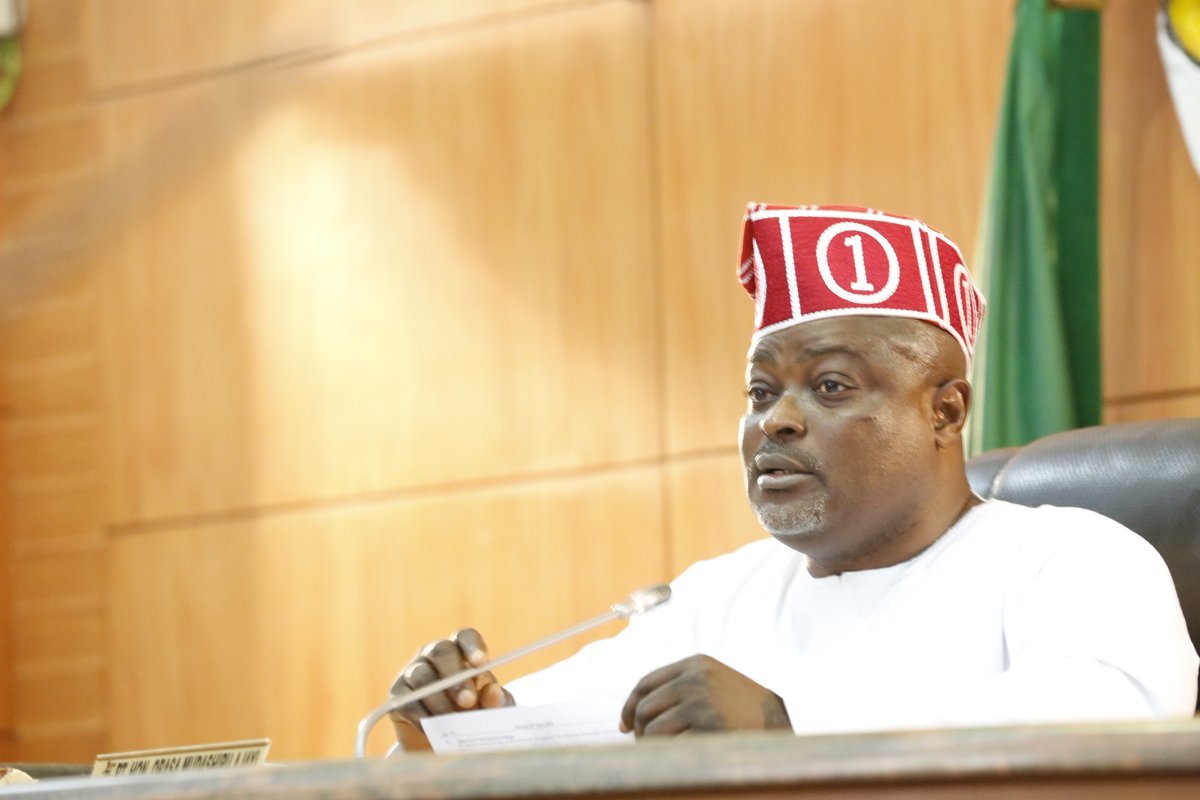
Following weeks of tussle and mourning over his removal as the Speaker of the Lagos State House of Assembly, embattled Lagos lawmaker, Hon Mudashiru Obasa, has approached the court to challenge his removal, dragging the State House of Assembly and the Speaker, Mojisola Meranda.

The lawmaker dragged the duo before a State High Court in Ikeja on Friday, claiming that the lawmakers were wrong to have removed him when the Assembly was on recess. He subscribed to the opinion of a cross section of analysts that his removal was a coup as it happened in his absence.

Recall that Obasa, who has been a Lagos lawmaker for over 20 years, 10 of which he served as Speaker since 2015, was suddenly removed by 36 ouy of the 40 members of the House following a motion moved by the member representing Kosofe Constituency, Hon Femi Saheed under Matter of Urgent Public Importance. The former speaker was accused of financial misappropriation, poor administrative qualities and high handedness among other vices.

In the motion however, dated February 12, 2025, Obasa, through his counsels, led by Chief Afolabi Fashanu SAN, sought an order from the court for an accelerated hearing of the suit.

Obasa, who was out of the country, was removed as the Lagos Assembly speaker on January 13, 2025, by 36 lawmakers, a situation that has since generated unwarranted power play involving members of the Governance Advisory Council (GAC), the highest decision making body of the All Progressives Congress (APC) in Lagos, and to an extent, the Presidency, where the names of President Bola Tinubu, and his wife, Remi, were mentioned as stakeholders in the matter. The members were also at one time invited by the Department of State Security (DSS) for questioning, a move that gave the impression that Tinubu was actually, and not happy with Obasa’s removal. The presidency had since denied Tinubu’s involvement.

Obasa had refused to accept his removal and challenged same upon return to the country, claiming that he remained the speaker while dismissing all allegations against as “fictitious and unsubstantiated”. He insisted that he who alleges must prove.

While addressing supporters on his return, the impeached Speaker maintained that he was not afraid of being impeached but emphasised that due process was not followed, accusing the state Commissioner of Police of aiding the process.

He claimed security agents, led by the police commissioner, invaded the assembly complex and his homes in Agege and Ikeja, locking his family indoors with over 200 officers present.

“I am not afraid of being removed, after all, it is not my father’s chieftaincy title. I am representing my people and they have returned me six times. If you want to do anything, do it well.

“They did the removal all because I was out of the country. Lagos is a special place, we cannot denigrate the state,” he said.

He cited cases of the former speaker, Rt. Hon Jokotola Pelumi, and one time deputy speaker, Hon. Adefunmilayo Tejuosho, who were once removed from office with the aide of the Police.

“When my sister, former deputy speaker of the House, Hon. Adefunmilayo Tejuosho was removed, we did not invite the police.

“The Lagos State House of Assembly is above common standard of excellence.

“I appreciate the members of the governance advisory council and Governor Babajide Olusola Aanwo-Olu of the state. He is my brother and he always calls me his younger brother,” Obasa concluded in what observers described as attempt to curry favour and arouse sympathy.

Among the relief sought by the lawmaker include an order of the court fixing a date for the expeditious hearing of the originating summons, and abridging the time within which the defendants may file their response by way of counter-affidavits/written addresses to seven days after the hearing and determination of the application.

In the motion filed at the court, Obasa also sought an order of the court abridging the time within which the plaintiff may file its reply of points of law to three days.

The embattled lawmaker’s application is predicated on nine grounds, among which is the interpretation of sections 36; 90; 92(2)(c); 101 and 311 of the Constitution of the Federal Republic of Nigeria, 1999 (As amended) vis-à-vis Order V, Rule 18(2) and Order II, Rule 9(1)(ii)(iii)(iv)(v)(vi)(vii)(viii) of Rules and Standing Order of the Lagos State House of Assembly.

Part of the motion reads, “This action challenges the constitutionality of the sitting and proceedings of the Lagos State House of Assembly to sit during recess without the Speaker reconvening the House or giving any other person powers to reconvene the House.

“Public interest requires the case to be heard and determined speedily and expeditiously so that legislative activities in the state are not stalled.

“The legality of the continued sitting of the 1st defendant under the present leadership in violation of the aforementioned laws and rules calls for an urgent determination.

“This Honourable Court is imbued with inherent powers to grant accelerated hearing and abridgment of time.”

Obasa’s resort to the court of law stems from his inordinate ambition to remain perpetually the Speaker, set the records straight and the fact that Members of the Assembly have reaffirmed his removal as authentic just as the GAC has also rejected him as his removal, according to them, was conducted lawfully, in line with constitutional provisions.

In one their statements, e-signed by Hon. (Otunba) Ogundipe Stephen Olukayode, the lawmakers emphasized that the decision adhered strictly to the 1999 Constitution of the Federal Republic of Nigeria and the Powers and Privileges Act. They referenced Sections 92 and 96, which outline the procedures for electing and removing a Speaker, stressing that due process was followed.

“The Lagos State House of Assembly, as an independent arm of government, exercised its constitutional duty in the best interest of the people of Lagos. Any attempt to challenge this lawful action undermines the authority granted to us by the Nigerian Constitution,” the lawmakers stated.

While reiterating their commitment to legislative duties, the Assembly called on all stakeholders, including the executive and the public, to respect the sanctity of legislative processes and avoid undue interference.

Collaborating the stand of the lawmakers, insider source told The Boss that “everything Obasa is doing the last attempt of a dying snake. Even him, himself knows he is a goner. He can either return to the House as a regular lawmaker if actually his claim of serving his people and Lagos is a fact, or tender his resignation and move on. But as far as the speakers hip is concerned, the Assembly has far behind the issue.”


THE SINS OF OBASA

Both stakeholders, observers and politicians alike agree that the erstwhile speaker relapsed into arrogance and haughtiness, resulting in his total disregard of the governor, party structure and party elders.

According to an AfricanReport.com, “this power bestowed on Obasa by Tinubu made him arrogant to the extent of publicly disrespecting Governor Babajide Sanwo-Olu and other leaders.

“During the presentation of the 2025 budget proposal by Governor Sanwo-Olu back in December, Obasa arrived late. His speech at the event, wherein he stated that he was also qualified to be governor, was seen as an insult.”

Quoting a former commissioner in the state, and National Legal Adviser of the APC, Muiz Banire, who spoke on National Television, the paper said “Beyond the issue of the budget and the delay of the governor, Obasa took a position contrary to that of his governor and his party… For him to go against such an establishment, he had to face the consequences.”

It was also alleged that when Tinubu visited Lagos during the Christmas holidays, the political leadership, GAC, laid several complaints before Tinubu against Obasa.

Meanwhile, the new Speaker, Meranda has continued to received goodwill from all and sundry including the GAC, the Executive and the general public, at the eventual takeover, with many vowing their total support to her and the new look Lagos House of Assembly.

Everyone expects a new direction after 10 years of the Obasa leadership, and hopes it would point Lagos to the supposed promised land. But all will depend on the outcome of the lawsuit instituted by Obasa.

Continue Reading
Click to comment

Leave a Reply

Your email address will not be published. Required fields are marked *

Headline

Court Validates PDP 2025 Convention in Ibadan, Affirms Turaki-led NWC

Published

on

By

The Oyo State High Court sitting in Ibadan has affirmed the validity of the 2025 Elective Convention of the Peoples’ Democratic Party (PDP), which produced Dr. Kabiru Turaki as the substantive National Chairman of the party.

Delivering judgment on Friday, Justice Ladiran Akintola upheld the convention in its entirety, ruling that it was conducted in full compliance with the relevant constitutional and statutory provisions governing party elections in Nigeria.

The decision marked a significant legal victory for the party’s leadership and brought clarity to the dispute surrounding the convention’s legitimacy.

The ruling followed an amended originating summons filed by Misibau Adetunmbi (SAN) on behalf of the claimant, Folahan Malomo Adelabi, in Suit No. I/1336/2025.

In a comprehensive judgment, the court granted all 13 reliefs sought by the claimant, effectively endorsing the processes and outcomes of the Ibadan convention.

Justice Akintola held that the convention, organised by the recognised leadership of the party, satisfied all laid-down legal requirements as stipulated in the 1999 Constitution of the Federal Republic of Nigeria, the Electoral Act 2022 (as amended), and the relevant provisions of the Electoral Act 2026.

The court found no breach of due process or statutory non-compliance in the conduct of the exercise.

In the same proceedings, the court dismissed the Motion on Notice seeking a stay of proceedings and suspension of the ruling, filed by Sunday Ibrahim (SAN) on behalf of Austin Nwachukwu and two others. The applications were described as lacking merit.

Earlier in the proceedings, the court had also rejected a bid by Ibrahim to have his clients joined in the suit.

Justice Akintola ruled at the time that the joinder application was unsubstantiated and consequently dismissed it.

Continue Reading

Headline

Opposition Parties Reject 2026 Electoral Act, Demand Fresh Amendment

Published

on

By

Opposition political parties have rejected the 2026 Electoral Act recently passed by the National Assembly, which President Bola Tinubu swiftly signed into law.

The parties called on the National Assembly to immediately begin a fresh amendment process to remove what they described as “all obnoxious provisions” in the law.

Their position was made known at a press briefing themed “Urgent Call to Save Nigeria’s Democracy,” held at the Transcorp Hilton Hotel in Abuja on Thursday.

In a communiqué read by the Chairman of the New Nigeria Peoples Party (NNPP) Ahmed Ajuji, the opposition leaders stated:

“We demand that the National Assembly immediately commence a fresh amendment to the Electoral Act 2026, to remove all obnoxious provisions and ensure that the Act reflects only the will and aspiration of Nigerians for free, fair, transparent and credible electoral process in our country. Nothing short of this will be acceptable to Nigerians.”

Some of the opposition leaders present in at the event include former Senate President David Mark; former Governor of Osun State, Rauf Aregbesola; former Vice President Atiku Abubakar; former Governor of Rivers State, Chibuike Rotimi Amaechi; and former Governor of Anambra State, Peter Obi, all from the African Democratic Congress (ADC).

The National Chairman of the New Nigeria Peoples Party (NNPP), Ahmed Ajuji, and other prominent members of the NNPP, notably Buba Galadima, were also in attendance.

The coalition said the amended law, signed by Bola Tinubu, contains “anti-democratic” clauses, which they argue may weaken electoral transparency and public confidence in the voting system.

At the centre of the opposition’s concerns is the amendment to Section 60(3), which allows presiding officers to rely on manual transmission of election results where there is communication failure.

According to the coalition, the provision weakens the mandatory electronic transmission of results and could create loopholes for manipulation.

They argued that Nigeria’s electoral technology infrastructure is sufficient to support nationwide electronic transmission, citing previous assurances by officials of the Independent National Electoral Commission (INEC).

The parties also rejected the amendment to Section 84, which restricts political parties to direct primaries and consensus methods for candidate selection.

They described the change as an unconstitutional intrusion into the internal affairs of parties, insisting that indirect primaries remain a legitimate democratic option.

The opposition cited alleged irregularities in the recent Federal Capital Territory local government elections as evidence of what they described as a broader pattern of electoral compromise.

They characterised the polls as a “complete fraud” and said the outcome has deepened their lack of confidence in the ability of the electoral system to deliver credible elections in 2027.

The coalition also condemned reported attacks on leaders of the African Democratic Congress in Edo State, describing the incidents as a serious threat to democratic participation and political tolerance.

They warned that increasing violence against opposition figures could destabilise the political environment if not urgently addressed.

In their joint statement, the opposition parties pledged to pursue “every constitutional means” to challenge the Electoral Act 2026 and safeguard voters’ rights.

“We will not be intimidated,” the leaders said, urging civil society organisations and citizens to support efforts aimed at protecting Nigeria’s democratic system.

On February 18, 2026, President Bola Tinubu signed the Electoral Act (Amendment) 2026 into law following its passage by the National Assembly. The Act introduced several reforms, including statutory recognition of the Bimodal Voter Accreditation System and revised election timelines.

However, opposition figures such as Atiku Abubakar and Peter Obi have also called for further amendments, particularly over the manual transmission fallback clause, which critics say leaves room for manipulation.

The president said the law will strengthen democracy and prevent voter disenfranchisement.

Tinubu defended manual collation of results, questioned Nigeria’s readiness for full real-time electronic transmission, and warned against technical glitches and hacking.

The Electoral Act sparked intense debate in the National Assembly over how election results should be transmitted ahead of the 2027 general elections.

Civil society groups under the “Occupy NASS” campaign demanded real-time transmission to curb manipulation.

In the Senate, lawmakers clashed during consideration of Clause 60, which allows manual transmission of results if electronic transmission fails.

Senator Enyinnaya Abaribe (ADC, Abia South) demanded a formal vote to remove the proviso permitting manual transmission, arguing against weakening real-time electronic reporting.

The move led to a heated exchange on the floor, with Senate President Godswill Akpabio initially suggesting the demand had been withdrawn.

After procedural disputes and a brief confrontation among senators, a division was conducted. Fifteen opposition senators voted against retaining the manual transmission proviso, while 55 supported it, allowing the clause to stand.

Earlier proceedings had briefly stalled during clause-by-clause review, prompting consultations and a closed-door session.

In the House of Representatives, a similar disagreement came up over a motion to rescind an earlier decision that mandated compulsory real-time electronic transmission of results to IReV.

Although the “nays” were louder during a voice vote, Speaker Tajudeen Abbas ruled in favour of rescinding the decision, triggering protests and an executive session.

Continue Reading

Headline

AFP: How Tinubu’s Govt Paid Boko Haram ‘Huge’ Ransom, Released Two Terrorists for Kidnapped Saint Mary’s Pupils

Published

on

By

The Nigerian government paid Boko Haram militants a “huge” ransom of millions of dollars to free up to 230 children and staff the jihadists abducted from a Catholic school in November, an AFP investigation revealed Monday.

Two Boko Haram commanders were also freed as part of the deal, which goes against the country’s own law banning payments to kidnappers. The money was delivered by helicopter to Boko Haram’s Gwoza stronghold in northeastern Borno state on the border with Cameroon, intelligence sources told AFP.

The decision to pay the militants is likely to irritate US President Donald Trump, who ordered air strikes on jihadists in northern Nigeria on Christmas Day and has been sent military trainers to help support Nigerian forces.

Nigerian government officials deny any ransom was paid to the armed gang that snatched close to 300 schoolchildren and staff from St. Mary’s boarding school in Papiri in central Niger state on November 21. At least 50 later managed to escape their captors.

Boko Haram has not been previously linked to the kidnapping, but sources told AFP one of its most feared commanders was behind the mass abduction: the notorious jihadist known as Sadiku.

He infamously held up a train from the capital in 2022 and netted hefty ransoms for the release of government officials and other well-off passengers.

Boko Haram, which has waged a bloody insurgency since 2009, is strongest in northeast Nigeria.

But a cell in central Niger state operates under Sadiku’s leadership. The St. Mary’s pupils and staff were freed after two weeks of negotiations led by Nuhu Ribadu, Nigeria’s National Security Adviser, with the government insisting no ransom was paid. Nigeria’s State Security Service flatly denied paying any money, saying “government agents don’t pay ransoms”.

However, four intelligence sources familiar with the talks told AFP the government paid a “huge” ransom to get the pupils back. One source put it at 40 million naira per head – around $7 million in total.

Another put the figure lower at two billion naira overall. The money was delivered by chopper to Ali Ngulde, a Boko Haram commander in the northeast, three sources told AFP.

Due to the lack of communications cover in the remote area, Ngulde had to cross into Cameroon to confirm delivery of the ransom before the first group of 100 children were released.

Nigeria has long been plagued by mass abductions, with criminals and jihadist groups sometimes working together to extort millions from hostages’ families, and authorities seemingly powerless to stop them.

Source: Africanews

Continue Reading

Trending