Islam
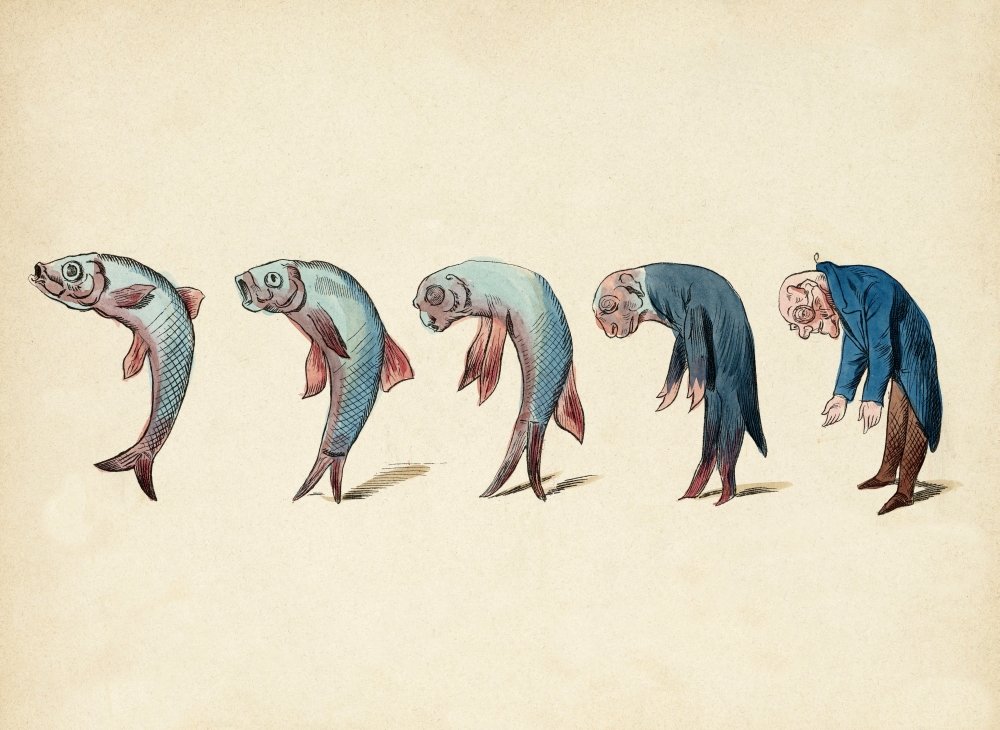
Friday Sermon: Did Humans Actually Evolve from Fish: An Excursion in Evolution
Published
2 years agoon
By
Eric
By Babatunde Jose
And Allah has created every animal from water: Of them there are some that creep on their bellies; some that walk on hind legs; and some that walk on four. Allah creates what He wills; for verily Allah has power over all things. (Quran 24:45)
About 375 million years ago the lobe-finned fish, Tiktaalik, was said to have evolved wrists and ankles which enabled it to use its fins as feet to crawl up the beach, and it or a close relative became the ancestor of all vertebrates that are not fish, including us. John Luczaj – Professor Emeritus (Geoscience) at University of Wisconsin – Green Bay.
All land vertebrates are said to have evolved from a group of lobe-finned fish called crossopterygians. This in itself is a very tendentious statement considering the millions of species of non-fish vertebrates in existence. However, to the utter amazement of biologists, surviving members of the group, called coelacanths, turned up in the Indian Ocean in 1938.
On closer analysis, Amphibians evolved and lived in freshwater. To this day there are no marine amphibians as a result of biological complications.
Studies have shown that amphibians were more amenable in shallow fresh waters where they evolved fully functional limbs before crawling out onto land. Most importantly, amphibians have always been what they are, amphibians. Period. The salamander has not evolved into a crocodile in 375 million years.
Did the amphibians evolve into lions, mammoths, goats, sheep, dinosaurs, and other mammals? Why did some vertebrates continue laying eggs while mammals evolved into having a different reproductive regime?
How come it is only the lobe-finned fish called crossopterygians that developed limbs and all and became amphibians, crawled out of the water, and eventually evolved into land vertebrates? Of all the myriads of creatures in the deep, why the crossopterygians? Did they all evolve into humans because there are facts to suggest that they are not really extinct? To the utter amazement of biologists, surviving members of the group, called coelacanths, turned up in the Indian Ocean in 1938. And interestingly: Modern coelacanths reproduce by internal fertilization, and the mother gives birth to live young.
The Coelacanth are described as living fossils of the sea and are in fact deep sea wonders. Once known only from fossils, the coelacanth was thought to have gone extinct around 65 million years ago, during the great extinction that wiped out the dinosaurs. The coelacanths did not evolve into amphibians as they still live in the deeps.
Fossils of these creatures dated from 80 to 360 million years ago, and yet in 1938, one was found off the coast of South Africa alive. A fish almost entirely unchanged since the days of dinosaurs. Praise God! It had not turned into a human.
This discovery therefore represents one of the most significant natural historical discoveries of recent times. Living at depths of around 200 meters, down in the Twilight Zone of the ocean, they are found around the steep rocky slopes of volcanic islands, venturing forth from their lava-rock caves at night to feed; being passive drift-feeders, they move slow and feed on cephalopods and smaller fish.
Believed by many to have no living relatives, the Coelacanth is a truly unique species. They are the only living vertebrates with a jointed skull that swings upward to greatly increase the gape of the mouth: But they are not amphibians.
Their limb-like pectoral fins are also unique, as they are internally supported by bone, a feature not found in many other fish. They use them in a paddle-like fashion, as if they are walking through the water column.
These unusual features have led to the coelacanth’s evolutionary history becoming a matter of controversy; but most experts argue it is an early ancestor of modern-day bony fish, with lungfish being its closest relative.
The sight of these 2 meter long, 200-pound living fossils drifting in the deep is an ominous sight indeed. With only two known coelacanth populations in the world, both having been isolated for millions of years, their low numbers have led to a classification of critically endangered. Only a very small number of specimens have ever been observed, and without careful management of human activities, this species could be lost forever, after having survived unchanged for millions of years.
There you have it.
Could life as we know it – plant, animal, and human life – have spontaneously happened by chance? Could our amazing solar system be the result of an accident? The more advanced science becomes, the more evidence there is for a Master Designer.
Again, we ask, could humans have evolved from the 2 meter long, 200-pound living fossils?
Recently we read an interesting article in the United Christian Broadcasters’, ‘Word for Today’, where it is said that researchers continue to uncover the divine order in each tiny human cell.
American biochemist Bruce Alberts, former president of the National Academy of Sciences, writes, ‘We have always underestimated cells; undoubtedly we still do…Cells are the basic unit of life…indeed the entire cell can be viewed as a factory that contains an elaborate network of interlocking assembly lines, each of which is composed of a set of different protein machines in defined positions.’
The psalmist David wasn’t a scientist, yet he recognized that each of us is a complex product of God’s amazing hands! ‘You made all the delicate, inner parts of my body and knit me together in my mother’s womb…You watched me as I was being formed in utter seclusion…woven together in the dark of the womb…How precious are your thoughts about me…They cannot be numbered! (Psalm: 13, 15, 17-18 NLT).
The average human heart beats 115,000 times a day. Our blood travels 12,000 miles every day (about three times the length of Lagos to Abuja!). Adults take an average of 18,000 to 30,000 breaths a day, and for the most part, all these functions take place unconsciously. Amazing!
Speaking of our amazing bodies…what about DNA? Each human cell (up to 100 trillion) contains a database larger than the Encyclopedia Britannica! Could all that have originated by chance?
In the Bible, Mathew 6:26-28, we are told to observe intensely God’s handiwork as doing so can deepen our faith, instill confidence in the Creator and build appreciation for God’s wisdom and power.
The Quran reads: He created you (all) from a single person: then created, of like nature, his mate; and he sent down for you eight head of cattle in pairs: He makes you, in the wombs of your mothers, in stages, one after another, in three veils of darkness. such is Allah, your Lord and Cherisher: to Him belongs (all) dominion. There is no god but He: then how are ye turned away (from your true Centre)? (Quran 39:6)
The greatest of all creations is man himself, the marvelous machine – precise and efficient. The body has a chemical plant far more intricate than any plant that man has ever built. This plant changes the food we eat into living tissue. It causes the growth of flesh, blood, bones, and teeth. It even repairs the body when parts are damaged by accident or disease.
As for the human brain, it is ‘… the most complex and orderly arrangement of matter in the universe’, says Isaac Asimov. The brain is the centre of a complex computer system more wonderful than the greatest one ever built by man.
In the body, nerves are the wires that carry the information back and forth from the central nervous system. And in just one human brain there is probably more wiring, more electrical circuitry, than in all the computer systems of the world put together. Yes, it is a wonderful thing.
In our eye the focus and aperture are adjusted automatically; a process called accommodation: The act or state of adjustment or adaptation; the automatic adjustment in the focal length of the lens of the eye to permit retinal focus of images of objects at varying distances.
The heart actually is a muscular pump forcing blood through thousands of miles of blood vessels. Blood carries food and oxygen to every part of the body. The heart pumps an average of six liters (1.5 U.S. gallons) of blood every minute, and in one day pumps enough blood to fill more than forty 200-litre drums.
A far more astonishing wonder is in the development of the human embryos. See (Quran 23:12-14) The wonders which occur during the nine-month gestation period are unsurpassable.
During the first four weeks of the new life, billions of cells are formed, and they arrange themselves according to a fascinating plan to shape the new human being: A dramatic new development occurs; the first blood vessels appear. A few days later, within the tiny breast of the 1.7 mm long embryo two blood vessels join to form the heart, which begins to pump blood through the miniscule body. The tiny new heart provides the developing brain with blood and oxygen.
In the fourth month, the heart of the fetus already pumps almost 30 liters of blood per day, and at birth this volume will increase to about 350 liters.
In the embryonic stage, lungs, eyes, and ears develop, although they are not used yet. After two months, the embryo is only three to four centimeters long. But even at this stage all organs are already present. During the following months the organs increase in size and assume their eventual shape. Allahu Akbar!
All these because about 375 million years ago the lobe-finned fish, Tiktaalik, evolved wrists and ankles which enabled it to use its fins as feet to crawl up the beach and evolve into man. Na juju be that!!!
How is it possible that embryonic development does not entail disorderly growth of cells, but is systematic and purposeful according to a set timetable? A precise plan, in which all stages are programmed in the finest detail, underlies all these processes. Surely, there is God!
Prominent scientist Francis Crick wasn’t noted for his faith, but even he said: ‘The origin of life seems almost to be a miracle, so many are the conditions which would have had to have been satisfied to get it going.’ Let us ponder and reflect.
Barka Juma’at and Happy weekend.
Related
You may like
Islam
Friday Sermon: Religion: Reflecting the Violence and Desperation of Our Time
Published
2 days agoon
December 19, 2025By
Eric
By Babatunde Jose
Recently, the country has been entangled in a controversy over allegations of persecution of Christians. Like in many other regions of the world, many of our difficulties mask a deeper spiritual crisis. During the twentieth century, we saw the eruption of violence on an unprecedented scale. Sadly, our ability to harm and mutilate one another has kept pace with our extraordinary economic and scientific progress.
We seem to lack the wisdom to hold our aggression in check and keep it within safe and appropriate bounds. The explosion of the first atomic bombs over Hiroshima and Nagasaki laid bare the nihilistic self-destruction at the heart of the brilliant achievements of our modern culture. Here in this clime the ubiquitous cattle Fulani and their sanda have been suddenly transformed into wielding military-grade weaponry. What’s going on?
Auschwitz, Rwanda, Bosnia, and the destruction of the World Trade Center were all dark epiphanies that revealed what can happen when the sense of the sacred inviolability of every single human being has been lost.
Religion, which is supposed to help us to cultivate this sense of sacredness often, seems to have lost its influence. Almost every day we see examples of religiously motivated terrorism, hatred, and intolerance. We all look for moments of ecstasy and rapture, when we inhabit our humanity more fully than usual and feel deeply touched within and lifted momentarily beyond ourselves.
In recent decades, there has been a spiritual revival in many parts of the world, and the militant piety that we often call “fundamentalism” is only one manifestation of our postmodern search for enlightenment. This trend is very much pronounced in our clime: Especially since the dawn of the Islamic fundamentalist group Boko Haram and others.
It is frequently assumed, for example, that faith is a matter of believing certain creedal propositions. Indeed, it is common to call religious people “believers,” as though assenting to the articles of faith were their chief activity.
What matteres is not what you believe but how you behave. Religion is about doing things that change you at a profound level. The only way you could encounter what they call “God,” “Nirvana,” “Brahman,” or the “Way” is to live a compassionate life. Indeed, religion is compassion.
Religion which ought to bring some temperance into the political atmosphere and check the utterances and behaviors of political players has sadly failed. Rather, religion has formed an alliance with the political actors and in the process the conscience of the people has been killed.
In the Nigerian setting, it has been a catalogue of conflicts, bloodshed, lootings and all kinds of exploitation. This seems to confirm the Marxist perspective on religion. Lenin writes: Religion is one of the forms of spiritual oppression which everywhere weighs heavily upon the masses of the people over–burdened by their perpetual work for others, by want and isolation. . . . those who live by the labour of others are taught by religion to practice charity while on earth, thus offering them a cheap way of justifying their existence as exploiters. Religion is the opium for the people. Religion is a sort of spiritual booze in which the slaves of capital drown their human image, their demand for a life more or less worthy of man.
According to A.C. Bouquet, Religion is a fixed relationship between the human entity, the sacred, the supernatural, the self-existent, the absolute or simply God. (J.I. Omoregbe, A Philosophical Look at Religion. Lagos: 1993).
However, religion could be seen as human activities manifesting through beliefs and ritual practices in response to the Super-sensible Being, believed to exist.
Seeing as it were that man is homo politicus and at the same time homo religio, it follows that we cannot do without politics as well as religion in our everyday life. Therefore, we tend to politicize religion and religionize politics. Mixing the two however makes religion lose its sacredness and it becomes a lethal weapon.
This is the reality of our post-colonial state, particularly the capture and control of state power by a self-centered and divided political class. They whip up religious sentiments, weaponizing it and accentuating its divisive tendencies. Hence, almost all political actions are seen through the prism of religion.
The Boko Haram issue is also a good example. These misguided terrorists and their local and international sponsors have continued to wreak havoc on our society, killing, kidnapping and maiming, regardless of the religious affiliation of their victims. Yet, they have been seen as an arm of a wider Islamic tendency to Islamize the country. Interestingly, Boko Haram has refused to travel across the Niger or Benue rivers. It’s supposed Islamization has been localized to the predominantly Muslim North! Islamizing wetin?
Today, the politics of religious identification and affiliation now revolves around the religious inclination of the political leadership of the country. Hence, Muslims identify with a Moslem president and support him regardless of policy issues. This was also the case of the massive support of the Christian community for the presidency of Obasanjo and Jonathan: And the apogee of CAN in Nigerian politics.
It is, however, inconceivable and an over-stretch of the imagination bordering on incredulity for anyone to say that a President harbors an agenda to Islamize or Christianize Nigeria, the days of Jihad and Missionary Evangelism have passed. It is now all about money.
Religion and politics some may argue should not mix but it is obvious that religion cannot be divorced from politics; especially in a society where political leadership finds it very convenient to hide under the umbrella of religion. There is no doubt, as Prof Ali Mazrui noted:
In those African countries, where Islam is in serious competition with Christianity and both are politicized, the two creeds become divisive rather than unifying, destabilizing rather than legitimizing. Where religion reinforces ethnic differences on regional variation, governments become less stable rather than more… On the whole, the two Semitic religions in Nigeria, Christianity and Islam reinforce regional and ethnic differences, and make stability more difficult. (Mazrui, A.A. (1996) “Military Intervention in African Politics”. In Ralph Uwechue (ed), Africa Today. Third Edition. United Kingdom)
The ferocious gyration of Nigerians about religious matters which will not be replicated when it comes to national interest has weakened the Nigerian state. A survey of ethno-religious crisis in Nigeria reveals that blood of innocent Nigerians are shed and properties destroyed on account of this passion, fervor, emotional and emotive reactions, moral certitude, and religiosity. (Ojo, E.O. (2006) “A Survey of Ethno-Religious Crisis in Nigeria and its implication for Democracy” in Ojo, E.O. (ed). Challenges of Sustainable Democracy in Nigeria; Ibadan).
The political class cannot exonerate itself from the present predicament of Nigeria. A lot of useful energy is diverted to building religious sentiment. Rather than mobilize Nigerians to their cause as politicians, the new political elites are busy mobilizing their religious constituencies for a war against one another. With religion generating so much passion, the polarization of the nation has found full expression as the country is finally pitched as a battleground between Christians and Muslims.
“Religion does not make people good or bad. On the contrary, it is being used as an instrument of oppression and deceit in Nigeria. It appears that Nigerians have resigned themselves to fate, and this is possibly further compounded by poverty, illiteracy, and lack of political education on the part of the majority.” (Egbewole, W. O., and Etudaiye, M. A. (2011). Religion, Politics and Justice: Interplay of Forces in Nigeria).
The manipulation of religion by some powerful individuals who hide under the guise of religion to pursue selfish interests, and the greed and avariciousness of some religious leaders who patronize corrupt rulers remains part of the negative effects of religion on the polity.
Efforts by Nigerian politicians to gain ascendancy and power have led to a situation in which politics have swept away sacred precepts of religion, and in the process, contaminated the hearts of people with bitterness and enmity for the religion of others.
“The effect of religion on politics all over the world is bifocal, in the sense that it is both positive and negative. It is positive in the sense that religion, as earlier identified, is value-driven and it naturally robs off on the polity through the participation of ardent religious believers. The negative effect could be deciphered from the perspective of sectarian tendency; where religious bigots do anything in the name of religion to ensure that positions or offices are gained by their adherents. Such people stand on the position that their ideals and beliefs dominate any environment they find themselves in.” (New York Times, 2005).
Unfortunately, the North has always been the bedrock of religious crisis. Since 1992, over tens of thousands of people have died from communal-religious conflicts. Plateau, Benue, Taraba, Borno, and Kaduna States constitute the highest figure of casualties. In recent years, incidents of Christian/Muslim violence have become more frequent and bloodier.
Insecurity in Northern Nigeria has reached alarming levels, driven by a complex interplay of socio-economic, political, and structural factors, leading to significant loss of life and widespread suffering. The National Security Adviser, Nuhu Ribadu, reported that over 47,000 lives were lost to insecurity in the North before the current administration took office, highlighting the dire state of security in the region.
The insecurity in Northern Nigeria is attributed to several interrelated factors, including: High levels of poverty and unemployment have fueled discontent and violence, particularly among the youth.
The region is plagued by ethno-religious violence and land-related conflicts, which often result in killings and displacements.
Corruption and ineffective governance have exacerbated the security situation, leading to a lack of trust in government institutions.
The activities of groups like Boko Haram and other bandits, have intensified insecurity, with Boko Haram alone accounting for over 35,000 deaths in the North-East.
The consequences of this insecurity are profound, affecting various aspects of life in Northern Nigeria: Millions have been displaced from their homes due to violence, leading to a humanitarian crisis.
Insecurity has disrupted local economies, leading to food shortages and loss of livelihoods. Many children have been forced out of school due to the violence, further perpetuating the cycle of poverty and insecurity.
To address the insecurity in Northern Nigeria, experts recommend strengthening security institutions including improving the capacity and effectiveness of security forces to combat violence.
Need to encourage community-led peace building initiatives to foster trust and cooperation among different groups.
Initiate economic development issues such as investing in entrepreneurship and job creation to alleviate poverty and reduce the appeal of militant groups.
In conclusion, the insecurity in Northern Nigeria and Nigeria as a whole is a multifaceted issue that requires urgent and comprehensive action from both the government and local communities to restore peace and stability. But, it is not a religious issue. Ethnicity and religion have a curious mix in the matter.
Guide us to the straight path. The path of those upon whom You have bestowed favor, not of those who have evoked [Your] anger or of those who are astray. (Quran 1:6-7)
Barka Juma’at and a happy weekend
In the name of God, the Most Gracious, the Most Merciful, I wish to thank Allah Subhanahu Wa Ta’ala for His Grace and mercies. Next week, Thursday 25th December, our brother Babatunde Jose will add another year to his sojourn on this earth. Alhamdulillah, he will turn 76; going up in the evening of life. May it please Allah to bless the new age and may his days be long in good health. Every waking day, we move nearer the grave. May Allah teach us how to number our days and guide us into living a righteous life. For those who have walked with me this far, I thank you all, may Allah accept our prayers and supplications. It is well, even in the well!
Babatunde Jose – +234 803 311 0822
Related
Islam
Friday Sermon: Climate Change and the Hands of God
Published
1 week agoon
December 12, 2025By
Eric
Allah has created the universe in all its diversity, richness and vitality: The stars, the sun and moon, the earth and all its communities of living beings. All these reflect and manifest the boundless glory and mercy of their Creator. All created beings by nature serve and glorify their Maker, all bow to their Lord’s will. We human beings are created to serve the Lord of all beings, to work the greatest good we can for all the species, individuals, and generations of God’s creatures.
In the Quran, Allah is depicted as the controller of nature, gently driving clouds, merging them, and allowing rain to fall as He wills. The Quran emphasizes the importance of not spreading corruption on earth, which includes theft, fraud, and environmental degradation. As global warming and environmental issues increasingly affect our world, Islamic teachings underscore the need for environmental stewardship, reminding us to respect and care for our planet.
The Quran and Sunnah provide significant lessons on the relationship between humans and the environment, highlighting the moral responsibility to preserve natural resources. Severe weather events, such as storms and hail, are acknowledged but are not overtly tied to apocalyptic signs in Islamic texts. Verse 11 in Surah Az-Zukhruf emphasizes that rain is sent down in measured amounts, reflecting Allah’s control over the environment. There should be no doubt about this.
Islam cautions against wastefulness in resource usage, using terms like ‘Tabdhir’ (squandering) and ‘Israaf’ (extravagance) to convey the importance of balance and conservation. The Quran offers timeless guidance on living harmoniously within our ecological limits, promoting the thoughtful use of natural resources for the benefit of all creatures. This speaks to the flaring of gas in our oil fields.
The Quran explicitly advises against wastefulness, with verses reminding believers of the importance of using resources thoughtfully. Allah says in the Quran: “, but do not waste; verily, He does not love the wasteful.” (Quran 7:31)
By embracing these principles, Muslims can positively impact the environment. The Quran reminds us of Allah’s provisions, such as the creation of the ozone layer, which protects life on earth. Additionally, weather forecasting is viewed as an informed practice based on observing nature. In summary, the Quran provides profound insights that advocate for environmental awareness and responsibility, urging believers to act diligently in caring for the earth.
However, we should be cautious when discussing the issue of climate change in abstraction. The world and the universe were created by an All-Knowing God who apportioned with precision the provisions he has made. “Do not those who disbelieve see that the heavens and the earth were a closed-up mass, then We opened them out? And We made from water every living thing. Will they not then believe?” (Quran 21:30)
Knowing that we would one day transit from one energy source to another in order to maintain the growing population which he had commanded to ‘be fruitful and multiply’, Allah in His wisdom buried hydrocarbon in the soils of Saudi Arabia, Iran, Iraq, Uzbekistan, Nigeria, Angola, United States, Venezuela, Russia and many other countries. God was not stupid; He was provisioning us with sources of energy.
However, in the course of its usage, these gifts of fossil fuel are now turning into our albatross as a result of global warming. Allah has warned us in the Quran to use whatever we were given judiciously without committing excesses.
The Quran sets forth key principles of eco-consciousness that resonate with us as believers. Concepts such as responsible consumption, avoiding wastefulness, and nurturing the land highlight our role in environmental protection. The teachings encourage us to view nature as a divine trust, prompting us to respect and preserve the ecosystem as part of our spiritual obligation.
The Quranic perspective on the environment is not merely a set of guidelines but a comprehensive framework that shapes how Muslims interact with the natural world. These teachings are deeply embedded in the concepts of stewardship, balance, respect, and conservation.
With this in mind, we have a significant role to play in addressing climate change through the lens of Islam. Our faith encourages stewardship of the Earth and making choices that reflect a commitment to sustainability. By incorporating environmentally-friendly practices into our daily life, we can fulfill this Islamic responsibility and contribute to a healthier planet.
According to Islamic teachings, humans are Allah’s vicegerents (khalifah) on Earth see Quran 2:30. The theology of creation emphasizes that humans have a responsibility to manage and protect the environment and to use their abilities in accordance with divine guidance. This stewardship is integral to fulfilling their role as vicegerents on Earth.
The greatest contributor to climate change, if truth must be told, has been the phenomenal industrial and socio economic development of the First World. From coal fired energy sources to oil and gas, the climate effect cannot be overemphasized. There is also the need for heating fuel during winter, without which people in the cool temperate regions would freeze to death.
The People’s Republic of China, the United States, India, the European Union, Indonesia, the Russian Federation, and Brazil accounted for half of all global greenhouse gas emissions. This is an inevitable corollary of industrial development.
The US military is the single largest institutional consumer of fuel in the world. Credible estimates place it in the range of 80 to 90 million barrels of fuel per year. This staggering figure highlights the military’s dependence on fossil fuels and the significant logistical challenges involved in supplying forces around the globe.
Beginning during the second half of the twentieth century, fossil fuel consumption by the world’s militaries grew substantially. As warfare has become increasingly carbon intensive, military aircraft and other large war machines have continued to guzzle massive amounts of gasoline, diesel, and jet fuel. Today’s modern armies, air forces, and naval fleets are consuming fossil fuels at unprecedented rates. In addition to using fossil fuels to power machinery like tanks and battleships, weapons manufacturing also guzzles a significant amount of energy and fossil fuels.
Former Director of the Central Intelligence Agency and retired United States Army General David Petraeus once famously said, “Energy is the lifeblood of our war fighting capabilities” (Crawford, 2019). As the world’s largest military power, the U.S. military is the single biggest consumer of fossil fuels and producer of greenhouse gas emissions in the world. In addition to concerns about climate change, American military officials continue to highlight the national security implications of being overly dependent on fossil fuels.
Since the 1800s, human activities have caused shifts in weather conditions, chiefly because human activity has increased exponentially as a result of the quantum leap of world population.
Burning fossil fuels can cause global warming as it releases large amounts of carbon dioxide and greenhouse gas into the air, which can trap the sun’s heat and increase temperatures. These however cannot be helped. The burning of fossil fuel as coal, oil and gas are corollary of human population development. More than half of the current world population depends on firewood, coal and other fuels for their livelihood.
The pace of Global climate change today is of a different order of magnitude from the gradual changes that previously occurred throughout the most recent era, the Cenozoic. Moreover, it is human-induced: we have now become a force dominating nature. The epoch in which we live has increasingly been described in geological terms as the Anthropocene, or “Age of Humans”.
Our species, though selected to be a caretaker or steward (khalifah) on the earth, has been the cause of such corruption and devastation on it that we are in danger of ending life as we know it on our planet.
This current rate of climate change cannot be sustained, and the earth’s fine equilibrium (mīzān) may soon be lost. As we humans are woven into the fabric of the natural world, its gifts are for us to savour.
But the same fossil fuels that helped us achieve most of the prosperity we see today are the main cause of climate change. In the brief period since the Industrial Revolution, humans have consumed much of the non-renewable resources which have taken the earth 250 million years to produce – all in the name of economic development and human progress.
We note with alarm the combined impacts of rising per capita consumption combined with the rising human population. We also note with alarm the multi-national scramble now taking place for more fossil fuel deposits under the dissolving ice caps in the arctic regions. We are accelerating our own destruction through these processes.
Excessive pollution from fossil fuels threatens to destroy the gifts bestowed on us by Allah – gifts such as a functioning climate, healthy air to breathe, regular seasons, and living oceans. But our attitude to these gifts has been short-sighted, and we have abused them. What will future generations say of us, who leave them a degraded planet as our legacy?
Our planet has existed for billions of years and climate change in itself is not new. The earth’s climate has gone through phases wet and dry, cold and warm, in response to many natural factors. Most of these changes have been gradual, so that the forms and communities of life have adjusted accordingly. There have been catastrophic climate changes that brought about mass extinctions, but over time, life adjusted even to these impacts, flowering anew in the emergence of balanced ecosystems such as those we treasure today. Climate change in the past was also instrumental in laying down immense stores of fossil fuels from which we derive benefits today. Ironically, our unwise and short-sighted use of these resources is now resulting in the destruction of the very conditions that have made our life on earth possible.
Rabbana atina fid dunya hasanatan wa fil Aakhirati hasanatan waqina ‘adhaban-nar: Our Lord, give us in this world [that which is] good and in the Hereafter [that which is] good and protect us from the punishment of the Fire.
Barka Juma’at and a happy weekend
Related
Islam
Friday Sermon: Pride and the Pitfalls of Arrogance
Published
2 weeks agoon
December 4, 2025By
Eric
“Pride goes before destruction, and a haughty spirit before a fall.” Proverbs 16:18 .
The problem with pride is that it is a dangerous and deceptive sin. Nothing brings more destruction to our nation, homes, and relationships than a prideful spirit.
Adrian Rogers says, “Pride is a problem that all wrestle with, and those who think they don’t have it probably have more of it.”
A good self-image or self-esteem is not pride; neither is receiving honor or awards we’ve worked for.
Pride is an attitude of independence from God; it is a spirit of ungratefulness to God. A prideful person esteems himself better than other people.
The great sin of pride is a snare into which we fall all too easily, and its deceitful road leads only to destruction. Charles Haddon Spurgeon (Late Baptist preacher) declares that “There is nothing into which the heart of man so easily falls as pride, and yet there is no vice which is more frequently, more emphatically, and more eloquently condemned in Scripture.”
Unchastity, anger, gluttony, arrogance, conceit, drunkenness, and all that, are mere flea bites in comparison: it was through Pride that the devil became the devil: Pride leads to every other vice: it is the complete anti-God state of mind…… it is Pride which has been the chief cause of misery in every nation and every family since the world began.
Pride defies God; it is a fist in His face. Pride is what created the devil and ruined the human race in the Garden of Eden. God hates it, and when we harbor pride in our hearts, we become His adversary.
Pride divides society; there has never been an argument, a war, a divorce, or church split apart where pride was not the major factor.
Pride dishonors life; in the pursuit of honor, pride brings shame. Proverbs 29:23 says, “A man’s pride will bring him low, but the humble in spirit will retain honor.”
Pride is the road to ultimate ruin—national, domestic, financial, emotional, spiritual, and eternal ruin—because it destroys all that it controls.
Pride is a matter of the heart; if we are not right with God, we cannot be right with one another. But the grace of God is sufficient for everyone. James 4:6 says, “God resists the proud, but gives grace to the humble.”
There is none so bad he cannot be saved, there is none so good he doesn’t need saving. Defeating pride begins with humbling ourselves before God.
A profane person is one who has no spiritual conception, who sets no value on a birthright, and will sell it for red pottage. A profane person has no consciousness of the eternal, no commerce with the spiritual, is proud of animal ability, and acts as though independent of God. Profanity never prays, never worships, never speaks of spiritual intercourse, has no traffic with the eternities, no commerce with heaven.
What is pride? Pride is an attitude of independence from God. Pride is a spirit of ungratefulness to God. God has so blessed us. We have so many things. We act like we deserve it and have earned it, and it is ours.
Some may say that they worked for what they have. Who gave us the ingenuity to work? Who gave us the strength and energy? We do not have one thing that we have not received. Pride is esteeming ourselves better than other people.
A proud person becomes irritated when corrected for mistakes. A proud person accepts praise for things over which he or she has no control, such as beauty, talent, and abilities. Those are gifts.
C.S. Lewis said that pride gets no pleasure out of having something, only out of having more of it than the other man.
The Quran states that Allah does not like the arrogant and boastful, and those with an atom’s weight of arrogance in their heart will not enter Paradise. Humility, on the other hand, is a central goal of spiritual purification and is seen as the opposite of pride.
The concept of conceit, expressed in the Quran with terms like ‘mukhtal’ (self-deluded) and ‘fakhur’ (boastful), is a severely condemned spiritual disease. Pride is a direct challenge to Allah’s attribute of Al-Kabeer (The Greatest). Allah explicitly states His dislike for the arrogant and boastful.
Tafsir by authorities like Ibn Kathir on Quran 4:36 For Allah loveth not the arrogant, the vainglorious; and 57:23 For Allah loveth not any vainglorious boaster; clarifies that this refers to an arrogant individual who is pleased with themselves and boastful to others, while being ungrateful to Allah for His blessings.
In classical Islamic scholarship, pride (Al-Kibr) is a grave spiritual malady of the heart, defined by the Prophet Muhammad (SAW) as the dual act of rejecting divine truth and holding people in contempt. Classical authorities like Imam Al-Ghazali elaborate that it is an internal sense of self-aggrandizement that positions oneself above others and, ultimately, above the truth itself.
Across the 11 key Quranic verses on this topic, from the ‘pride in sin’ (2:206) “When it is said to him, “Fear Allah,” he is led by arrogance to (more) crime. Enough for him is Hell; – an evil bed indeed (to lie on)!” – to turning away from people scornfully (31:18); a consistent theme emerges: Pride is the primary veil that blinds the heart to guidance and severs the connection with Allah.
Ibn Kathir’s tafsir confirms that this was the foundational sin of Iblis and the cause of ruin for past nations who rejected their prophets. This synthesis establishes pride not merely as a negative trait but as a direct challenge to divine authority and a fundamental obstacle to spiritual purification.
In theological perspective, pride is a spiritual disease of the heart (qalb) that corrupts faith and actions.
Seen as the root of narcissism, inability to accept criticism, and contempt for others, leading to social isolation and spiritual ruin; Pride seals the heart from accepting truth and guidance from Allah and His messengers.
Overcoming pride and cultivating its opposite, humility, is a central goal of spiritual purification.
Prophet Muhammad (SAW) warned severely against it, stating that no one with an atom’s weight of arrogance in their heart will enter Paradise.
There is a powerful connection between pride and the senses. Verses like 22:9 (Disdainfully) bending his side, in order to lead (men) astray from the Path of Allah: For him there is disgrace in this life, and on the Day of Judgment We shall make him taste the Penalty of burning (Fire). And 75:33 Then did he stalk to his family in full conceit! show that internal arrogance is not abstract; it physically manifests in one’s posture, gait, and even the direction of one’s gaze. This proves that purification in Islam is holistic, requiring both internal change and external correction. — Al-Ghazali, Al-Qurtubi
A cross-verse synthesis of ‘pride in sin’ (2:206) and ‘pride of ignorance’ (48:26) uncovers a critical insight: pride creates a self-reinforcing cycle. The ‘pride of ignorance’ prevents one from seeking knowledge, and the ‘pride in sin’ prevents one from accepting correction, trapping the individual in a downward spiral of ignorance and disobedience, a spiritual feedback loop that only humility can break.
One recurring theme emphasized throughout the Quran is the importance of humility and the warning against pride and arrogance. These negative traits are viewed as obstacles in the spiritual journey, hindering individuals from attaining closeness to Allah and fostering harmonious relationships with others.
Surah Luqman, verse 18, states formerly cited highlights the detestable nature of arrogance and also contrary to the qualities that Allah desires in His servants.
“Indeed, He does not like the arrogant.” (Quran 16:23). This verse serves as a clear message that pride and arrogance find no favor in the sight of Allah.
Surah Al-Baqarah, verse 206, illustrates the grave consequences of arrogance. It highlights that when individuals become self-absorbed and disregard the guidance of Allah, they pave the way for their own spiritual downfall.
Surah Al-Furqan, verse 63, provides a contrasting image: “And the servants of the Most Merciful are those who walk upon the earth easily, and when the ignorant address them [harshly], they say [words of] peace.” This verse showcases the virtue of humility in the face of adversity.
The Holy Quran serves as a beacon of guidance for Muslims, offering profound insights into various aspects of life. Among the recurring themes emphasized in the Quran are the condemnation of pride and arrogance, and the promotion of humility. These negative traits are seen as hindrances to spiritual growth and detrimental to one’s relationship with Allah and fellow human beings. These verses underscore the importance of humbleness, while warning against the pitfalls of arrogance.
By cultivating humility in their hearts and actions, believers can strive to embody the virtues that Allah seeks in His servants, fostering an atmosphere of love, respect, and harmony within themselves and their communities.
Today, we celebrate the birthday of a virtuous woman of impeccable humility and godliness who has demonstrated forbearance and patience. A paragon of beauty, resilience and acceptance: We present to you our amiable sister Alhaja Lateefah Abimbola Kuru (the last daughter), retired but not tired and ever smiling. May Allah bless her new age and bless her home. Grant her good health and the wherewithal to take care of Amal, her lovely daughter. Bola, happy birthday and Allah’s everlasting blessings.
Barka juma’at and happy weekend.
Related


Another 115 Students of Catholic Missionary School Papiri Reportedly Regain Freedom
Voice of Emancipation: Christmas: A Time to Reflect
Adeleke Celebrates Owa Obokun, Ijesa People on Iwude Ijesha Festival
Hollywood Bubbles As Season of Awards Sets in
Consistent, Focused, Impactful: The Story of Bella Disu
Tinubu’s 2026 Budget Bad Omen for Nigerians – PDP
Actress Iyabo Ojo Makes Case for Single Mothers
NNPCL Slashes Fuel Price by N80
Alleged Corrupt Practices: Dangote Petitions ICPC Against NMDPRA MD Farouk
Book Launch: Tinubu Vows to Sustain Buhari’s Legacies
Corruption Allegations: NMDPRA Boss Farouk Ahmed Meets Tinubu, Resigns
I’m Ready for Probe, NMDPRA Boss Farouk Ahmed Responds to Dangote’s Corruption Allegation
Tinubu Didn’t Win 2023 Election, Will Lose in 2027 – Abaribe
US Congressman Recounts Harrowing Experience in Nigeria, Confirms ‘Systematic Genocidal Campaign’
Trending
-
Business2 days agoNNPCL Slashes Fuel Price by N80
-
Headline5 days agoAlleged Corrupt Practices: Dangote Petitions ICPC Against NMDPRA MD Farouk
-
National5 days agoBook Launch: Tinubu Vows to Sustain Buhari’s Legacies
-
Headline4 days agoCorruption Allegations: NMDPRA Boss Farouk Ahmed Meets Tinubu, Resigns
-
National4 days agoI’m Ready for Probe, NMDPRA Boss Farouk Ahmed Responds to Dangote’s Corruption Allegation
-
Headline5 days agoTinubu Didn’t Win 2023 Election, Will Lose in 2027 – Abaribe
-
World5 days agoUS Congressman Recounts Harrowing Experience in Nigeria, Confirms ‘Systematic Genocidal Campaign’
-
Headline3 days agoFree at Last: Burkina Faso Releases 11 Nigerian Soldiers, Aircraft