Headline
Grazing Route: Can Buhari Dare His Own Governors?
Published
4 years agoon
By
Eric
By Eric Elezuo
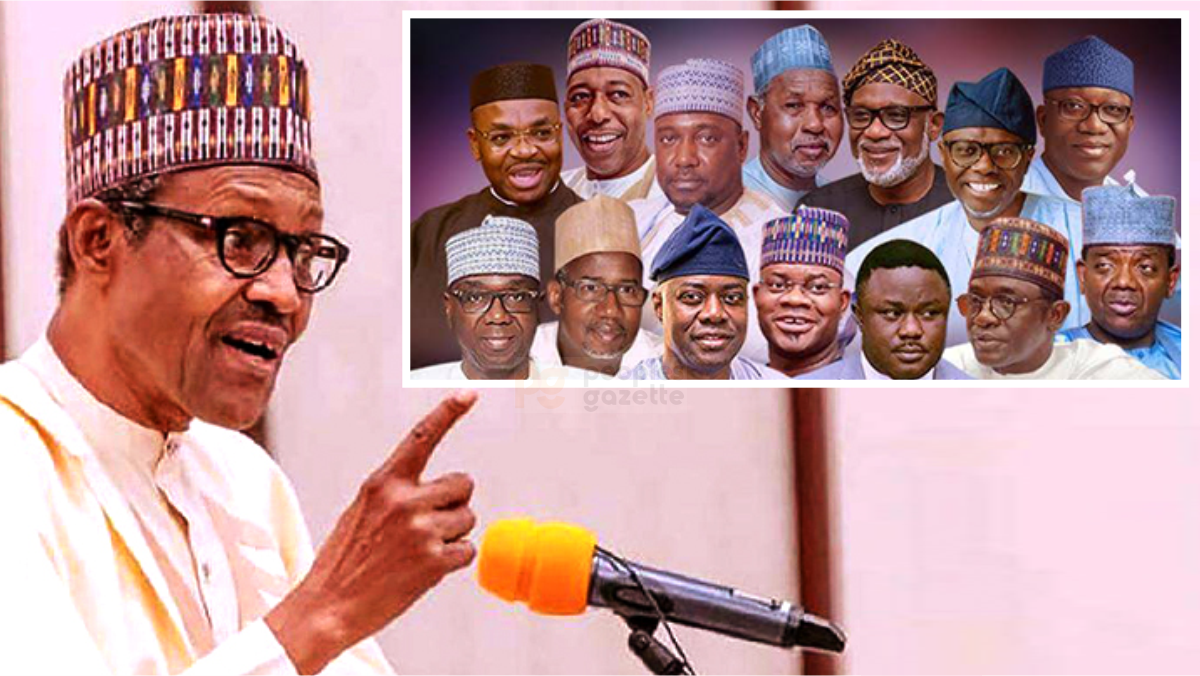
At two separate meetings held in May and July 2021 in Asaba and Lagos respectively, 17 southern governors unanimously agreed to ban open grazing in their states in a bid to curb growing insecurity in the region. Their action, however, appears to put a clog in regards for President Muhammadu Buhari, who particularly, is against such moves having proposed the RUGA alternatives as well as the resuscitation of the long abandoned grazing routes.
President Buhari had given his directive on revival of grazing routes while fielding questions during an Arise Television interview. The directive has met with diverse reactions among state governments across the country.
Buhari had said that approval had been given for the reclamation of grazing routes as a way out of the perennial farmer-herders conflicts. This directive, stakeholders have noted, was rooted in the First Republic concept in which there were designated routes where herders moved cattle in different parts of the country.
The move generated mixed feelings among Nigerians. While some, mostly from the northern parts supported the move, which they said would end the protracted farmer-herder clashes, governors, socio-cultural groups, farmers and other stakeholders from the south opposed it.
However, the governors, many of whom are of All Progressives Congress (APC) extraction, the president’s party, threw caution to the winds, deciding to toe the line of the region. Some of them have harboured a feeling, justifiably though, that Mr. President is either not capable of the confronting the insecurity in the region occasioned by the marauding herdsmen or he is completely nonchalant of the deadly situation. This stance tended to declare a ‘to your tents O Israel’ situation among the 17 states that make the southern region.
The group had therefore, given itself till September 1, 2021 to pass and sign into law every machinery required to ensure that open grazing is forbidden in the region. This will put paid to the grazing route proposal by the president, a move most analysts wondered why the president should even mute the idea, seeing that time and development have overtaken the matter.
But reactions trailed the southern governors resolution from many quarters including the presidency and Fulani groups.
A Fulani group, Gan Allah Fulani Development Association, warned against the decision of the Southern governors to ban open grazing in their states.
It explained that a ban on open grazing in Southern states would lead to a breakdown of peace between Northerners and their neighbours from the South.
The group described the resolution as unfortunate and capable of affecting Nigeria’s unity.
The group’s National Secretary, Ibrahim Abdullahi, described the resolution as unfortunate and capable of affecting Nigeria’s unity, adding that it was impossible because they have not made an alternative plan for herders.
He stated that the decision of the governors would promote hatred between Southerners and Northerners.
“If you stop open grazing in the South, you are simply saying that those people should move to the North or they should move to other parts of the country. What happens if those in the North also ask the Southerners to leave?
“Are we promoting unity or hatred? What the governors are saying is practically impossible and it does not promote the unity of this country.
“You don’t stop people’s means of living and expect peace to reign. So, the implication is that the unity of Nigeria is going to be in question.
“You don’t expect those that will be affected to return to the North and live in peace with people from the South living in the North.”
As the matter raged, President Buhari, through his media aide, Garba Shehu, responded as follows:
PRESIDENT BUHARI OKAYS DEEP ROOTED SOLUTIONS TO HERDSMEN ATTACKS, CLEARS WAY FOR RANCHING AND REVIVAL OF FOREST RESERVES
President Muhammadu Buhari has expressed a strong resolve to address the conflicts of herders and farmers in a sustained and lasting manner that should lead to the emergence of a permanent solution to the frequent clashes between them, as well as the associated problem of the gun-wielding “killer herdsmen.”
The President had approved a number of specific measures to bring a permanent end to the frequent skirmishes as recommended by Alhaji Sabo Nanono, the Minister of Agriculture in a report he submitted and the President signed off on it back in April, well before the actions of the Southern Governors Forum which attempts to place a ban on open grazing and other acts of politicking intended by its signatories to demonstrate their power.
It is very clear that there was no solution offered from their resolutions to the herder-farmer clashes that have been continuing in our country for generations.
But the citizens of the southern states – indeed citizens of all states of Nigeria – have a right to expect their elected leaders and representatives to find answers to challenges of governance and rights, and not to wash their hands off hard choices by, instead, issuing bans that say: “not in my state.”
It is equally true that their announcement is of questionable legality, given the Constitutional right of all Nigerians to enjoy the same rights and freedoms within every one of our 36 states (and FCT) -regardless of the state of their birth or residence.
Fortunately, this declaration has been preempted, for whatever it is intended to achieve and Mr. President, who has rightly been worried about these problems more than any other citizen in consultation with farmers and herders alike, commissioned and approved an actionable plan of rehabilitating grazing reserves in the states, starting with those that are truly committed to the solution and compliant with stated requirements.
With veterinary clinics, water points for animals, and facilities for herders and their families including schooling – through these rehabilitated reserves, the Federal Government is making far-reaching and practical changes allowing for different communities to co-exist side-by-side: supporting farmers to till their fields, herders to rear their livestock and Nigerians everywhere to be safe.
The entire country is acutely aware of the strain the COVID-19 pandemic has taken on public finances, for both Federal and States. Still, given the pressing urgency of addressing the perennial challenges, the federal funding for the project that has been delayed is now being partly unlocked. Actual work for the full actualization of the modern reserve system in a few of the consenting states should take off in June.
As a federation, stakeholders watched to see if the president would dare the governors under his command, especially those of them under the winnowing broom of the APC, to take a stand against his administration. But unfolding situations have shown that it was the governors, who dared Buhari.
In addition, the socio-cultural group, Miyetti Allah Kauta Hore, said they will not recognise anti-open grazing policy, describing it as ‘satanic’. The herders said the anti-open grazing policy taking off September 1 had been overtaken by events, even as they declared their support for the Federal Government’s plan to revive grazing reserves, grazing routes and facilitate ranching in all the states.
National secretary of Miyetti Allah, Saleh Alhassan, said members would not recognise any anti-open grazing policy in the country. “Nobody can do anti-grazing policy in Nigeria, where we are constitutionally guaranteed the right of movement and occupation,” he said.
But Governor Oluwarotimi Akeredolu of Ondo State took the bull by the horns, calling the bluff of Mr. President, Muhammadu Buhari, when he suspended all activities in Ondo State forest reserves. He followed it up on the twilight of August 2021 with the signing into law of the Anti-Grazing Bill passed by the State House of Assembly.
A statement his Commissioner for Information and Orientation, Donald Ojogo, released to newsmen noted that “the move is in line with the resolution of the Southern Governors’ Forum at its last meeting in Lagos where September 1 was set as the deadline for governors in Southern Nigeria to sign the Anti-Open Grazing Bill into law.
“This is worthwhile and a very laudable development aimed at stemming needless instances of skirmishes, conflicts as well as infractions on the enviably peaceful disposition of the good people of Ondo State,” the statement said.
Explaining the import of the new law across the 18 local councils of the state, Akeredolu, who is also the Chairman of the Southwest Governors’ Forum, said: “For emphasis, no particular group of persons is the target. While it is the hope of government that all residents would take an ample advantage of this law to enhance our socio-economic well being in Ondo, compliance of same shall be given the utmost attention.
Oyo State, on its part, said it has passed the anti-cattle grazing bill into law since 2019, though it still experiences skirmishes with implementation as herdsmen move freely in some parts of the state unrestricted.
Due to this development, some commuters said the road is still a dangerous route at night owing to activities of armed herdsmen, an indication the law, which was indeed passed, does not have the force of implementation.
Enugu State residents had given explicit support and approval to the State House of Assembly to enact the anti-open grazing law in the state.
During a public hearing on a “Law to prohibit open grazing, regulate cattle ranching and for connected purposes,” organised by the Joint Committees on Judiciary, Agriculture, Public Petitions, Ethics and Privileges and Youths, Sports and Culture of the state Assembly, the people stated that enacting such law would not only restore peace, but security of farmers and residents.
Herdsmen under the aegis of Miyetti Allah Cattle Breeders’ Association of Nigeria (MACBAN) and the Hausa community in the state said Northerners in the state were for anything that would ensure safety and peaceful coexistence.
Leader of Northern Community in Enugu and Sariki Hausawa Enugu, Alhaji Yusuf Sambo, as well as Chairman of MACBAN, South East Zone, Alhaji Gidado Siddiki, said the one month period would enable them articulate their position on the said law.
The resonating effects of the ban have echoed in the north as well, as some Northern states have also taken firm decision. The Katsina State government, among other states, has banned the transportation of cattle from the state to any part of the country.
This was contained in a statement signed by Abdu Labaran, Director General, Media to the state government. The ban is part of efforts to improve security in the state and is backed by the Security Challenges (Containment) Order signed into law by Governor Aminu Bello Masari.
The order also bans trucks/lorries carrying firewood from the bush and the sale of animals at the markets of Jibia, Batsari, Safana, Danmusa, Kankara, Malumfashi, Charanchi, Mai’aduwa, Kafur, Faskari, Sabuwa, Baure, Dutsinma and Kaita local councils.
In the same vein, Niger State Governor, Abubakar Bello, has suspended the operation of cattle markets across the state. This was communicated in a statement signed yesterday by the Secretary to the State Government (SSG), Ahmed Matane, which stated that it was part of measures to address security challenges in the state.
The directive is expected to take effect from today. “Any vehicle carrying cattle into the state must show way-bill and evidence of the origin where the cattle were purchased and their destination,” the statement added.
It also noted that the state government had banned the sale of petroleum products in jerry cans or any other containers at filling stations. “All filling stations should not sell petrol of more than N10,000 to each vehicle at a time and should be wary of vehicles or motorcycles coming for repeat purchases,” the statement read.
The pan-Yoruba socio-political organisation, Afenifere, In a communiqué, lauded governors for their resolution against open grazing, calling on them to intensify efforts in deployment of Amotekun operatives, hunters and vigilantes.
“We hear that the head of Miyetti Allah said they will not recognise the law passed by our states and that our governors will never be able to enforce those laws. We will enjoin the governors to ensure that the laws are enforced. If they have the capacity to tell us that the laws passed by our own parliaments in our own various states will not be enforced, we will say Yoruba people will support the governors to ensure the laws are enforced and we assure them that the Yoruba people will support the governors to enforce the laws,” the communiqué read.
While most states in the north have commenced process of reclaiming lands for cattle grazing route, the southern states including some northcentral states like Niger have remained adamant, insisting on total ban to open. Most of them have followed it up with legislative process leading to enactment of laws.
The Niger State Government in a statement by the Secretary to the Government, Alhaji Ahmed Ibrahim Matane, said ranching and grazing reserves would be the best solution for cattle farmers, saying that reopening grazing routes might be difficult because of the level of development in the country.
“We believe that if we are adopting the ranching system, in the long run, there would be no need for grazing routes.
“We should also be mindful of the fact that most of the routes are now farmlands; most of them have been taken up by towns, villages and communities as a result of development.
Frowning at Buhari’s grazing route concept, Akeredolu, who is also the Chairman, Southern Governors Forum, said: “Would you say that where the Deji of Akure’s palace is now is a grazing route and we have to remove it for a grazing route? We can’t do that now. Things are changing and there has to be a paradigm shift.”
Speaking for the Southeast region, the Vice President of Ohaneze Ndigbo worldwide, Chief Damain Ogene Okeke, said there was no grazing route in the South-East, and so there is nothing to resuscitate
“There is no grazing route in the South-East. The president should be interested in restoring the glory of the country instead of talking about grazing routes,” he said.
Most residents knocked Buhari saying that the demand for the recovery of grazing routes suggested that the president had interest in the activities of the Fulani across the country.
The Pan Niger Delta Forum (PANDEF) rejected open grazing and movement of cattle as an archaic practice that had become untenable in contemporary Nigeria.
“Everything about this presidency indicates that it is not nationalistic. The conduct and actions of this administration have been largely parochial and sectional.
“We will continue to aver that nepotism under the Buhari administration has caused more problems for Nigeria than anything else,” the group said through its spokesman, Ken Robinson said.
Daily Trust quoted Hameed Ajibola Jimoh, a lawyer, as saying that grazing routes were not the same as freedom of movement, adding that grazing is not under the exclusive legislative list and concurrent legislative list, but under the residual legislative list.
“This gives grazing powers to state governments. The federal government can only make grazing laws and control same as it concerns the Federal Capital Territory (FCT), Abuja and federal lands within states, but not on state governments’ lands as distributed under the Land Use Act.
“The taking over of grazing routes in states infringes not only on the autonomy of states and powers of governors, it affects their sovereignty and violates federalism as a democratic principle, except as it relates to the FCT, Abuja and federal lands within states.”
Another lawyer, E.M.D Umukoro said: “The answer is simple. The law known as the Grazing Reserve Law of 1965 provides for grazing and grazing routes. However, this law is only applicable to northern Nigeria.
“Therefore, the applicability of the directive of Mr President is for only the northern states of Nigeria.
“It must also be added that it is the responsibility of the attorney-general and other legal minds within the government to advise Mr President on legal issues.
“The spokesperson of the Senate has been reported to state that there is no grazing act in Nigeria, so it will be ultra vires for the powers of the president to give such directive,” he said.
Analysts have proved variously that the issue of grazing does not occur on the exclusive list, and so, way beyond the purview of presidential powers. Consequently, Buhari has no right to legislate on grazing matters. They maintained that it appears on the residual list, and as a result, only state governors can legislate on it.
So will Buhari dare the governors, and go beyond his constitutional powers, thereby causing constitutional crisis.
Time will tell!
Related
You may like
Headline
Israeli Ambassador Accuses Iran of Spreading Terror, Sponsoring Extremist Activities in Nigeria
Published
4 days agoon
March 6, 2026By
Eric
Israeli Ambassador to Nigeria, Michael Freeman, has accused Iran of sponsoring extremist activities in Nigeria and other parts of the world, alleging that Tehran supports groups aimed at destabilising countries while pursuing its hostility against Israel.
Freeman made the remarks on Friday while speaking during an interview on The Morning Show on Arise News.
The envoy claimed that Iran is the only country within the United Nations that openly expresses a desire to destroy another sovereign state, referring to repeated threats against Israel.
According to him, the Iranian government has, over several decades, supported militant groups and terror organisations around the world in pursuit of that objective.
Freeman alleged that Iran has backed groups such as Hamas and Hezbollah, adding that Tehran was also behind the October 7 attack carried out by Hamas against Israel.
He further claimed that Iranian activities aimed at spreading instability have been observed across several regions, including Europe, Australia, and parts of Africa.
Speaking specifically about Nigeria, the Israeli ambassador alleged that the Islamic Movement of Nigeria receives backing from the Iranian government.
According to Freeman, statements of support from Iran’s leadership, including posts by Ali Khamenei on social media, have openly indicated such ties.
He said: “The issue here is about Iran. Iran is the only country in the world, in the United Nations, who expressly desires to wipe another country off the face of the earth. Iran has stated its very policy is to destroy Israel. Is to wipe Israel off the map is to make sure they kill every single person and no regime, no country that has an express desire to destroy Israel, and it’s not only an expressed desire.
“We’ve seen over 47 years, they’ve taken all the actions they can in order for that to happen. We’ve seen them sponsor terror organizations. They were behind October the seventh massacre of Hamas. We’ve seen them sponsoring Hezbollah. We’ve seen them acting in Europe. We’ve seen them acting in Australia. We’ve seen them acting in Nigeria.
“We’ve seen these people acting all across the world in order to spread disturbance for them to try and carry out their aim of destroying Israel, and Israel will not allow another country to have nuclear weapons when they’ve expressly stated they want those weapons to destroy Israel”.
“I think that it is well documented. We know that there are certain movements, for example, the Islamic movement of Nigeria is sponsored and is backed by the Iranian regime. This is not me saying this, we’ve seen that documented by the Iranian regime.
The Supreme Leader posted on X his support and his backing there. So that’s very open. And there are other areas as well that Iran is working for, destabilizing, not only Nigeria, but all of West Africa.”
Related
Headline
Why Nigerians Must Reject INEC’s Revised Timetable – ADC
Published
1 week agoon
February 28, 2026By
Eric
By Eric Elezuo
The Independent National Electoral Commission (INEC), during the week, released a fresh elections timetable, with major amendments to accommodate the just passed and signed Electoral Act 2026 by the National Assembly and President Bola Tinubu respectively.
Following the repeal of the Electoral Act, 2022 and the enactment of the Electoral Act, 2026, which introduced adjustments to statutory timelines governing pre-election and electoral activities, the Commission has reviewed and realigned the Schedule to ensure full compliance with the new legal framework.
Accordingly, the Commission has resolved as follows:
- Presidential and National Assembly Elections will now hold on Saturday, 16th January 2027 as against the earlier stated February 20, 2027
- Governorship and State Houses of Assembly Elections will now hold on Saturday, 6th February 2027 as against the former date of March 6, 2027
Also in accordance with the approved Schedule of Activities, the electoral bidy noted in the revised timetable that:
Conduct of Party Primaries, including resolution of disputes arising from primaries, will commence on 23rd April 2026 and end on 30th May 2026.
Presidential and National Assembly campaigns will commence on 19th August 2026.
Governorship and State Houses of Assembly campaigns will commence on 9th September 2026.
As provided by law, campaigns shall end 24 hours before Election Day. Political parties are strongly advised to adhere strictly to these timelines. The Commission will enforce compliance with the law.
But in a swift reaction, the opposition coalition, African Democratic Congress (ADC), rejected the revised 2026–2027 general election timetable, describing it as a politically biased schedule designed to favour the re-election agenda of President Bola Tinubu, and calling on all Nigerians to speak up enmasse to reject the revised timetable.
The ADC, in a statement by its National Publicity Secretary, Bolaji Abdullahi, on Friday argued that the new deadlines and compliance requirements under the Electoral Act 2026 create near-impossible hurdles for opposition parties seeking to field candidates.
On February 13, INEC initially scheduled the 2027 Presidential and National Assembly elections for February 20, 2027, while the Governorship and State Houses of Assembly elections were fixed for March 6, 2027.
The timetable, however, faced objections from some Muslim stakeholders who noted that the dates coincided with the 2027 Ramadan period.
Following the concerns, the National Assembly amended Clause 28 of the Electoral Act Amendment Bill, reducing the required election notice period from 360 to 300 days, allowing INEC to adjust the election dates.
Subsequently, INEC released a revised schedule on Thursday, signed by its Chairman, Joash Amupitan, moving the Presidential and National Assembly elections to January 16, 2027, and the Governorship and State Houses of Assembly elections to February 6, 2027.
Reacting, the ADC said the requirement that political parties submit a comprehensive digital membership register by April 2, 2026, effectively bars opposition parties from participating.
The party stated: “The African Democratic Congress rejects the updated 2026–2027 electoral timetable released by the Independent National Electoral Commission. What has been presented as a routine administrative schedule of the upcoming general elections is, in fact, a political instrument carefully structured to narrow democratic space and strengthen the incumbent administration ahead of the 2027 general elections.
“According to the timetable, party primaries are to be conducted between April 23 and May 30, 2026, just 55 to 92 days from today. However, more significant is that, pursuant to Section 77(4) of the Electoral Act 2026, political parties are required to submit their digital membership registers to INEC not later than April 2, 2026.
“That is only about 34 days away. Section 77(7) further provides that any party that fails to submit its membership register within the stipulated time shall not be eligible to field a candidate. These are not routine administrative rules but are deliberately constructed barriers designed to exclude the opposition from participating in the election.”
The party further noted that Section 77(2) of the Electoral Act 2026 requires the digital register of members to contain name, sex, date of birth, address, state, local government, ward, polling unit, National Identification Number (NIN) and photograph in both hard and soft copies, while Section 77(6) prohibits the use of any pre-existing register that does not contain the specified information. It warned that failure to meet these requirements would lead to disqualification.
The ADC questioned the fairness of the digital membership requirement, noting that the ruling All Progressives Congress began its registration process in February 2025, long before the requirement became mandatory.
“It is not a product of foresight but insider advantage. They knew what was coming. They therefore had one full year to carry out an exercise that other political parties are expected to complete in one month, during which they must collect, process, collate and transmit large volumes of digital data to INEC under the threat of exclusion. This is practically impossible.
“Democratic competition is based on a level playing field that does not give any contestant an undue advantage. A system where one party exploits incumbency to gain a one-year head start on a requirement that other parties only became aware of when it was nearly too late is a rigged system.”
The ADC said it has joined other opposition parties in rejecting the Electoral Act 2026, adding that the INEC timetable is equally rejected as it appears designed to serve what it described as a self-succession agenda.
“Let it be clear that ADC will not take any action that appears to confer legitimacy on a fraudulent system. We are reviewing our options and will make our position known in the coming days,” the party said.
The party also called on civil society organisations, democratic stakeholders and Nigerians to scrutinise the timetable and demand fairness, stressing that democracy cannot survive when electoral rules are structured to produce predetermined outcomes.
The party has consistently accused the Tinubu-led All Progressives Congress (APC) of scheming to silence the opposition as the 2027 General Elections draw closer, citing his manipulation of state governors and Assembly members from jumping ship, and settling with the ruling party.
Presently, the president’s party has a total of 31 out of 36 states governors, more than majority of the national and states Houses of Assembly.
A frontline publisher and chieftain of the ADC, Chief Dele Momodu, has warned that Tinubu is gradually transforming into full-blown dictatorship, stressing that his second term in office would turn state governors into ‘total slaves’.
Related
Headline
Second Term for Tinubu Will Turn Governors into Total Slaves, Dele Momodu Warns
Published
1 week agoon
February 28, 2026By
Eric
Chairman, Ovation Media Group, and former presidential aspirant, Aare Dele Momodu, has expressed strong concern over what he described as growing political support for President Bola Ahmed Tinubu among state governors across the country.
The media entrepreneur cautioned that allowing Tinubu to secure a second term in 2027 could, in his view, lead to excessive concentration of power. He particularly criticized what he described as a growing wave of opposition figures aligning with the ruling All Progressives Congress> (APC).
Momodu referenced reports of opposition governors, including Ahmadu Umaru Fintiri, allegedly moving closer to the ruling party, describing the development as politically troubling.
According to him, some governors are allegedly competing to demonstrate loyalty to the president ahead of future elections.
“The governors are fighting to ensure Tinubu wins a second term, fighting to be the biggest thug for him. If a man in his first term can capture the bodies and souls of Nigerians this way, imagine what he would do with a second term. It will be a full-blown dictatorship, and the governors will regret it as they become total slaves to him,” Momodu said.
He concluded by urging Nigerians to remain vigilant and actively protect democratic institutions, warning that unchecked consolidation of political power could threaten the nation’s democracy and future stability.
Gistmania
Related


Former Super Eagles Coach, Festus Onigbinde is Dead
Appeal Court Upholds Sacking of Turaki-led PDP Executive
International Women’s Day: The Boss Celebrates 100 Influential Nigerian Women
South African Actress, Nomzamo Mbatha, Tells Success Story on Glo-Sponsored African Voices
Iran Confuses Israel As Missile Splits into Multiple Warheads in Tel Aviv
Voice of Emancipation: Yoruba Sovereignty is Inevitable
The Scars of Glory and the Burden of Leadership!
FIFA Strikes Out Nigeria’s Petition, Okays DR Congo for 2026 World Cup Play-Off
Give What, to Gain What? Reflections on the 2026 International Women’s Day Theme
140 Missing As US Submarine Sinks Iran’s Warship in Indian Ocean
IGP Disu Removes Benjamin Hundeyin As FPRO
Akume Leads Nigeria’s Delegation to Jesse Jackson’s Funeral in US
Assets Declaration: Court Dismisses NDLEA’s Case Against Abba Kyari
Presidency Releases Postings of Ambassadors-designate
Trending
-
Sports6 days agoFIFA Strikes Out Nigeria’s Petition, Okays DR Congo for 2026 World Cup Play-Off
-
Opinion5 days agoGive What, to Gain What? Reflections on the 2026 International Women’s Day Theme
-
World5 days ago140 Missing As US Submarine Sinks Iran’s Warship in Indian Ocean
-
News5 days agoIGP Disu Removes Benjamin Hundeyin As FPRO
-
Featured5 days agoAkume Leads Nigeria’s Delegation to Jesse Jackson’s Funeral in US
-
Featured4 days agoPresidency Releases Postings of Ambassadors-designate
-
News5 days agoAssets Declaration: Court Dismisses NDLEA’s Case Against Abba Kyari
-
Featured5 days agoI Dey kampe, Not Dying Anytime Soon, Obasanjo Declares at 89