Connect with us

Featured

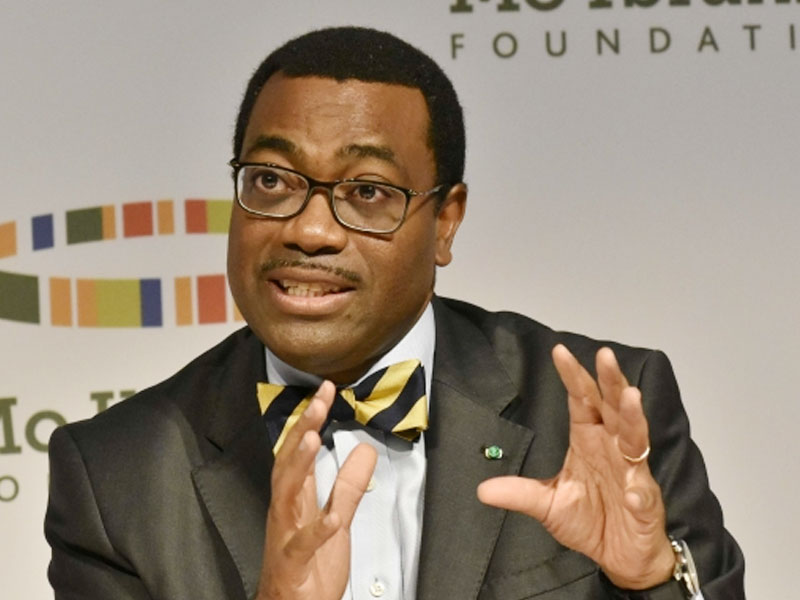
EHINGBETI 2021: AfDB President, Akinwumi Adesina Speaks

Published

on

Your Excellency, President Muhammadu Buhari GCFR, President of the Federal Republic of Nigeria;
Honorable Babajide Olusola Sanwo-Olu, Executive Governor of Lagos State;
Your Excellencies, Executive Governors, Honorable Ministers,
Honorable Commissioners and senior members of the Lagos State Government
The Youth and the Women of Lagos,
Esteemed members of the media,
Distinguished Guests,
Ladies and Gentlemen.

Let me start Mr President by offering my congratulations to you on the election, yesterday, of my sister, Ngozi Okonjo-Iweala as the Director General of World Trade Oraganisation. What a day it is. The first woman to become the head of that organization. The first black person. And of course, the first African. And of course, should I add with pride, the first Nigerian.

Mr President, you supported me greatly as well when I was re-elected for my second term as President of Africa Development Bank. Go Nigeria. Congratulations to everybody.

I wish to commend you, Governor Sanwo-Olu for your visionary leadership and selfless commitment to the people of Lagos State. You are young, dynamic and focused with an eye on the future – the future Lagos.

I will like to congratulate all the past governors of Lagos State, who have worked to make it what it is today. Just last week, we lost one of them, the late Chief Lateef Kayode Jakande, the dynamic, people-centered governor – the “action governor” of Lagos. May his soul rest in peace.

As a child growing up in Nigeria, some of my most fun memories was to have a chance to travel to Lagos. I loved the beans “ewa aganyin” sold by the incredible women – local chefs – and would do anything to travel more than 120 kilometers from Ibadan just to have a taste and go back.

Lagos is a melting pot of fun, always buzzing with such excitement, that I used to ask my Dad “when are we going to the Bar Beach in Lagos?”.

Everyone wants to be in Lagos, forget the noise, forget the traffic — so much so that the population of Lagos grew from 500,000 persons in 1959, just before Independence in 1960, to nearly 20 million inhabitants today.

The city is expanding at an astonishing rate of 77 persons every 60 minutes. By 2030, Lagos is projected to be one of the ten largest cities in the world, alongside Cairo and Kinshasa.

To understand the potential of Lagos, think of the size of the economy. The GDP of Lagos estimated at over $80 billion, is far larger than that of Ghana at $67 billion, and compares closely to Kenya’s GDP of $95.5 billion.

If you are looking for a place to invest in Africa: think Lagos! According to the United Nations, Lagos will become the third-largest consumer market in the world within the next decade, with its population projected to reach 36 million people.

The greater wealth of Lagos, in the future, will come from the youth of Lagos. Today, almost two-thirds of the population is under the age of 30. That means some 2/3 of my speech should be devoted to how to unlock this demographic youth advantage and turn it into wealth for Lagos!

The youth are not the problem of Lagos, the youth are the assets of Lagos. It is time to create youth-based wealth in Lagos.

The past must yield to the present, the old to the new. The dominant phrase should not be “the young shall grow”, it must be “the young have arrived”.

Not only must there be a generational shift, there must be a wealth shift by unlocking the potential of the youth. We must not see the youth as risks, we must see the youth as assets.

The young shoots are springing up. Today, Lagos has its own Silicon Valley. Yabacon Valley has emerged as one of the leading tech hubs in Africa with between 400 and 700 active start-ups worth over $2 billion, second only to Cape Town.

Andela, a global technology start-up based in Yabacon Valley, recently attracted $24 million in funding from Facebook founder Mark Zuckerberg.

The $200 million investment by Stripe (a Silicon Valley firm) in the local payments company Paystack, and $400 million into three Fintech companies in just one week in 2019 signals the huge potentials of Lagos to attract global digital commerce and financial services.

The African Development Bank is implementing a programme to support Africa’s youth in computer coding for employment. Launched in 2018, the Bank’s “Youth in Africa Coding for Employment Program” has already equipped over 80,000 young people with ICT skills to enhance their employability in this digital era.

I applaud the government of Lagos for launching its “Digital Skills Initiative Lagos” to equip one million students with digital skills by 2023.

The youth do not need empowerment. Look around, often those who say they are empowering them are actually simply empowering themselves. The youth do not need handouts. The youth need investment.

That’s why the African Development Bank is developing the establishment of Youth Entrepreneurship Investment Banks. They will be financial institutions for young people, run by first-rate young bankers and financial experts, to drive youth-wealth creation in Africa.

The African Development Bank will put its capital at risk for the future of the youth of Africa, and that is a risk worth taking!

The wealth and prosperity of Lagos must be for all – a Lagos by all, a Lagos for all.

Progress is being made, as the poverty rate in Lagos has declined in the past one decade, from 40.3% in 2009 to 4.5% in 2019. That is a remarkable achievement. Congratulations!

Yet, more than 50% of the population of Lagos live in slums, without water, sewage, or electricity. While some advocate for slum upgrades, I do not believe in slum upgrades.

There are no five star slums!

Significant investments will be needed for decent and affordable housing for low-income people, in roads, electricity, water, sewage systems, and waste disposal, for local governments, especially those in poor areas.

A prosperous Lagos must also be a healthier Lagos; and a healthier Lagos will be a more productive Lagos.

The future Lagos must be knowledge-based. Two of the universities in the State, Lagos State University and the University of Lagos, rank 2nd and 3rd in University rankings in Nigeria. They also rank 10th and 14th among African Universities.

A lot more work is needed to deepen the tertiary education system, especially in science, technology, engineering and mathematics; and connect them to well-funded secondary and primary schools, to build the human capital for growth and prosperity.

We must turn the universities in Lagos to world-class universities, and connect them better to industries, to provide the students with the knowledge and skills for the jobs of tomorrow.

The future Lagos must be one that is climate-smart, green and resilient. With global climate change, and rising sea-levels, the city faces significant risks of flooding and coastal erosion. Climate-proofing the development of Lagos must therefore be an urgent priority.

The landmark Eko Atlantic project, to save the sea shores of Lagos, and the rest of the state from the waves of the Atlantic, is one of the most innovative climate resilient urban infrastructure development that I have seen, anywhere.

There is a need to invest massively in greening the transport system, reducing pollution, and making the transport system more efficient.

The African Development Bank is looking into supporting the Lagos Metropolitan Transport Authority in its drive to introduce Compressed Natural Gas into the public transportation system.

And by using drones, CCTV cameras and satellites, Lagos should be turned into a smart city, to enhance security, which will further boost attractiveness for investors.

This is all the more important with the establishment of the African Continental Free Trade Area, the world’s largest free trade zone worth $3.3 trillion in combined GDP.

Lagos is well positioned.

Developing inter-connections with the Apapa Port (when you can get there!) with more efficient road and rail systems will enhance its linkage to countries along the Lagos-Abidjan corridor, a major part of the Trans-African Highway.

The African Development Bank will continue to support transformative projects that will benefit Lagos State and the Nigerian economy.

For example, the African Development Bank is financing the development of the Abidjan-Lagos Highway Corridor. This project, which is part of the Trans African Highway, will dramatically improve road connectivity between Lagos and other coastal cities in West Africa.

The African Development Bank will support the Lagos Sky-Train project, which will help to decongest the city and provide safe, reliable and affordable public transport services.

The African Development Bank is also supporting the Lagos State government to implement our first sub-national financing operation in the power sector. This will pilot the rollout of electricity cooperatives, as franchises, that will provide reliable electricity services to 60,000 households in unserved and under-served periurban and rural areas.

To make faster progress, the private sector must be mobilized to support the creation of the new Lagos – the Lagos we want. Public-private partnerships should be prioritized.

Fiscal incentives should be provided for the private sector to invest in infrastructure, housing and digital financial services for wider financial inclusion, especially for women.

After all, women run Lagos!

Resource mobilization will continue to be critical, especially leveraging the institutional investors such as the pension funds. Lagos itself should have its own sovereign wealth fund to finance its future.

Taxes have been the key for financing Lagos, the highest in Nigeria, estimated at N 400 billion in 2019.

But to whom much is given much is expected.

Taxes require a social contract between the government and the citizens. The taxes of the people belong to the people, not in pockets of individuals.

There must be accountability for the taxes collected from citizens, through transparent tax collection and administration.

Your Excellency, Mr. President, Your Excellency the Executive Governor of Lagos, distinguished ladies and gentlemen,

I see a greater Lagos.

A Lagos where dreams are made.

A Lagos where visions are turned into realities.

A Lagos where women thrive.

A Lagos where the youth shine.

A Lagos, thriving and prosperous, with wealth shared by all.

A Lagos, where like my experience growing up, we can pass on to the
future generations to come and see — with pride.

Lagos is a center of excellence.

Lagos — arise now and excel!

Thank you all very much.

Continue Reading
Click to comment

Leave a Reply

Your email address will not be published. Required fields are marked *

Featured

Why I Visited Nnamdi Kanu in Prison – Alex Otti

Published

on

By

By Eric Elezuo

Governor Alex Otti of Abia State has explained the reasons behind his much talked about visit to the leader of the Indigenous Peoples of Biafra (IPOB), Mazi Nnamdi Kanu, in Sokoto Correctional Centre.

Nnamdi Kanu was found guilty of all the seven count charges of terrorism brought against him by the Federal Government, and sentenced to life imprisonment, by Justice James Omotosho of the Federal High Court, Abuja, on November 20.

The governor also declared his intention to retire from partisan politics after serving as governor of the state.

Governor made these remarks in Umuahia while reacting to a viral video in which an individual berated him for visiting the IPOB leader in Sokoto Correctional Centre recently and alleged that the visit was aimed at positioning him (Otti) for either the presidential or vice presidential ticket. Otti however, denied having any presidential or vice presidential ambition after his governorship role.

According to him, he would not even contest for the senatorial position after serving as governor of Abia State.

Criticisms, he said, are part of democracy, adding that everyone is free to hold an opinion, even as he acknowledged that some criticisms, especially undue ones, are far from being the truth.

His words, “In the first place, that is the beauty of democracy. So, people should hold their opinions, and we respect people’s opinions. And that you hold a different opinion doesn’t mean you are right.

“One of the things he talked about was my ambition after being governor. And I had said it before, and I want to say it again, that by the time I’m done with governorship, I will retire.

“So, I don’t have presidential ambition, nor vice-presidential ambition. I also don’t have senatorial ambition. So, when I finish with the governorship, I’ll retire.

“I came for a mission. And when I deliver that mission, I will give way to younger people. So, he was talking of Igbo presidency. I don’t even understand what that means.

“So, I think if his thesis is based on that assumption, the assumption has collapsed, because he won’t see me on the ballot.

The Abia governor argued that it is important for a political office holder to know when to quit, especially when the politician has done what he is asked to do.

“When you have done what you have been asked to do, you clear, give way for other people. We’ve seen people here, after being governor who went to serve as Local Government Chairman. That’s not what we are. We are not cut out for those kinds of things.

Otti used the forum to explain why he visited Mazi Nnamdi Kanu at the Sokoto prison.

He said, “The second point is about Nnamdi Kanu. And I don’t want to put this matter in the public space so that it doesn’t jeopardise the discussions that I’m having.

“The truth about it is that exactly 24 months ago, I opened up discussions at the highest level on Nnamdi Kanu.

“And going to see him is the right thing to do, because he comes from my state. In fact, he comes from this local government (Umuahia North – the state capital).

“And there are always ways to solve a problem. I don’t believe that the way to solve a problem is to ignore it. And I had written extensively, even about Nnamdi Kanu and Operation Python Dance, I think in 2017 or 2018. And I condemned it.

“And I still condemn it. And some of the recordings that the gentleman put in his video, I cannot vouch for the veracity of that recording.”

Governor Otti maintained that he knows that when an issue has been approached from the legal point of view, there is also another window called the administrative point of view, stressing that, that is where he (the governor) is coming from.

“I’m not a lawyer. And if the judiciary says the man has been condemned to life imprisonment, that is the judiciary. Even that is not the end, because that’s the court of first instance. There is still an opportunity to appeal and then an opportunity to even go to the Supreme Court.

“But what we are trying to do is to intervene. I’m not a supporter of the disintegration of Nigeria.

“So, my position is that it would be insensitive of me to sit here and say one of our own who has been convicted should die when we have an opportunity to discuss, negotiate, and sue for peace. So, that is my position,” he said.

Continue Reading

Featured

How Glo Network Became the Lifeline That Saved Two Lives: A True Story from Sallari

Published

on

By

By Dr. Sani Sa’idu Baba

It was one of those calm, bright mornings in Sallari, a town in Tarauni Local Government Area of Kano State. I had gone to visit my longtime friend and colleague, Dr. Muhammad Umar Abdullahi, at his private facility, Rauda Clinic and Maternity. We were in his office discussing research, the usual challenges of medical practice, and other issues when the sound of hurried footsteps and anxious voices broke the calm. A young man rushed in, calling for the doctor.

Without hesitation, Dr. Muhammad sprang into action. I followed him instinctively. Within moments, two people burst through the gate, one man carrying a weak, heavily pregnant woman in his arms. Her breathing was shallow and wheezy, her face pale, and her body trembling between labor contractions and an asthma crisis. The scene was intense, we both knew that every second counted.

The team quickly moved her to the emergency bed. The Chief Medical Director Dr. Muhammad and his nurses worked swiftly to stabilize her breathing and monitor the baby. Oxygen was connected, IV lines were set, and within minutes, her breathing began to steady. The baby’s heartbeat was strong. After a short but tense period, she delivered a healthy baby girl. Relief filled the room like a gentle wind.

At that moment, I couldn’t help but admire the efficiency and dedication of Rauda Clinic and Maternity. The facility operated with the precision and compassion of a modern hospital. Every member of the team knew their role, every piece of equipment was in place, and the environment radiated calm professionalism. It reminded me that quality healthcare is not only about infrastructure, but about commitment and readiness when it truly matters. Rauda Clinic stood out that day as a quiet pillar of excellence and hope for patients and families alike.

The following day, I placed a call to Dr. Muhammad to ask about the condition of the woman who had been brought in the previous morning. He sounded cheerful and relieved. “Both mother and baby are fine now,” he said. Then, with deep reflection in his voice, he narrated the extraordinary story behind their survival, a story that showed how a single phone call, made at the right moment, became the bridge between life and death. As I listened to him recount the events, I couldn’t help but marvel at how sometimes, survival depends not only on medicine but also on connection.

Her name was Amina, a mother of three. That morning, she was alone at home, her husband was in Dutse, the capital of Jigawa state where he works, and her children had already gone to school. The first wave of pain came suddenly, followed by a tightening in her chest. Within minutes, she was gasping for air, her asthma worsening with every breath. She reached for her phone to call her husband, but the call wouldn’t go through. She tried again and again, each time, “Network error.”

Her strength was fading fast. She tried to reach her neighbors, but again, no connection. Alone, frightened, and struggling to breathe, she said she felt her end was near. Then, a thought crossed her mind, her maid had left her phone in the sitting room that morning. Gathering the last of her strength, Amina crawled toward the television stand where the phone lay.

When she reached it, she noticed the green SIM icon, it was a Glo line. Hope flickered. But when she tried to make a call, she saw there was no airtime. That could have been the end until she remembered Glo’s Borrow Me Credit service. With trembling fingers, she dialed the Glo borrow me code and she got the credit instantly, and that small credit became her lifeline.

Her first attempt to reach her husband failed. Then she dialed her younger brother, Umar. This time, the call went through immediately. Interestingly, Umar is a Glo user too. Without delay, Umar and his wife rushed to her house, found her collapsed on the floor, and carried her into their car.

On their way, Umar called ahead to alert the doctor, and again, the call went through clearly. By a remarkable coincidence, Dr. Muhammad was also using a Glo line. That seamless connection meant the hospital team was fully prepared by the time they arrived. Within minutes, Amina was stabilized, and both she and her baby were safe.

The next morning, Dr. Muhammad told me that Amina had smiled faintly and said to him, “Doctor, when every other network failed me, Glo answered. If that call hadn’t gone through, I wouldn’t be here today.”

Her words carried a truth that stayed with me. It wasn’t just a patient’s gratitude, it was a testimony about the power of reliable connection. At that moment, Glo wasn’t just a telecommunications network, it was the bridge between life and death, between despair and hope.

In today’s world, a simple phone call can determine whether someone lives or dies. That day reminded me that technology, when dependable, is not just about data speed, it’s about human connection at its most critical. Glo proved to be that connection: steady, available, and trustworthy when it mattered most.

Before she was discharged, she laughed and told the doctor she had already chosen a nickname for her baby “Amira Glo.” They both laughed, but deep down, Dr. Muhammad understood the meaning behind that name. It symbolized gratitude, faith, and survival.

As I ended the call with Dr. Muhammad that day, I felt a quiet pride. I had witnessed not just the miracle of life, but the harmony of medicine, compassion, and reliable technology. Through Rauda Clinic and Maternity, I saw what true service means, dedication without boundaries, and connection that saves.

Amina’s story isn’t an advert, but living proof that sometimes, when every other signal fades, Glo stands firm, and when every other facility seems far away, Rauda Clinic and Maternity remains a beacon of care and excellence.

For patients, families, and health workers alike, Glo is proven to be a network of necessity. It connects life to hope, when every second truly counts…

Dr. Sani Sa’idu Baba writes from Kano, and can be reached via drssbaba@yahoo.com

Continue Reading

Featured

Delta Govt Confirms Death of Senator Nwaoboshi at 68

Published

on

By

Senator Peter Onyelukachukwu Nwaoboshi, the former lawmaker who represented Delta North Senatorial District in the National Assembly, has passed away. He was 68.

Reports said that Nwaoboshi died on Friday in Abuja following a brief illness.

His demise was confirmed in a condolence statement issued by the Delta State governor, Rt. Hon. Sheriff Oborevwori.

Expressing sorrow, the governor described Nwaoboshi’s passing as a monumental loss to Delta State, the Anioma nation, and the Nigerian federation.

In the statement by his Chief Press Secretary, Sir Festus Ahon, Governor Oborevwori hailed the late Senator as a “fearless advocate” of the Anioma cause whose contributions to nation-building remain indelible.

The governor recalled Nwaoboshi’s impactful tenure in the Red Chamber, particularly his role as Chairman of the Senate Committee on Niger Delta Affairs.

He noted that Nwaoboshi’s consistent advocacy for the development of the oil-rich region distinguished him as a passionate and committed leader.

“On behalf of the government and people of Delta State, I mourn the passing of my dear friend, Senator Peter Onyelukachukwu Nwaoboshi,” the governor said.

“I extend my heartfelt condolences to his immediate family, the people of Anioma nation, members of the All Progressives Congress (APC), and all those whose lives he touched. I pray that Almighty God grant his soul eternal rest.”

Before his elevation to the Senate in 2015, he served meritoriously as a two-term Chairman of the Peoples’ Democratic Party (PDP) in Delta State, where he was instrumental in consolidating the party’s grip on the State.

Continue Reading

Trending