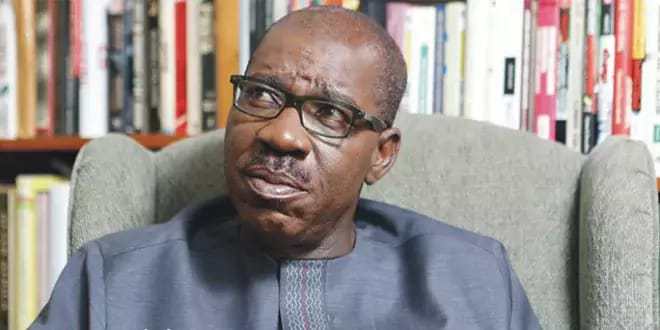
By Sylvester Odion Akhaine
Your Excellency,
I chose this medium of an open letter to reach out to you because of the existential danger presently confronting the peoples of Edo State. It is no longer news that Nigeria has become an open killing field stalked by so-called Fulani ‘herdsmen’, a roving band of terrorists acknowledged by the Global Terrorism Index as the fourth most dangerous terrorist organisation in the world.
The crux of the matter is that while every community in Nigeria is alive to this danger posed by this band of terrorists and have openly rejected penetration projects variously referred to as ‘cattle colonies’ and ‘ranches’ advanced by their sponsors who currently control the levers of power at the centre, the governing elite in Edo state has maintained felonious silence over their forceful occupation of Edoland and murderous activities within. It is possible that the silence is induced by honest ignorance of the dynamics of the activities of these terrorists on your part and therefore requires some enlightenment by a recourse to some aspects of our history.
History is a resource central to the survival of peoples and organisations. As it is often said, it is the compass to navigate the past, appreciate the present and consider the future. The Edo people fenced off attempts by neighbours and aliens to dominate them. We did not impose our culture on them if they were sworn to oaths of peace and good neighbourliness. As indigenous people with a legend of the creation of the world, we never ceded an inch of our territory to any other people. We resisted the incursion of the British in 1897, despite their superior fire power and occupation of the capital, we waged enduring guerrilla battles against the British up to the time of so-called independence in 1960.
Importantly, before British invasion, the same alien forces who are ravaging all parts of the country in murderous adventures today invaded Hausaland in 1804 and seized the political superstructure of the Hausa who today are subsumed under their domination. They indeed invaded Edoland from the north of our space known today as Kukuruku areas, a name engendered by the heroic resistance to the invaders known to oral tradition as Azanamas.
To be sure, in about 1850 during the reign of Oba Adolo (1848-1888) the Edo people fought wars with the Nupes who formed the bulk of the invaders under the superintendence of the Fulanis. The Nupes who launched out on two fronts, westwards against the Yorubas and southwards against the Edos in their crusade against the peoples of the forest region met with resistance. The Yorubas inflicted a crushing defeat on them at the famous battles of Osogbo spearheaded by the Ibadan forces in 1840 and later the British at Erinmope in the late 19th century. They had a field-day in the Kukuruku country which they raided for slaves and altered the socio-political institutions of that part of Edoland a great deal. In the records of the British, the Kukuruku division was formed with headquarters in Fugar in 1919. Until this period much of Edo North, including Ososo, Okpella, Uzairue North and North Ibie were administered as part of Northern Nigeria under the British from Lokoja. Indeed, without the overwhelming resistance from our forebears, we would have been living in a world of aliens (for a comprehensive knowledge, read Akhaine, S. O., The Kukuruku Wars and the Secularity of the Nigerian State: Some Preliminary Reflections).
Unfortunately, the British decolonisation process placed the levers of power in the hands of the same feudal forces and the dynamics of the civil war were to ensure their total control of the material forces of the state—all the instruments of coercion to ensure perpetual domination of the rest of the country (See Kunle Lawal, The Role of the United States in the Decolonisation process in Nigeria). A recent writer and combatant in that war called the outcome of the civil war, ‘tragedy of victory’.
Your Excellency, the struggle for restructuring is to restore what Pa Enahoro called equitocracy to the federal arrangement of the country. It is the extant relation of domination that Majors S. D. Mukoro and Gideon Orkar sought to undo in their military revolt of April 22, 1990. It is exactly what the incumbent administration has been reinforcing by what is now famous as his nepotist appointments in the security forces. The partisan nature of the military in the genocidal war against peace-loving peoples of this country is legendary. For example, when the people of Ukpabi Nimbo in Enugu in South-East converged to discuss their fate in the hands of the Fulani terrorists, security forces were deployed to halt the gathering while arrest were made. Bosso Community in Niger state were attacked by the ‘herdsmen’, and therefore primed themselves for self-defence. For that reason, men of the 31st Artillery Brigade invaded the community in a dawn raid. Nearer home, after the killings in Ewu, Edo State, the innocent protesters were shot at by the military from a unit in Auchi. There are more damning evidences across the country which lent credence to the accusation of complicity of the military/security forces by the former army chief, General T. Y Danjuma.
The above is to give you a sense of the continuity in the quest for domination by the Fulanis currently masquerading as herdsmen. One of the methods they have adopted in recent times is what the British have called swamping. They evacuate their people at nights into neighbourhoods and then form innocuous retail posts over which they make inroads into occupied communities. It is an old stratagem they employed in Hausaland before take-over in the 19th century. Having been profiled by their murderous activities, they have been unable to realise their occupation agenda so far. The current minders of the Nigerian state whose interest is coterminous with this murderous ethnic group seek the realisation of the agenda through ‘cattle colonies’ and ‘ranches’. Hence, the corresponding resistance across the North, Middle Belt and the South.
Assuming, it was a question of grazing only, late Chief Obafemi Awolowo who read between the lines, suggested a civilised approach to nomadic grazing long ago: a functional rail line between the North and South that could facilitate the transportation of beef through airconditioned compartments to the markets in the South. The Guardian Newspaper even suggested in one of its editorials, a dual economy, that is, the south selling hay to the herders in the north while purchasing beef from them. It will interest you to know that the then Midwest region had attempted a self-sufficiency approach by establishing ranches to feed its own people. They include Igarra and Ubiaja. The latter had a dairy. The last stocks at Igarra were slaughtered for pepper soup by the Igbinedion Administration while the Ubiaja ranche was sold to late Admiral Aikhomu for a pittance and ownership has since changed.
My fear is the influx of the ‘herders’ into all parts of Edoland: from Ovia North East, Orhionmwon, Ikopa-Okha, Ibillo, Igarra, Ekpoma, Irrua, Ugbegun, Igueben Agenegbode. Most alarming is large concentration of the ‘herders’ in a large swathe of land lying athwart Ewohimi and Uromi in Edo central (Esanland). The ‘herders’ script in Nigeria is land grab and control of the locals.
The quest for land acquisition is beyond doubt a well-thought out occupation script acted successfully in Darfur by the Sudanese government. Under the pretext of drought, Arabs from the north of Sudan and Chad moved into Darfur known for its lush vegetation and settled. Before long, the Arab government in Khartoum first and foremost armed the Janjaweed bands to undermine the local people. Subsequently, it re-engineered the administrative units of the areas and imposed the hegemony of the migrants over the indigenous groups such as Fur, Masalit and Daju. The consequence was the formation of two armed groups for self-determination, namely, Justice and Equality Movement (JEM) and the Sudan Liberation Army/Movement (SLA/M) (for details, see the UN Report on Darfur). This is already being perfected in Southern Kaduna where Governor Nasir el-Rufai has just created new emirates to impose Fulani jurisdiction over the indigenous people of Southern Kaduna and render them second class citizens in their ancestral lands.
Indeed, the continuous influx of the terrorist herders into Edoland indicates that the State government under your leadership may have ceded our land to them for occupation, thereby fostering an existential crisis for Edo people. I am not unaware of a statement from your office to the effect that Edo State Government “has not ceded any land, in any part of the state, for ranching project to any one” and recognises animal husbandry as a form of business by private individuals, and that “the state government does not, as a matter of policy, directly engage in businesses” but act to provide enabling environment to attract private investors. I am also not unaware of the ban on night grazing by your government. In relation to the actions of Governors Ortom and Fayose, these are all kid gloves approaches. Human lives matter.
The reality on the ground belies your government’s position. It is that a large chunk of Edoland is being occupied by ‘herdsmen’ steadily and illegally. The lie of things in relation to the subject demands more than statements. It requires practical action.
So far, we have recorded uncountable casualty from their murderous activities. In the last three years, the following killings, by no means exhaustive, were recorded. In 2016, a 64-year old farmer was killed in Okada town in Ovia North East; a medical doctor identified as Ehidiamen Oakimena was killed by herdsmen along Okada-Benin road in Edo state, a teenager was killed in Ibore, Irrua; Two women, Mrs. Martina Emoyon and Mrs. Ariu were raped and killed in Ewu in 2017; also, in 2017, a pregnant woman was raped and killed in Ukpenu, Ekpoma. In the current year, a student of Ambrose Alli, Collins Ojierakhi, was killed in Ugboha; Mr. Pius Eromosele, a pastor was killed in Odighi Community in Ovia North East; the right hand of Arowolo Jerome, a farmer in Igodi quarters of Ojah in Akoko Edo Local Government Area of Edo State amputated by the herdsmen; A bus driver with Gloryland group of school was butchered along Auchi road, Igarra. The domino effect in terms of halting farming activities is immeasurable. Our people now stand the risk of famine.
I have in the above-offered insight into the threat the ‘herdsmen’ pose to our collective existence. I am inclined to suggest some solutions. The first solution is based on assumptions. If the present conflict is truly farmer-herder and driven by climate change as some have argued the Edo government should sponsor an executive bill to prohibit open grazing in Edoland as is done in all civilised countries. The states from which the herdsmen are coming have been the recipient of cash to push back desertification, and fortunately for them, the Chinese have evolved biotechnique for growing vegetation in the desert, they should buy into it and not export the consequence of their negligence to other states. Some Edo indigenes have cows that are also grazing in the open, they should be summoned and ask to put them into ranches and encouraged to make the state self-sufficient without relying on cows from the north. Also, there are already existing cattle markets in Aduwawa and Ivbiaro-Warake road at the bank of River Orle on the Auchi Side; they should be re-organised to be exclusively managed by Edo State indigenes. Northern cattle traders can bring in their cows, sell and go—no settlement and no occupation. Nigeria is not a frontier state but a country of Indigenous people.
The second solution flows from my conviction that the elements masquerading as ‘herdsmen’ are terrorists and are part of a heinous agenda of the current minders of the Nigerian state to occupy the rest of the country and subjugate them. The level of killings and its morbid nature which the terrorist herdsmen have perpetrated in the Middle Belt and our own casualty in their barbarism support my position. Our solution is a no, no, to the Federal Government herders project, namely, Cattle Colony, Ranches and Livestock Transformation Plan. Edo is listed among others state where the pilot project would be experimented and over which the Federal Government has voted N179 billion naira. While other states have said no vehemently, Edo state under your watch is still prevaricating. In practical terms, the state government must mobilise all available legal instruments to remove the terrorists presently occupying parts of the state. The open grazing law will deny them the cover for their sinister project.
Let me warn that if proactive steps are not taken now, we might soon find ourselves in ‘dishonourable graves’. It requires practical action and the time to act is now.
Thanks for your attention.
Sylvester Odion Akhaine, PhD (London), is an associate professor of political science and acting head, department of political science, Lagos State University.