Connect with us

National

Just In: Protest Begins in Abuja over Electoral Act Controversy

Published

on

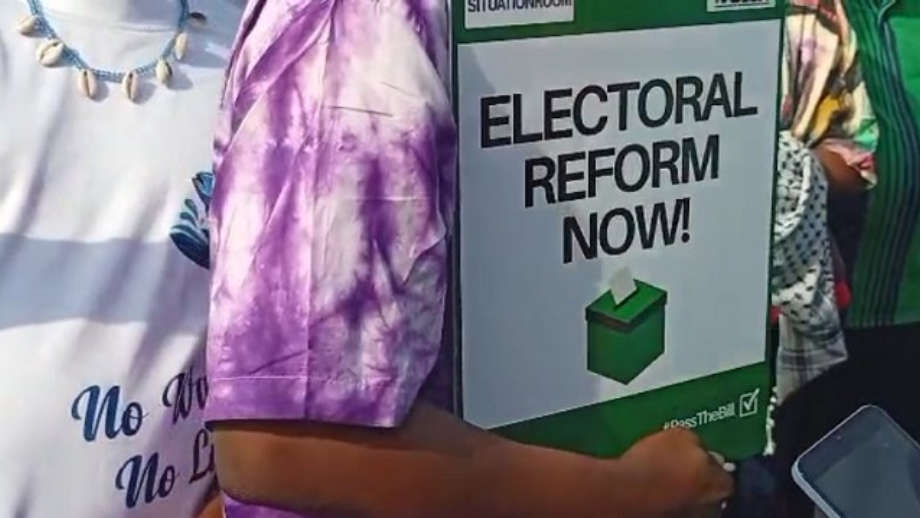
Protesters, on Monday morning, began converging on the entrance of the National Assembly in Abuja for the “Occupy National Assembly” protest.

There was a heavy security presence at the scene, with personnel drawn from the Nigeria Police Force, the Nigerian Army, and the Nigeria Security and Civil Defence Corps.

The protest is against the backdrop of the Senate’s position on the electronic transmission of election results.

Although the Senate has issued several clarifications over reports that it rejected electronic transmission of results, the protesters insist that lawmakers must be explicit by including the phrase “real-time electronic transmission” in the proposed legislation.

Members of civil society organisations, a handful of opposition African Democratic Congress (ADC) members, and some women’s groups are gathered at the entrance of the National Assembly for the protest.

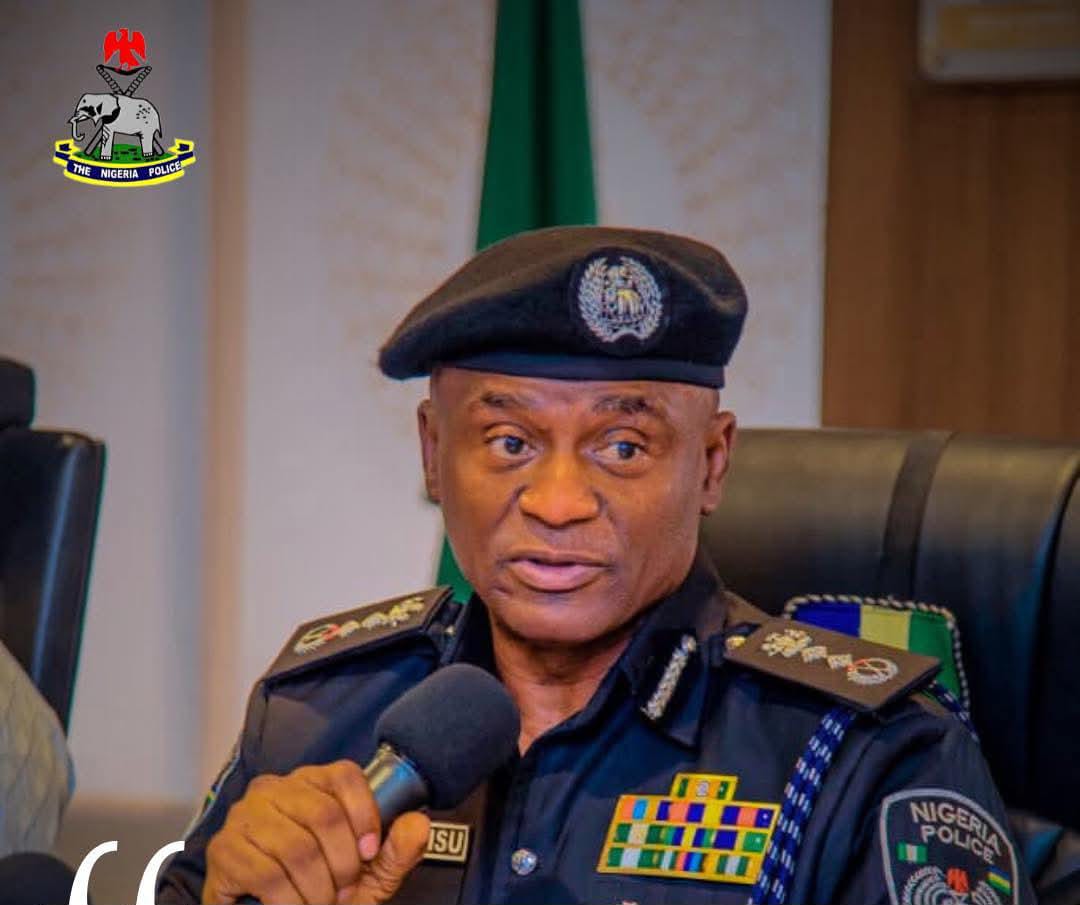
The police have already barricaded the entrance to the National Assembly.

Some members of the civil society groups, who spoke to Channels Television, disclosed that the protesters do not intend to enter the National Assembly premises, as the protest is expected to take place mainly at the entrance.

The protesters have begun their march from the Federal Secretariat, heading towards the National Assembly gate.

Continue Reading
Click to comment

Leave a Reply

Your email address will not be published. Required fields are marked *

National

Akpabio Admits Deleting ‘Real-Time’ from Electoral Act, Proffers Defence

Published

on

By

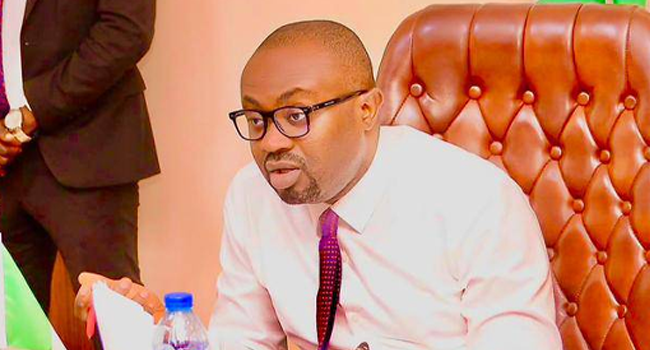
President of the Senate, Godswill Akpabio, on Saturday, admitted that the Senate deliberately deleted the provision for “real-time” transmission of election results from the Electoral Bill, 2026.

Akpabio said the Senate took the decision because it believed that “technology must save and not endanger democracy.”

He spoke in Abuja at the unveiling of a book titled “The Burden of Legislators in Nigeria”, authored by Senator Effiong Bob.

The Senate President likened the issues raised in the book to the challenges faced by lawmakers in the course of their duties, including the controversy and alleged “abuses” directed at the Senate following the passage of the electoral bill.

Defending the removal of real-time electronic transmission from the bill, Akpabio argued that the entire country could be thrown into chaos if, for instance, network or power failure affected the uploading of results.

He insisted that Form EC8A and other official election records should remain the most reliable means of declaring results.

“All we said was to remove the word ‘real-time’ to allow INEC decide the mode of transmission. If you make it mandatory and there is a system failure, there will be a serious problem,” Akpabio told the gathering, further confirming that the bill, as passed, excluded real-time electronic transmission of results.

He gave another example: “Real-time means that if there are nine states where there is no network, does it mean elections will not take place there?

“Or in any part of the country where there is a grid breakdown, does it mean there will be no election?

Reacting to the outrage that trailed the Senate’s action, the Senate President said the legislature would not be “intimidated” into passing a faulty law simply to please opposition political parties, civil society groups and non-governmental organisations (NGOs).

Akpabio criticised NGOs for insisting that because they organised retreats for lawmakers – where ideas were exchanged on the electoral bill – the Senate must adopt their positions, even if such positions did not align with the interests of all segments of the country.

“Why are people setting up panels on television stations and abusing senators? I leave them to God.

“We will not be intimidated but will do what is right for Nigeria, not what one NGO says. A retreat is not law-making.

“Why do you think that the paper you agreed to in Lagos must be what we must approve?” he asked.

Akpabio, who noted that many Nigerians had turned themselves into authorities on legislative matters despite being ignorant of the law-making process, however, softened his stance, promising that there was still a window of opportunity for amendments to the bill.

He cited the Votes and Proceedings of the day’s sitting, explaining that as long as they had not been approved, the bill could still be corrected if the majority of senators supported such changes.

“We have not even completed it until we look at the votes and proceedings. When we bring out the votes and proceedings, any senator has the right to rise and amend it.

“We can amend anything before we approve the votes and proceedings. Why abuse the Senate when what we have is incomplete?

“I can’t talk until they tell me to drop the gavel. In this case, we are yet to complete the process,” he said.

The Senate President also stated that attacks on the Senate were uncalled for, noting that any provision rejected by the Senate could be reinstated by the Conference Committee of the Senate and the House of Representatives. He said there was therefore no need to hastily criticise senators.

However, the National Chairman of the African Democratic Congress (ADC) and former President of the Senate, Senator David Mark, who chaired the occasion, immediately responded, cautioning Akpabio against speaking for the Independent National Electoral Commission (INEC).

“What the ADC is saying is: pass the law and let INEC decide whether it can implement real-time electronic transmission or not. Don’t speak for INEC.

“The position of the ADC is clear: pass the bill and let INEC decide what it will do with it,” Mark insisted.

Several speakers at the event, including Akwa Ibom State governor, Pastor Umo Eno, and the book reviewer, Professor Maxwell Gidado, praised Senator Bob’s courage in writing the book, describing it as a bold effort to highlight the challenges faced by Nigerian legislators in the course of their duties.

The author also outlined some of these challenges, listing electoral battles, conflicts with governors and political godfathers, judicial annulment of electoral victories, addressing private concerns of constituents, and self-inflicted challenges.

“The courage to defend democracy is in the legislature and the legislators,” he said.

Continue Reading

National

APC Drops Uzodinma As National Convention Chairman, Names Masari As Replacement

Published

on

By

The All Progressives Congress, APC, has reconstituted the leadership of its 2026 National Convention Central Coordination Committee, appointing former Katsina State Governor, Aminu Bello Masari, as the new chairman.

Governor Hope Uzodimma of Imo State, who was initially named chairman of the committee, has been reassigned to serve as treasurer.

In addition, the APC expanded the committee’s membership from 73 to 90 members to accommodate more party stakeholders.

Newly added members include Senator Barry Mpigi and several other prominent APC chieftains.

According to the party, the adjustments form part of the revised 2026 APC National Convention Central Coordination Committee and were made to reflect zoning considerations and other strategic exigencies.

Continue Reading

National

Fight Against Terrorism: US Troops Finally Arrive in Nigeria

Published

on

By

The United States has sent a small team of troops to Nigeria, the general in charge of the U.S. command for Africa (AFRICOM), General Dagvin R.M. Anderson, said on Tuesday.

The development is the first acknowledgment of U.S. forces on the ground since US airstrikes targeting terrorists in Nigeria’s North-West on Christmas Day, 2025.

US President, Donald Trump, who announced that he ordered the airstrikes on what he described as Islamic State targets, had said there could be more U.S. military action in the country.

According to Reuters, the U.S. had been conducting surveillance flights over the country from Ghana since at least late November.

Speaking on the decision to send troops to Nigeria, the top general said both countries agreed that more needed to be done to combat the terrorist threat in West Africa.

“That has led to increased collaboration between our nations to include a small US team that brings some unique capabilities from the United States,” General Dagvin R.M. Anderson, head of the U.S. military’s Africa Command AFRICOM, told journalists during a press briefing on Tuesday.

Anderson did not provide further details about the size and scope of their mission.

According to Reuters, Nigeria’s Defense Minister, Christopher Musa, confirmed that a team was working in Nigeria but did not provide further details.

A former U.S. official told Reuters that the U.S. team appeared to be heavily involved in intelligence gathering and enabling Nigerian forces to strike terrorist-affiliated groups.

Nigeria has come under intense pressure by Washington to act after President Trump accused the West African nation of failing to protect Christians from Islamist militants operating in the northwest.

The Nigerian government denies any systematic persecution of Christians, saying it is targeting Islamist fighters and other armed groups that attack both Christian and Muslim civilians.

Continue Reading

Trending