Connect with us

Headline

Hounding of Opposition Leaders: I Cannot Be Intimidated – Tambuwal Vows

Published

on

By Eric Elezuo

From every quarter, the tension associated with desire to either consolidate power come 2027 by the ruling All Progressives Congress (APC) or the quest to wrest power from the present administration, especially by the newly redefined opposition party, the African Democratic Congress (ADC), continue to reverberate, creating unease and subject of discourse across political landscapes.

With opposition politicians raising alarm on a daily basis regarding the intimidation being suffered from the ruling party, many have either decamped to the APC or remained aloof, muffling their own voices for fear of being targeted for attack, victimisation or outright persecution.

This untold uneasy fear among the camps of the opposition has remained tenable until the rebirth of the ADC with major political players and ranking administrators holding sway, and sticking their necks out in one collective effort to ‘rescue Nigeria’.

But that move, which caught the APC unawares, has led to a re-jigging of the strategy, culminating in what the ADC described as victimisation of the opposition by the ruling party.

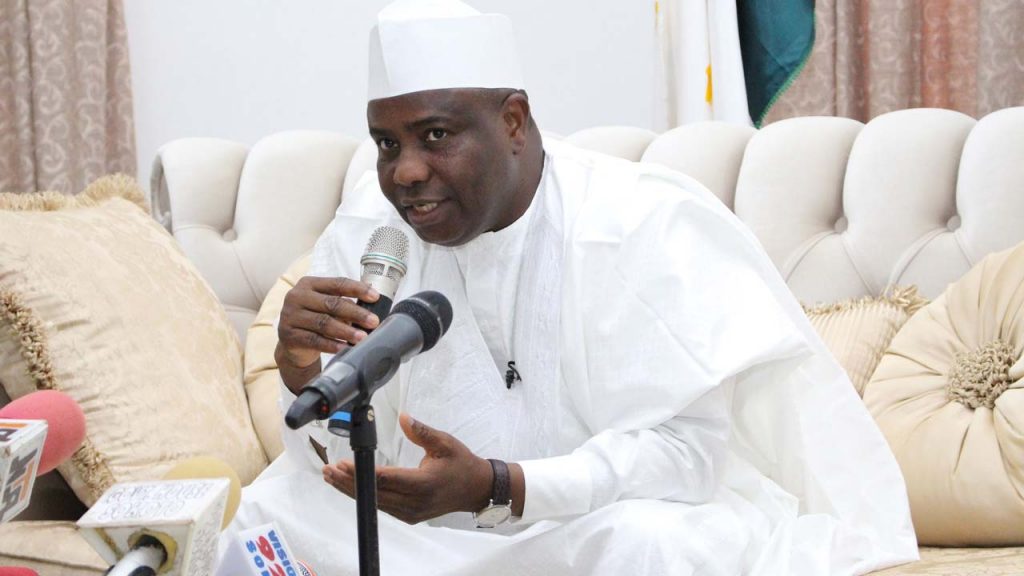
Consequently, many of the leading figures in the opposition have been hounded either in their businesses or political endeavours. The latest being the former governor of Sokoto State, who doubles as a sitting senator, representing Sokoto South, Aminu Waziri Tambuwal.

Also a former Speaker of the House of Representatives, Tambuwal, who was arrested, detained and later released by the Economic and Financial Crimes Commission (EFCC) has vowed not to be silenced by what he described as intimidation and blackmail.

The EFCC had quizzed Tambuwal and detained him for a night over alleged misappropriation of N189bn during his tenure as governor, a move the opposition African Democratic Congress described as a political witch-hunt aimed at weakening opposition forces ahead of the 2027 presidential election.

Returning to Sokoto just before the weekend to a hero’s welcome from thousands of supporters, Tambuwal had addressed a cheering crowd at his residence, pledging to continue the fight for “equitable and democratic governance” in the state.

“I cannot be intimidated or blackmailed. I believe I shall be vindicated, and victory shall be ours,” he declared, drawing loud chants of solidarity from his supporters.

Recounting his encounter with the EFCC, in a statement titled ‘APC is Anti-People, I Cannot Be Intimidated’, Tambuwal said he honoured the agency’s invitation on August 6, but was denied release on personal recognition, despite his credentials as a former Speaker of the House of Representatives, two-term governor, and serving senator.

The full statement of the former governor is presented as follows:

APC IS ANTI PEOPLE, I CANNOT BE INTIMIDATED

Distinguished ladies and gentlemen. Lend me your ears. I know that you have been following developments in the last one week. But before I go into that, let me thank Allah (SWT) for giving me the place, the strength, the health and enablement to arrive home to this receptive

I was first invited by the EFCC and went there voluntarily, on my own volition without being forced, on the 6th of August. That was my first visit to the EFCC. I was interrogated. At sometime they let me go back home with a view of coming back on Monday, 11th of August. I went back and was further interrogated. I requested that I should be allowed to go back home until another time so that we could continue. I was told by the operatives interviewing me that I need to get someone or some people to get me on bail. I told them to go back and tell the Chairman of the EFCC that I was the Speaker of Federal House of Representatives for four years; that I served the people of Sokoto State for an uninterrupted period of eight years; and that now as a Senator of the Federal Republic of Nigeria; and also as a Commander of the Order of the Federal Republic of Nigeria (CFR), I should be allowed my personal recognition. They said that no, the Chairman has declined; that I must bring two directors from the Federal Civil Service, who must get letters of introduction from their employers, and some other conditions for me to be granted bail. This was around 5-6 pm. My lawyer, a Senior Advocate of Nigeria (SAN), appealed that liberal conditions for the bail should be given. They refused. I was taken to cell A23, where I rested till the following morning. Of course, by the grace of God and prayers the conditions of bail were met and I was allowed to go.

Now. Why now? Why at this moment. When the current government in Sokoto constituted a Kangaroo Commission of Inquiry that couldn’t work; and by the grace of Allah it will not work, because we know what we did for the people of Sokoto State; and the people here are the living witnesses; that there are basis for comparison between the government we handed over to and our own government. But that is not the issue.

We have been involved in the process of bringing everyone together, because there are two paradigms in Nigeria today: those in government today; and those of the people of Nigeria. I and my colleagues here chose to be with the people that are working against sustaining the current bad situation in Nigeria. Once you join APC, whatever your sins are will be forgiven. Now, I want to ask you a question: do you want our sins to be forgiven so that we can join APC? Do you want us to continue to work for the coalition?

I’m going to say what they don’t want to hear: What they failed to realize is that I cannot be intimidated. And, no one can tarnish my record: from my service in the House of Representatives in 2006, when I served as Minority Leader, 2007 when I served as Deputy Chief Whip to 2011 when I served as Speaker; and Governor of this state up to 2023, I believe we have done well in the service of this country.

Therefore, I will take on anybody who wants to tarnish my image. The process is there. Whatever it is, I believe that by the grace of God, victory shall be ours. At the end of the day, we shall be independent. Let me assure you. I remain resolved and resolute and unshaken by this near attempt to coerce, blackmail and intimidate.

We remain committed to the process of democracy; and ensuring that peoples’ votes count in Nigeria, particularly, insha Allah, in 2027. What they are working towards is to create an impression of invisibility: that they cannot be beaten. Their policies are anti-people. They have no compassion. They have no feelings. What is going on in Sokoto East, what is happening in North West, North East, North Central and South South; South West and South East States

Is Bola Tinubu’s administration considering the federal character in Nigeria today; in terms of giving opportunities to Nigerians to serve? In terms of projects? Nigerians are not fools. In any case, the election was rigged. So, we will not, by the grace of God, allow that to happen again. We’re committed to democratic ethos and the democratic process. We will join forces to gather tendencies in Nigeria, to make sure, by the grace of God, in 2027, we end this misrule and misgovernance over our country.

The former governor carpeted both the Sokoto State government and the President Bola Tinubu-led Federal government of orchestrating a “Kangaroo investigative committee” against him, stressing that no competent authority had found him guilty of any wrongdoing, and deviating from the Federal character arrangement as enshrined in the Constitution, respectively.

It would be recalled that earlier in July, shortly after its formation, the coalition had raised alarm of the government’s plan to clampdown on it leaders and members across the country with spurious accusations.

In a statement by the Interim National Publicity Secretary of ADC and Opposition Coalition, Mallam Bolaji Abdullahi, the group responded to a tweet by presidential spokesperson, Bayo Onanuga, who alleged a sinister plot to overthrow the Tinubu administration, saying, “Just two years after Tinubu began implementing the reforms, the haters of Nigeria’s progress are banding together to overthrow an administration that has been the most focused, most transformative in our history.”

The ADC spokesperson, who described the tweet as reckless and malicious, further noted that it revealed an imminent plot to clamp down on opposition leaders, ahead 2027 general elections.

He warned that “such reckless and unsubstantiated claim signals a broader campaign of intimidation and repression against political opposition leaders by the Tinubu administration.”

The full statement reads: “Bayo Onanuga’s tweet is a textbook example of a political dog whistle. The APC-led federal government appears to be constructing a false narrative that is designed to justify a potential clamp down on dissent, and to criminalise legitimate opposition activity under the guise of national security.

“The ADC is not interested in truncating democracy; we are solely committed to saving the nation from the irredeemable incompetence of this government. And the only means available to us is the democratic means. We are not soldiers, we are politicians. We don’t have bullets; we only have the ballots. When the time comes, we will only present our solutions and an alternative vision of the future to the Nigerian people and leave them to make their choice.

“We are left to wonder why the APC government is so jittery that it is so eager to betray its own heritage. APC is the first opposition party to come to power in Nigeria. It is, therefore, a great wonder that the same party now appears to find it strange that there is an opposition at all.

“We, therefore, call on President Bola Ahmed Tinubu to promptly caution his aides from further baseless but dangerous allegations that have the potential to heat up the system even two years ahead of the next election. This manner of crying wolf when there is none does not make the president look good and only betrays a sense of panic.

“We also call on the Nigerian people to be vigilant and discerning, and to reject the underhanded tactics being deployed to delegitimise the opposition and silence alternative voices. The health of our democracy depends on a free, open, and competitive political environment.

“Finally, we urge the international community, democratic governments all over the world, international observers, and human rights organisations, to closely monitor the unfolding political environment in Nigeria. We call on them to hold the Tinubu administration accountable for any actions that undermine democratic freedoms or violate the political rights of Nigerian citizens.

“The ADC remains committed to building a better Nigeria, through peace, participation, and the power of the people.”

The Nigerian political space has gathered momentum ever since the announcement of the opposition coalition group, which later adopted the ADC as its political platform for the 2027 general election. The group is led by a former Senate President, David Mark, with former governor of Osun State, Rauf Aregbesola as the National Secretary.

So far, every member of the coalition has received tremendous approval from their supporters across their various regions, signaling what may be a landmark challenge of Tinubu’s APC in the forthcoming elections.

Continue Reading
Click to comment

Leave a Reply

Your email address will not be published. Required fields are marked *

Headline

Opposition Parties Reject 2026 Electoral Act, Demand Fresh Amendment

Published

on

By

Opposition political parties have rejected the 2026 Electoral Act recently passed by the National Assembly, which President Bola Tinubu swiftly signed into law.

The parties called on the National Assembly to immediately begin a fresh amendment process to remove what they described as “all obnoxious provisions” in the law.

Their position was made known at a press briefing themed “Urgent Call to Save Nigeria’s Democracy,” held at the Transcorp Hilton Hotel in Abuja on Thursday.

In a communiqué read by the Chairman of the New Nigeria Peoples Party (NNPP) Ahmed Ajuji, the opposition leaders stated:

“We demand that the National Assembly immediately commence a fresh amendment to the Electoral Act 2026, to remove all obnoxious provisions and ensure that the Act reflects only the will and aspiration of Nigerians for free, fair, transparent and credible electoral process in our country. Nothing short of this will be acceptable to Nigerians.”

Some of the opposition leaders present in at the event include former Senate President David Mark; former Governor of Osun State, Rauf Aregbesola; former Vice President Atiku Abubakar; former Governor of Rivers State, Chibuike Rotimi Amaechi; and former Governor of Anambra State, Peter Obi, all from the African Democratic Congress (ADC).

The National Chairman of the New Nigeria Peoples Party (NNPP), Ahmed Ajuji, and other prominent members of the NNPP, notably Buba Galadima, were also in attendance.

The coalition said the amended law, signed by Bola Tinubu, contains “anti-democratic” clauses, which they argue may weaken electoral transparency and public confidence in the voting system.

At the centre of the opposition’s concerns is the amendment to Section 60(3), which allows presiding officers to rely on manual transmission of election results where there is communication failure.

According to the coalition, the provision weakens the mandatory electronic transmission of results and could create loopholes for manipulation.

They argued that Nigeria’s electoral technology infrastructure is sufficient to support nationwide electronic transmission, citing previous assurances by officials of the Independent National Electoral Commission (INEC).

The parties also rejected the amendment to Section 84, which restricts political parties to direct primaries and consensus methods for candidate selection.

They described the change as an unconstitutional intrusion into the internal affairs of parties, insisting that indirect primaries remain a legitimate democratic option.

The opposition cited alleged irregularities in the recent Federal Capital Territory local government elections as evidence of what they described as a broader pattern of electoral compromise.

They characterised the polls as a “complete fraud” and said the outcome has deepened their lack of confidence in the ability of the electoral system to deliver credible elections in 2027.

The coalition also condemned reported attacks on leaders of the African Democratic Congress in Edo State, describing the incidents as a serious threat to democratic participation and political tolerance.

They warned that increasing violence against opposition figures could destabilise the political environment if not urgently addressed.

In their joint statement, the opposition parties pledged to pursue “every constitutional means” to challenge the Electoral Act 2026 and safeguard voters’ rights.

“We will not be intimidated,” the leaders said, urging civil society organisations and citizens to support efforts aimed at protecting Nigeria’s democratic system.

On February 18, 2026, President Bola Tinubu signed the Electoral Act (Amendment) 2026 into law following its passage by the National Assembly. The Act introduced several reforms, including statutory recognition of the Bimodal Voter Accreditation System and revised election timelines.

However, opposition figures such as Atiku Abubakar and Peter Obi have also called for further amendments, particularly over the manual transmission fallback clause, which critics say leaves room for manipulation.

The president said the law will strengthen democracy and prevent voter disenfranchisement.

Tinubu defended manual collation of results, questioned Nigeria’s readiness for full real-time electronic transmission, and warned against technical glitches and hacking.

The Electoral Act sparked intense debate in the National Assembly over how election results should be transmitted ahead of the 2027 general elections.

Civil society groups under the “Occupy NASS” campaign demanded real-time transmission to curb manipulation.

In the Senate, lawmakers clashed during consideration of Clause 60, which allows manual transmission of results if electronic transmission fails.

Senator Enyinnaya Abaribe (ADC, Abia South) demanded a formal vote to remove the proviso permitting manual transmission, arguing against weakening real-time electronic reporting.

The move led to a heated exchange on the floor, with Senate President Godswill Akpabio initially suggesting the demand had been withdrawn.

After procedural disputes and a brief confrontation among senators, a division was conducted. Fifteen opposition senators voted against retaining the manual transmission proviso, while 55 supported it, allowing the clause to stand.

Earlier proceedings had briefly stalled during clause-by-clause review, prompting consultations and a closed-door session.

In the House of Representatives, a similar disagreement came up over a motion to rescind an earlier decision that mandated compulsory real-time electronic transmission of results to IReV.

Although the “nays” were louder during a voice vote, Speaker Tajudeen Abbas ruled in favour of rescinding the decision, triggering protests and an executive session.

Continue Reading

Headline

AFP: How Tinubu’s Govt Paid Boko Haram ‘Huge’ Ransom, Released Two Terrorists for Kidnapped Saint Mary’s Pupils

Published

on

By

The Nigerian government paid Boko Haram militants a “huge” ransom of millions of dollars to free up to 230 children and staff the jihadists abducted from a Catholic school in November, an AFP investigation revealed Monday.

Two Boko Haram commanders were also freed as part of the deal, which goes against the country’s own law banning payments to kidnappers. The money was delivered by helicopter to Boko Haram’s Gwoza stronghold in northeastern Borno state on the border with Cameroon, intelligence sources told AFP.

The decision to pay the militants is likely to irritate US President Donald Trump, who ordered air strikes on jihadists in northern Nigeria on Christmas Day and has been sent military trainers to help support Nigerian forces.

Nigerian government officials deny any ransom was paid to the armed gang that snatched close to 300 schoolchildren and staff from St. Mary’s boarding school in Papiri in central Niger state on November 21. At least 50 later managed to escape their captors.

Boko Haram has not been previously linked to the kidnapping, but sources told AFP one of its most feared commanders was behind the mass abduction: the notorious jihadist known as Sadiku.

He infamously held up a train from the capital in 2022 and netted hefty ransoms for the release of government officials and other well-off passengers.

Boko Haram, which has waged a bloody insurgency since 2009, is strongest in northeast Nigeria.

But a cell in central Niger state operates under Sadiku’s leadership. The St. Mary’s pupils and staff were freed after two weeks of negotiations led by Nuhu Ribadu, Nigeria’s National Security Adviser, with the government insisting no ransom was paid. Nigeria’s State Security Service flatly denied paying any money, saying “government agents don’t pay ransoms”.

However, four intelligence sources familiar with the talks told AFP the government paid a “huge” ransom to get the pupils back. One source put it at 40 million naira per head – around $7 million in total.

Another put the figure lower at two billion naira overall. The money was delivered by chopper to Ali Ngulde, a Boko Haram commander in the northeast, three sources told AFP.

Due to the lack of communications cover in the remote area, Ngulde had to cross into Cameroon to confirm delivery of the ransom before the first group of 100 children were released.

Nigeria has long been plagued by mass abductions, with criminals and jihadist groups sometimes working together to extort millions from hostages’ families, and authorities seemingly powerless to stop them.

Source: Africanews

Continue Reading

Headline

Unlawful Invasion: El-Rufai Drags ICPC, IGP, Others to Court, Demands N1bn Damages

Published

on

By

Former Governor of Kaduna State, Nasir El-Rufai, has slammed a ₦1 billion fundamental rights enforcement suit against the Independent Corrupt Practices and Other Related Offences Commission (ICPC) for what he claimed was an unlawful invasion of his Abuja residence.

El-Rufai, in a suit filed at the Federal High Court in Abuja, also listed the Chief Magistrate, Magistrate’s Court of the FCT, Abuja Magisterial District; Inspector-General of Police, and the Attorney-General of the Federation (AGF) as 2nd to 4th respondents respectively.

According to the suit filed through his lawyers, led by Oluwole Iyamu, El-Rufai prayed the court to declare that the search warrant issued on February 4 by the Chief Magistrate, Magistrate’s Court of the FCT (2nd respondent), authorising the search and seizure at his residence as invalid, null and void.

Security operatives had stormed and searched the former Governor’s residence in the ongoing investigations against him.

However, he argued in the case marked: FHC/ABJ/CS/345/2026, that the search was in violation of Section 37 of the Constitution, and urged the court to declare that the search warrant was “null and void for lack of particularity, material drafting errors, ambiguity in execution parameters, overbreadth, and absence of probable cause thereby constituting an unlawful and unreasonable search.”

In the suit dated and filed February 20 by Iyamu, ex-governor, who is currently under detention, sought seven reliefs.

He prayed the court to declare that the invasion and search of his residence at House 12, Mambilla Street, Aso Drive, Abuja, on Feb. 19 at about 2pm and executed by agents of ICPC and I-G, “under the aforesaid invalid warrant, amounts to a gross violation of the applicant’s fundamental rights to dignity of the human person, personal liberty, fair hearing, and privacy under Sections 34, 35, 36, and 37 of the Constitution.”

He urged the court to declare that “any evidence obtained pursuant to the aforesaid invalid warrant and unlawful search is inadmissible in any proceedings against the applicant, as it was procured in breach of constitutional safeguards.”

El-Rufai, therefore, sought an order of injunction restraining the respondents and their agents from further relying on, using, or tendering any evidence or items seized during the unlawful search in any investigation, prosecution, or proceedings involving him.

“An order directing the Ist and 3rd respondents (ICPC and I-G) to forthwith return all items seized from the applicant’s premises during the unlawful search, together with a detailed inventory thereof.

“An order awarding the sum of N1,000,000,000.00 (One Billion Naira) as general, exemplary, and aggravated damages against the respondents jointly and severally for the violations of the applicant’s fundamental rights, including trespass, unlawful seizure, and the resultant psychological trauma, humiliation, distress, infringement of privacy, and reputational harm.”

The breakdown of the ₦1 billion in damages includes “a N300 million as compensatory damages for psychological trauma, emotional distress, and loss of personal security;

“A ₦400 million as exemplary damages to deter future misconduct by law enforcement agencies and vindicate the applicant’s rights.

“A ₦300 million as aggravated damages for the malicious, high-handed and oppressive nature of the respondents’ actions, including the use of a patently defective warrant procured through misleading representations.”

He equally sought ₦100 million as the cost of filing the suit, including legal fees and associated expenses.

Iyamu argued that the search warrant was fundamentally defective, lacking specificity in the description of items to be seized, containing material typographical errors, ambiguous execution terms, overbroad directives, and no verifiable probable cause.

He added that the warrant violated Sections 143-148 of the Administration of Criminal Justice Act (ACJA), 2015; Section 36 of the Corrupt Practices and Other Related Offences (ICPC) Act, 2000, and constitutional protections against arbitrary intrusions and several other constitutional provisions.

“Section 146 stipulates that the warrant must be in the prescribed form, free from defects that could mislead, but the document is riddled with errors in the address, date, and district designation;

“Section 147 allows direction to specified persons, but the warrant’s indiscriminate addressing to “all officers is overbroad and unaccountable.

“Section 148 permits execution at reasonable times, but the contradictory language creates ambiguity, undermining procedural clarity,” he submitted.

Iyamu stated that the execution of the invalid warrant on Feb. 19 resulted in an unlawful invasion of his client’s premises, constituting violations of the rights to dignity (Section 34), personal liberty (Section 35), fair hearing (Section 36), and privacy (Section 37) of the Constitution.

He further argued that the search was conducted without legal justification and in a manner that inflicted humiliation and distress.

Evidence obtained without a valid warrant is unlawful and inadmissible, as established in judicial precedents such as C.O.P. v. Omoh (1969) NCLR 137, where the court ruled that evidence procured through improper means contravenes fundamental rights and must be excluded,” he said.

In the affidavit in support of the application, Mohammed Shaba, a Principal Secretary to the former governor, averred that on Feb. 19 at about 2p.m., officers from the ICPC and Nigeria Police Force invaded the residence under a purported search warrant issued on or about Feb. 4.

According to him, the said warrant is invalid due to its lack of specificity, errors, and other defects as outlined in the grounds of this application.

He said the “search warrant did not specify the properties or items being searched for.”

Shaba stated that the officers failed to submit themselves for search as provided by the law before proceeding with the search.

“That the Magistrate did not specify the magisterial district wherein he sits.

“That during the invasion, the officers searched the applicant’s premises without lawful authority, seized personal items including documents and electronic devices, and caused the applicant undue humiliation, psychological trauma, and distress.

“Now shown to me and marked as ‘EXHIBIT B’ Is the list of the items carted away.

“That no items seized have been returned, and the respondents continue to rely on the unlawful evidence.

“That the applicant suffered violations of his constitutional rights as a result, and this application is brought in good faith to enforce same,” Shaba said.

Source: Naijanews.com

Continue Reading

Trending