
Featured
Rivers: Falana faults Tinubu on Suspension of Fubara, Other Elected Officers

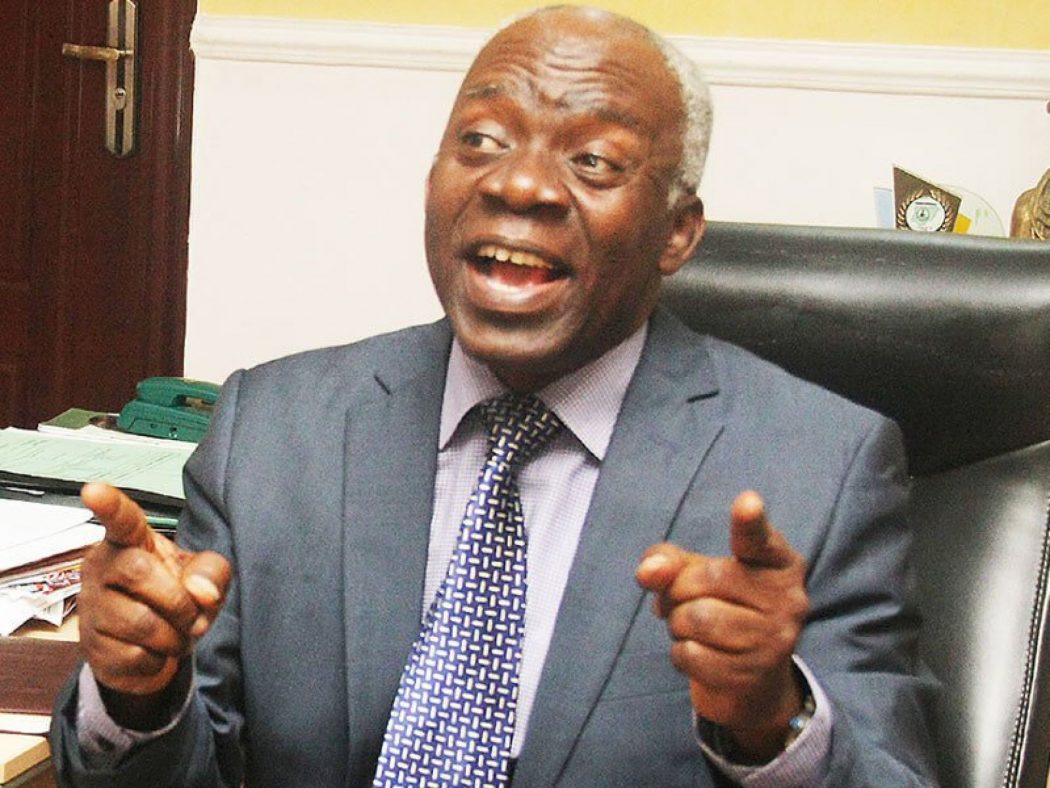

A human rights lawyer, Mr. Femi Falana, has described as illegal the decision of President Bola Tinubu to suspend Governor Siminalayi Fubara, his deputy Ngozi Odu, and all elected members of the Rivers State House of Assembly for a period of six months.
In a statement made available to the media, the senior lawyer said the President’s decision cannot be justified under any of the provisions of the 320 sections of the Constitution of the Federal Republic of Nigeria, 1999, as amended.
While recognizing that Section 305 of the Constitution empowers the President to take extraordinary measures to restore law and order if there is an actual breakdown of public order and public safety in the Federation, Falana argued that the extraordinary measures which may be adopted by the President to restore peace and security do not include the suspension of an elected Governor, an elected Deputy Governor, and the dissolution of other democratic structures.
He, therefore, called on the President to follow the path of constitutionalism without any delay and to proceed to reinstate the suspended Governor Fubara and Deputy Governor Odu and restore all democratic structures in Rivers State.
The learned silk said: “This call is without prejudice to the duty imposed on the President to adopt extraordinary measures to restore law and order in Rivers State under Governor Fubara in strict compliance with the provisions of the 1999 Constitution of the Federal Republic of Nigeria, as amended.”
Below is the full statement
ILLEGALITY OF DISSOLUTION OF ELECTED DEMOCRATIC STRUCTURES IN NIGERIA
The decision of President Bola Tinubu to suspend Governor Siminalayi Fubara, his deputy, Mrs Ngozi Odu, and all elected members of the Rivers State House of Assembly for six months is illegal as it cannot be justified under any of the provisions of the 320 sections of the Constitution of the Federal Republic of Nigeria, 1999 as amended.
No doubt, Section 305 of the Constitution empowers the President to take extraordinary measures to restore law and order if, among other reasons, there is actual breakdown of public order and public safety in the Federation or any part thereof to such extent as to require extraordinary measures to restore peace and security or there is a clear and present danger of an actual breakdown of public order and public safety in the Federation or any part thereof requiring extraordinary measures to avert such danger.
But, the extraordinary measures which may be adopted by the President to restore peace and security in the Federation or in any particular State does not include the suspension of an elected Governor, an elected Deputy Governor and the dissolution of other democratic structures. For the avoidance of doubt, section 45(3) of the Constitution provides that a ‘period of emergency’ means “any period during which there is in force a Proclamation of a state of emergency declared by the President in exercise of the powers conferred on him under section 305 of this Constitution.”
Thus, in accordance with the relevant provisions of the Nigerian Constitution, the office of an elected governor can only become vacant upon death, ill health, resignation, or impeachment. Even where the office of the Governor becomes vacant for any reason whatsoever, the Deputy Governor shall be sworn in as the Governor.
And where the offices of the Governor and Deputy Governor become vacant at the same time, the Speaker of the State House of Assembly shall become an Acting Governor for not more than 3 months. During the 3-month period, a fresh election shall be conducted by the Independent National Electoral Commission for the election of a new governor.
It is pertinent to state that the failure of a House of Assembly to function in Rivers State can not be a justification for the dissolution of democratic structures in any State of the Federation. Indeed, the Constitution had envisaged that a State House of Assembly may not be able to function due to one reason or another. Hence, section 11(4) of the Constitution stipulates as follows:
“At any time when any House of Assembly of a State is unable to perform its functions by reason of the situation prevailing in that State, the National Assembly may make such laws for the peace, order and good government of that State with respect to matters on which a House of Assembly to be necessary or expedient until such time as the House of Assembly is able to resume its functions; and any such laws enacted by the National Assembly pursuant to this section shall have effect as if they were laws enacted by the House of Assembly of the State:
Provided that nothing in this section shall be construed as conferring on the National Assembly power to remove the Governor or the Deputy Governor of the State from office.”
In 2004 and 2006, we condemned the illegal dissolution of democratic structures when President Olusegun Obasanjo imposed emergency rules on Plateau State and Ekiti State, respectively. Regrettably, on both occasions, the Supreme Court refused to determine the constitutional validity of the dissolution of democratic structures on the ground that the suit were procedurally incompetent because they were instituted during the six-month emergency period by the suspended legislators in the name of Plateau State without the authorization of the Sole Administration of the state!
However, in 2013, when a state of emergency was declared in Adamawa, Borno and Yobe States by former Presidents Goodluck Jonathan, we urged him to reject the pressure mounted on by anti democratic forces to remove the elected Governors and dissolve democratic structures in the affected States. President Jonathan followed the path of constitutionalism.

In 2021, the then Attorney-General of the Federation and Minister of Justice, Mr. Abubakar Malami SAN announced the plan of the federal government to declare a state of emergency in Anambra State over insecurity and threat to a complete breakdown of law and order in that part of the Federation We advised President Buhari not to demolish democratic structures even if emergency rule was imposed on the state. President Buhari followed the path of constituionalism.
In the cases of Adegbenro vs. Attorney-General of the Federation (1962) 1 NLR 338 F.R.A. Williams V Dr. M.A. Majekodunmi (1962) 1 NLR 328 the Supreme Court of Nigeria validated the Emergency Powers Act 1961 to justify the dissolution of democratic structures as well as suspension of fundamental human rights in western region. As there is no equivalent of the Emergency Powers Act 1961 under the current constitutional dispensation, the suspension of an elected Governor by an elected President is a constitutional anomaly under the 1999 Constitution.
In Attorney General of the Federation v. Attorney General of Abia State & Ors (2024) LPELR-62576 (SC) filed by the Bola Tinubu administration, the Supreme Court of Nigeria held that the removal of elected chairmen and councilors as well as appointment of sole administrators or caretaker committees by State Governors to run local government councils are illegal and unconstitutional. It follows to reason that the suspension of elected governors and elected members of the House of Assembly by the President is illegal and unconstitutional in every material particular.
To that extent, a serving or retired military officer can not be imposed as a Sole Administrator to govern any state in Nigeria. Similarly, a military officer cannot be appointed by the National Assembly as a Sole Administrator to govern the Nigerian people during a war between Nigeria and another country.
In the Speaker, Bauchi State House of Assembly v Hon Rifkatu Danna (2017) 49 WRN 82 and several other cases, Nigerian Courts have held that the suspension of elected legislators is illegal and unconstitutional. Therefore, the National Assembly should not endorse the illegal suspension of the Rivers State legislators that have not defected from the People’s Democratic Party to the All Progressive Congress. Instead of approving the illegal dissolution of democratic structures in Rivers State, the National Assembly should assist Governor Fubara by invoking its powers under section 11 (4) of the Constitution “to make laws for the peace, order and good government of that State”
Therefore, we are compelled to call on President Bola Tinubu to follow the path of constituionalism without any delay. The President should proceed to reinstate the suspended Governor Fubara and Deputy Governor Odu and restore all democratic structures in Rivers State. This call is without prejudice to the duty imposed on the President to adopt extraordinary measures to restore law and order in Rivers State under Governor Fubara in strict compliance with the provisions of the 1999 Constitution of the Federal Republic of Nigeria, 1999 as amended.
Femi Falana SAN
Featured
Tinubu Nominates Oyedele As Minister of State for Finance, Moves Anite-Uzoka to Budget Ministry





Give What, to Gain What? Reflections on the 2026 International Women’s Day Theme

140 Missing As US Submarine Sinks Iran’s Warship in Indian Ocean

NDLEA Nabs UK-wanted Drug Lord after 15-Year Hunt

Akume Leads Nigeria’s Delegation to Jesse Jackson’s Funeral in US

FIFA Strikes Out Nigeria’s Petition, Okays DR Congo for 2026 World Cup Play-Off

Disu Inaugurates Committee for Implementation of State Police

Tinubu Nominates Oyedele As Minister of State for Finance, Moves Anite-Uzoka to Budget Ministry

Prof Jide Owoeye: When a Distinguished Academic Turns 70

The Oracle: Entertainment is the Next Hope for Nigeria After Oil (Pt. 2)

Beyond the Vision: The Alchemy of Turning Ideas into Execution

Iran’s Supreme Leader Khamenei Cut Off from Contact, Fate Unknown

Federal Government Issues Travel, Safety Warning for Nigerians in Iran, Gulf States

Iran Confirms Supreme Leader Ali Khamenei Dead after US-Israeli Attacks
Ag. IGP Olatunji Disu: The Rise of a Diligent Officer
-
 Boss Of The Week5 days ago
Prof Jide Owoeye: When a Distinguished Academic Turns 70
-
 The Oracle6 days ago
The Oracle: Entertainment is the Next Hope for Nigeria After Oil (Pt. 2)
-
 Opinion5 days ago
Beyond the Vision: The Alchemy of Turning Ideas into Execution
-
 Middle East5 days ago
Iran’s Supreme Leader Khamenei Cut Off from Contact, Fate Unknown
-
 National5 days ago
Federal Government Issues Travel, Safety Warning for Nigerians in Iran, Gulf States
-
 Middle East4 days ago
Iran Confirms Supreme Leader Ali Khamenei Dead after US-Israeli Attacks
-
 Boss Picks5 days ago
Ag. IGP Olatunji Disu: The Rise of a Diligent Officer
-

 News2 days ago
NELFund Extends Deadline for Student Loan Applications Nationwide