Connect with us

Headline

Insecurity: INEC Fears Disruption of Elections in North-West, South-East

Published

on

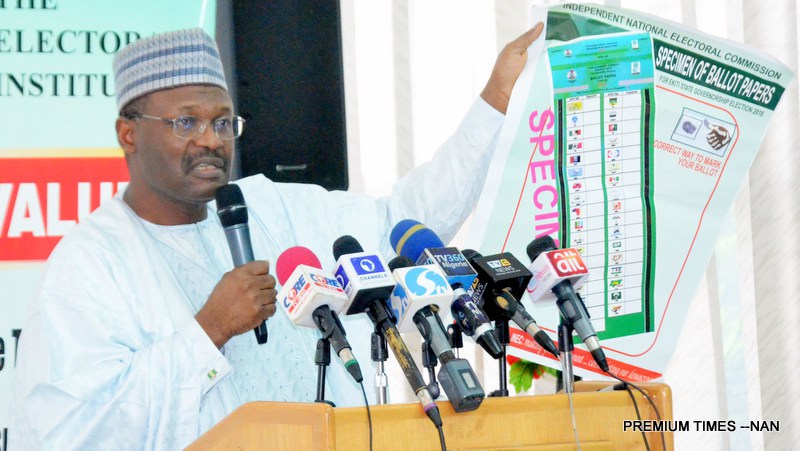
The Chairman of the Independent National Electoral Commission, Prof Mahmood Yakubu, has said insecurity may hamper elections in the North-West and South-East states

Yakubu said the insecurity in the country was concerning, noting that the security challenge which was hitherto restricted to the North-East region has now spread to other parts of the country.

For over two decades, Nigeria has battled the Boko Haram insurgency in the North-East but this has evolved into banditry in the North-West and killings in the South-East allegedly perpetrated by Eastern Security Network, the militant arm of the outlawed Indigenous People of Biafra.

According to INEC, over 41 attacks have been carried out against its offices across 14 states since the 2019 general election, with the South-East recording 13 attacks.

The attacks which started in Abia on May 9, 2021, spread to Enugu and Ebonyi, with three incidents each;  Imo, with two attacks; and Anambra and Abia with one each and in Bayelsa and Akwa Ibom states.

In all, the electoral body recorded nine attacks in 2019, 21 incidents in 2020 and over 12 as of May 2021. It also lost 9,836 smart card readers, 345 ballot boxes, and 135 voting cubicles, among other assets.

But speaking in Washington on Tuesday, the INEC chairman, however, said he has received assurances from the service chiefs that they would secure the voting environment during the 2023 polls.

Yakubu spoke at an event organised by the National Endowment for Democracy and the International Foundation for Electoral Systems at the NED Headquarters, Washington DC, United States of America.

He also acknowledged the issue of political thuggery which he said was organized by some of the political actors.

In his keynote address made available to journalists on Wednesday, the INEC chairman said, “Are there concerns about the 2023 general election? I’ll be the last to say there are no concerns. The first concern is the perennial issue of insecurity in different parts of the country, compounded by the traditional issues of thuggery during elections organized by some of the political actors.

“I say it is a perennial issue because, at the end of the day, it is nothing new. However, the dimension of the insecurity is concerning in the sense that in the past, it was localized or confined to a particular part of the country, the northeast. But now, it is more widespread and we are keeping our eyes, particularly on the northwest and the southeastern parts of the country.’’

Speaking further on other concerns, he stated, ‘’Elections are conducted by human beings. We worry about the security of our officials, voters and the materials to be deployed. Without them, we cannot conduct elections. We have spoken to the security agencies and they have assured us that the situation will improve before the elections.

“So, fingers crossed. Those who are supposed to secure the environment have assured us that they will secure the environment for us to conduct elections. Our responsibility is to conduct elections.”

Buttressing the significance of the Bimodal Voter Accreditation System, Yakubu noted that the machine has eliminated the flaws in previous elections, including identity theft and multiple accreditations.

According to him, the commission has dispatched the BVAS to over 23 states of the federation.

The electoral body also said that with the introduction of the BVAS, identity theft, multiple registrations and the use of incident forms during elections have been eliminated.

The deployment of technology in the nation’s electoral process, it added, had increased the citizens’ confidence.

INEC stated, “The BVAS has eliminated multiple accreditations that were observed in previous elections. Now, you are sure that the person who is accredited is the voter and the bearer of the card.

“It has increased public confidence in the outcome of elections as shown in the recent off-cycle elections. People tend to be more confident now with the protection of the process of accreditation using technology.’’

Speaking further on the benefits of the e-transmission machine, Yakubu noted, “It has eliminated the use of the Incident Form. For those of you who have been following our elections for a long time, when the Card Reader was introduced, the machine would read the card but it may not read the biometrics.

“So, when it fails to read the biometrics, they then say – give the voter the Incident Form. And through that, many people voted using identity theft. We have eliminated the Incident Form.

‘’So, every registered voter must go through the biometric and the facial, and we jokingly say that the only way the two processes can fail, particularly the facial, is when the voter forgets his or her face at home on election day. The system of using the BVAS for the conduct of elections has come to stay. There’s no going back.”

Yakubu disclosed that the Commission has printed over 50 per cent of the Permanent Voters’ Cards which will be available by November.

He stated “Nigerians have been asking the commission; when you finish registration and clean-up of the data, what about our Permanent Voters’ Cards? This will be available for new registrants by next month – November.  We are looking at early to the middle of the month to make the cards available.

“We have already printed over 50 per cent of the cards but we haven’t delivered them to the states yet. As we clean the data, we also print the cards. Nigerians who have registered should be rest assured that they will have their cards ahead of the general election. We also need to do so in good time because the law now requires us to publish the number of cards collected per polling unit.”

The Punch

Continue Reading
Click to comment

Leave a Reply

Your email address will not be published. Required fields are marked *

Headline

Insecurity: Akpabio Begs Tinubu to Reinstate Police Orderlies for NASS Members

Published

on

By

Senate President, Godswill Akpabio, has appealed to President Bola Tinubu to reconsider the directive withdrawing police orderlies from members of the National Assembly, citing safety concerns.

Akpabio made the appeal during the presentation of the 2026 budget to a joint session of the National Assembly, by President Tinubu, warning that some lawmakers fear they might be unable to return home safely following the withdrawal.

His said: “As we direct the security agencies to withdraw policemen from critical areas, some of the National Assembly said I should let you know they may not be able to go home today.

“On that note, we plead with Mr. President for a review of the decision.”

President Tinubu, on November 23, ordered the withdrawal of police officers attached to Very Important Persons (VIPs), directing that they be redeployed to core policing duties across the country.

According to Bayo Onanuga, Special Adviser to the President on Information and Strategy, Tinubu issued the directive after a security meeting with Service Chiefs and the Director-General of the Department of State Services (DSS) following heightened security issues in the country.

Under the order, VIPs requiring security are to seek protection from the Nigeria Security and Civil Defence Corps, as the Federal government seeks to boost police presence in communities, particularly in remote areas grappling with insecurity.

Tinubu later reaffirmed the directive on December 10, moments before presiding over the Federal Executive Council, expressing frustration over delays in implementation.

He instructed the Minister of Interior, Olubunmi Tunji-Ojo, to work with the Inspector-General of Police (IGP), Kayode Egbetokun, and the Civil Defence Corps to immediately replace withdrawn escorts to avoid exposing individuals to danger.

“I honestly believe in what I said…It should be effected. If you have any problem because of the nature of your assignment, contact the IGP and get my clearance,” Tinubu said.

“The minister of interior should liaise IG and the Civil Defence structure to replace those police officers who are on special security duties.

“So that you don’t leave people exposed,” he said.

Continue Reading

Headline

Defence Gulps Lion Share As Tinubu Presents N58.47trn 2026 Budget to NASS

Published

on

By

President Bola Tinubu has presented a budget of N58.47 trillion for the 2026 fiscal year to a joint session of the National Assembly, with capital recurrent (non‑debt) expenditure standing at N15.25 trillion.

Tinubu presented the budget on Friday, pegging the capital expenditure at N26.08 trillion and putting the crude oil benchmark at US$64.85 per barrel.

He said the expected total revenue is N34.33 trillion, projected total expenditure: N58.18 trillion, including N15.52 trillion for debt servicing. The budget is N23.85 trillion, representing 4.28% of GDP.

The budget was anchored on a crude oil production of 1.84 million barrels per day, and an exchange rate of N1,400 to the US Dollar for the 2026 fiscal year.

In terms of sectoral allocation, defence and security took the lion’s share with N 5.41 trillion, followed by infrastructure at N3.56 trillion.

Continue Reading

Headline

Mike Adenuga, Emmanuel Macron Hold High-Powered Meeting in Paris

Published

on

By

Accomplished billionaire businessman and Commander of the French Légion d’Honneur, Dr. Mike Adenuga Jr., GCON, CdrLH, has held a private meeting with the French President, Emmanuel Macron.

The two powerful citizens of the world held the meeting on Wednesday at the historic Élysée Palace in Paris.

The high-level engagement underscores the longstanding relationship between Dr. Adenuga and the French Republic, as well as his continued relevance in global business and diplomatic circles. 

A respected industrialist and philanthropist, Adenuga has been widely acknowledged for his contributions to economic development, telecommunications, energy, and humanitarian causes across Africa and beyond.

The meeting adds to Dr. Adenuga’s growing profile as a bridge between African enterprise and international leadership.

Continue Reading

Trending