By Hon. Femi Kehinde
Society nourishes its history through the oral testimony of those who have impacted its growth and development or were lucky to be at the theatre of its story. In a clime, where we celebrate the dead at the expense of the living, it is desirable to celebrate the living, who have impacted our lives and essence.
In the Nigerian firmament, Victor Omololu Showemimo Olunloyo is certainly one. History is baked and garnished by their tales.
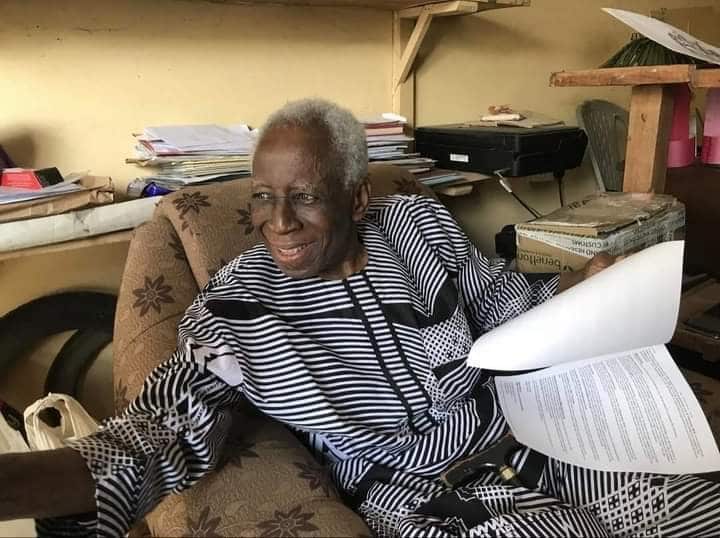
A few weeks ago, 87 year old Victor Omololu Olunloyo, suffered massive stroke, which may be infirmity, occasioned by old age. Like a cat with nine lives, Olunloyo regained consciousness after a few days in the Intensive Care Unit at the University College Hospital, Ibadan. The University College Hospital, being the first of its kind in Africa, was officially opened by Queen Elizabeth II, in 1956.
According to Omololu Olunloyo, “I regained my faculty after a massive stroke”
He was later transferred to an elite private suite, also under intensive medi-care and observation, in the hospital.
It was in this private suite, that I visited him on a Saturday evening, still on the hospital bed, but not lying critically ill. He was still his bouyant and exuberant self, full of intellect, learning, knowledge, wisdom and erudition.
I had an informal talking session with him. The words coming from his mouth, encouraged me to go on this informal talking session, though mildly and gently, with occasional interjections by Yomi Olunloyo, a nephew, also visiting the recuperating former governor of Oyo State.
Our informal talk shop, started with the Awolowo / Shagari case. This was a law suit between Chief Obafemi Awolowo and Alhaji Shehu Shagari, in which Chief Obafemi Awolowo’s Petition, challenged the declaration of Shehu Shagari as the President elect of Nigeria, on the 11th of August, 1979.
The law suit- SC 162/1979, was decided on the 26th of September, 1979. The Justices at the Supreme Court were Atanda Fatai Williams CJN, Mohamed Bello JSC, Kayode Esho JSC, Mohamed Uwais JSC, Andrew Otutu Obaseki JSC, Ayo Gabriel Irikefe JSC, Chike Idigbe JSC.
The gravamen of the election petition of Chief Awolowo, was that the election declaration did not conform with Section 34A (1) (c) of the Electoral Law, i.e winning a quarter of the votes in 2/3 of all the states in the Federation.
The Supreme Court affirmed the decision of the Tribunal and dismissed Awolowo’s appeal. The only dissenting Judge, was Kayode Esho (JSC), who affirmed that there could be no 12 two thirds states, but 13- in other words, there was no fractional states, but whole states and two thirds of 19 states being exact 12 2/3 or 12.667, should be rounded up to 13 states. There was obviously a legal and mathematical log jam. At the time, there were only 19 states in Nigeria. The bone of contention was what was 2/3 of 19 states. Awolowo won, clearly in 6 states, Shagari in 12 states and his legal pundits led by Chief Richard Akinjide SAN, said Shagari won the election, by winning 12 two third states, claiming Kano to be the 2/3 state. Chief G.O.K Ajayi SAN represented Obafemi Awolowo and his Party- Unity Party of Nigeria (UPN).
To solve this mathematical log jam, Chief Obafemi Awolowo, Chief Simon Adebo, Gen. Adeyinka Adebayo consulted two egg heads- Professor Ayodele Awojobi and Dr. Victor Omololu Olunloyo.
According to Olunloyo-
“I told the committee set up, that the problem was a mathematical problem and not engineering. Awojobi was a mechanical engineer, whilst I hold a PH.D, both in Engineering and mathematics” (The former Governor of Oyo state, attained these Doctorate Honours in 1961, at the age of 26 years and perhaps, the first Ibadan indigene to attain this feat).
“It was a mathematical problem and I got to the heart of it. Awolowo had insisted that 12 2/3 was not rational, sensible or reasonable. I told them of the principle of non-interchangeability, i.e- you cannot interchange states, Akinjide did. When I did the calculations, I found that even if you said it was 12 2/3, Shagari did not make that figure. It was either 12 2/3 or 13. Before you could be President, the law said you should win in at least 2/3 of the total 19 states we had in Nigeria then.
Shagari won in 12. Kano state was the bone of contention. The 2/3 of Kano state had meaning, only in terms of the governorship election in Kano state.”
Omololu Olunloyo, now fully engrossed in this informal talk shop, asked a lady Nurse, to come back for check up, because according to him-
“I am in the middle of a lecture”
He was at this moment, imaginarily, drawing on the wall, beside his bed, with mathematical interjections and self assurance. He further enthused-
“Shagari did not score two thirds, two thirds (of twenty local governments). In decimal is something like 13.3, instead, he scored 12 point something. How I discovered it is that I asked my brother- Segun, he lent me his computer and I ran a programme.
Now drawing again on an imaginary graph, using the imaginary board on his bedside, he said-
“Of the 20 local government in Kano, you find out which one Shehu Shagari scored the highest. It happened to be Kano Municipality: 50.1%. Next was Dambatta, 48.2, next and next. If you went through the whole list, it ended with something like 12 point something. The whole state didn’t reach 25 per cent for him. Isn’t it an easy calculation? It starts at the high level of 50.1 at Kano Municipality and Bichi and like that, down the line. Then drew a line at where he scored up to two thirds. As you come down in descending order, you’ll see that if he got two-thirds of Kano State, it would show easily. The cut off point in the calculation should be 13, but when we got to 13, there was already a disaster. The two-thirds of 20 is 13 1/3 but he had fallen below that. He ended up with 12 point something…”
Now moving away from mathematical gymnastics, I was a little bit relieved to move into soft issues.
I asked him about his relationship with Chief Obafemi Awolowo.
He said: “Perfect!, Awolowo was my political idol and my father- Horatio’s good friend and lawyer. He comes to my father’s house regularly and share drinks.” Awolowo, my father and M.S Showole, then, drank Gin together. S.L Akintola and Samuel Shonibare drinks Whisky. Shortly thereafter, Awolowo left this drinking club and never to go back to it again. He promised M.S Showole, but left them to their revelries. He said it was undemocratic for him to stop anybody from enjoying his fancies, but, nonetheless, will still serve wine and alcohol to his guests
At a later time, when I then became involved in several endeavours, I visited Chief Obafemi Awolowo in his Oke Bola Ibadan house and we had lunch together. We had Amala, Ewedu with beef together and I was surprised, and I asked him;
“But they said you don’t eat meat?”
He laughed and said, “Omololu, that was media creation, I eat beef, you cannot live in Ibadan, without eating Amala. (Awolowo moved to Ibadan in January, 1927, when he was admitted to Wesley College, Elekuro, Ibadan.”)
Olunloyo still talking –
“From my early days, I was very close to S.L Akintola and Chief Awolowo. Awolowo was a statesman, technocrat and administrator per excellence, he was not a politician; but Akintola was a politician. He was witty, scholarly, humorous, with a sonorous voice. He was fond of me and calls me Professor. Unofficially, I attended some of their meetings- the Action Group Executive Council Meeting as a repertoire and observer.”
I then asked him, why did he, despite being a mathematician, developed interest in law and politics?
Still on the hospital bed, he heaved a sigh, and he smiled-
I told you Awolowo was my father’s friend and lawyer, I watched a court session at the Western Nigerian Court of Appeal, at the Parliament building, Secretariat, Ibadan, where Awolowo and Rotimi Williams were opposing counsels. I was impressed with their legal learning and erudition. Justice Charles Madarikan was the Presiding Judge. He later retired as a Justice of the Supreme Court of Nigeria.
The court adjourned briefly for a short recess and asked the counsels to address the court on the principles of void and voidable and stare Decisis.
“I was excited. But I had made up my mind to become an engineer and mathematician.” I cut in, to tell him, that in the Memudu Lagunju case, where Obafemi Awolowo was Counsel for Oba Adetoyese Laoye, the Timi of Ede, he was described by the court as a “terrible cross examiner” and he agreed with that description.
Then dinner came, acknowledging the presence of the kitchen staff and her culinary expertise. He was pleased with the smell of the Edikainkong, but pleaded with the young lady to keep the food and allow him to finish up with the lecture. He was actually getting excited and absorbed. He then said-
“I like the legal Profession. The sight of a well dressed lawyer, excites me. I am well aware of the principles of the Mac Foy and UAC case, delivered by Lord Denning in 1961 and the Ratio Decedendi of the High trees case. I know Actus Reus and Mens Rea in Criminal Law.
I am an avid reader of law books and publications. So many years ago, I went to Ile Ife to deliver a Public Lecture. After the lecture, I went to the office of this Owo man- Professor David Ijalaye, who was then Dean of the Law Faculty and Professor of International Law. I asked him to give me a list of all the books I needed to read, from part one to part four, to become a lawyer. He laughed. I told him I was serious. He gave me a list of 38 books, which includes law of contracts, torts, Nigerian Legal System, Land law, Criminal Law, Evidence Law, Equity, Jurisprudence and so many others.
When I got to Ibadan, I went to Odusote Bookshop to look for the books. In Ibadan, I got 36 of the books and the bookshop ordered for 2 of the remaining books from their Lagos office.
I read all of them and I became greatly knowledgeable in law. All the books are still in my library. I went back to Professor Ijalaye to tell him I am now a lawyer, even though in Equity.”
Down memory lane again, he said- “I have read all the books of Lord Denning- Master of the Rolls, most especially, his last book- “What next in the law?”
“Lord Denning, like me had a first class Degree in Mathematics, in the University, after which he studied law and little wonder his judgments had mathematical touch. I have read all the law books of Justice Oputa and the Acts of Advocacy by Justice Aniagolu and also the Supreme Court judgment of the Nasiru Bello’s Case, where a murder convict, before his appeal was heard at the Supreme Court, was executed by hanging. This injustice was described by the Supreme Court as executive lawlessness.”
I also asked the great mathematician about his knowledge, of the Bode Thomas and Alaafin Adeniran Adeyemi’s imbroglio, in November, 1953. To whet his appetite, I said-
As a result of the Macpherson Constitution of 1952, which now gave immense powers to political elites as against traditional institutions, the powers of traditional institutions, as regards the political control of their domains ceased. Chief Bode Thomas now became the first Chairman of the Oyo Divisional council in 1953, while the Alaafin of Oyo then became a mere member. On Chief Bode Thomas’ first appearance in council, after being appointed as Chairman, all the council members stood up for him in deference to welcome him, except Oba Adeniran Adeyemi II, who for cultural reasons, could not show deference to anyone in public.
Bode Thomas rudely shouted at the king, for having the temerity and audacity to disrespect him –“why were you sitting when I walked in, you don’t know how to show respect” At that time, Bode Thomas was 35 years old and Oba Adeniran Adeyemi was in his 80s. The Alaafin felt very insulted and said “se emi lon gbomo baun?” (is it me you are barking at like that?) Oba Adeniran Adeyemi II, for emphasis, was father to the late Alaafin- Oba Lamidi Olayiwola Adeyemi III.
Now, Omololu added his own version-
He said-
“On the 22nd of November, 1953, Bode Thomas, arrived Oyo in the morning, went to the Palace of Alaafin. On his way out of the Palace for the council meeting, the Palace drummers, began to drum an alert drum in sweet rendition-
Olori buruku ti kuro laafin. (the evil man has left the palace)
He left the Palace of the Alaafin in his private car and drove straight to the Alapinni’s house (one of the seven Oyo Mesi). In Alapinni’s house, he was offered “Wara”- (Condensed Yoghurt), and from there, drove to the Atiba hall, for the council meeting.
The driver dropped him at the council meeting, unfortunately, the private car and the driver were never seen, till today.
When the “Ma gbo lo ba un” (continue to bark like that) incidence happened that day, there was no car or driver to take him back to Lagos.
The council arranged for him a vehicle to take him back to Lagos for urgent medical attention, after he had started to behave strangely. He was taken to a local herbalist in Ijebu Igbo, who attempted to restore his health. He was unfortunately traced to Ijebu Igbo by some people in Oyo and this aggravated his health situation. He died on the 23rd of November, 1953.”
His mother and his wife had called Dr. Majekodumi, his private medical doctor… I quipped in-
“But Majekodumi in his auto biography said Bode died of mental delirium”
Olunloyo, who later became Majekodumi’s Economic Development commissioner in 1962, responded- “Ko ko de le tan ni o”- (he had not said said it all)
Down memory lane again, Olunloyo recalled his memorable moment with Samuel Ladoke Akintola, whom Awolowo had once described in 1953, in their good days as “an able lawyer with a brazing and afiable character, who cannot be ruffled easily, if at all.”
“His potential gift consists of his capacity to argue two opposing points of view with equal competence and plausibility. This quality, backed by a sense of humour and his capacity for nuances, made him a puzzle to opponents.”
According to Olunloyo, one day, Premier Ladoke Akintola was on a campaign trail, to a town called Ale, close to Badagry. He had asked his advance team to visit Ale for reconnaisance. The report was favourable and the Premier embarked on the journey to Ale. In the car, with Duro Ogundiran, a Minister in his government and also a lawyer, he asked Duro-
“How do we address the people of Ale?, do we great them as “Omo Ale” (child of a bastard or a child born out of wedlock), he told Duro Ogundiran that the people of Ale will not like that”.
When he got to Ale and the people of Ale trooped out to welcome the visiting Premier, he was excited. At the campain rally, he greeted them. He said- “E ku ile o, eyin omo ilu Ale!” (I greet you, sons and daughters of Ale town.) The crowd, went into frenetic ecstacy. He cleverly wriggled out, from calling Ale people bastards. That was S.L.A Akintola for you. After the campaign rally, he asked Gbeleyi, his private purse and confidant too, to give the people of Ale, some money, to express his appreciation- “Gbeleyi, o yo a seto fun won”
When S.L.A went to an Ekiti town to campaign, he met a quiet and desolate town and he quickly asked- where are the able bodied men of this town? rhetorically, he answered the question himself- “won ti lo se G.C.E” nio!”- that is, they have all gone to write G.C.E exams, (Ekiti people loves books)
At the departure lounge of the Muritala Mohammed Airport, Lagos, Dr. Olunloyo, his wife and his son on a wheel chair, were waiting to board the aircraft to London.
M.K.O Abiola, the good natured man and philanthropist, saw the boy on the wheel chair and he quickly asked- E jo wo o, tani o ni omo yi (please, who are the parents of this child?) Olunloyo answered- He is my son, on a trip to London, for medical attention. M.K.O quickly recognised Olunloyo, his party man and former governor of Oyo State. He said “Egbon, sorry o, so he is your son?” he quickly tore off, the front edge of the newspaper with him and wrote – Please pay Dr. Omololu Olunloyo, with Nigerian international passport number ***, the sum of £20, 000 and gave it to Omololu and wished them a safe trip to the United Kingdom. He nonetheless told Olunloyo, that he had 41 signatures. Olunloyo, his son and his wife, boarded the aircraft and he deliberated with his wife, what will become of him, if he presents this sheet of torn newspaper, to the named manager of Barclays bank in London. For two days, Olunloyo could not summon the courage to present the piece of torn newspaper, to the said Barclays bank. After two days of prevarications and reflections, he summoned the courage and straight, he went to the bank. He presented the sheet of paper, the lady cashier called him, asked for his International passport and also asked him the particular denomination of currency he would prefer.
The joyous Omololu, answered the cashier excitedly- “any denomination, but preferably Ten Pounds Notes.” He was quickly handed over, the sum of freshly mint, £20, 000:00, in Ten Pounds denominations. He said- “That was M.K.O Abiola for you and may his soul continue to rest in peace.”
“When he was contesting election as President of Nigeria, I told M.K.O that I dreamt of a mandate that disappeared.”
In circumlocution, we went back to Awolowo again-
“Awolowo was like my father, because he was my father’s good friend, and I know he was a man that came before his time. People of his sterner stuff, are very rare to find, he was a first class administrator and statesman. I told him, he could not win the Presidential election, because he was too honest… I told him at least if he won the election, as his son, I will be a beneficiary of his government”.
“I was fond of my grandfather, the Rev. Olunloyo, who was then Vicar of the Saint Paul’s, Anglican Church, Gbongan, now in Osun State.”
“He was to the Gbongan community then, a priest, teacher, scholar, statesman and pathfinder. He was involved in almost every sphere of the Gbongan life. I moved to Gbongan to complete my Primary School education and in 1947 in standard 5, I sat for a common entrance examination to the Government College Ibadan. Out of about 2,000 students who sat for the examination, I was among the first ten, who excelled in the common entrance examination, to commence secondary education at the Government College Apata, Ibadan, in January 1948, on scholarship, I did not read standard 6.”
“It was in Gbongan in 1949, that I met Chief Afe Babalola, now Senior Advocate of Nigeria, who was then a pupil teacher at the Saint Paul’s Anglican Primary School, Gbongan, that I attended. He was always very logical in his arguments with me, and was also fluent in English language. I told my grandfather, the Rev Olunloyo of my discovery of a class room teacher, who should be encouraged to pursue greener pastures. My grandfather encouraged his movement to Ibadan, from where he started another journey of life, by reading for his O levels and A levels and later pursued a degree through correspondence college in Economics and eventually, became a lawyer.”
“My father, Horatio Vincent Victor Sowemimo Olunloyo, was Administrator of Mapo Council, between 1944 and 1948. He was a scholar, statesman, organist of Saint David’s Anglican Church Kudeti, Ibadan, and an Ibadan Aristocrat of Owu Ancestry.
As the Administrator of Mapo Council, he was in charge of the Agodi Prisons, Adeoyo Hospital, Eleiyele Water works, and the Controller of Mapo Taxes, which went as far as Iwo, Ede, Osogbo then. In fact, the late Oluwo of Iwo, Oba Samuel Abimbola, was a tax officer under my father, in charge of Iwo taxes. Haratio built his house in Molete, Ibadan, moved into his house on the 28th of December, 1948 and died the following day on the 29th of December, 1948, at the age of 42 years.
At the funeral sermon, Ven. Samuel Adigun, the Vicar of the Saint David’s Anglican Church Kudeti, Ibadan, where Horatio served as the church Organist said:
“Haratio I advised you not to work in Mapo, that they will kill you and now, they have killed you. Interestingly, those who killed you are on the front row in this church at this funeral service.”
People on the front row were looking at each other. Horatio was poisoned”.
I was a form one student at the Government College, Ibadan, when he died.”
In 1983, I ran election for the office of Governor of Oyo State. I needed money for the campaigns, Alhaji Arisekola Alao and Alhaja Aminatu Abiodun, the late Iyalode of Ibadan, majorly funded the campaigns.
I used my Owu ancestry and went to Olusegun Obasanjo to ask him about some strategies and tactics. Like the astute man he is always, he said he had no money, but he gave me some strategies and tactics. I pulled out his drawer and found dollars and pounds sterling in his Ota farm. I said “my brother, you said you have no money, but this is money. He said no, no. This one belongs to the chicken.”- (Owo Awon Adie)
After this brain tasking exercise, spanning about two hours, the man of knowledge was still ready to go on, but a doctor and a nurse, had just come in to ask us to close the session.
On a parting note, he bade us farewell and I promised him that this session will continue as soon as he his back in Molete in good and sound health. He has since been discharged from the University College Hospital (UCH), Ibadan and now recuperating.
Victor Omololu Sowemimo Olunloyo was born in Ibadan on 14 April 1935. His father, Horatio Olunloyo was Christian and his late mother Alhaja Bintu Tejumola Abebi Olunloyo who died October 2013 at 102-year-old was Muslim.
Olunloyo gained a Ph.D. from St. Andrews University in 1961. His thesis was on the Numerical Determination of the Solutions of Eigenvalue Problems of the Sturm–Liouville Type. He published several other papers on number theory and applied mathematics.
Olunloyo was appointed Commissioner for Economic Development for the Western Region in 1962 at the age of 27, in the cabinet of Dr. Moses Majekodunmi. He was re-appointed when Colonel Adeyinka Adebayo was appointed military governor of Western State. Other positions included Commissioner for Community Development, Education (twice), Special Duties, Local Government and Chieftaincy Affairs which includes crowning of two of Nigeria’s monarchs namely the Alaafin of Oyo, Oba Lamidi Adeyemi III and the Soun of Ogbomosho Oba Jimoh Oyewunmi. He was appointed Chairman of the Western Nigerian Development Corporation- the precursor of the present Odua Group of Companies.
Victor Omololu Olunloyo; may you continue to enjoy further long life in good health and prosperity. May your spectacular knowledge, be continually useful and relevant to the society and mankind.
Hon. (Barr.) Femi Kehinde is a Legal Practitioner and Former Member of the House of Representatives Representing Ayedire/Iwo/Ola-Oluwa Federal Constituency of Osun State (1999-2003)








 News4 days ago