Featured
EndSARS, Lekki Massacre, Diaspora and FDIs: The Ramifications a Year Later
Published
4 years agoon
By
Eric
By Dolapo Aina
First things first, writing about politics, its abracadabra, its luggage and attendant baggage is not what I do (as one left that forte years ago.) And the primary reason for not writing about Nigerian, African or global politics is that as any noteworthy writer and strategic thinker who is worth his or her salt would attest to, you see and can connect the dots long before the citizenry understand what politicians are cooking, serving and dishing out to them. Basically put, writing about politics is not usually intellectually engaging because it is usually déjà vu (if you know or have read the history of the particular context and subject matter). But there are exceptions to the rule where a writer sees patterns others might not have seen and would have to highlight it. The endsars is one of such cases.
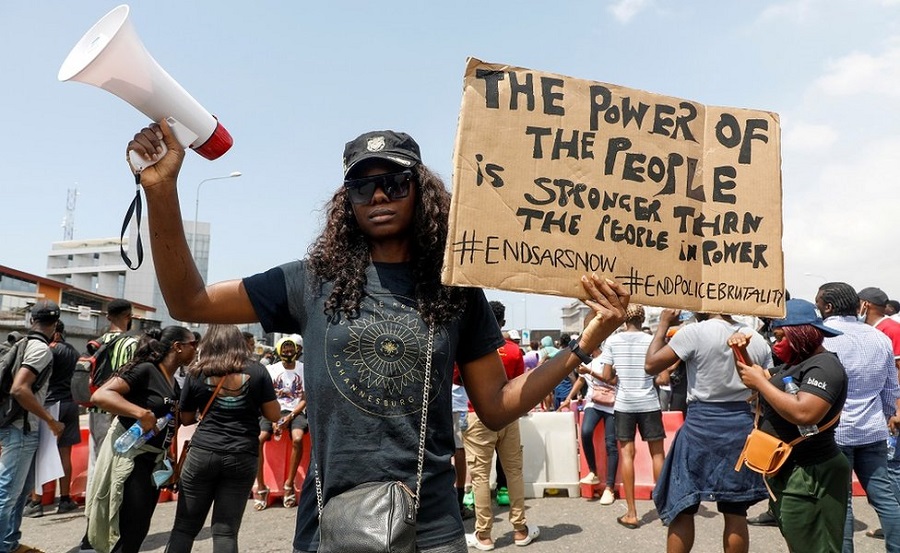
Every Nigerian who was following the endsars’ protests from the first week of October 2020 knew where he or she was on the evening of Tuesday, October 20, 2020 and still remembers what he or she saw and heard on some people’s livestreams and DJ Switch’s Instagram livestream. Rehashing the images that emanated from the livestream of DJ Switch would be re-opening mental and psychological wounds that have not healed for those who survived the ordeal at Lekki tollgate, those who barely survived, the families of those whose loved ones have not been found i.e., no closure and those who watched the horror online. Everyone (probably without knowing it) is still going through a post-traumatic stress disorder PTSD which I would get back to shortly.
The ramifications of what happened that night (which one would think was a movie shot by African American movie director Antoine Fuqua who is known for his detailed hyper action movies) morphed from online to reality and is not lost on anyone, as any Nigerian who met Nigerians outside Nigeria might have noticed and deduced. The Nigerians who were in the country and especially Lagos and the island on that day, who I have met outside Nigeria, always seem to have an interesting feature, something in the mould of a PTSD-infused dejection about the country which you cannot miss. The number of Nigerians one met outside Nigeria shortly after October 2020 was on the high side as it would appear that those who could afford it stepped or flew outside Nigeria for breath of fresh air to recalibrate from the turmoil that engulfed the country and most importantly, to re-evaluate their professional and personal options vis-à-vis an enabling environment which was not what they left behind and many attested to this.
Migration and brain drain are not new phenomena for it is as old as the Biblical times. But in the 21st Century where anywhere on any continent can become home if several factors are in place notably, an enabling environment deliberately engineered by forward thinking governments, people would readily move or relocate. And one major outcome of the endsars protests and Lekki massacre has been the obvious migration of upwardly mobile Nigerians (in this particular instance, I am focusing on those with high skillsets and human capital). I have lost count of how many, one has met outside Nigeria and the final trigger for this head-scratching migration of highly skilled category and demography was and still is October 20, 2020.
Now, according to Wikipedia, a remittance is a non-commercial transfer of money by a foreign worker, a member of a diaspora community, or a citizen with familial ties abroad, for household income in their home country or homeland. Money sent home by migrants competes with international aid as one of the largest financial inflows to developing countries. Workers’ remittances are a significant part of international capital flows, especially with regard to labour-exporting countries. According to the World Bank, in 2018 overall global remittance grew 10% to US$689 billion, including US$528 billion to developing countries. Overall global remittance is expected to grow 3.7% to US$715 billion in 2019, including US$549 billion to developing nations.
Due to its large Diaspora and overseas expats population, India consecutively remains the top receiver of remittance, e.g. with US$80 billion in 2018, US$65.3 billion (2.7% of India’s GDP) in 2017, US$62.7 billion in 2016 and US$70 billion in 2014. Other top recipients in 2020 were US$67 billion to China, US$34 billion each to Philippines and Mexico and US$26 billion to Egypt.
Now, Diaspora is the dispersion or spread of any people from their original homeland. It also means to scatter about. Furthermore, the term diaspora comes from an ancient Greek word meaning “to scatter about.” And that’s exactly what the people of a diaspora do. They scatter from their homeland to places across the globe, spreading their culture as they go. Cambridge Dictionary states that Diaspora is a group of people who spread from one original country to other countries.
The Bible refers to the Diaspora of Jews exiled from Israel by the Babylonians. Jews living outside Israel; the dispersion of the Jews beyond Israel. The main diaspora began in the 8th–6th centuries BC.
In a piece written by Adolphus Aletor in the Guardian Nigeria newspaper of Monday, October 18, 2021, titled; “Enough of Nigeria’s Dependence on Diaspora Remittances”, he stated that; “Early this year 2021, the World Bank reported that diaspora remittance in Nigeria for the year 2020 fell to $17bn from $23 in 2019. Analysts attributed the use of alternative platforms powered by blockchain technology, partly, as a reason for the reduction. Since then, the Federal Government has taken steps not only to stabilise the Naira but increase diaspora remittances.”
He furthered stated that, “In 2018, Nigerians abroad sent a total of $25billion representing about 6.1% of Gross Domestic Product that year which made Nigeria second in Africa after Egypt with $28billion. However, recent reports from the World Bank show that in 2019, it dropped to $23.81billion and in 2020, to $17.21billion representing four per cent of Nigeria’s Gross Domestic Product in 2020. In 2020, total international migrants were estimated to be 281million people, that is, 3.6% of the world population out of which about 15 million is touted to be Nigerians. In 2017 alone, about 1.3 million people left Nigeria.”
He stated that, “In 2020, the following five countries came tops globally for remittances inflow; India (83 billion), China (60 billion), Mexico (43 billion), the Philippines (35 billion), and Egypt (30 billion). India has occupied the top position since 2008. According to the World Bank, the decline in inflows to Sub-Saharan Africa was mostly due to a 28 per cent decline in remittance flows to Nigeria. Excluding flows to Nigeria, remittances to Sub-Saharan Africa increased by 2.3%, demonstrating resilience.”
Whilst these figures might cause dizziness, one crystal clear and immaculate truth is that countries appreciate and place high value to diaspora remittances. But this is not where this piece is leading you to. Hold onto your seat belts.
One ramification which isn’t being focused on is that even though a large diaspora community means more remittances back home to a country and more remittances mean more foreign exchange to stimulate an economy, the bigger problem isn’t yet a talking point. Stay with me.
With the events of October 20, 2020 still fresh and still playing in people’s hearts and minds. With the diplomatic placements of some of the main actors of October 2020 and knowing that the international implications of October 20, 2020 would begin to play out in 2023 (after this current administration); what is slowing playing out from the outside is that the diaspora who have the skillsets, human capital and global connections and networks are beginning to migrate their global connections to where the environments are conducive and friendly. In essence, the diaspora who have connections which can translate into foreign direct investments (FDIs) for their ancestral country are moving such potential investors to other peaceful environments and climes. In simple English, FDIs typically need and trust someone or people who is/who are from a certain country or continent and who can give in-depth knowledge about what to do and what not to do. Now, imagine that the diaspora with such high net-worth FDIs, would they member of the diaspora take the FDIs to a place where the system would discredit and tarnish his or her standing credibility which must have been meticulously garnered and painstakingly built for several years? Succinctly put, foreign direct investments (FDIs) supersede diaspora remittances.
Now, here is the real and mighty elephant in the ceramic shop. Anyone who has been observant would realise that for close to a year since 2020 and recently, news items on Nigerian tech start ups are all there for all to read, assimilate and think about. And more of such news would keep on beating into the recollective skulls and eardrums of forward-thinking policy makers on the African Continent and globally in 2022 and beyond. But, October 2020 in Nigeria, was akin to a flick (only that the events were real) shot by Antoine Fuqua but the mindset of diaspora with FDIs’ connections is akin to a Quentin Tarantino TV Series which would stretch way beyond the elections of 2023. Something did happen; something did snap on Tuesday, October 20, 2020 and it finally broke upwardly mobile Nigerians vis-à-vis the meaning of wholehearted patriotism (for more than a decade I have come to the conclusion that patriotism in several countries is a song sung by politicians to their citizens only. But when push comes to shove, the politicians would hum a different hymn and sing a new song.) The evidence can be seen and felt from the outside when you have a Nigerian themed discussion or chitchat with Nigerians or people of Nigerian descent. So, what is the solution? It is to engage in civic responsibilities and politics way before elections begin, so as to elect those who would genuinely serve their respective localities and the citizenry in general.
Again, but something snapped and shifted on that dreadful night of Tuesday, October 20, 2020. The Nigerian Diaspora is taking their potential direct foreign investors elsewhere (for there is a lot at stake, credibility being one of the major factors), to where there is an enabling environment and where there is peace of mind. Present-day pragmatism (you might say). It is what it is.
Dolapo Aina writes from Kigali, Rwanda
Related
You may like
Featured
Leatherworld: A Masterclass in Enduring Excellence
Published
4 days agoon
March 21, 2026By
Eric
Leatherworld defines what it means to be classy. And it has confidently taken the higher road. For more than three decades, it has not merely sold furniture — it has demonstrated what class truly means in business: integrity in craftsmanship, consistency in service, and vision in growth. And as its name, “Leatherworld” implies, it is a world of its own.
Founded in 1994 to meet the demand for high-quality furniture in Nigeria, Leatherworld began as a retail outlet focused on premium pieces through partnerships with Italian luxury brands. However, it has now upped its ante, spreading its tentacles with showrooms in Victoria Island and Lekki Lagos, and also in Abuja in the Federal Capital Territory.
At a time when durability was often sacrificed for cost and quick turnover, the company made a deliberate decision: it would never compromise quality to cut corners. That principle has remained its compass ever since.
This is indeed the story of Leatherworld. For over 30 years, it has defined what luxury furniture means in Nigeria. It is not just a brand, it has consistently stood for one core principle: quality that lasts.
The company’s commitment to seasoned hardwood, aged for up to seven years before production, speaks to a patience that is rare in modern manufacturing. Indeed, its furniture is designed not for seasons, but for decade
Its growth has been matched by recognitions and honours from far and wide. Notable among some of these awards and recognitions are; international honours such as the Quality Summit New York International Award for Excellence (2013) to multiple awards from reputable organisation such as; the Nigerian National Assembly 2004 Awards, Furniture and Allied Products Manufacturers Association of Nigeria Award (2008), Interior Designer Association of Nigeria, IDAN, Award (2012). Indeed, Leatherworld’s name has become synonymous with leadership in interior décor and furniture manufacturing.
But beyond awards and expansion, it is its customer loyalty that tells the real story. For many clients, the Leatherworld experience begins long before the furniture is delivered.
The brand has earned respect across borders. But class is not proven by trophies alone. It is revealed in everyday interactions. Customers consistently describe professional staff, meticulous delivery teams, and after-sale technical support that is “second to none.”
From custom requests handled with speed and care to full-room assemblies executed with precision, Leatherworld treats service as part of the product itself.
Many customers attest to owning Leatherworld pieces for over 30 years — still structurally sound, still comfortable, still elegant. In a marketplace often flooded with disposable options, that kind of longevity is not accidental; it is intentional. This explains why the customers of Leatherworld attests to the durability and high quality of its products.
“I really enjoyed my shopping experience,” says Anita Ajah, who visited the Lagos showroom. “Their customer service was unlike anything I have experienced in Nigeria.”
Diana Ufuah shares a similar sentiment. “Leatherworld is the very best in terms of quality. I bought a sofa there and it is extremely comfortable and durable. What I also find intriguing is their customer service. My family and I were treated like royalty while shopping.”
It is a recurring theme – professionalism, warmth, and attention to detail.
Oluwole Adekoya describes the experience as “first-class quality furniture reasonably priced,” recommending the brand to anyone “with a dimension for taste.”
Kunle Adegbite highlights the end-to-end service: “I found exactly what I was looking for. Not only were the choices incredible, the service was outstanding. I requested their operations team to assemble my living room and they were quick, professional, and executed it beautifully. I couldn’t ask for more.”
Chioma Okonkwo, a long-standing client is more effusive in her review: “You only get bored with the same furniture but the thought of the new price you will pay keeps you loving your FOREVER furniture from Leatherworld!”
Those testimonies indeed speak volumes. Still, Leatherworld has not dithered from its vision to revolutionise the furniture and interior design industry in Nigeria and West Africa. And its message is simple: quality furniture is not a cost — it is an investment. You choose once. You choose well. You buy for life.
Leatherworld’s aesthetic draws inspiration from the elegance of Florence and the opulence of Nigerian culture — a fusion that respects global sophistication while celebrating local identity.
Its collections range from classical and neo-classical to contemporary and simple-line designs, ensuring that individuality is never compromised.
In doing so, the company has positioned itself not just as a seller of furniture, but as a curator of lifestyle — crafting pieces that define spaces for scholars, business leaders, families and discerning homeowners alike.
In business, class is consistency when no one is watching. It is honouring promises made decades ago. It is building products that outlive marketing campaigns. It is choosing long-term reputation over short-term gain.
In a competitive industry where shortcuts are tempting and compromise is common, Leatherworld has shown that real class lies in endurance — of materials, of service, of vision and of trust.
And in doing so, it has not only furnished homes across Nigeria and West Africa; it has furnished an example of how a company can grow, lead, and still remain grounded in excellence.
Bimbo Alashe, as the founder and CEO of Leatherworld Furniture Company, leads the international furniture retailing assemblage and manufacturing company in Nigeria. The company offers top quality leather furniture and accessories in wood, glass, marble, and other authentic and elegant materials, establishing a reputation for excellence in craftsmanship and design.
She is one of the most formidable entrepreneurs in Nigeria. Beyond building her company, she sits on the board of several companies and serves as a mentor to a number of aspiring and established entrepreneurs, sharing her experience and insight to help others grow.
Her story is not the typical one of a person who grows from old money. Alase had to create her story herself, making her way from the rough early days of owning a small mini-store to the point where she became a mega business owner through determination and persistence.
When Leatherworld was established, it entered the furniture space to redefine luxury and class. The business created an opportunity for her to explore her love for creativity, guided by a straightforward vision — to make high-quality furniture available to everyone.
Related
Featured
Tinubu, Atiku, Obi Felicitate with Muslim Ummah, Nigerians at Eid-el-Fitr
Published
4 days agoon
March 21, 2026By
Eric
By Eric Elezuo
The three frontline political leaders in Nigeria; President Bola Tinubu, Alhaji Atiku Abubakar and Mr Peter Obi, have in separate messages call for the strengthening of security, sustenance of the spirit of goodwill imbibed during Ramadan as well as kindness among Nigerians as the Muslim Ummah celebrate the 2026 Eid-el-Fitr.
The messages are in response to the successful completion of the 30-day fasting – a period of dedication, sacrifice, spiritual renewal and stocktaking – which end birth the Eid-el-Fitr celebration.
Leading the avalanche of messages, President Tinubu, through a statement signed by his Special Adviser on Information and Strategy, Bayo Onanuga, reiterated the need to lead a pious life seasoned by empathy and unity among humankind.
He noted that though the Ramadan season is over, but the lessons of piety, selflessness, perseverance, kindness and compassion, which the period is known, must consistently be the watchword of every Nigerian.
The message is captured in details below:
As Muslims worldwide celebrate Eid-el-Fitr, marking the end of Ramadan, President Bola Ahmed Tinubu has congratulated the Muslim faithful in Nigeria, urging renewed commitment to the nation and humanity.
President Tinubu enjoined Nigerian Muslims to rededicate themselves to the noble teachings of the holy month, which emphasize piety, empathy, and unity among humanity.
“We have a lot to draw from the noble lessons of Ramadan, especially at a time like this. We must continue to abide by the virtues of piety, selflessness, perseverance, kindness and compassion beyond this period,” he said.
President Tinubu urged all Muslim faithful to extend a hand of kindness to the needy of all faiths, to further show unity and camaraderie.
The President also tasked Muslim leaders to use the occasion to offer prayers for peace and prosperity to prevail in the country.
In the same vein, former Vice President of Nigeria and chieftain of the African Democratic Congress (ADC), Atiku Abubakar congratulated the Muslim faithful in Nigerian and across the world on the successful completion of the mandatory Ramadan fasting, and the celebration of the Eid-el-Fitr.
A press statement signed by the media office of the former Vice President, admonished Muslims to remain steadfast in piety by maintaining peace and in charitable causes.
According to Atiku, the completion of the obligatory fasting in the noble month of Ramadan should lead to more commitment to the injunctions of Almighty Allah.
“The completion of the Ramadan fasting is a call to duty that ensures we sustain the good deeds that the noble month requires of us.
“We must ensure that the lessons of the month are not lost on us and that the celebration of today is a reminder to the people, especially Muslims, to follow in the tradition of the noble Prophet Muhammad (SAW) in seeking closeness to God through worship and maintaining peace,” Atiku said.
He further called on the government to take it more seriously, stressing that “the protection of the lives and property of citizens is a divine decree and the sole responsibility of every government.”
Atiku similarly enjoins the privileged in the society to keep providing charity to the less privileged as this would go a long way in ensuring that the rising tide of economic downturn does not weigh too heavily on the poor.
“A greater number of people are being crushed by the economic downturn and global events in the past three weeks have further exacerbated the situation. It is incumbent on the wealthy to be more compassionate by taking up the responsibility of charity to help cushion the effect of the burden on the poor,” Atiku said.
Also lending his voice the congratulatory messages, Labour Party’s former presidential candidate, and former Governor of Anambra State, Peter Obi, urged Nigerian Muslims to imbibe the spirit of Ramadan going forward even as the 30-day fast has officially ended.
“I join you with heartfelt joy as we celebrate Eid al-Fitr, the blessed festival that marks the successful completion of the sacred month of Ramadan.
“This occasion is a profound reminder of the power of faith, discipline, selflessness, and unwavering devotion to Almighty Allah.
“Throughout Ramadan, you have fasted, prayed, given charity, and drawn closer to God, embodying values that inspire not only the Muslim ummah but every person of goodwill. These lessons of compassion, humility, patience, and solidarity must not end with the month; may they continue to guide our hearts, our actions, and our shared life as Nigerians.”
Many other prominent Nigerians and institutions have also identified with the Muslims in celebration, drumming the lesson of service, patriotism, piety and above unity of purpose to the hearing and learning of all and sundry.
Related
Featured
TEF Entrepreneurship: Tony Elumelu Foundation Sets March 22 to Announce 2026 Cohort
Published
5 days agoon
March 20, 2026By
Eric
The Tony Elumelu Foundation (TEF), the leading philanthropy empowering young African entrepreneurs will announce the 12th cohort of the flagship TEF Entrepreneurship Programme on Sunday, March 22, 2026.
In 2026, the Foundation will empower a total of 3,200 entrepreneurs across all its entrepreneurship programmes:
1,751 entrepreneurs through Heirs Holdings Group: Heirs Energies, Transcorp Power, Transcorp Hotels, and United Capital; 1,049 entrepreneurs in partnership with the European Commission, OACPS, BMZ and GIZ; 100 entrepreneurs in partnership with Sèmè City Development Agency; 100 entrepreneurs in partnership with DEG, the German Development Agency; 100 entrepreneurs in partnership with the IKEA Foundation, UNICEF’s Generation Unlimited and the Dutch Government; and 100 entrepreneurs in partnership with UNDP and the Rwandan Ministry of Youth and Arts.
Applications to the flagship programme were received from over 265,000 young Africans, representing all 54 African countries, underscoring Africa’s vibrant entrepreneurial sector and the funding challenge for entrepreneurs. The new cohort will join the TEF Alumni community of more than 24,000 entrepreneurs.
The selection process is conducted by Ernst & Young, ensuring an independent and rigorous assessment of applicants.
Each selected Tony Elumelu Entrepreneur will receive $5,000 in non-refundable seed capital, access to world-class business management training on TEFConnect, one-on-one mentorship, and entry into a powerful network of investors, partners, and other entrepreneurs.
The Tony Elumelu Foundation has empowered over 2.5 million young Africans with access to business management training on our proprietary digital hub, TEFConnect, and disbursed over US$100 million in seed capital to more than 24,000 selected entrepreneurs. Collectively, these entrepreneurs have generated $4.2 billion in revenue and created more than 1.5 million direct and indirect jobs. Through our support for African entrepreneurs, TEF has lifted 2.1 million Africans above the poverty line, and positively impacted more than 4 million African households, with 46% of supported entrepreneurs being African women.
Ahead of the upcoming announcement, Tony O. Elumelu, C.F.R., Founder of the Tony Elumelu Foundation, reiterates his unwavering belief in the potential of Africa’s entrepreneurs:
“The future of Africa will be built by Africans who create businesses, generate jobs and solve the challenges of our continent. At the Tony Elumelu Foundation, we believe that empowering entrepreneurs is the most sustainable path to Africa’s economic transformation.
I look forward to announcing and congratulating the 2026 cohort of Tony Elumelu Entrepreneurs and look forward to witnessing the impact they will create across our continent.”
The general public is invited to join, virtually.
Related


Iran Has Given Up on Nuclear Weapons, Trump Claims
IGP Disu Redeploys Top Police Officers in Major Shake-up
FG Helpless over Power Outages, Minister Adelabu Admits, Apologises to Nigerians
Obi Condemns Arrest of Sheikh Ahmad Shortly after Meeting in Kaduna
Dangote Warns of Dire Consequences for Nigeria If Iran War Continues
N868m Fraud: Court Jails Ex-AGF Nwabuoku 72 Years
Trump Announces 5-Day Ceasefire on Strikes Against Iran, Opts for Talks
AFCON 2025: George Weah Urges CAS to Overrule CAF’s Verdict
My Dear Brother, Dele Momodu by Segun Adeyemi
The Oracle: The New Digital Colonialism: Navigating AI Policy Uunder Foreign Tech Dominance (Pt. 3)
Why Investing in People Outperforms Every Resource on Earth
2027: Peter Obi Raises Doubt About Clinching ADC Presidential Ticket
AI and Neurodiversity: The Future Must Work for Everyone
Trump Announces 5-Day Ceasefire on Strikes Against Iran, Opts for Talks
Trending
-
Sports4 days agoAFCON 2025: George Weah Urges CAS to Overrule CAF’s Verdict
-
Opinion4 days agoMy Dear Brother, Dele Momodu by Segun Adeyemi
-
The Oracle5 days agoThe Oracle: The New Digital Colonialism: Navigating AI Policy Uunder Foreign Tech Dominance (Pt. 3)
-
Opinion4 days agoWhy Investing in People Outperforms Every Resource on Earth
-
Headline6 days ago2027: Peter Obi Raises Doubt About Clinching ADC Presidential Ticket
-
Tech and Humanity5 days agoAI and Neurodiversity: The Future Must Work for Everyone
-
World2 days agoTrump Announces 5-Day Ceasefire on Strikes Against Iran, Opts for Talks
-
Featured5 days agoTEF Entrepreneurship: Tony Elumelu Foundation Sets March 22 to Announce 2026 Cohort