
Headline
Why Okonjo-Iweala Should Be WTO’s Director General


By Eric Elezuo
“You need energy, you need enthusiasm, you need to see opportunity where there are challenges, and that’s me” – Ngozi Okonjo-Iweala
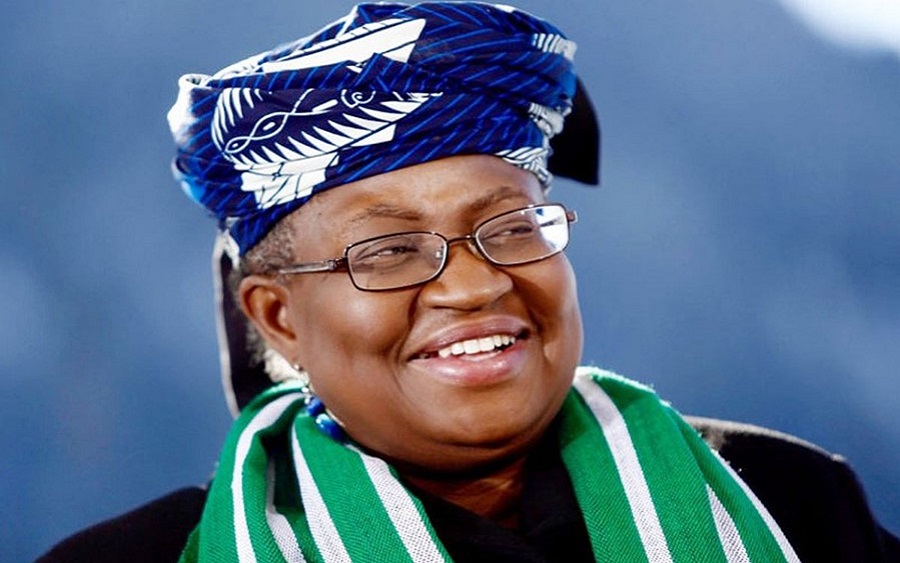
In the coming week, Nigeria’s former Finance Minister and Coordinating Minister of the Economy, Mrs Ngozi Okonjo-Iweala, will be having a sure foothold on the director-general position of the World Trade Organisation. Okojo-Iweala, a nominee of President Muhammadu Buhari, is arguably the most qualified of the remaining five shortlisted hopefuls for the prestigious seat, owing to her deep knowledge of world trade and unmatched experience acquired in various fields of financial and diplomatic related endeavours.
After thorough consultations, the WTO had announced that five out of eight candidates for the post of WTO Director-General will advance to the next stage of the selection process. They are Nigeria’s Ngozi Okonjo-Iweala, Republic of Korea’s Yoo Myung-hee, Amina C. Mohamed from Kenya, Mohammad Maziad Al-Tuwaijri from Saudi Arabia and Liam Fox who was nominated from the United Kingdom. These candidates made it to the round as a result of receiving “the broadest and deepest support from the WTO membership.
However, the likes of Jesús Seade Kuri from Mexico, Abdel-Hamid Mamdouh from Egypt and Tudor Ulianovschi Moldova lost out, and will not advance to the next phase. The candidates were said not to be able to secure the support needed for the first round of 3 rounds of voting.
As the week unfolds, these remaining five candidates, who are from the initial pool of eight candidates that were shortlisted, will be further pruned down to just two candidates after the second round of elimination, and Nigeria’s Okojo-Iweala is expected to stay on the line, and win eventually when the next DG is announced in November.
Of the remaining five candidates are in the race to replace Roberto Azevedo, who stepped down as the WTO Director-General last month a year ahead of schedule, two are Africans. And it is expected that an Africa take up the mantle of leadership in spite of the nomination of another European
Feelers coming from the trade body remains quite unclear if the WTO members will ultimately agree on another leader from Europe. There is however, no requirement for a regional rotation of the WTO chief position, but a general and unspoken agreement points to the direction of the African continent. This has therefore, given an edge to the Nigerian finance guru, given that her closest African rival, from Kenya is a Cabinet Secretary for Sports, Heritage and Culture. Though a lawyer and diplomat, Mohamed’s present position, and some of those hitherto held, put her on parallel line with the coveted post.

Ngozi Okonjo-Iweala
As the calls for an African to finally get a shot at running the organization, which has been led by three Director-Generals from Europe, and one each from Oceania, Asia and South America since its creation in 1995, the chances continue to get brighter for Okonjo-Iweala.
Iweala in-depth knowledge about trade and business endeavours is highly obvious as noted in one of her statements that “if we didn’t have the WTO we would have to invent it.” This expresses her passion for a world single digital market. It is therefore not out of place to say she will run the world body with all sense of diligence when selected.
In an interview she granted African Report, Okonjo-Iweala exposed her deep sense of stewardship and can-do attitude towards revamping the WTO. The medium stated that “She does believe however that the WTO has a role to play in helping countries, often in the South, often in Africa, who have failed to benefit from the global trading system as it is structured today. Okonjo-Iweala said were she to be elected she would push for instruments such as aid for trade, or other mechanisms to help level the playing field.”
It stressed that ‘one policy proposal African countries might appreciate from Okonjo-Iweala, especially given fresh reports of Chinese fishing trawlers plundering West African fish stocks – is the attempt to take swift action at the WTO over what Okonjo-Iweala calls ‘bad subsidies that encourage overfishing’.
In the chat with African Reports, Okonjo-Iweala fielded questions intelligently, prompting one to assume she had held a WTO top position in the recent past. Check out this answer as she was how the WTO deal with the fact that the pandemic has prompted more distrust of global supply chains and a shift back to local production.
“This is one of the most important questions. We will surely have more pandemics and epidemics and how we deal with them with respect to world trade will be important.
“On WTO rules, to some extent, countries can decide on export restrictions, provided it’s temporary, transparent and proportionate and notified, and that they remove it in the end. So we should make sure that this does not become a reason to block trade.
“There are countries that are completely food import dependent. In a situation where some countries don’t have the economies of scale to manufacture either food or medical supplies …. we should have a world trading system that allows them to have access. That does not mean that for other countries who want to take measures to improve manufacturing behind borders of any kind, it shouldn’t stop any country or putting more manufacturing in.”
She explained in more certain terms why the WTO has not concluded a single trade negotiation round of global trade talks since 1995.
“In terms of a major round, the Doha Round has never been concluded and no other major round has been launched. Over time there’s been a growing divide among countries and a lack of trust, not seeing things from the same point of view. But as you look at it, this is not overwhelming. I feel that there’s still room to rebuild that trust, to try and build that consensus and to come to agreements.
“That’s why the WTO needs now a director-general that can work with the members to move forward some critical pieces. The fisheries negotiation, for instance, could be concluded and could be a very important one from several viewpoints.
“It would deal with overfishing, with depletion of fish stocks which is a threat to biodiversity, by getting rid of destructive subsidies that don’t help. And it can also support small-scale fisheries in developing countries.”
It would be recalled that the selection process for the new Director-General started on May 14 when former WTO Director-General Roberto Azevêdo announced that he would step down from his post on 31 August, cutting his term short by one year.
With regards to the guidelines for the third and final stage of the selection process agreed by the General Council on 31 July, WTO General Council Chair David Walker from New Zealand, with Chair of the Dispute Settlement Body, Dacio Castillo from Honduras and Chair of the Trade Policy Review Body, Harald Aspelund from Iceland, conducted confidential consultations with WTO members from 7-16 September 2020 to identify their preferences. On 16 September, the pool of candidates was reduced from eight to five. The results and the next steps in the selection process were announced at a Heads of Delegation meeting on 18 September.
The second phase of confidential consultations has been on since September 24, and is expected to end on October 6 when only two members will emerge. Here, WTO members will be requested to submit their preferences to “the troika” (Walker, Castillo, and Aspelund), following which the field of candidates will be reduced from five to two. At that time, the timetable for the third and final round of consultations will be announced.
According to the WTO, the “ultimate objective of this measured and clearly defined process is to secure a consensus decision by members on the next Director-General.”
According to Wikipedia, Okonjo-Iweala was born on June 13, 1954 in Ogwashi-Ukwu, Delta State, Nigeria where her father Professor Chukwuka Okonjo is the Eze (King) from the Obahai Royal Family of Ogwashi-Ukwu.
Okonjo-Iweala was educated at Queen’s School, Enugu, St. Anne’s School, Molete, Ibadan, and the International School Ibadan. She arrived in the US in 1973 as a teenager to study at Harvard University, graduating magna cum laude with an AB in Economics in 1976. In 1981, she earned her Ph.D in regional economics and development from theMassachusetts Institute of Technology (MIT) with a thesis titled Credit policy, rural financial markets, and Nigeria’s agricultural development. She received an International Fellowship from the American Association of University Women (AAUW), that supported her doctoral studies.
Okonjo-Iweala spent a 25-year career at the World Bank as a Development Economist, scaling the ranks to the Number two position of Managing Director, Operations between 2007 and 2011. She also served two terms as Finance Minister of Nigeria (2003–2006, 2011–2015) under the leadership of President Olusegun Obasanjo and President Goodluck Jonathan respectively. She also had a stint in the external affairs ministry as minister.
She is a seasoned economist and international development expert. She sits on the Boards of Standard Chartered Bank, Twitter, Global Alliance for Vaccines and Immunization (GAVI), and the African Risk Capacity (ARC).
She is married to Dr. Ikemba Iweala, a neurosurgeon. They have four children – one daughter, Onyinye Iweala (AB, MD, PhD, Harvard) and three sons, Uzodinma Iweala (AB, Harvard, MD, Columbia), Okechukwu Iweala (AB, Harvard) and Uchechi Iweala (AB, MD, MBA, Harvard).
Okonjo-Iweala became a US citizen in 2019 after spending several decades working and studying in the United States. Many believe that given the ongoing trade tensions between China and the US, the disclosure may be a contributing factor in shaping China’s attitude towards her considering the trade conflict between the United States and China, the two largest economies in the world.




ADC Raises Alarm over INEC’s Plot to Prevent Party from Fielding Candidates
Jigawa ADC Receives Defecters from APC, NNPP, PDP

I Won’t Be Intimidated, Seun Okinbaloye Replies Wike

Amnesty Condemns Wike’s ‘Shoot’ Remark Against Seun Okinbaloye

‘ADC Membership Hits 500,000 after INEC Derecognition of Leadership’

Is Amupitan’s INEC Complicit?

Effective Strategic Leadership: Resolving Nigeria’s Contemporary Challenges and Unlocking Inclusive Possibilities

When Anthropic Accidentally Opened Its Own Vault: The Claude Code Leak of March 31, 2026
Effective Strategic Leadership: Resolving Nigeria’s Contemporary Challenges and Unlocking Inclusive Possibilities

Bauchi Gov Bala Mohammed Signals Possible Defection to ADC

The Oracle: The New Digital Colonialism: Navigating AI Policy Under Foreign Tech Dominance (Pt. 5)
ADC Rejects INEC’s Interpretation of Court of Appeal Ruling

This Attack on Democracy Will Not Stand – ADC Chairman, David Mark

Joeboy Stars on Easter Edition of Glo-Powered African Voices
-
 Tech and Humanity4 days ago
When Anthropic Accidentally Opened Its Own Vault: The Claude Code Leak of March 31, 2026
-
 Opinion2 days ago
Effective Strategic Leadership: Resolving Nigeria’s Contemporary Challenges and Unlocking Inclusive Possibilities
-
 Headline6 days ago
Bauchi Gov Bala Mohammed Signals Possible Defection to ADC
-
 The Oracle3 days ago
The Oracle: The New Digital Colonialism: Navigating AI Policy Under Foreign Tech Dominance (Pt. 5)
-
 Headline5 days ago
ADC Rejects INEC’s Interpretation of Court of Appeal Ruling
-
 Headline4 days ago
This Attack on Democracy Will Not Stand – ADC Chairman, David Mark
-
 Entertainment4 days ago
Joeboy Stars on Easter Edition of Glo-Powered African Voices
-

 Featured4 days ago
Gov Adeleke Commends MicCom Legacy As Family Launches N150m Engineering Endowment at OAU