Featured
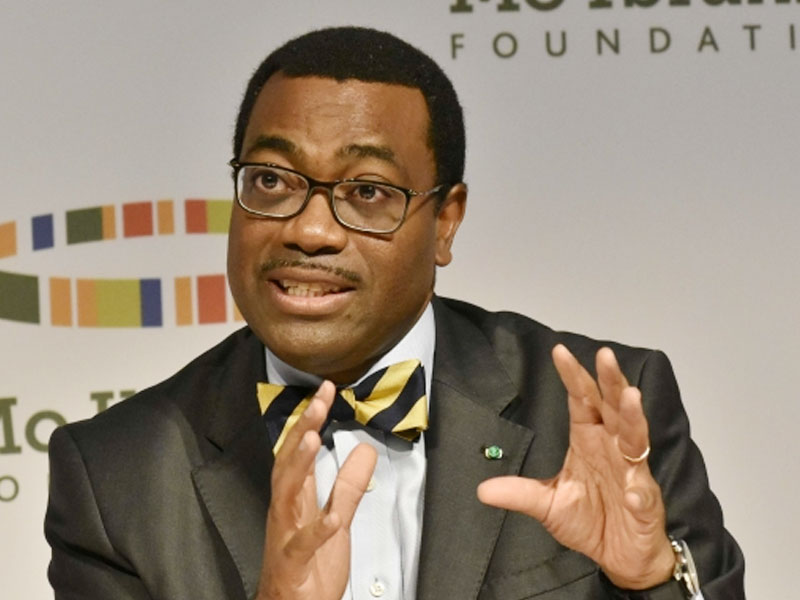
Full Text of Dr. Adewunmi Adesina’s Speech at Bowen University’s Convocation Ceremony
Published
6 years agoon
By
Eric
Vice Chancellor, Registrar, Members of the University Council, Members of the Senate, Deans of Faculties, Senior Officers of the university, lecturers, parents, families and friends of the students, and most importantly, the great students of Bowen University!
Congratulations to you all on the 13th convocation ceremony of the Bowen University.
I am delighted to be here today to deliver the convocation lecture. I’d like to congratulate the university on graduating another set of students that will shape the future of Nigeria, Africa and the world.
You prepare leaders through scholarship, knowledge and biblical principles. You set up your students on solid foundations. The storms and the waves may come, as they face life, but Bowen has prepared them to stand. Their anchors will hold in the storms of life.
I am a believer in Baptist education. I attended high school at Ejigbo Baptist High school. We sang from the Baptist Hymnal. I remember so well one of my favourite songs “I am pressing on the upward way, new heights I am gaining everyday… a higher plane than I have found, Lord plant my feet on higher ground”.
Oh, how I always cherished the words of that hymn, its call for us to reach for glory land. It always inspired me as well to reach out to higher ground here in life, by pressing on. Today, I ask you to press on to higher ground.
That is the kind of higher ground by the Nigerian Baptist Convention when it established Bowen University in 2001. Then, it had only 500 students. By 2017, it had 5,000 students. And all its programs are accredited by the Nigerian University Commission.
One of my favourite scriptures is the parable of talents. One had 5 and invested and doubled to 10. Another had 2 talents and doubled to 4. One had one talent but buried it. When the master came he praised the first two and gave them more. He berated the third one for not investing his talents.
So today, let’s talk about investing your talents through entrepreneurship.
Universities are known as citadels of leaning. They are reservoirs that nourish the mind, sharpen a sense of inquiry, unlock intellectual curiosity. You are taught to question things, to always ask why and why not, to find alternative pathways and solutions.
In my days at the university, you got a job immediately after you graduated. Your future was set.
No longer. The graduate today is graduating into a world of uncertainty. Over 13 million young people enter the job markets each year but only 3 million get jobs. Africa will have the largest number of youths joining the labour market by 2030 than all the world taken together.
I took a look at your website and noticed that according to the Stutern Nigerian Graduate Report, 2018, 60 per cent of Bowen graduates are employed. Two things stood out to me. The probability of getting employed is 60 per cent. Second, your graduates are working for others, though it did not say what kinds of jobs they have.
But one thing is missing: it did not talk about how many of the students were entrepreneurs, who created businesses, employing others: Job creators, not job hunters.
This is the time to remember the song above, and press on to higher ground. That higher ground is not to depend on others to employ you. The higher ground is for you to be job creators. The key to that is entrepreneurship.
Scott Belsky, the Founder of Behance said: “It’s not about ideas. It’s about making ideas happen”.
How true! How pertinent! Indeed, it is entrepreneurship that makes ideas happen.
To be a successful entrepreneur you need some attributes that you were not taught in school. The key one is perseverance. Perseverance is defined as “persistence in doing something despite difficulty or delay in achieving success”.
Steve Jobs said, “I am convinced that about half of what separates successful entrepreneurs from non-successful ones is pure perseverance”.
The university system does not teach you to make mistakes. You are to be perfect. You got an F, your future was finished. Really? Maybe not. Do not get me wrong, I am not advocating failure. But to be an entrepreneur get used to failures.
You will not succeed at your first idea. Indeed your idea may lead you many times to want to quit. But don’t.
Think about Thomas Edison who developed the light bulb. He was said to have failed 1,000 times when trying to develop the light bulb. He had a different view: he said no, I did not fail 1,000 times, the development of the light bulb required 1,000 steps”. What a perspective.
Albert Einstein said, “Anyone that has never made a mistake has never tried anything new”.
Universities should shift away from rote teaching into allowing students to experiment, try things, put ideas to work, and innovate.
To do this, universities need to have structured institutional arrangements for supporting innovations. In the US universities set up offices for innovation development and commercialisation of innovations developed by universities.
Developing patents is not enough. Patents must lead to business and that can only happen through supportive environments for them to thrive. Setting up university foundries is a good way to achieving this.
Take Purdue university; it runs a foundry that supports its students to turn their ideas into businesses.
Stanford university has programs in entrepreneurship for students, start-up garages where ideas are tested and venture studios that it uses to connect graduate students to a world of ideas, other innovators, community of entrepreneurs, including its own alumni.
How many students here have taken courses on entrepreneurship? How many even know about venture capital or angel investors?
By the way these are not angels in the Bible, just so we are on the same page!
I read a book while I was a student in the Christian union fellowship in the university undergraduate days called “Angels on Assignment”. It talks about how God sends angels to help us in difficult situations.
In the world of business, for your ideas to be turned into a business generating money, as a start-up you will need angel investors. They size up your ideas, your business, value your business and provide financing, usually convertible debt or debt they convert to shareholding.
While God has angels watching over billions of people without knowing, angel investors watch over business ideas, looking for what may work. Where there are no ideas that can thrive into viable businesses, you will not find angel investors.
Now, how many angel investors have you seen on your campus? You can measure the likelihood of a university generating wealth by whether you see angel investors hanging around your campus. If you don’t find them, check yourself: you may not be driving and nurturing entrepreneurship and innovation. You may not thriving. You may be missing great opportunities to turn the university into a hub of innovations that will lead to successful big businesses.
And women are great entrepreneurs. Just take a look at women in Nigeria. They are very enterprising. Everywhere you look you see them hard at work. Women run Nigeria!
Young female students deserve special entrepreneurship programs to unleash their potential.
Think about the case of We@Yale that was created to specifically support women entrepreneurs at Yale University to launch 500 business ventures in five years.
No bird can fly with one wing. When women’s potential is fully unlocked, Nigeria will fly with two wings.
The African Development Bank is supporting entrepreneurship programs in African universities. One example is the Rwanda Institute of Science and Technology, a collaborative program on Masters in ICT, jointly with Carnegie Mellon University in the US. With $40 million support from the Bank, the school is world class. And 100 per cent of their students get jobs even before they graduate, with many setting up their own ventures.
Such is the case of Clarisse Irigabiza, a student who set up her own IT business, and sold it for $21 million at the age of 27. What did the university do to help her? World class education, yes. But much more: exposure to entrepreneurship.
Rwanda has set up with our support the Rwanda Innovation Fund to support its young entrepreneurs. The university is linked to the Kigali Innovation City, a modern tech enabling hub linked to universities to help ideas grow, to turn ideas into innovations, and turn innovations into thriving businesses.
One of the important areas ripe for entrepreneurship is the agriculture sector.
One of the young people in Nigeria I am very proud of is Dr.Tope Aroge. I met him when I was Minister of Agriculture and provided him a grant of $5 million Naira. He is a medical doctor, now farmer. You may say wow! Yes, go ahead.
You are wondering why did he change from being a medical doctor to farming? That’s because you do not know that the size of food and agribusiness in Africa by 2030 will be worth $1 trillion. Yes, you heard me right: $1 Trillion dollars.
I did not say Naira. Today, Tope has a 300 ha farm, and he has set up a high quality cassava flour/ industrial starch processing factory which has a 6,000 tonnes capacity. He is an agricultural entrepreneur. Some of you should be like him. Here is why: The future millionaires and billionaires of Africa will not come from oil and gas, but from agriculture sector. So, universities should move beyond agricultural science, to agriculture as a business.
That is exactly what the Wageningen University in Netherlands is doing. It has food-manufacturing companies, including Nestle, the world’s largest food manufacturing company; research and innovation centres located on its campus, investing tens of millions of dollars. No wonder it is ranked number one in the world for agriculture.
The ranking of the 100 most innovative universities is instructive. US universities have 45; African universities have none. Stanford University for the past several years have consistently ranked number one. Others in top ranks are Yale, Harvard and MIT. In the UK you have Imperial College.
Listen to a quote on Stanford by David M. Ewalt published just few days ago: “Located in the heart of California’s Silicon Valley, Stanford University has played a key role in the development of our networked world. In the early 1970s, Stanford professor Vint Cerf co-designed the TCP/IP protocols that became the basic communication standard for the Internet; and in 1991, physicists at the Stanford Linear Accelerator Center deployed the first world wide web server outside of Europe. The university’s faculty and alumni have founded major tech companies including Google, Hewlett-Packard and Cisco Systems.
A 2012 study by the university estimated that companies formed by Stanford entrepreneurs generate so much revenue that if they formed an independent nation, it would rank among the 10 largest economies in the world.[1]
The lesson is clear: universities must understand the needs of the private sector and look for how to drive technologies, innovation and entrepreneurship to meet those opportunities. That’s the kind of win-win partnerships that the private sector is looking for from universities.
The world today and more so in the future is and will be dominated by science, technology and innovations. With the fourth industrial revolution, there is rapid advances in artificial intelligence, machine learning, robotics, automation and quantum data analytics.
It is not data that will control the world, it is those who control data. Think of it: every time you use Google, WhatsApp a friend, post on Instagram or Facebook your data has been collected.
While they offer you nice networking social media they are mining your data. Chinese universities are surging forward in the field of artificial intelligence, with rapid research in medical sciences, neurosciences, machine learning and big data analytics. Listen to a recent piece by Sawahel and Sharma: “Chinese universities make up 17 out of top 20 academic players in artificial intelligence”.[2]
Africa is getting itself positioned to improve its relevance in this space. The African Institute of Mathematical Sciences (AIMS) is becoming a significant platform to strengthen science, technology and mathematical sciences.
Start-ups are emerging in Africa. In 2015, Africa had 3,500 new tech-related ventures and $1 billion in venture capital. By 2019, 6,500 tech start-ups have been established, with $2.27 billion investments in tech start-ups.
The continent’s Internet of Things (IOT) is estimated to be $12.6 billion by 2021 in Africa and Middle East. By 2019 financing for Big Data start-ups inched to $9.8 million.
So what does it all mean. Let me start with the lesson from the Bible. It says to your faith add… My question you is: what are you adding to your education?
Today, I ask you to add new skills, entrepreneurship, and make the university not just about knowledge, but about transformative knowledge, one that is enabled to create the next great businesses for the world.
Transformative knowledge is best captured by the World Economic Forum on human capital: “the knowledge and skills people possess that enable them to create value in the global economic system”.
This is quite instructive! We must not look at knowledge in terms of local environments. Knowledge, to be transformative, must also have global relevance.
You can measure the extent of progress of nations by how much they spend on research and development. The most innovating country in Africa is South Africa. Not surprisingly its universities are doing much better on innovations. A report about to be released by the African Development Bank found that of 24 universities surveyed, 23 have technology transfer offices.
Today, South Africa has developed the largest 3D printer in the world. This is already positioning it to be able to be competitive in industrial use, such as to develop parts for airplanes and shape aeronautics.
Despite this, our review of the readiness of countries for the use of innovations as drivers of growth showed a pattern: of 16 African countries looked at, on a score of 0-100, they all scored between 3.28 to 5.37. On a scale of 0-100, Nigeria is at 3.68.
What this tells us is clear: Nigeria needs to urgently spend a lot more on research and development. That’s what others are doing.
Take for example the case of Dubai and Abu Dhabi. They have just set up the Mohamed bin Zayed University for Artificial Intelligence; the world’s first University dedicated only to Artificial Intelligence. It will train masters and PhD students. And they already have over 3,000 applicants, drawing the best professors and innovators from across the world.
And guess why? They recognise that the size of the Artificial Intelligence market will be worth $15.7 trillion by 2030; just eleven years from now. Dubai, which Nigerians flock to today, as consumers, is already building itself to the AI hub for innovation and entrepreneurship in the world.
Only those that see the future will invest for the future. Only those who see the future can move to higher grounds. My favourite Baptist hymnal echoes in my mind. Lord, please set our feet on higher ground. O Lord, please set our nation, Nigeria, on higher ground.
This is not just a prayer. It is something I believe in very strongly. This is what led me to donate $1.1 million, representing the combined prize monies and matching funds from my 2017 World Food Prize Award and my 2019 SunHak Peace Prize to create the World Hunger Fighters Foundation, to support the youth entrepreneurs in food and agriculture.
And how excited my wife, Grace and I, were two weeks ago to unveil our first set of 10 Fellows – called Borlaug-Adesina Fellows – at the World Food Prize in Iowa, in the United States of America.
They are great talents, just like those I see in front of me here today.
The youth are not the future. They are the present. Our collective responsibility is to prepare the youth to thrive today to drive the future, through entrepreneurship.
So, what is the path to the future for entrepreneurship and universities. Let me offer seven short suggestions.
First, all students in universities must be supported to become entrepreneurs. Not only grades should matter. All must pass the entrepreneurship requirement. That way, universities become knowledge transmitters, as well as entrepreneur developers.
Second, universities should set up technology business incubator and innovation hubs. They should be connected to venture capital and angel investors.
Third, governments should set up financial systems that support young people. Instead of talking about youth empowerment, we should focus on youth investment, for the future. Governments should set up Youth Entrepreneurship Investment Banks. They will be banks that support hope, not those that hinder hope. Banks by the youth, run by the youth, for the youth.
Fourth, private sector should be encouraged to locate research, technology and innovation centres on university campuses. Students should be supported to have internships in these centres. Universities should set up endowed funds to invest in ventures of their students.
Fifth, what is not measured does not get done. The measure of the growth of countries should not just be GDP. Nobody eats GDP. Rather, we must begin to measure the contribution of the youth to the GDP – what I call Y-GDP. And that can only happen when we support small and medium sized enterprises of the youth.
Six, Nigeria needs to set up a National Science and Innovation Fund, devoting about 20 per cent of its oil earnings to driving innovation for the faster tech-enabled growth of Nigeria to power the Nigeria of the future.
Finally, we must believe in the youth. Faith is the evidence of things hoped for and the substance of things not yet seen. Our hope must be in the youth. And that hope must be brought quickly from the future into the present. For hope delayed, is promise denied.
As I look around here today, I see hope. I see a generation destined for success. I see a cohort of graduates, prepared to be global change makers.
Go ahead and become entrepreneurs! Take on the future from today. Reach for the stars. Or better still, become the stars yourselves!
Lift your eyes to the hills, for your help comes from God, the maker of heavens and earth. He will not suffer your feet to be moved.
Instead he will set your feet on higher ground!
Thank you all very much.
Speech By AfDB President Dr Akinwumi A. Adesina
Related
You may like
Featured
Class, Glamour As Global Statesman, Chief Olusegun Obasanjo Celebrates 89th Birthday
Published
3 days agoon
March 7, 2026By
Eric
By Ruth Akpan
The historic city of Abeokuta, the capital of Ogun State, played host to an extraordinary gathering of statesmen, diplomats, scholars, traditional rulers and business leaders, who converged at the iconic Olusegun Obasanjo Presidential Library to celebrate the 89th birthday of Nigeria’s former President and globally respected elder statesman, Chief Olusegun Obasanjo.

The remarkable occasion, marked by a high-profile commemorative lecture, transcended the boundaries of a mere birthday celebration. Instead, it blossomed into a national intellectual convocation reflecting the towering stature of the former Nigerian leader whose enduring influence continues to shape political thought, diplomacy, and continental discourse across Africa and beyond.
The atmosphere at the majestic venue was one of intellectual engagement and dignified celebration as eminent personalities gathered to honour the remarkable life and enduring legacy of Olusegun Obasanjo. Gracefully by his side throughout the memorable gathering was his wife, Mrs. Bola Obasanjo, while members of the Obasanjo family, led by his daughter Iyabo Obasanjo, joined well-wishers in celebrating the patriarch whose decades of service have left an indelible mark on Nigeria and the African continent.

Organised by the Centre for Human Security and Dialogue, the event featured a distinguished lecture titled “The Global Africa Enlightenment: From Chains to Renaissance,” a thought-provoking theme that resonated profoundly with Africa’s historical journey—from centuries of enslavement and colonial subjugation to a future defined by unity, knowledge, and purposeful leadership.
The lecture provided a powerful moment of reflection on Africa’s past struggles while inspiring renewed commitment toward building societies anchored in justice, innovation, and institutional strength. The discourse also emphasized that Africa’s progress ultimately depends on strengthening democratic institutions, nurturing visionary leadership, and cultivating societies that uphold fairness, creativity, and collective advancement.


In his keynote address on the lecture’s theme, His Excellency Jean-Robert Pillard, Haitian Ambassador Extraordinary and Plenipotentiary to the Republic of South Africa, observed that history binds people together while culture reminds humanity of its shared identity. He noted that culture should not be viewed merely as nostalgic memory but as compelling evidence that the separation among African peoples was largely political rather than spiritual.
According to the ambassador, the concept of the Global Africa Enlightenment is not a newly invented philosophy but rather a reunion of peoples who share common ancestry, history, and heritage. While history preserves memory, he stressed, destiny demands action.
He further noted that the call for a Global Africa Enlightenment by Olusegun Obasanjo represents far more than poetic expression; rather, it is a clear policy direction and intellectual blueprint for the renewal and revitalisation of African civilisation.


The intellectual depth of the gathering was further enriched by scholarly responses delivered by Professor Oyedunni Arulogun, Vice-Chancellor of Chrisland University, and Professor Eyitope Ogunbodede, former Vice-Chancellor of Obafemi Awolowo University, Ile-Ife. Their reflections expanded on the lecture’s themes, examining Africa’s role in global intellectual discourse and the imperative for visionary leadership, innovation, and education.
Additional contributions came from student representative Rehinat Ololude, the Alake and Paramount Ruler of Egbaland, Oba Adedotun Aremu Gbadebo, and Dr. Eke Agbai, whose remarks added intergenerational perspectives to the profound discussions of the day.

One of the significant highlights of the event was the presentation of two scholarly works authored by the celebrant himself. With characteristic intellectual passion, Chief Obasanjo formally presented his books titled “Lest We Forget: Slavery, Slave Trade, Emancipation, and Reparation” and “Nigeria: Past and the Future.”
The books, which delve into the complex historical realities of slavery and Africa’s political evolution, reflect Obasanjo’s enduring commitment to documenting history while offering profound insights into Nigeria’s developmental trajectory and the continent’s future. 

In a stirring tribute, the Governor of Ogun State, Prince Dapo Abiodun described the celebrant as “an enduring study in leadership,” noting that his influence extends far beyond Nigeria to the wider African and international community. Reflecting on Obasanjo’s remarkable diplomatic engagements, the governor highlighted his numerous interventions in regional conflicts, particularly in countries such as Liberia, Ethiopia, and the Democratic Republic of the Congo, where he served as mediator and peace envoy.
“Beyond Nigeria, Baba, your influence has extended across Africa and the wider international community, particularly in the area of conflict resolution and diplomacy.

“Through the African Union, the United Nations, and various global initiatives, you have consistently promoted dialogue as a pathway to peace and stability.”
Governor Abiodun further emphasised the importance of studying exemplary leaders such as Obasanjo, especially for younger generations across Africa.
“Young Africans must study figures like Baba, not merely to celebrate their achievements but to understand the principles that guide their decisions. They must learn how leadership, when driven by purpose and service, can influence the direction of a nation and even a continent,” he added.
The governor also reflected on Obasanjo’s historical role as Nigeria’s military Head of State, recalling how the nation firmly opposed apartheid and colonial rule under his leadership. According to him, Obasanjo strongly believed that the freedom of one African nation was intrinsically linked to the freedom of all African peoples.
Goodwill messages also poured in from across Nigeria and the international community.
Former President Goodluck Jonathan and President of the African Development Bank, Akinwumi Adesina sent congratulatory messages praising Obasanjo as an “apostle of peace” whose commitment to dialogue and stability has helped shape Africa’s diplomatic landscape.
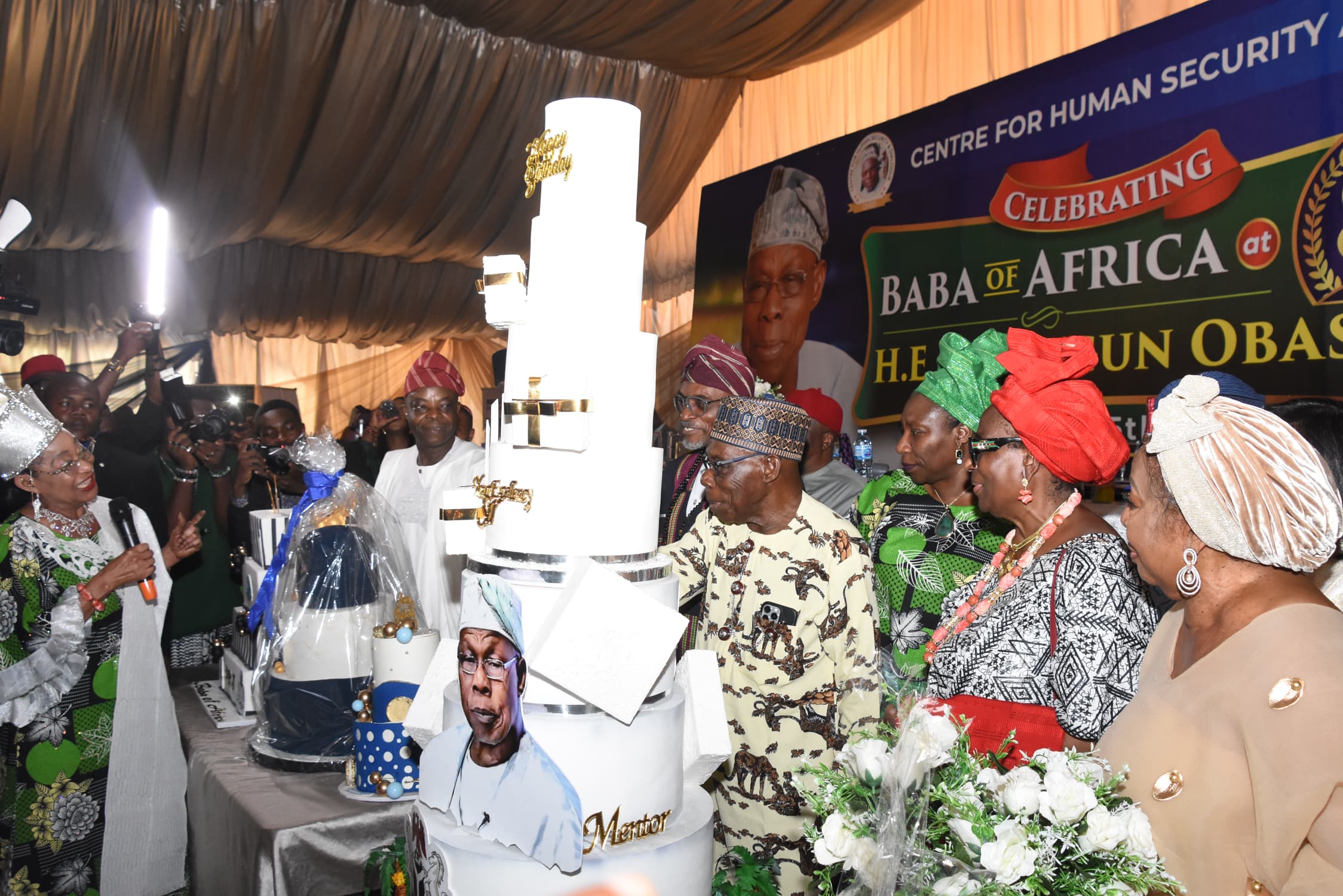
The ceremonial cutting of the beautiful birthday cake was coordinated by respected business leader and former minister, Nike Akande as the celebrant, flanked by family members and friends marked the joyous moment.
Also present at the occasion were the Governor of Ogun State, Prince Dapo Abiodun, Deputy Governor of Ogun State, Noimot Salako-Oyedele, members of the Ogun State Executive Council, former Governors of Ogun State Gbenga Daniel and Ibikunle Amosun, former Governor of Osun State, Olagunsoye Oyinlola, former Governor of Kano State, Rabiu Musa Kwankwaso, renowned political economist Pat Utomi and former presidential candidate Peter Obi.
Adding regal splendour to the occasion was the presence of eminent traditional rulers including the Olubadan of Ibadanland, His Imperial Majesty Rasidi Adewolu Ladoja; the Alake of Egbaland, Oba Adedotun Aremu Gbadebo; and the Olowu of Owu Kingdom, His Royal Majesty Saka Adelola Matemilola.
Following the intellectually stimulating lecture, guests proceeded to a lavish reception held at the OOPL Marquee where the atmosphere transformed into one of celebration, camaraderie and conviviality.
Serving as Chairman of the occasion, the former Governor of Osun State, Olagunsoye Oyinlola delivered warm and reflective opening remarks that set the tone for the event, describing Chief Obasanjo as a visionary leader whose contributions to Nigeria, Africa, and the global community remain immeasurable.
Equally moving was the glowing tribute delivered by Erelu Abiola Dosunmu, who paid heartfelt homage to the celebrant, describing him as a courageous leader, visionary statesman, and tireless advocate for peace and African unity.
The event was attended by distinguished personalities including former Commonwealth Secretary-General Emeka Anyaoku; the elegant society matriarch, Erelu Abiola Dosunmu; respected entrepreneur and founder of Chisco Motors, Chidi Anyaegbu; and the ever-gracious former senator Florence Ita‑Giwa, among numerous other eminent personalities.
The evening was enlivened by captivating musical entertainment from legendary juju maestro Ebenezer Obey, whose timeless melodies filled the air with nostalgia and elegance.

Related
Featured
2027: APC Afraid of Competition, Jittery – Dele Momodu
Published
3 days agoon
March 7, 2026By
Eric
By Eric Elezuo
To further prove the opposition’s ability to contest and wrest power from the President Bola Tinubu-led All Progressives Congress (APC) national government, a chieftain of the African Democratic Congress (ADC), who is the Chairman, Ovation Media Group, Chief Dele Momodu, has made convincing arguments, stressing why Tinubu may not return to power in 2027.
Speaking during an interview on Channels television during the week, Momodu reiterated that though Tinubu has succeeded in muscling opposition through coercion and intimidation, a new force of the people will ensure that the APC and Tinubu are sent packing in 2027. He reiterated that the ruling party is jittery, and is afraid of competition. And that explains why opposition forces are being coerced to join the APC.
The following are excerpts from the no-holds-barred interview:
I can almost guess one of your answers to some of the questions we’ll ask you, but let me start by asking: some activity has kicked off in different political parties. But you know how it is—people want to see some opposition, a major opposition that challenges the ruling party, so people can have a proper alternative. Because what is a democracy without opposition in the first place? So, what’s going on with the ADC?
Okay. Let me start by saying that you are not being fair to the ADC.
How so?
I’ll prove it in a moment. The reason you are saying this is because the APC was already comfortably seated. They “jagabaned” as many people as possible from the other parties into their own party. They have all the resources in the world. They have all the security in the world. They even have control of INEC. When I say control of INEC, I mean that INEC is appointed by the government.
And they have jumped the gun. They started campaigning more than a year ago. You cannot say you are not aware that, recklessly, even a minister left his job and travelled to his home state. I’m sure for a week or two weeks, he was running a campaign as if the election would be next month.
So how then do you expect an opposition to operate when they have virtually shut down most of the opposition parties—either forcefully or even frontally? They are not hiding it.
Today, for the first time, we have a leader who controls two parties and is approved by the President of Nigeria. He says, “Yes, he is the leader of my party, APC,” and he is also a leader in the PDP. Is that democracy?
So the president cannot speak about the PDP, while the minister cannot speak about the APC, because it does not technically belong to the APC. But just because of the ongoing rascality in Nigeria, anything goes, and everything goes.
So when you blame the opposition, of course, the opposition is gathering momentum. You can see that even the government is jittery. Forget about their propagandists; they can import or export whoever they want to use for their propaganda. It is obvious that the ruling party is jittery, and that is why they are going all out, frantically, trying to showcase and pretend that all is well.
If you read the news today, you will see that the APC is indeed a house of commotion. From Benue to Zamfara to so many other places, you will see them fighting themselves like babies fighting for lollipops. And it is just starting.
For us, we have to be more technical. We have to be more sober.
The APC is able to fund its activities. Everybody that goes there right now is going there for various reasons. One, if you are a governor, you are afraid for your second term. If you are a governor, you are afraid of the EFCC. If you are a governor, you are afraid of the ICPC. If you are a governor, you are afraid of so many things—including your own shadow.
So a governor will voluntarily go into slavery and servitude because they know that the leadership they are dealing with is not a regular leadership. It is not a Goodluck Jonathan.
You understand? So you have a very tough leadership at the moment. There is this palpable fear across the nation, and so the opposition is trying to put its act together. We cannot, at this stage, behave recklessly.
If you want to play Brazil in football, you must play a different style. We cannot play their style because we don’t have what they have—the apparatus of power and so on and so forth.
But the most important thing is that we are ready to ask the electorate: is your life better today than it was when Buhari was in power? Now, the APC is supposed to be an offshoot of the Buhari administration. Yet every day it is the APC itself that is blaming Buhari and blaming the APC.
So when you see a situation like that, you will wonder if these people are serious at all.
Now they are saying, “Oh yes, they stabilized the exchange rate against the dollar.” I laugh. They forget to tell us where the dollar was when they took power.
They tell us today they are running budgets in trillions, but they forget to tell us what they have done with the trillions and whether they have been able to balance the budget.
They tell you that there is no government ever like the government of President Bola Tinubu. No problem. Maybe it’s reverse psychology so that people can believe that this government actually is not doing what it is supposed to be doing.
So when they talk about everything, you removed fuel subsidy from Day 1, you have not been able to tell us how it has affected Nigeria positively.
All the people are feeling is the negative effect of the subsidy. You have taken more loans than all the governments of Nigeria combined, yet we have not seen the effect of those loans.
So a lot is going on that Nigerians cannot understand. But there is a preponderance of propagandists who are willing to delete their brains and sell their souls for peanuts. That is why you see this cacophony of excuses on radio, on television, and in the newspapers.
So for me, the ADC does not have to do much. We will meet them, insha’Allah—by God’s grace—point by point, and we will demand answers to those issues.
Okay. So, in terms of what the electorate wants to see—organization, for instance. The last time the ADC came forward and spoke about the Electoral Act, many people wondered why those concerns did not come earlier, when the window was open, rather than after it had already been signed and then asking for it to be looked into again.
People thought, “Okay, does the ADC have some sort of plan that the public is not aware of?” Because even smaller opposition parties—well, let me not say smaller because they might get angry, but it’s a statement of fact. APP, for example, has also dissolved its executives and is electing new ones.
So those kinds of activities are what people expect to see. Because the media only reports what happens; if it doesn’t happen, they cannot report or fabricate it.
So those are the kinds of things we are asking about in terms of organization and preparedness, to be sure that the timeframe is met. Now that the presidential election is in January, these actions ought to have kicked in so that candidates—or aspirants—can know that, “Okay, I think I can pitch my tent here.”
My dear brother, there is nothing to worry about. There is nothing to worry about.
Strategy is strategy. I said it earlier—we cannot use Tinubu’s strategy. We cannot use his methodology. He has his own way of getting his results. So we now have to factor in how we are going to navigate and meander around his own strategy to get him out of the seat. That is the job of the opposition. That is what he did when he was in opposition. So there is no reason why others should not be allowed to do the same.
One thing is clear to us in opposition—I’ve said it before—the APC is jittery. Number two, the APC does not want competition, especially at the presidential level. That is very clear. They don’t want any form of competition. And if possible—and that is why they are sowing seeds of discord from party to party—it is clear. That is why they will hold some people and they will not hold others. It doesn’t matter.
You see, I am always spiritual in my life. I was born in Aladura church in Ile-Ife, and all my life I have always believed that it is God who gives power. No matter how powerful you are, God has a way. In Nigeria, when you talk about God, people say it means you are helpless. Don’t worry—I have seen miracles in my life. So those miracles will happen in Nigeria.
I am a good student of history, and I can see clearly that all the shenanigans going on right now around the APC, trying to infiltrate every political party—I know that their mission and ambition now, if possible, is to have all 36 governors. It doesn’t matter. Let them take all the governors.
But when you look back to 2023, you will see that we had the G5 governors led by Nyesome Wike. Out of those five governors, three of them contested to be senators, supervised by governors in their own states. Yet all three of them lost their senatorial seats.
It tells you something: there is no guarantee that even if they carry all the governors, those governors can deliver for Asiwaju. So when people panic and say they cannot see preparations, don’t worry. Be patient. Slow and steady wins the race. We know what we are doing. And to say that we have not been campaigning or doing anything—I don’t know anybody who has worked better than Mallam Bolaji Abdullahi. I watch him every day. I see all the activities. We respond to all the radicality and so on and so forth.
But like I said, of course, the will of the state is very strong. All we are trying to do is chip away at it slowly but steadily, and then effectively. It will happen.
You have to remember that I was there when the APC itself was formed. I wasn’t a member at that time, but we supported the government of Buhari. And this was the same way the PDP people were saying, “No, it’s not possible. You cannot defeat an incumbent.”
And people are arguing now, saying, “Oh, because Tinubu is next to God, he is an oracle in Lagos, he is everything on planet earth.” No problem.
But we all have brains. And that brain is what we are going to use.
Let me ask you this, because a number of people wonder—and it’s a question I have almost always asked. Look, how does the internal politics of one political party become so susceptible to the influence of an individual from another political party? But maybe that’s not an issue to respond to for now.
There is an issue in the Electoral Act, and I’m sure it is something that is also of concern to you. Oh, by the way, you may want to respond to that other issue.
It is about the digital register that is being sought. Is the ADC, in your opinion, ready? Because I don’t think we can give any excuse. The understanding we have for now—even in a statement put out by YIAGA Africa—is that any political party that does not have its digital register ready may not be able to present candidates during the elections.
So is the ADC ready? What are the inhibitions or hurdles that you think need to be crossed by the ADC in particular, in order to get it ready? Do you think it is something that the ADC, as a growing and substantive opposition, can achieve?
My dear brother, as a prominent media practitioner, I beg you—try to encourage democracy. Try to encourage opposition.
Look, all the APC has been doing is to manipulate the system, and every day, there are new laws that you must obey. There are requirements that you must fulfil. Is that democracy?
But they cannot hide behind one finger, as Chief MKO Abiola used to say. Let them continue to manipulate and meander, and we too will navigate around it.
Is there any law anywhere that says only party members will vote during the general election? The answer is no. So when it comes to picking candidates, there are different methods and ways by which a party can choose its candidate. It has nothing to do with digital registration.
The digital registration right now is ongoing everywhere in different political parties. At the appropriate time, the parties will determine how they will do it. They are not the ones who will tell us who to pick or how to pick that person.
So I don’t know why this panic exists. Go and check the APC that you say is ready. In almost every state right now, they are fighting. In Lagos State, the only reason nobody can fight openly is because they have always operated the “Baba’s sope” style of governance.
I apologize for cutting in, but the question I’m asking is actually about the preparedness of the ADC. Because whether we like it or not—just a second—whether we like it or not, it’s already a law. Political parties must present their digital register.
I’m saying that they are complying. The ADC will comply. Even when we disagree with some of the things they are throwing at us, the ADC is strong enough.
You have some of the biggest veterans of politics in the ADC, and they are ready. They know how to play the game. So I am telling you—we are not illiterate.
So how do you want to frustrate us or intimidate us with digitalization? It is something that everybody would like to participate in. But to now single out the ADC and say, “We don’t know what you guys are doing”—I have already said: be patient with us.
When was the ADC was formed, all manner of challenges were thrown at us, yet we were still standing. So don’t panic on our behalf. Let us do our job. Let us focus on what we need to do. And if we fail, then you can say anything.
We are hoping that no political party will fail, sincerely. Otherwise, there will be no democracy at all. Because we need to have a viable opposition—truly viable opposition.
How do you have a viable opposition when the ruling party is clearly dictatorial? How? That’s why I said you should be practical and support the opposition by asking relevant questions from the ruling government.
Is it not an admission on your part, Chief Momodu, that the ADC does not have what it takes to stand up against the APC?
Don’t say that. That is judgmental.
No, what you are saying is that the APC has muscled the opposition.
Yes, it has muscled the opposition. But wait for the response from the people. You always talk about opposition as if it is only about political parties. The biggest opposition in the world are the floaters. The floaters don’t have to belong to any party.
On the day of voting, you will see how they will pour out and vote massively against an oppressive government—and defend their vote.
You are saying it as if the APC has a monopoly on this thing. That’s why I’m saying our strategy cannot be open at this stage. In fact, we would be stupid to let the whole world know what we are planning. We can’t.
A lot of people did not even see the ADC coming, yet they had been meeting for over a year. And when they finally came together, the ruling party was scared. That is why they are running helter-skelter, sending their agents—“Go and file this case in court, go and file that case against the Labour Party, go against NNDP, go against this one.”
You will see the coalition.
I told you I was there in 2015. How many leaders came together in 2015 to make Buhari president? The number of people we have in the ADC today, and the calibre of men and women we have in the ADC today, will scare the daylights out of them.
They can spend all their resources—spend all the resources of Nigeria—trying to defeat the ADC, but the ADC will emerge victorious. I’m very sure about that.
So, as we wind down, you said we shouldn’t panic on your behalf—we’ll note that. But yesterday we had the Governor of Adamawa State on the program, and when we asked him the reasons why he moved and what that meant for the opposition—he was in the PDP and then moved to the APC—he said the North should forget about 2027.
According to him, there is an unwritten rule that, for things to move smoothly politically, the South has to finish its turn, and then it reverts to the North so that the unwritten agreement can continue smoothly. What do you think of that?
It is those who have nothing better to say who talk about North and South.
The Constitution of Nigeria is supreme, and the Constitution of Nigeria does not talk about zoning. Even if you want to talk about whether zoning has been fair to a particular region in the South or in the North, you will see that Nigeria has been fair to the South.
Obasanjo did eight years, after which Yar’Adua did about three years, and then Jonathan completed that tenure to about ten years. Jonathan then contested and won, giving him about five years plus the earlier eight years of Obasanjo—and he was still allowed to contest again, which, if he had won, would have made it about seventeen years out of twenty-four or thereabouts. So look, those who say these things—I don’t want to waste my time on that.
But let me respond to the Governor Fintiri, who joined the APC because he believes it is the turn of the South. Oh, how cheeky.
His people were chased out of their villages just in the last couple of days or weeks. So has he gone to the APC to thank them for securing his people? A lot of people who are going into the APC—why are they going?
Take Kwara State now, which is in the hands of the APC. Are they happy and joyous that their people are being killed by bandits?
In every part of the nation where you have the APC, it is a story of sorrow, tears, and blood.
So what exactly is the APC offering them that they are all running out of shelter and falling over themselves to praise a god of iron who must be obeyed?
It’s unfortunate.
But when tomorrow comes—we have seen it before.
I remember when a lot of people insisted they must join the Abacha government. Go and read the history and see what happened there afterward. Everybody was saying, “If you don’t join Abacha, other people will take the appointment.”
Is life only about power? The answer is, No.
The problem with Nigerian leaders is that they don’t read much, especially history. They don’t like history. If they liked history, they would know what happened to others in the past who tried to enslave their own people. They would read about it all over the world.
Some governors now believe the only way they can win a second term—by fire, by force—is if they go to the APC. This is what is going on. You are asking why the opposition cannot take them on. Take on who? Take on Tinubu? Why didn’t the opposition take them on in Lagos in the last 27 years? You know how this game is played.
The President of Nigeria is one of the most powerful presidents—until Donald Trump started whipping sense into us. The presidency can do anything. Now our president is begging America to come and help us. Who does that, when we were the ones helping other parts of Africa?
I was there in Sierra Lone, I was there in Congo. I was in Liberia. Our soldiers controlled ten out of fifteen counties in Liberia. So what has happened to our soldiers today that we have to beg America to come and take over our country? We’re not serious.
In case I might have missed it—do we have a date for the ADC congresses?
Everything will be announced, and of course, you know Channels will be one of the first to get it. We are operating in a very professional way. We are not going to play a rough game with the APC. It is not necessary.
The people we are targeting are the people. This is not about playing politics.
Most of us—when you see us now—we are veterans. There is nothing I am looking for in politics. I have always technically been in opposition, and I am happy that we are still standing firm.
The ADC is not the problem of Nigeria.
The APC is the problem.
So let’s all come together. Don’t discourage anybody. If you have suggestions, make them to whomever you wish.
But to say, “Oh, we are not ready. We can’t take them on with just one year to the election.” Are we still talking about that? Anything can happen in the next one month.
The APC is falling apart. They appointed ambassadors, and they can’t even post them. Some of them did thanksgiving in church. Some of them went to fashion designers to sew their dresses in advance.
Yet today they are not there. They are all mourning behind the scene.
Look, the majority of my friends are in the APC. Sometimes when I hear their pain, I feel it. They talk about the difficulties they are facing. They don’t know what is going on because everybody must wait for Abuja. They can’t do anything without Abuja.
So I’m very confident. I know what is going on behind the scenes. A lot of people are going there, but what they expect to find there, they are not finding easily.
Thank you.
So we’ll have to anchor at this point. We do thank you very much indeed for your time this morning. Many will be looking to see how those activities also kick off.
Chief, thank you for your time today.
Thank you, and have a nice day.
All right.
Related
Featured
Presidency Releases Postings of Ambassadors-designate
Published
4 days agoon
March 6, 2026By
Eric
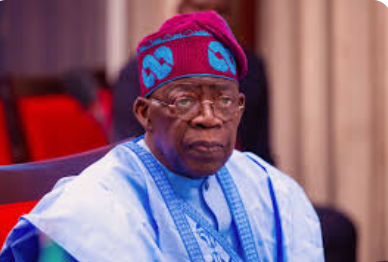
President Bola Ahmed Tinubu has approved the postings of 31 career and 34 non-career ambassadors to various countries and the United Nations. The Senate confirmed the ambassadors-designate last December.
POSTINGS OF NON-CAREER AMBASSADORS / HIGH COMMISSIONERS
S/N NAME MISSION APPROVED
1. SENATOR GRACE BENT: LOME-TOGO
2. SEN. ITA ENANG: SOUTH AFRICA
3. IKPEAZU VICTOR: SPAIN
4. NKECHI LINDA UFOCHUKWU: TEL-AVIV, ISRAEL
5. MAHMUD YAKUBU: QATAR
6. PAUL OGA ADIKWU: THE VATICAN CITY HOLY SEE
7. VICE ADMIRAL IBOK-ETE EKWE IBAS: THE PHILIPPINES
8. MR. RENO OMOKRI: MEXICO CITY, MEXICO
9. HON. (ENGR.) ABASI BRAIMAH (FMHR): BUDAPEST, HUNGARY
10. MRS. ERELU ANGELA ADEBAYO: PORTUGAL
11. BARR. OLUMILUA OLUWAYIMIKA AYOTUNWA: TOKYO, JAPAN
12. RT. HON. UGWUANYI IFEANYI LAWRENCE: ATHENS, GREECE
13. BARR. CHIOMA PRISCILLA OHAKIM: WARSAW, POLAND
14. AMINU DALHATU: UNITED KINGDOM, UK
15. LT. GEN ABDULRAHMAN BELLO DAMBAZAU: BEIJING, CHINA
16. HON. TASIU MUSA MAIGARI: GAMBIA
17. OLUFEMI PEDRO: AUSTRALIA
18. BARR. MUHAMMED UBANDOMA ALIYU: ARGENTINA
19. LATEEF KAYODE ARE: USA
20. AMB. JOSEPH SOLA IJI: RUSSIA
21. SEN. JIMOH IBRAHIM: UN PERMANENT REPRESENTATIVE
22. FEMI FANI KAYODE: GERMANY
23. PROF. ISAAK FOLORUNSO ADEWOLE: OTTAWA, CANADA
24. AJIMOBI FATIMA FLORENCE (F): AUSTRIA
25. MRS. LOLA AKANDE (F): SWEDEN
26. AYODELE OKE: FRANCE
27. YAKUBU N. GAMBO: SAUDI ARABIA
28. SENATOR PROF. NORA LADI DADUUT: SEOUL, SOUTH KOREA
29. BARR. ONUEZE CHUKWUJIKA JOE OKOCHA SAN: DUBLIN
30. DR. KULU HARUNA ABUBAKAR: TUNIS, TUNISIA
31. RT. HON. JERRY SAMUEL MANWE: PORT OF SPAIN, T&T
POSTINGS OF CAREER AMBASSADORS / HIGH COMMISSIONERS LIST
S/N NAME MISSION APPROVED
1. AMB. NWABIOLA EZENWA CHUKWUMEKA: COTE D’IV/OIRE
2. BESTO MAIMUNA IBRAHIM: NIAMEY-NIGER
3. MONICA OKWUCHUKWU ENEBECHI: SAO TOME, STP
4. AMB. MOHAMMED MAHMUD LELE: ALGIERS-ALGERIA
5. ENDONI SYNDOPH PAEBI: OUAGADOUGOU-BURKINA FASO
6. AHMED MOHAMMED MONGUNO: CAIRO EGYPT
7. AMB.JANE ADAMS (NEE OKON) MICHAEL (F): KINGSTON-JAMAICA
8. AMB. CLARK-OMERU ALEXANDRA (F): LUSAKA-ZAMBIA
9. CHIMA GEOGGREY LIOMA DAVID: BAMAKO-MALI
10. AMB. ODUMAH YVONNE EHINOSEN: MALABO –E/GUINEA
11. AMB WASA SEGUN IGE: BEIRUT, LEBANON
12. RUBEN ABIMBOLA SAMUEL (F): ROME, ITALY
13. AMB.ONAGA OGECHUKWU KINGSLEY: MAPUTO, MOZAMBIQUE
14. AMB.MAGAJI UMAR: KINSASHA, DR CONGO
15. AMB.MUHAMMAD SAIDU DAHIRU: NEW DELHI-INDIA
16. AMB. ABDUSSALAM HABU ZAYYAD: DAKAR-SENEGAL
17. AMB SHEHU ILU BARDE: ACCRA GHANA
18. AMB.AMINU NASIR: ETHIOPIA
19. ABUBAKAR MUSA MUSA: N’DJAMENA, CHAD
20. AMB. HAIDARA MOHAMMED IDRIS: THE HAGUE-NETHERLANDS
21. AMB.BAKO ADAMU UMAR: RABAT-MOROCCO
22. AMB. SULU GAMBARI OLATUNJI AHMED: MALAYSIA
23. AMB.ROMATA MOHAMMED OMOBOLANLE (F): TANZANIA
24. AMB. SHAGA JOHN SHAMAH: BOTSWANA
25. SALAU, HAMZA MOHAMMED: TEHRAN, IRAN
26. AMB.IBRAHIM DANLAMI: KENYA
27. IBRAHIM ADEOLA MOPELOLA (F): COTONOU-BENIN
28. AMB.AYENI ADEBAYO EMMANUEL: BRUSSELS, BELGIUM
29. AMB.AKANDE WAHAB ADEKOLA: BERNE-SWITZERLAND
30. AMB. AREWA (NEE ADEDOKUN) ESTHER (F): WINDHOEK-NAMIBIA
31. AMB.GERGADI JOSEPH JOHN: LIBREVILLE-GABON
32. AMB. LUTHER OGBOMODE AYO-KALATA (F): SIERRA LEONE
33. DANLADI YAKUBU NYAKU : KHARTOUM-SUDAN
34. BELLO DOGON-DAJI HALIRU: BANGKOK, THAILAND
The Ministry of Foreign Affairs has already received agrément from the United Kingdom for the High Commissioner-designate, Ambassador Aminu Dalhatu. Similarly, France has sent the agrément for Ambassador Ayo Oke.
The Ministry has also conveyed the nominations of the other 62 designated envoys to all the countries concerned, including a request for their agréments in line with standard diplomatic practice.
President Tinubu has directed that the Ministry of Foreign Affairs should immediately commence the induction programme for the ambassadors-designate and High Commissioners.
Bayo Onanuga,
Special Adviser to the President,
(Information and Strategy)
March 6, 2026.
Related


Former Super Eagles Coach, Festus Onigbinde is Dead
Appeal Court Upholds Sacking of Turaki-led PDP Executive
International Women’s Day: The Boss Celebrates 100 Influential Nigerian Women
South African Actress, Nomzamo Mbatha, Tells Success Story on Glo-Sponsored African Voices
Iran Confuses Israel As Missile Splits into Multiple Warheads in Tel Aviv
Voice of Emancipation: Yoruba Sovereignty is Inevitable
The Scars of Glory and the Burden of Leadership!
FIFA Strikes Out Nigeria’s Petition, Okays DR Congo for 2026 World Cup Play-Off
Give What, to Gain What? Reflections on the 2026 International Women’s Day Theme

140 Missing As US Submarine Sinks Iran’s Warship in Indian Ocean
IGP Disu Removes Benjamin Hundeyin As FPRO
Akume Leads Nigeria’s Delegation to Jesse Jackson’s Funeral in US
Assets Declaration: Court Dismisses NDLEA’s Case Against Abba Kyari
I Dey kampe, Not Dying Anytime Soon, Obasanjo Declares at 89
Trending
-
Sports6 days agoFIFA Strikes Out Nigeria’s Petition, Okays DR Congo for 2026 World Cup Play-Off
-
Opinion5 days agoGive What, to Gain What? Reflections on the 2026 International Women’s Day Theme
-
World5 days ago140 Missing As US Submarine Sinks Iran’s Warship in Indian Ocean
-
News5 days agoIGP Disu Removes Benjamin Hundeyin As FPRO
-
Featured5 days agoAkume Leads Nigeria’s Delegation to Jesse Jackson’s Funeral in US
-
News5 days agoAssets Declaration: Court Dismisses NDLEA’s Case Against Abba Kyari
-
Featured5 days agoI Dey kampe, Not Dying Anytime Soon, Obasanjo Declares at 89
-
Featured4 days agoPresidency Releases Postings of Ambassadors-designate