Connect with us

Featured

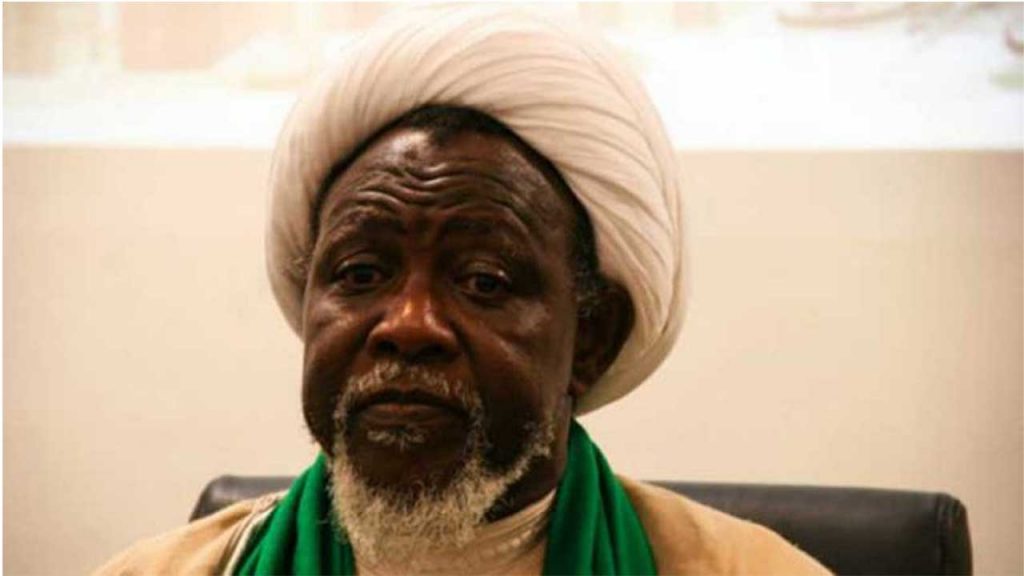
FG Explains Why El-Zakzaky was Brought Back Home

Published

on

The Federal Government on Friday raised the alarm over alleged plans by the leader of the Islamic Movement of Nigeria, Ibraheem El-Zakzaky, to seek asylum.

The government specifically said his actions in India demonstrated malicious intents that were capable of embarrassing the governments of Nigeria and India.

A statement issued in Abuja by the Permanent Secretary in the Federal Ministry of Information and Culture, Grace Isu Gekpe, entitled: “The repatriation of Ibraheem El-Zakzaky from India”, said the wife of the IMN leader also antagonised the Indian and Nigerian security agencies and accused them of killing her children to win international sympathy as well as disparage the Nigerian government.

The statement reads: “The Federal Government wishes to inform the public about the latest development in the Ibraheem El-zakzaky medical trip controversies to India. The government notes with dismay the acts of misconduct exhibited by El-Zakzaky that necessitated his repatriation.

“The earlier statement of August 14, 2019, by the government addressed the issues that would have raised some questions with the latest occurrences and particularly the uncelebrated return of El-Zakzaky from India.

“The public may note that El-Zakzaky’s actions in India demonstrated malicious intents that were capable of embarrassing the governments of Nigeria and India. With total disrespect and complete loss of decorum for international procedures while in India, he initiated contacts with a team of lawyers led by Ali Zia Kabir Chaudary and Gunjan Singh in that country.

“He also contacted some Non-Governmental Organisations, such as the Islamic Human Rights Commission and other Shiite groups. His aim was to seek asylum and eventually relocate to another country. It is important to note that if an Indian court had granted El-Zakzaky asylum or leave to travel to another country, it would have violated the Nigerian court order that granted him permission to travel for medical treatment.

“However, he used the opportunity of being in India to attempt to internationalise his cause by mobilising the Rights groups. Even most unfortunate and rather embarrassing as earlier stated, was his quest to be relocated to a 5-Star hotel to receive visitors instead of being admitted in the hospital as a sick person he claimed to be.

“In spite of his misconduct, El-Zakzaky’s spouse went further to antagonize the Indian and Nigerian security agents and accused the latter of killing her children. These acts were aimed at winning international sympathy as well as disparaging the Nigerian government.

The Punch

Continue Reading
Click to comment

Leave a Reply

Your email address will not be published. Required fields are marked *

Featured

US Cancels Visa Processing for Nigeria, Brazil, Russia, 72 Other Countries

Published

on

By

The Trump administration is suspending all visa processing for applicants from 75 countries, a State Department spokesperson said on Wednesday.
The spokesperson did not elaborate on the plan, first reported by Fox News, which cited a State Department memo.
The pause will begin on January 21, Fox News said.
Somalia, Russia, Iran, Afghanistan, Brazil, Nigeria, Thailand are among the affected countries, according to the report.
The memo directs U.S. embassies to refuse visas under existing law while the department reassesses its procedures. No time frame was provided.
The reported pause comes amid the sweeping immigration crackdown pursued by Republican U.S. President Donald Trump since taking office last January.
In November, Trump had vowed to “permanently pause” migration from all “Third World Countries” following a shooting near the White House by an Afghan national that killed a National Guard member.
Source: Reuters

Continue Reading

Featured

‘A Friend of a Thief is a Thief’, Defence Minister Warns Gumi, Other Bandit-Sympathizers

Published

on

By

The Minister of Defence Minister, Lt.-Gen. Christopher Musa, (rtd), has warned Sheikh Ahmed Gumi and other persons in the country against including bandits in northern brotherhood.

General Musa, via a statement on Wednesday in Maiduguri, declared: “A friend of a thief is a thief,” warning Nigerians against supporting terrorists and bandits in any form.

He said that the warning statement is neither accidental nor symbolic; explaining that it is a clear response to narratives previously promoted by Sheikh Gumi, who described bandits’ hiding in the bush as “our brothers” and argued that society cannot do without them.

General Musa’s message draws a firm line between compassion and complicity. While empathy has its place, justifying or normalising terrorism only strengthens criminal networks that have devastated communities, displaced families, and claimed innocent lives.

Labeling bandit as “brothers” does not reduce violence it legitimizes and undermines national security efforts.

The Defence minister’s warning serves as a reminder that terrorism thrives not only on weapons but also on moral cover. Anyone who excuses, defends, or shields criminals through words, influence, or silence shares responsibility for the consequences. In matters of national security, neutrality is not an option.

Nigeria cannot defeat banditry and terrorism while dangerous rhetoric blurs the line between victims and perpetrators. The choice is clear: stand with the law and the nation, or be counted among those enabling crime.

Continue Reading

Featured

Strategy and Sovereignty: Inside Adenuga’s Oil Deal of the Decade

Published

on

By

By Michael Abimboye

In global energy circles, the most consequential deals are often not the loudest. They unfold quietly, reshape portfolios, recalibrate value, and only later reveal their full significance.

The recent strategic transaction between Conoil Producing Limited and TotalEnergies belongs firmly in that category. A deal whose implications stretch beyond balance sheets into Nigeria’s long-troubled oil production narrative.

For Mike Adenuga, named The Boss of the Year 2025 by The Boss Newspapers, the agreement is more than a corporate milestone. It is the culmination of a long-term upstream strategy that is now translating into hard value barrels, cash flow, and renewed confidence in indigenous capacity.

At the heart of the transaction is a portfolio rebalancing agreement that sees TotalEnergies deepen its interest in an offshore asset while Conoil consolidates full ownership of a producing block critical to its medium-term growth trajectory. The parties have not publicly disclosed the monetary value, industry analysts place similar offshore and shallow-water asset transfers in the high hundreds of millions of dollars, depending on reserve certification and development timelines. What is indisputable, however, is the deal’s structural clarity: each partner exits with assets aligned to its strategic strengths.

For Conoil, the transaction represents something more profound than asset shuffling. It is the validation of an indigenous oil company’s ability to operate, produce, and partner at scale. That validation was already underway in 2024, when Conoil achieved a landmark breakthrough: the successful production and export of Obodo crude, a new Nigerian crude blend from its onshore acreage.

In a country where new crude streams have become rare, Obodo’s emergence signalled operational maturity. More importantly, it shifted Conoil from being perceived primarily as a downstream and marginal upstream player into a full-spectrum producer with export-grade assets.

The commercial impact was immediate. Obodo crude enhanced Conoil’s revenue profile, strengthened cash flows, and materially improved the company’s asset valuation.

For Mike Adenuga, Obodo represented something else entirely: oil income with scale and durability. Producing crude shifts wealth from theoretical to realised. It is the difference between potential and proof.

That momentum was reinforced by Conoil’s acquisition of a new drilling rig, a move that underscored its intent to control not just resources, but execution. In an industry where rig availability often dictates production timelines, owning modern drilling capacity gives Conoil a strategic advantage lowering costs, reducing dependency, and accelerating development cycles. It also enhances the company’s bargaining power in partnerships such as the one with TotalEnergies.

Taken together, the Obodo crude success, the rig acquisition, and the TotalEnergies transaction, these moves materially expand Conoil’s enterprise value. While private company valuations remain opaque, upstream assets with proven production, infrastructure control, and international partnerships typically command significant multiple expansion. For Adenuga, all of these represents a stabilising and appreciating pillar of wealth.

As The Boss Newspapers honours Mike Adenuga as Boss of the Year 2025, the recognition lands at a moment when his oil ambitions are no longer peripheral to his legacy. They are central. In Obodo crude, in steel rigs, and in carefully negotiated partnerships, Adenuga is shaping a version of Nigerian capitalism that privileges patience, scale, and execution over spectacle.

In the end, the most powerful statement of wealth is not net worth rankings or headlines. It is the ability to convert strategy into assets, assets into production, and production into national relevance. On that score, the Conoil–TotalEnergies deal may well stand as one of the most consequential chapters in Mike Adenuga’s business story and in Nigeria’s evolving oil future.

Continue Reading

Trending