Connect with us

National

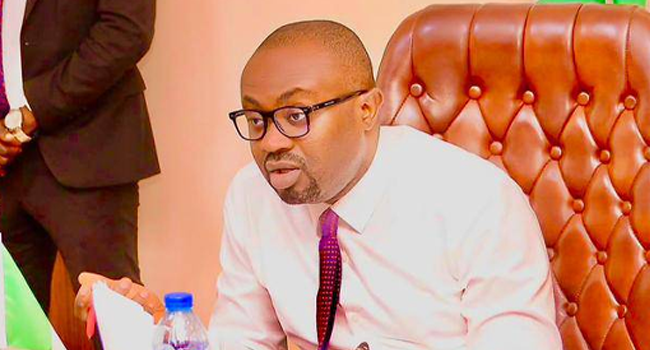
Kayode Egbetokun ‘Resigns’ As IGP

Published

on

The Inspector General of Police (IGP), Kayode Egbetokun, has resigned from office at the request of President Bola Tinubu, according to a report by PREMIUM TIMES.

A source in the presidency said Mr Egbetokun was asked to resign at a meeting with the president at the Presidential Villa in Abuja on Monday.

Mr Egbetokun is to be replaced by Tunji Disu, an Assistant Inspector General of Police (AIG).

Although the plan has not been officially announced, sources in the presidency and the police headquarters told PREMIUM TIMES that preparations are underway for a formal handover ceremony from Mr Egbetokun to Mr Disu.

Mr Egbetokun was appointed by President Tinubu as the 22nd IGP on 19 June 2023. His substantive appointment was confirmed by the Nigeria Police Council on 31 October that year.

Appointed as IGP at the age of 58, Mr Egbetokun was due for retirement on 4 September 2024, upon reaching the mandatory age of 60.

However, the National Assembly amended the police law, allowing him to serve his full four-year term as IG unless removed by the president.

He was thus expected to complete his four-year tenure and remain in office until 31 October 2027.

Despite complaints by many Nigerians, the presidency explained that Mr Egbetokun remained in office legally, citing the amended Police Act 2024, which allows an appointed IGP to serve a fixed four-year term regardless of their age or years of service.

Mr Egbetokun’s tenure as IGP was marked by several controversies, including human rights abuses.

The presidency has yet to issue a statement confirming Mr Egbetokun’s removal. Calls to presidential spokesperson Bayo Onanuga and police spokesperson Ben Hundeyin did not go through at the time of this report. However, a source at the presidency said an official announcement would be made later on Tuesday

Continue Reading
Click to comment

Leave a Reply

Your email address will not be published. Required fields are marked *

National

FCT, Rivers, Kano Polls: Democracy Threatened Under Tinubu – Atiku Warns

Published

on

By

Former Vice President of Nigeria and chieftain of the African Democratic Congress (ADC), Atiku Abubakar, has raised alarm over the low voter turnout recorded in Saturday’s FCT Area Council elections.

Reacting to the exercise, Atiku described the turnout – averaging below 20 per cent, with the Abuja Municipal Area Council recording 7.8 per cent – as a damning verdict on the state of Nigeria’s democracy under the current administration.

According to him, such poor civic participation in the nation’s capital is not accidental but the result of “a political environment poisoned by intolerance, intimidation, and the systematic weakening of opposition voices.”

The Waziri Adamawa accused the Bola Tinubu-led government of shrinking the democratic space, harassing dissenters, and fostering a climate where alternative political views are treated as threats.

“When citizens lose faith that their votes matter, democracy begins to die,” he said. “This is not mere voter apathy. Democracy in Nigeria is being suffocated – slowly and dangerously.”

Atiku warned that continued erosion of participatory governance could cause lasting damage to the country’s democratic foundations and called on opposition parties to unite.

“This is no longer about party lines; it is about preserving the Republic. The time to stand together to rescue and rebuild Nigeria is now,” he added.

Continue Reading

National

Just In: Tinubu Signs Electoral Bill into Law

Published

on

By

President Bola Ahmed Tinubu has signed the Electoral Act, 2022 (Repeal and Re-Enactment) Bill 2026 into law.

This follows the passage of the bill by the National Assembly on Tuesday after months of deliberations.

The House of Representatives on Tuesday, during the emergency plenary, passed the Electoral Act (Amendment) bill, 2026, through Third Reading, with approval of both manual and electronic transmission of election results from each polling unit to the IREV portal, as prescribed in Form EC8A.

Despite the walkout protest staged by members of the opposition lawmakers Caucus led by the Minority Leader, Rep. Kingsley Chinda, the House adopted Clause 60 on ‘Counting of votes and forms’, during the Committee of the Whole, chaired by the Deputy Speaker, Hon. Benjamin Kalu.

Continue Reading

National

Senate Passes Electoral Act Amendment Bill 2026

Published

on

By

The Senate, on Tuesday, passed the Electoral Act, 2022 (Repeal and Re-Enactment) Bill 2026.

Before the passage, there was a rowdy session as the upper chamber resumed proceedings with a demand for division over Clause 60 raised by Senator Enyinnaya Abaribe (ADC/Abia South).

The Senate President, Godswill Akpabio, stated that he believed the demand had previously been withdrawn, but several opposition senators immediately objected to that claim.

Citing Order 52(6), the Deputy Senate President, Barau Jibrin, argued that it would be out of order to revisit any provision on which the Senate President had already ruled.

This submission sparked another uproar in the chamber, during which Senator Sunday Karimi had a brief face-off with Abaribe.

The Senate Leader, Opeyemi Bamidele, then reminded lawmakers that he had sponsored the motion for rescission, underscoring that decisions previously taken by the Senate are no longer valid.

He maintained that, consistent with his motion, Senator Abaribe’s demand was in line.

Akpabio further suggested that the call for division was merely an attempt by Senator Abaribe to publicly demonstrate his stance to Nigerians.

The Senate President sustained the point of order, after which Abaribe rose in protest and was urged to formally move his motion.

Rising under Order 72(1), Abaribe called for a division on Clause 60(3), specifically concerning the provision that if electronic transmission of results fails, Form EC8A should not serve as the sole basis, calling for the removal of the proviso that allows for manual transmission of results in the event of network failure.

During the division, Akpabio directed senators who supported the caveat to stand.

He then asked those opposed to the caveat to rise.

Fifteen opposition senators stood in opposition.

However, when the votes were counted, the Senate President announced that 15 senators were not in support of the proviso, while 55 senators voted in support of it.

Earlier, proceedings in the Senate were momentarily stalled as lawmakers began clause-by-clause consideration of the Electoral Act, 2022 (Repeal and Re-Enactment) Bill 2026, following a motion to rescind the earlier amendment.

The motion to rescind the bill was formally seconded on Tuesday, paving the way for the upper chamber to dissolve into the committee of the whole for detailed reconsideration and reenactment of the proposed legislation.

During the session, the Senate President, Godswill Akpabio, reeled out the clauses one after another for deliberation.

However, the process stalled when at clause 60, Senator Enyinnaya Abaribe (ADC/Abia South), raised a point of order, drawing immediate attention on the floor.

Following the intervention, murmurs spread across the chamber as lawmakers began speaking in small groups and approaching the Senate President’s desk for consultations.

The chamber immediately moved into a closed door session.

Before rescinding the Electoral Act, the Red Chamber raised concerns over the timing of the 2027 general elections and technical inconsistencies in the legislation.

Rising under Order 52(6) of the Senate Standing Orders, the Senate leader, Opeyemi Bamidele, moved the motion to reverse the earlier passage of the bill and return it to the Committee of the Whole for fresh deliberations.

He explained that the development follows the announcement by the Independent National Electoral Commission (INEC) of a timetable fixing the 2027 general elections for February 2027, after consultations with the leadership of the National Assembly.

He stated that stakeholders had raised concerns that the proposed date conflicts with the provisions of the amended law, particularly the requirement that elections be scheduled not later than 360 days before the expiration of tenure.

He further noted that upon critical review of the passed bill, the 360-day notice requirement prescribed in Clause 28 could result in the scheduling of the 2027 Presidential and National Assembly elections during the Ramadan period.

According to him, holding elections during Ramadan could negatively affect voter turnout, logistical coordination, stakeholder participation, and the overall inclusiveness and credibility of the electoral process.

The motion also highlighted discrepancies discovered in the Long Title and several clauses of the bill, including Clauses 6, 9, 10, 22, 23, 28, 29, 32, 42, 47, 51, 60, 62, 64, 65, 73, 77, 86, 87, 89, 93, and 143. The identified issues reportedly affected cross-referencing, serial numbering, and internal consistency within the legislation.

Continue Reading

Trending