Connect with us

Headline

Remembering Ife’s 50th Ooni, Oba Sijuwade Okunade

Published

on

By Eric Elezuo

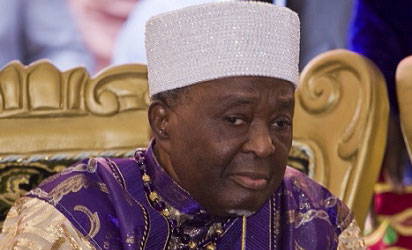
10 years after the death of one of the most cosmopolitan monarchs Nigeria has produced, His Imperial Majesty Oba Okunade Sijuwade, Olubuse II CFR, family, friends and the traditional institutions are gearing up for a mother of all remembrance and memorial ceremony. Oba Okunade Sijuwade is the 50th Oni of Ife.

On Tuesday, at the elaborate Civic Centre, in the heart of Victoria Island, stakeholders and people of interest, gathered to inform the public through the media, veritable steps being taken to honour the progeny of Oduduwa and until his death in 2015, the prime custodian of the Yoruba tradition.

According to the invitation to the media briefing, organizers noted that the events are being held in conjunction with the National Council of Traditional Rulers under the Chairmanship of His Imperial Majesty, Oba Adeyeye Ogunwusi, Ojaja II, Ooni of Ife CFR and His Eminence Sultan Sa’ad Abubakar, the Sultan of Sokoto CFR.

In his address, the Curator and Consultant for the 10th year Memorial Celebration of His Imperial Majesty, Oba Okunade Sijuwade, Olubuse II, Dr. Oludamola Adebowale, described the event as a decade of legacy, while noting as follows:

“A Decade of Legacy: 10th Year Memorial Celebration of His Imperial Majesty, Oba Okunade Sijuwade, Olubuse II.

“At a press briefing held at the Civic Centre in Victoria Island, Lagos, the family of the late Ooni of ile-Ife, His Imperial Majesty Oba Okunade Sijuwade, Olubuse II, unveiled a series of cultural, intellectual, and commemorative events marking the 10th anniversary of the revered monarch’s passing. The Programme is a tribute to his enduring legacy as a custodian of culture, a bridge-builder across Nigeria, and a global advocate for African heritage.

“Organized in partnership with the National Council of Traditional Rulers of Nigeria, the memorial activities are spearheaded by the Co-chairmen of the Council, Ooni of Ife, His Imperial Majesty Oba Adeyeye Enitan Ogunwusi, CFR, Ojaja II, alongside His Eminence, Alhaji Muhammadu Sa’ad Abubakar, CFR, the Sultan of Sokoto.

“A key highlight is a Three-State Inter-School Debate Tour featuring students from King’s College, Lagos; Abeokuta Grammar School; Oba Sijuwade’s alma mater; and Oduduwa College, Ile-Ife. The theme, “Traditional Governance vs. Modern Democracy: Which Best Preserves Cultural Heritage?’ invites students to explore the relevance of indigenous leadership in today’s world. The final debate presentation will be held on July 25, 2025.

“Another major feature is the Grand Memorial Exhibition, showcasing rare photographs, personal items, and archival materials from Oba Sijuwade’s life and reign—many being displayed publicly for the first time. The exhibition features collections from the National Archives of Nigeria, the UK National Archives, Horniman Museum & Gardens (UK), and the African American Research Library and Cultural Center (Florida), home of the Dr. Niara Sudarkasa Collection and also the Sijuwade Personal Collection.

“The exhibition is curated by renowned cultural historian and archivist Dr. Oludamola ADEBOWALE.

“A national symposium titled “Unifying and Securing Nigeria’s Future Through Traditional Institutions” will gather traditional rulers, scholars, and policymakers to examine the evolving role of indigenous leadership in peacebuilding, national identity, and governance.

“The grand finale of the memorial will take place in Ile-Ife, the cradle of Yoruba civilization. It includes a church thanksgiving service and solemn prayers at the late Ooni’s mausoleum—concluding the memorial in dignity and grandeur.

“Looking ahead, the Sijuwade family announced a series of legacy projects, including:

– A Nubian Jak Blue Plaque at his former London residence, recognizing his global impact in cultural diplomacy.

– The launch of a commemorative book detailing his life, leadership, and international engagements.

– The development of the Oba Okunade Sijuwade Memorial Hall and Museum in Ile-Ife to preserve his legacy and Yoruba heritage.

“This far-reaching initiative reflects the far-sighted vision of Oba Okunade Sijuwade—an imperial figure whose reign was defined by grace, wisdom, and an unwavering commitment to cultural excellence. These legacy projects are not only tributes to his memory but enduring pillars that will continue to inspire future generations in Nigeria, across Africa, and throughout the global diaspora. Through them, the timeless values he embodied—dignity, unity, heritage, and leadership—will live on, shaping a future deeply rooted in the strength of tradition and the promise of progress.

OBA OKUNADE SIJUWADE (1930 – 2015)

According to accounts obtained from Wikipedia, the life and times of Oba Sijuwade is captured as follows:

Born January 1, 1930, Alayeluwa Oba Okunade Sijuwade CFR, was the 50th traditional ruler (or Ooni) of Ife from December 6, 1980 to his death on July 28, 2015. He reigned for 35 influential years, taking the regnal name Olubuse II. His installation ceremony was attended by the Emir of Kano, Oba of Benin, Amayanabo of Opobo and Olu of Warri, as well as by representatives of the Queen of the United Kingdom.

Sijuwade was born to the ruling House of Sijuwade which is a fraction of the Ogboru ruling house, Ilare, Ile-Ife. His paternal grandfather was Ooni Adelekan Sijuwade – Olubuse I the 46th Ooni of Ife who ruled from 1884 – 1910. While his father was Omo-Oba Adereti Sijuade (1895 – 11 May 1949) and his mother was, Yeyeolori Emilia Ifasesin Sijuwade (nee Osukoti Adugbolu), from the town of Akure. He was a Christian and in November 2009 he attended the annual general meeting of the Foursquare Gospel Church in Nigeria accompanied by 17 other traditional rulers. He declared that he was a full member of the church and said all the monarchs who accompanied him would now become members. At his birthday celebration two months later, the Primate of the Anglican Communion described Sijuwade as “a humble monarch, who has the fear of God at heart”.

Oba Okunade Sijuwade or Prince Okunade Sijuwade as he was then called started his elementary education at Igbedin School, Abeokuta from where he proceeded to Abeokuta Grammar School under the governance of the well-known educationalist Reverend I O Ransome-Kuti, who was the principal of the school. Upon leaving Abeokuta Grammar School, Oba Okunade Sijuwade transferred to Oduduwa College in Ile-Ife before attending Northampton Technical College in the United Kingdom to study business management.

He worked for three years in his father’s business, then for two years with the Nigerian Tribune, first as a reporter then a sales executive before going to university.

By the age of 30, he was a manager in A.G Leventis, a Greek-Nigerian conglomerate. In 1963 he became Sales Director of the state-owned National Motors in Lagos. After spotting a business opportunity during a 1964 visit to the Soviet Union, he formed WAATECO a company to distribute Soviet-built vehicles and equipment in Nigeria, which became the nucleus of a widespread business empire. He also invested in real estate in his hometown of Ile Ife. By the time Sijuwade was crowned Ooni in 1980 he was already a wealthy man.

Shortly after becoming the 50th Ooni of Ife, Oba Okunade Sijuwade founded Sijuwade Group, which he was the chairman of. The conglomerate operates in several sectors including oil and gas, infrastructure, real estate, industrials, and hospitality. The company holds partnerships with several multinational companies such as Centrica, Equinor (formerly Statoil), CCC, Eser and RCC (Reynolds Construction Company) and has executed over $2 billion worth of contracts and projects in Nigeria.

When Sijuwade became Ooni of Ife in December 1980, he inherited an ongoing dispute over supremacy between the obas of Yorubaland. In 1967 a crisis had been resolved when Chief Obafemi Awolowo was chosen as the leader of the Yoruba. In 1976 the Governor of Oyo State, General David Jemibewon, had decreed that the Ooni of Ife would be the permanent chairman of the State Council of Obas and Chiefs. Other Obas led by the Alaafin of Oyo, Oba Lamidi Adeyemi said the position should rotate. The dispute calmed down when Osun State was carved out of Oyo State in August 1991, but ill will persisted.

Towards the end of 2009 a more local dispute between the Ooni, the Awujale of Ijebuland and the Alake of Egbaland was finally resolved. Sijuwade traced the dispute back to a falling out between Obafemi Awolowo and Ladoke Akintola during the Nigerian First Republic, which had led to a division between the traditional rulers.

In February 2009, Sijuwade helped mediate in a dispute over land ownership between the communities of Ife and Modakeke, resolved in part through the elevation of the Ogunsua of Modakeke as an Oba. The new Oba, Francis Adedoyin, would be under the headship of Oba Okunade Sijuwade.

Oba Okunade Sijuwade had 4 wives and 20 children in total. His wives were:

  • Yeyeluwa Oyetunde Sijuwade, Oba Okunade Sijuwade’s first wife and the first Yeyeluwa of Ife. She was the mother to Prince Adetokunbo Sijuwade.
  • Olori Morisola Sijuwade, Oba Okunade Sijuwade’s second wife and the second Yeyeluwa of Ife from 1986 after Yeyeluwa Oyetunde Sijuwade’s death.
  • Olori Oladunni Sijuwade, Oba Okunade Sijuwade’s third wife and the daughter of the very popular politician Chief Adedamola Harold-Sodipo.
  • Olori Odunola Sijuwade, a princess of Ila-Orangun and the daughter of the revered Ila-Orangun, Oba William Ayeni.
According to Forbes Oba Okunade Sijuwade was the third Richest King in Africa. He also owned several residentials properties in Nigeria and the United Kingdom including Chester Terrace, Grosvenor Square, and a country home in Burnham, Buckinghamshire. In the 80’s, shortly after Oba Okunade Sijuwade became the Ooni of Ife, he visited President Rajiv Gandhi of India and King Fahd Al Saud of Saudi Arabia at the invitation of both countries to foster friendly relations between them and Nigeria. Few years later as Ooni, he visited Japan to meet Emperor Akihito along with Emir Ado Bayero of Kano.

Activities are expected to kick off in mid June 2025, and terminate late July, 2025.

Continue Reading
Click to comment

Leave a Reply

Your email address will not be published. Required fields are marked *

Headline

Court Validates PDP 2025 Convention in Ibadan, Affirms Turaki-led NWC

Published

on

By

The Oyo State High Court sitting in Ibadan has affirmed the validity of the 2025 Elective Convention of the Peoples’ Democratic Party (PDP), which produced Dr. Kabiru Turaki as the substantive National Chairman of the party.

Delivering judgment on Friday, Justice Ladiran Akintola upheld the convention in its entirety, ruling that it was conducted in full compliance with the relevant constitutional and statutory provisions governing party elections in Nigeria.

The decision marked a significant legal victory for the party’s leadership and brought clarity to the dispute surrounding the convention’s legitimacy.

The ruling followed an amended originating summons filed by Misibau Adetunmbi (SAN) on behalf of the claimant, Folahan Malomo Adelabi, in Suit No. I/1336/2025.

In a comprehensive judgment, the court granted all 13 reliefs sought by the claimant, effectively endorsing the processes and outcomes of the Ibadan convention.

Justice Akintola held that the convention, organised by the recognised leadership of the party, satisfied all laid-down legal requirements as stipulated in the 1999 Constitution of the Federal Republic of Nigeria, the Electoral Act 2022 (as amended), and the relevant provisions of the Electoral Act 2026.

The court found no breach of due process or statutory non-compliance in the conduct of the exercise.

In the same proceedings, the court dismissed the Motion on Notice seeking a stay of proceedings and suspension of the ruling, filed by Sunday Ibrahim (SAN) on behalf of Austin Nwachukwu and two others. The applications were described as lacking merit.

Earlier in the proceedings, the court had also rejected a bid by Ibrahim to have his clients joined in the suit.

Justice Akintola ruled at the time that the joinder application was unsubstantiated and consequently dismissed it.

Continue Reading

Headline

Opposition Parties Reject 2026 Electoral Act, Demand Fresh Amendment

Published

on

By

Opposition political parties have rejected the 2026 Electoral Act recently passed by the National Assembly, which President Bola Tinubu swiftly signed into law.

The parties called on the National Assembly to immediately begin a fresh amendment process to remove what they described as “all obnoxious provisions” in the law.

Their position was made known at a press briefing themed “Urgent Call to Save Nigeria’s Democracy,” held at the Transcorp Hilton Hotel in Abuja on Thursday.

In a communiqué read by the Chairman of the New Nigeria Peoples Party (NNPP) Ahmed Ajuji, the opposition leaders stated:

“We demand that the National Assembly immediately commence a fresh amendment to the Electoral Act 2026, to remove all obnoxious provisions and ensure that the Act reflects only the will and aspiration of Nigerians for free, fair, transparent and credible electoral process in our country. Nothing short of this will be acceptable to Nigerians.”

Some of the opposition leaders present in at the event include former Senate President David Mark; former Governor of Osun State, Rauf Aregbesola; former Vice President Atiku Abubakar; former Governor of Rivers State, Chibuike Rotimi Amaechi; and former Governor of Anambra State, Peter Obi, all from the African Democratic Congress (ADC).

The National Chairman of the New Nigeria Peoples Party (NNPP), Ahmed Ajuji, and other prominent members of the NNPP, notably Buba Galadima, were also in attendance.

The coalition said the amended law, signed by Bola Tinubu, contains “anti-democratic” clauses, which they argue may weaken electoral transparency and public confidence in the voting system.

At the centre of the opposition’s concerns is the amendment to Section 60(3), which allows presiding officers to rely on manual transmission of election results where there is communication failure.

According to the coalition, the provision weakens the mandatory electronic transmission of results and could create loopholes for manipulation.

They argued that Nigeria’s electoral technology infrastructure is sufficient to support nationwide electronic transmission, citing previous assurances by officials of the Independent National Electoral Commission (INEC).

The parties also rejected the amendment to Section 84, which restricts political parties to direct primaries and consensus methods for candidate selection.

They described the change as an unconstitutional intrusion into the internal affairs of parties, insisting that indirect primaries remain a legitimate democratic option.

The opposition cited alleged irregularities in the recent Federal Capital Territory local government elections as evidence of what they described as a broader pattern of electoral compromise.

They characterised the polls as a “complete fraud” and said the outcome has deepened their lack of confidence in the ability of the electoral system to deliver credible elections in 2027.

The coalition also condemned reported attacks on leaders of the African Democratic Congress in Edo State, describing the incidents as a serious threat to democratic participation and political tolerance.

They warned that increasing violence against opposition figures could destabilise the political environment if not urgently addressed.

In their joint statement, the opposition parties pledged to pursue “every constitutional means” to challenge the Electoral Act 2026 and safeguard voters’ rights.

“We will not be intimidated,” the leaders said, urging civil society organisations and citizens to support efforts aimed at protecting Nigeria’s democratic system.

On February 18, 2026, President Bola Tinubu signed the Electoral Act (Amendment) 2026 into law following its passage by the National Assembly. The Act introduced several reforms, including statutory recognition of the Bimodal Voter Accreditation System and revised election timelines.

However, opposition figures such as Atiku Abubakar and Peter Obi have also called for further amendments, particularly over the manual transmission fallback clause, which critics say leaves room for manipulation.

The president said the law will strengthen democracy and prevent voter disenfranchisement.

Tinubu defended manual collation of results, questioned Nigeria’s readiness for full real-time electronic transmission, and warned against technical glitches and hacking.

The Electoral Act sparked intense debate in the National Assembly over how election results should be transmitted ahead of the 2027 general elections.

Civil society groups under the “Occupy NASS” campaign demanded real-time transmission to curb manipulation.

In the Senate, lawmakers clashed during consideration of Clause 60, which allows manual transmission of results if electronic transmission fails.

Senator Enyinnaya Abaribe (ADC, Abia South) demanded a formal vote to remove the proviso permitting manual transmission, arguing against weakening real-time electronic reporting.

The move led to a heated exchange on the floor, with Senate President Godswill Akpabio initially suggesting the demand had been withdrawn.

After procedural disputes and a brief confrontation among senators, a division was conducted. Fifteen opposition senators voted against retaining the manual transmission proviso, while 55 supported it, allowing the clause to stand.

Earlier proceedings had briefly stalled during clause-by-clause review, prompting consultations and a closed-door session.

In the House of Representatives, a similar disagreement came up over a motion to rescind an earlier decision that mandated compulsory real-time electronic transmission of results to IReV.

Although the “nays” were louder during a voice vote, Speaker Tajudeen Abbas ruled in favour of rescinding the decision, triggering protests and an executive session.

Continue Reading

Headline

AFP: How Tinubu’s Govt Paid Boko Haram ‘Huge’ Ransom, Released Two Terrorists for Kidnapped Saint Mary’s Pupils

Published

on

By

The Nigerian government paid Boko Haram militants a “huge” ransom of millions of dollars to free up to 230 children and staff the jihadists abducted from a Catholic school in November, an AFP investigation revealed Monday.

Two Boko Haram commanders were also freed as part of the deal, which goes against the country’s own law banning payments to kidnappers. The money was delivered by helicopter to Boko Haram’s Gwoza stronghold in northeastern Borno state on the border with Cameroon, intelligence sources told AFP.

The decision to pay the militants is likely to irritate US President Donald Trump, who ordered air strikes on jihadists in northern Nigeria on Christmas Day and has been sent military trainers to help support Nigerian forces.

Nigerian government officials deny any ransom was paid to the armed gang that snatched close to 300 schoolchildren and staff from St. Mary’s boarding school in Papiri in central Niger state on November 21. At least 50 later managed to escape their captors.

Boko Haram has not been previously linked to the kidnapping, but sources told AFP one of its most feared commanders was behind the mass abduction: the notorious jihadist known as Sadiku.

He infamously held up a train from the capital in 2022 and netted hefty ransoms for the release of government officials and other well-off passengers.

Boko Haram, which has waged a bloody insurgency since 2009, is strongest in northeast Nigeria.

But a cell in central Niger state operates under Sadiku’s leadership. The St. Mary’s pupils and staff were freed after two weeks of negotiations led by Nuhu Ribadu, Nigeria’s National Security Adviser, with the government insisting no ransom was paid. Nigeria’s State Security Service flatly denied paying any money, saying “government agents don’t pay ransoms”.

However, four intelligence sources familiar with the talks told AFP the government paid a “huge” ransom to get the pupils back. One source put it at 40 million naira per head – around $7 million in total.

Another put the figure lower at two billion naira overall. The money was delivered by chopper to Ali Ngulde, a Boko Haram commander in the northeast, three sources told AFP.

Due to the lack of communications cover in the remote area, Ngulde had to cross into Cameroon to confirm delivery of the ransom before the first group of 100 children were released.

Nigeria has long been plagued by mass abductions, with criminals and jihadist groups sometimes working together to extort millions from hostages’ families, and authorities seemingly powerless to stop them.

Source: Africanews

Continue Reading

Trending