Connect with us

Headline

Nigeria’s Who’s Who Joins Otedola to Turn Sod for FirstBank’s 43-Storey New Headquarters

Published

on

By Eric Elezuo
Conducted in an atmosphere of class, beauty and wholesome networking, the event drew the likes of the Vice President of Nigeria, Senator Kashim Shettima, who represented President Bola Tinubu, as the special guest of honour.
Other dignitaries that graced the occasion were the governors of Lagos State, Mr. Babajide Sanwo-Olu; Ogun State, Prince Dapo Abiodun; Ondo State, Mr. Lucky Aiyedatiwa; and former governor of Delta State, Mr. James Ibori.
Also joining the retinue of the first class citizens were the Ghagoury brothers; Gilbert and Roland, Senator Daisy Danjuma, Mr. Deji Adeleke, Mustapha Ndimi, Alhaji Aliko Dangote, Mr. Tunde Folawiyo, Dr. Bukola Saraki, Mr. Ben Murray-Bruce, Chief Dele Momodu and a host of white cap chiefs, who represented the Oba of Lagos, Rilwan Akiotu.
Known for its penchant for creating firsts, the Nigeria’s premier and leading money deposit bank, as well as financial institution of choice, the bank is set to deliver a state-of-the-art edifice, described as the first of its kind in Nigeria, the West African subregion, and by hindsight, in the entire African continent.
It is also reported that on completion, the edifice will house a variety of facilities that will buttress, and toe the line of the Eko Atlantic City original manuscript, and lend candour to the skyline and nightlife of the exclusive city.
Earlier, the Managing Director and Chief Executive Officer of FirstBank Nigeria, Mr. Segun Alebiosu, had remarked in a statement that the building is a significant milestone and an ambitious project set to be an engineering and environmental delight due to its technologically advanced, eco-friendly and sophisticated construction that would set a new standard for the financial services sector in Africa.

“The groundbreaking ceremony signifies the beginning of a transformative journey that reinforces FirstBank’s commitment to excellence, innovation, and customer satisfaction.

“We are proud to mark this significant milestone in our journey towards excellence. Our new Head Office is envisioned as a world-class structure that represents our dedication to innovation, customer satisfaction, and sustainability.

“We believe that this development will play a crucial role in fostering economic growth and development across Africa, creating long-term value for all our stakeholders,” Alebiosu said.

The statement by the bank further revealed that the new headquarters is designed with sustainability in mind, featuring a green-certified building that reduces operational costs, and positions the bank as a leader in sustainable banking practices.

In his welcome address however, Alebiosu said that “The groundbreaking ceremony is a momentous occasion for us to redefine our commitment to position solidly as the bank for the future. Therefore, this new headquarters is not just about a modern architectural masterpiece; it is reimagining banking for generations yet unborn. It will serve as a hub for financial innovation, digital transformation, and operational excellence, ensuring that FirstBank remains ahead in an era where technology is reshaping activities.

“Situated in the heart of Eko Atlantic City, the iconic FirstBank headquarters complex, a 43-story edifice, will become the tallest building in Nigeria upon its completion.”

In his speech, the chief host, who is also the Chairman FirstHoldCo, Mr. Femi Otedola, praised the resilience of his FirstBank team, the Chagoury brothers for ‘creating land’ for Nigerians, stakeholders and the banking community, who have supported the FirstBank brand in 131 years of existence.

He noted that the gathering highlights the importance of collaboration and support from various sectors in bringing ambitious plans for the new headquarters to life.

“I appreciate the CBN for its efforts in sustaining the stability of the Nigerian financial services industry. I commend the Chagoury Group for their commitment to the infrastructural growth of the Nigerian economy. Worthy of note is that Chagoury has always been an inspiration and business model to me. I have personally felt that the creation of Eko Atlantic City is the ninth wonder of the world, coming after the eighth wonder, which is the Dangote Petrochemical City. These two wonders continue to reaffirm that Nigeria is indeed a great nation.

“To our customers and stakeholders of the bank, we must constantly be reminded that FirstBank is and will continue to be a legacy to behold. We shall continue to invest in cutting-edge technology, vibrant human capital, strategic partnerships, and customer-centric innovation that will define banking globally even as we detail our footprint across Nigeria, Africa, and the world. Thank you all for being a part of our rich heritage as we unveil this iconic building that will serve as the engine room of the bank’s next phase of dominance in the financial services sector and efforts to contribute our quota to the financial inclusion,” Otedola said.

The gathering was boosted by goodwill messages from stakeholders present including governors Sanwo-Olu, Abiodun and Aiyedatiwa. Other goodwill messages were delivered by Senator Danjuma, Mr Folawiyo, Alhaji Dangote, Mr. Adeleke and others.

In his charge, Sanwo-Olu ssaid, “First Bank, as usual, has led the way. I want to thank the visionaries who created a new city that will be Africa’s model city that all of us will be proud of. Mr. Femi Otedola, well done, well done to your board, well done to your management, and CBN Governor, thank you for the approval. We want you to give other financial institutions approval as well. There is space for them as well.”

One of the hallmarks of the event was the presentation of certificate to the FirstBank group by the Governor Sanwo-Olu, on behalf of the Lagos State government, to authorize commencement of construction.

In his keynote address however, the special guest of honour, President Bola Tinubu, who was represented by Vice President Kashim Shettima, lauded the building as representing and symbolising Nigeria’s ambition and progress.

“Today we lay the foundation for a monumental structure in Nigeria’s financial landscape, the First Bank iconic tower, a symbol of our nation’s progress and ambition. This tower will stand as a testament to our economic strength and vitality. The tower, which will be the tallest building in West Africa at 40 stories upon completion, is a symbol of confidence in our country’s future. For 130 years, FirstBank has been a pillar of our economy, empowering businesses, supporting families, and driving financial innovation. FirstBank has extended its reach from Lagos to London and all around major financial centres worldwide, proudly flying Nigeria’s flag on the global stage.

tower will symbolise ambition and excellence in Eko Atlantic, an investment that consolidates Lagos as a leading financial hub and showcases the dynamism of Nigeria’s private sector.

“As president, I reaffirm our unwavering commitment to fostering an environment where significant investment and transformative projects like this can thrive through bold economic reforms, strategic public-private partnerships, and infrastructure development. We are ensuring that Nigeria once again becomes the top destination for investment,” Shettima said on behalf of President Tinubu.

The event of the day was concluded with the turning of the sod to signify commencement of building activities for the 43-storey ambitious project, which will change the landscape of the Eko Atlantic City, banking industry and architectural intelligence.

Continue Reading
Click to comment

Leave a Reply

Your email address will not be published. Required fields are marked *

Headline

Wike Remains Undisputed Rivers APC, PDP Leader, Tinubu Rules

Published

on

By

President Bola Tinubu has, again, intervened to halt the escalating feud between Rivers State Governor, Siminalayi Fubara, and his predecessor and estranged godfather, Nyesom Wike.

The peace deal came after months of failed settlements that had pushed the state to the brink of governorship impeachment, legislative paralysis, and prolonged instability.

The president had previously intervened in the rift between Fubara and Wike in December 2023, when he brokered a fragile peace, which broke down soon after, leading the declaration of a six-month emergency rule in the state on March 18, 2025 by Tinubu and suspension of the governor.

However, in the fresh push to defuse one of the country’s most combustible political disagreements in recent times, Tinubu ordered an immediate suspension of any impeachment moves against Fubara, but with very strict conditions.

Multiple highly placed sources familiar with the issue told THISDAY that Tinubu, who acted just before departing for an official trip to Türkiye on January 26, laid down the political terms aimed at restoring peace between the two key political actors in Rivers State, a state seen as critical to the president’s re-election in 2027.

Tinubu’s intervention came with a blunt message to Fubara: Wike remains the undisputed political leader of the party, whether APC or Peoples Democratic Party (PDP) in Rivers State, and he must be respected in that regard.

THISDAY was told that the president, visibly displeased by the depth of the rift, despite his efforts in the past, warned that continued hostilities would undermine governance in the state and lead to instability, a situation Tinubu said he was not ready to condone.

Tinubu was said to have clearly told Wike to back off any impeachment plots against Fubara and allow governance in the state.

Fubara and his predecessor, Wike, have had a cat and mouse relationship just within months of the governor’s swearing into office in May 2023. What is now out in the open is that Wike, who personally engineered Fubara’semergence as his successor, has sought to control the levers of power from Abuja, while the governor has resisted what many see as the FCT minister’s chokehold on him.

The relationship began to fracture within months of Fubara’s inauguration, as the governor quietly sought to assert his independence, with political actors in the state immediately taking sides. Notably, in the ongoing fight, almost all the state lawmakers align with Wike.

Subsequently, attempts to impeach Fubara emerged from the pro-Wike group in the House of Assembly. Although the governor has tried to wriggle out of the situation several times, the shadows of impeachment continue to haunt him every time there is a disagreement with the minister.

Several efforts have been made to resolve the crisis, all of which failed to produce lasting peace. The failure of one of the peace meetings eventually led to the declaration of a state of emergency in the oil-rich state, which lasted six months.

While Wike’s camp continues to accuse Fubara of betrayal and political ingratitude, the governor’s allies argue that Rivers State cannot be run from outside the state by a former governor now serving as the FCT minister.

Still on the latest attempt to seek an end to the prolonged imbroglio, one insider recounted the president’s thinking, drawing a parallel with Lagos State, where Sanwo-Olu is the leader of the party.

Tinubu was said to have stated, “Is Babajide Sanwo-Olu my leader in Lagos, or was Babatunde Fashola my leader when he was governor?”, according to a source.

The president was equally said to have stated that Fubara should respect elders, saying Wike is an elder statesman in Rivers politics and should be regarded as such. Tinubu, one of the sources added, made it clear that political seniority could not be wished away because of personal disagreements.

As part of the peace deal, the president directed Wike and his camp to immediately halt all impeachment-related actions against Fubara, citing his overriding concern about stability in Rivers State.

In return, Fubara was instructed to make significant concessions. Chief among them was the formal recognition of Wike as the “political leader” in Rivers State, with final authority on party matters.

Sources said Tinubu stressed that all internal party disputes in the state must ultimately defer to Wike.

However, the complexity of Wike’s case is that he is not a card-carrying member of APC in Rivers State. Officially, he remains a member of the struggling opposition PDP, although he is a top minister under the ruling APC government – A position he has used to weaken his party, the PDP.

Besides, the understanding covered the upcoming state House of Assembly bye-elections in Rivers State. Tinubu directed that candidates loyal to Wike should be recognised by the APC leadership for the two vacant assembly seats. “It was explicitly stated that Wike has two candidates for the by-elections and that those candidates are to be recognised by the APC party structure,” one source said.

Already, Independent National Electoral Commission (INEC) has fixed February 21, 2026 for the contentious by-elections into Ahoada East II and Khana II State Constituencies of the state.

THISDAY learnt that while the Ahoada-East II seat became vacant following the resignation of its former occupant, Edison Ehie, who was appointed Chief of Staff (CoS) to Governor Fubara, the Khana II seat was vacant since the death of its lawmaker, Dinebari Loolo, in September 2023.

Notably, the sensitive issue of Fubara’s second term ambition also came up for deliberation, the source said, but was deliberately side-lined, with the president alleged to have said such discussions were too early for now. One source said Tinubu described any talk about the 2027 governorship in the state as still premature.

ThisDay/Arise News

Continue Reading

Headline

Otunba Adekunle Ojora: Farewell to a Good Man

Published

on

By

By Eric Elezuo

The curtain dropped on the elitist life of prominent Lagosian, traditional custodian, boardroom guru, refined journalist and elaborate philanthropist, Otunba Adekunle Ojora, on January 28, 2026, bringing to an over nine decades of spreading good tidings, prosperity, unity and humanity. He was 93 years.

His death was announced via a statement by his daughter, Mrs Toyin Ojora-Saraki, on behalf of the Ojora Family, saying he died early in the morning in full submission to the will of Almighty Allah (SWT)

“With total submission to the will of Almighty Allah (SWT), the Ojora family of Lagos hereby announces the passing of our beloved patriarch, Otunba Adekunle Ojora, the Otunba of Lagos and Lisa of Ife, who returned to his creator early this morning.

“We say Alhamdulilahi for a life well lived, and we comply with Allah’s words: ‘Surely, to Allah we belong, and to Him we will all return’ (Q2:156),” the statement reads.

A distinguished businessman, people-oriented-person, the Olori Omo Oba of Lagos and the Lisa of Ife, Adekunle Ojora’s passing came with a much ancipated heartbreak, wailings and regrets, among his hugely extended family members, circle of friends, mentees, colleagues in and across business and traditional terrain, associates and the well impacted general public.

With the announcement of his death came the heavy traffic of personalities, dignitaries and nobles to his Ikoyi palatial home, where his adorable wife, Ojuolape Ojora, and one of his distinguished daughters, Mrs Toyin Saraki, who is the wife of the former Senate President, Bukola Saraki, played significant hosts.

President Bola Tinubu was one of the first mourners with a statement signed by his spokesperson, Bayo Onanuga, acknowledging the dimunitive personality of the deceased, noting how he had affected humanity in a positive light.

Tinubu commiserated with the government and people of Lagos State, as well as the Ojora and Adele royal families.

“The passing of Otunba Ojora is a significant loss to the country, the private and public sectors, and traditional institutions,” the President said, describing the late industrialist as a man whose life was defined by humility, perseverance, hard work and generosity. He further noted that his values shaped his long and distinguished career.

“He remained a towering figure whose counsel and experience benefited institutions at both national and subnational levels,” Tinubu added.

In his condolence message, former President Olusegun Obasanjo described Ojora’s death as painful, saying his absence would be difficult to fill, according to a statement released by his Special Assistant on Media, Kehinde Akinyemi.

The ex-president described Ojora as “an amiable and distinguished Nigerian who, during his lifetime, built a remarkable legacy of integrity, wisdom, and unwavering dedication.”

“By his death, the country has lost a notable captain of industry and commerce, but there is no doubt that his memory lingers on through his many landmark contributions to the development of the South-West zone in particular, and the country in general,” Obasanjo added.

He also stated that “He was a remarkable entrepreneur whose vision, determination, and resilience added value to the community and to hundreds of families who depended on his commercial activities. He was a role model and exemplar whose personal life and achievements inspired a generation of entrepreneurs, industrialists, and merchants. Over the years, with his wise counsel, unquestioned strength, and gentle guidance, Otunba Ojora commanded respect and reverence, and took particular pleasure in mentoring younger men and women to succeed in life.”

Also reacting, a former Minister of Communications, Major General Tajudeen Olanrewaju (Rtd) described Ojora as a “veteran journalist and boardroom titan”.

The former General Officer Commanding (GOC) 3 Division Nigerian Army noted that he made positive contributions to the industrial and entrepreneurial sectors of the economy, lightened up the social fabric of his time in Lagos, in particular, and across our nation.

Among dignitaries that called to the home of the Ojora’s to express heartfelt condolences were the Governor of Osun State, Senator Ademola Adeleke and his elder brother, Dr. Deji Adeleke; Africa’s richest man, Alhaji Aliko Dangote, Mr. Femi Otedola and former governor of Akwa Ibom State, Udom Emmanuel.

As a revered Muslim, versed in Islamic doctrines, the nonagenarian’s burial followed the very next day, drawing an avalanche of well wishers and mourners to the Central Mosque, on Lagos Island, where the funeral rites or the Janazah, led by the Chief Imam of Lagos, Sheikh Sulaiman Abou-Nolla, and assisted by other prominent Islamic clerics, were conducted, and finally to the Vaults and Garden, Ikoyi, where the remains were committed to mother-earth. The events were a meeting point of some sort, as they drew together prominent Islamic scholars, family members, political bigwigs and other distinguished guests.

A roll call of the elite callers at the events include the deceased’s wife, Erelu Ojuolape Ojora; his daughter, Toyin Ojora-Saraki, and her husband, former Senate President and Kwara State Governor, Bukola Saraki. Also in attendance were Lagos State Governor Babajide Sanwo-Olu, former Ogun State Governor Ibikunle Amosun, former Speaker of the Kwara State House of Assembly Ali Ahmad, former PDP National Chairman Kawu Baraje, Mufti of Ilorin Sheikh Sulaiman Onikijipa, and National President of Ansar-Ud-Deen Society of Nigeria Prince Adeniji Kazeem.

The burial ceremonies began with a recovery of the remains, which were borne by pallbearers for a burial procession before it was a motorcade bore it to the venue of the Janazah.

The long convoy of dignitaries that accompanied the body to the mosque spoke volumes of the personality of Adekunle Ojora. As the solenm approached, Imam Sulaiman Abou-Nolla led the congregation in prayers, asking for the repose of the siul of the deceased.

At the conclusion of the prayers, the body was conveyed to the Ikoyi Vault, where pallbearers and Muslim Ummah as well selected members of the family and notable dignitaries accompanied the remains,  amid chants, to its final resting place.

THE MAN, OTUNBA ADEKUNLE OJORA 

The highly principled businessman was born Isiaq Adekunle Ojora on June 13, 1932, into the distinguished Ojora Royal Family of Lagos, where he grew with a deeply-rooted tolerance for the history, culture and traditional governance of the Yoruba race and Lagos in particular.

His lineage placed him among the foremost royal families in the state, a heritage he upheld with dignity throughout his long life. Over several decades, he emerged as one of the most influential figures within Lagos’ traditional institutions, commanding respect across royal, cultural and civic circles.

Ojora was a member of the Ojora and Adele royal families of Lagos and was himself the holder of the chieftaincy of the Otunba of Lagos. He studied journalism at Regent Street Polytechnic, with the intention of developing a career in journalism. He started work as a staffer at the BBC where he rose to become an assistant editor.

In 1955, he switched his services to the Nigerian government as a reporter with the Nigerian Broadcasting Corporation. He was soon transferred to Ibadan as an information officer in the office of the regional premier. Ojora’s stint with NBC lasted until 1961 when he took up appointment as the public relations manager at United African Company.

Ojora soon developed interest in the commercial units of enterprises, he became an executive director of UAC in 1962. After a military coup truncated the first republic, Ojora was nominated as a member of Lagos City Council in 1966. A year later, he was given political appointments in two government agencies, in 1967, he was managing director of WEMABOD, a regional property and investment company and also in 1967, he succeeded Kola Balogun as chairman of Nigerian National Shipping Line.

After leaving WEMABOD, he became an investor in various firms including AGIP petroleum marketing and NCR Nigeria. He also founded the private firms Nigerlink Industries, Unital Builders and a holding company Lagos Investments. After the Nigerian Enterprise Promotion Act, he took equity interest in some foreign companies operating in Nigeria such as investments in the Nigerian operations of Bowring Group, Inchape, Schlumberger, Phoenix Assurance, UTC Nigeria, Evans Brothers and Seven-Up. He married Erelu Ojuolape, and among their children is Toyin Saraki.

Beyond royalty, Otunba Ojora was widely regarded as a bridge between tradition and modern governance.

The Otunba Adekunle Ojora would be remembered as a quintessential gentleman,  astute businessman, excellent in speech, dignified in conduct, and deeply respected across generations.

For as many as those who know him, Ojora has for decades, remained a familiar and revered presence in elite social and cultural spaces, where his highly sought-after counsel and calm disposition have proved relevant and needful.

He is also known for his refined lifestyle and strong family values, an embodiment of a “brand of old-school nobility that earned him admiration well beyond wealth or status. He was often described as a man of honour whose life reflected discipline, tradition, and unwavering integrity.

Otunba Adekunle Ojora is survived by his wife, Erelu Ojuolape Ojora, his children, grandchildren and great-grandchildren.

Continue Reading

Headline

Incumbency Factor Will Not Determine 2027 Election, Atiku, Obi, Others Talk Tough

Published

on

By

The 2027 general elections will not be determined by incumbency, control of State power or wave of political defections, opposition leaders have declared.

They argued that voter choice, opposition unity, and the integrity of the electoral process would ultimately decide the outcome.

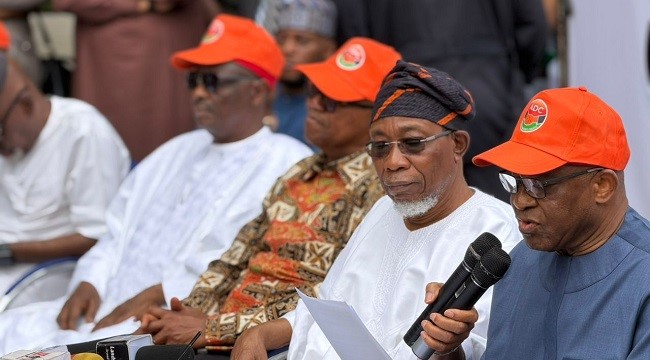
The opposition leaders made the declaration at the public launch of  “The Loyalist,’’ a memoir by National Publicity Secretary of the African Democratic Congress, ADC, Bolaji Abdullahi, in Abuja.

The event drew a wide mix of opposition leaders, former public office holders, lawmakers, intellectuals and party stakeholders.

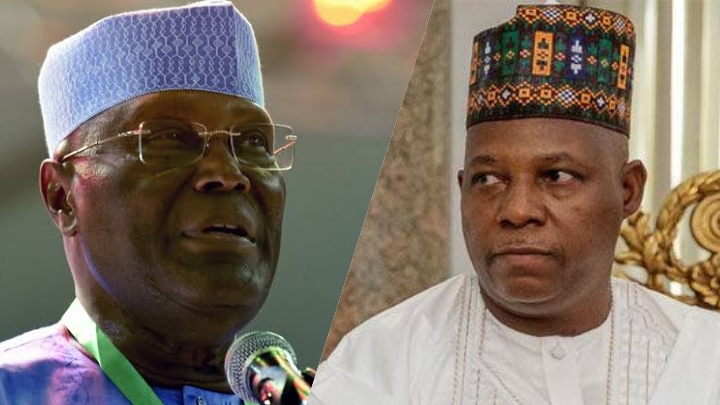
Speakers included former Vice President, Atiku Abubakar; former Anambra State governor, Peter Obi; former Minister of Interior and ADC National Secretary, Rauf Aregbesola; former Senate President and ADC National Chairman, David Mark, and veteran columnist and public intellectual, Hakeem Baba-Ahmed, who reviewed the book.

Although convened as a book presentation, the gathering quickly assumed a strong political tone, with speakers repeatedly returning to the issues of opposition unity, leadership responsibility, and the limits of incumbency power, ahead of the next general election.

Addressing what he described as a growing misconception in Nigerian politics, Aregbesola argued that governors and incumbents do not automatically determine election outcomes.

Drawing on the 2023 electoral results, he said the belief that political office guaranteed victory was not supported by evidence.

“The fact that certain governors are defecting to the APC shows that our unity is weakened, but the statistics do not support the belief that governors win elections,” Aregbesola said.

Using the South-West as an example, he said ruling party dominance at the state level had not translated into overwhelming electoral success.

“In the South-West, the APC controlled all the states except one, yet the maximum performance of the party was 55 per cent, with the other parties sharing the rest,” he said.

On his part, former Vice President, Atiku Abubakar, speaking as special guest of honour, linked the political moment to the theme of the book, describing loyalty as both a moral test and a personal burden in public life.

Atiku, who noted that his participation was informed by his own role in the political history examined in the memoir, said: “I am honoured to be part of this launch because I was also involved in the eventual inauguration of the Bukola Saraki administration, which this book deals with in very great detail.’’

He praised the author for taking on difficult questions about loyalty and conscience, saying “this is a work that dares to question loyalties, illuminate conscience, and broaden our public imagination.’’

Drawing a contrast between military discipline and political life, Atiku said loyalty in politics was rarely absolute and often exacted a heavy price.

“For those of us who come from the military and paramilitary professions, loyalty is non-negotiable; there is only absolute obedience. But in political life, loyalty is not as rigid, and it comes with consequences,” he said.

The former vice president also spoke candidly about his own experiences.

“Many of us have suffered because of loyalty. I have faced exile as a result of loyalty. I have survived assassination attempts as a result of loyalty,” he said.

Atiku warned that loyalty should never become blind allegiance, adding that “loyalty should strengthen the common goal, not narrow the circle of belonging.’’

Similarly, a former Governor of Anambra State, Peter Obi, who arrived late due to flight delays from Lagos, apologised for not observing traditional protocol before addressing the audience.

Obi also signalled political solidarity and regional commitment, saying: “I have been directed to represent the South-East, and I want to assure you that you will not be disappointed.’’

In one of the most direct political moments of the event, the author, Bolaji Abdullahi, appealed to opposition leaders to rise above rivalry and present a united front, ahead of 2027, adding that Nigerians were ready for change, though political leaders were not yet matching that urgency.

“For 2027, Nigerians are ready. But I don’t think we are ready. Nigerians look at us and see different enclaves and different entities. They see competition, rather than cooperation,” Abdullahi said.

Reviewing the book, Hakeem Baba-Ahmed said it initially provoked skepticism but ultimately impressed him.

“I brought to the book some prejudice and heightened curiosity. I expected the author to fall on his face somewhere. I was wrong,” he said.

He described the memoir as revealing and historically significant.

“This book is easily one of the most readable and revealing books I have read in a long while. It captures the essence of our contemporary social and political character,” Baba-Ahmed said.

Former Senate President, David Mark, described the task of rescuing Nigeria as a shared responsibility and praised Abdullahi’s character.

“He is a straightforward person. Even when I disagreed with him, his advice was always adopted,” Mark said.

He also clarified the long-standing controversy around the Doctrine of Necessity, saying “it was the sole responsibility of the Senate and had nothing to do with Kwara State or anyone from Kwara State.’’

Continue Reading

Trending