By Eric Elezuo
Tuesday March 22, 2022 stamped its feet on the annals of history as the Africa’s richest man, Alhaji Aliko Dangote, proved his worth, and brought to reality an audacious nine years project. It was the unveiling of the 3.0 million metric tonnes of Urea per annum Dangote Fertiliser Plant, sited at the Dangote Industries Free Zone, Ibeju Lekki, and built at a whopping cost of $2.5 billion. The Fertiliser Complex occupies 500 hectares of land space.
Describing the impetus behind the gigantic project, Dangote noted in his speech that it was yet another Nigerian success story.
He captured the entirety of what most people have described as the greatest wonder to come out of Nigeria, in a short speech delivered at the star studded commissioning, which brought together the best of Nigerians in all facet of human endeavours, cutting across politics, entrepreneurship, entertainment, security, academics and more.
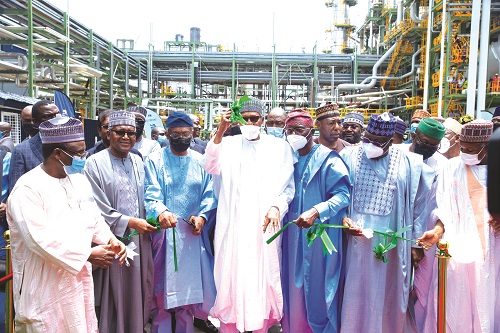
The biggest masquerade that graced the occasion was Nigeria’s president, and commander in chief of the Armed Forces, Muhammadu Buhari, who commissioned the project. He was ably assisted by the leaders of the National Assembly including the President of the Senate, Ahmed Lawan; Speaker of the House of Representatives, Hon Femi Gbajabiamila. Also present were some states’ governors led by the host governor, Mr. Babajide Sanwo-Olu. Others were Ifeanyi Okowa of Delta State, Abdullahi Ganduje of Kano State among others. Ministers in the federal cabinet were also represented in their numbers as well as traditional rulers, members of the diplomatic corps and high profiled entrepreneurial giants.
Speaking in his opening remarks, Dangote admitted that the project was ambitious and intended to drastically reduce the level of unemployment and youth restiveness in this country.
“It is an ambitious developmental project, which will drastically reduce the level of unemployment and youth restiveness in this country, through generation of direct and indirect employment. Agriculture accounts for over 20 per cent of Nigeria’s GDP, and the country is a leading producer of various agricultural commodities. The sector has the potential of becoming the biggest source of income for our Nation, providing employment and raw materials for industries. However, low fertilizer usage has been a major reason for low productivity in the sector,” he said.
He promised not to renege in his quest to continue to innovate, create value and invest in Nigeria as a result of the huge economic potential therein.
He said: “Our continuous efforts to innovate, create value and invest in Nigeria are borne out of our firm belief in the vast economic potential of our dear country. This has also informed our desire to continue with our investment strategy, with a focus on driving import substitution, ensuring that we increase local production to achieve self-sufficiency, and even export excess production.”
His full speech
Your Excellency, Mr President, the Senate President, the Rt. Hon. Speaker, State Governors, the Deputy Secretary General of United Nations, Honourable Ministers, distinguished Ladies and Gentlemen.
Permit me to stand on existing protocol. It is my honour and pleasure to welcome you all to the commissioning of our 3.0 million metric tonnes of Urea per annum Dangote Fertiliser Plant, sited at the Dangote Industries Free Zone, Ibeju Lekki. The Fertiliser Complex, which occupies 500 hectares, is built at a cost of $2.5 Billion.
I would like to express our immense gratitude to our Special Guest of Honour, His Excellency, Muhammadu Buhari, President of the Federal Republic of Nigeria, for his sustained support and encouragement, and for honoring our invitation to come, in person, to commission the Plant despite the exigencies of his exalted office.
We are also grateful to our Chief Host and Governor of Lagos State, Mr. Babajide Sanwo-Olu, whose Administration has provided the enabling environment that has made this project possible. The commissioning of this Fertiliser Plant is historic. It marks the official opening of the largest Granulated Urea Fertiliser Complex in Africa. The new plant will make Nigeria self-sufficient in fertiliser production, with excess capacity to export to other markets in Africa and the rest of the world. Our products have already reached the markets some African countries, the USA, Brazil, India and Mexico.
It is an ambitious developmental project, which will drastically reduce the level of unemployment and youth restiveness in this country, through generation of direct and indirect employment. Agriculture accounts for over 20 per cent of Nigeria’s GDP, and the country is a leading producer of various agricultural commodities. The sector has the potential of becoming the biggest source of income for our Nation, providing employment and raw materials for industries. However, low fertilizer usage has been a major reason for low productivity in the sector.
It is common knowledge that nonavailability of the product, in quantity and quality, rather than affordability, is the primary constraint to the use of fertilizer.
Our goal is to make fertiliser available in sufficient quantities and quality for our teeming farmers assuring greater agricultural output. To help realise this potential, we are rolling out initiatives that will transform the agricultural sector, including extension services for small and medium scale farmers. We have also established well-equipped soil-testing laboratories to ensure that the appropriate fertiliser blends are applied to specific soil and/or crop types. This will boost productivity, enhancing output across the Nation.
Dangote Fertiliser will partner with key stakeholders in the industry, including Farmer Associations, NPK Blenders, NGO/Development Partners and State Governments across Nigeria, who are committed to a sustainable approach to improving soil quality and farm yields.
Our continuous efforts to innovate, create value and invest in Nigeria are borne out of our firm belief in the vast economic potential of our dear country. This has also informed our desire to continue with our investment strategy, with a focus on driving import substitution, ensuring that we increase local production to achieve self-sufficiency, and even export excess production.
Your Excellency Mr. President, Your Excellencies, distinguished ladies and gentlemen, this ceremony is the outcome of many years of collaboration and partnership with many institutions and individuals. Let me therefore extend a warm thank you to all those who have contributed to make this day possible.
May I recognise and appreciate the Central Bank of Nigeria and my friend, Governor Godwin Emiefele, for his uncommon support and encouragement. The CBN, under his leadership has extended tremendous support, especially during some very difficult stages, ensuring the attainment of today’s milestone.
I appreciate our partner Ministers, the Hon. Minister of State Petroleum Resources, the Hon. Minister of Finance, Budget and National Planning, the Hon. Minister of Industries, Trade & Investment, the Hon. Minister of Transport and the Hon. Minister of Agriculture, and their various agencies, especially the Nigerian Ports Authority for their support.
I must appreciate the immense cooperation and support we have received from NNPC. My amiable
brother Mele Kyari, the GMD of NNPC, has left no stone unturned to ensure the availability of natural
gas without which this milestone would never have been achieved. I will always remain grateful for his
strong interventions to resolve problems on many critical occasions
I would also like to express my deep appreciation to the Security Agencies, in particular the Office of the
National Security Adviser, and the Nigerian Navy, for providing a safe and secure environment from the
outset of this Project. I wish to thank in a special way, the Chief of Naval Staff, Vice Admiral Awwal Gambo
for his unflinching support.
We will always remain immensely grateful to the various local and foreign financial institutions, especially our Nigerian banks, for not only investing in us, but for the expertise and sensitivity they brought to bear to ensure the viability and successful execution of this project.
Prof. Benedict Oramah, the President and Chairman of the Board of Afrexim Bank, deserves our special
thanks for his support and advice through all the stages of this venture.
I commend the traditional rulers, the Obas and leaders of our host communities, and their people,
for providing a peaceful and conducive environment. We have developed a collaborative partnership with
our various stakeholders in the communities, to strengthen this mutually rewarding relationship. I cannot end this address without recognising the many years of enthusiastic teamwork, labour, toil and sweat of the Management and Staff of Dangote Group for their commitment to high performance, perseverance and resilience.
Your Excellency Mr. President, Your Excellencies, Distinguished Ladies and Gentlemen, I am humbled
and highly honoured by the presence of such eminent leaders gathered here to witness this commissioning.
I wish to recognise and thank His Excellency the Senate President, The Rt. Hon. Speaker of the House of Representatives, our esteemed Deputy Secretary General of the United Nations, State Governors, past
and present, Honourable Ministers and Members of the Diplomatic Community, Heads of Public Agencies, our revered Royal Fathers, and my friends from the private sector. Last but not the least my
family.
Finally, to each and every one of you, our guests, I am really delighted that you are able, despite the
short notice and your tight schedules, to join us in celebrating yet another Nigerian success story,
May God Bless you all.
Earlier before the commissioning, Dangote had told all who cared to listen that “This plant will further entrench Africa’s role on the global map as not only a valued contributor for natural resources, but also a competent manufacturer of refined products and fertilizer. As a result, several African nations will be less reliant on importing fuel and fertilizer from foreign markets, reducing the negative impact of negotiating terms within increasingly turbulent international markets.”
In his speech at the occasion, a very elated Buhari observed that the nation stands to enjoy a boom in foreign exchange through the exportation of the product adding that his administration’s drive towards achieving self-sufficiency in food production will be boosted.
He said: “I am delighted to commission this Dangote Fertiliser plant which has the capacity of producing three million metric tons of Urea per annum which makes it the second of such plants in the world”
“This is expected to further our administration drive towards achieving self-sufficiency in food production, in the country. I commend the chairman, board and management of Dangote Industries Limited for their business initiative in bringing this plant which will help in reducing the importation of fertilizer, create jobs and increase the inflow of foreign exchange and accelerate economic growth”
“This new plant is a renewed testament to the widely economic patriotism of Aliko Dangote, it also demonstrates their commitment to the social-economic development of our country and the well being of our people”
“Dangote holds the record as the continent highest cement producer. The group’s investment in cement plants spanning the value chain has ended Nigeria’s dependence on the importation of cement. Along with other subsidiary companies, Dangote Industries limited has created thousands of jobs across Nigeria”
“It is the second biggest employer of labour in this country after the Federal Government. This is very pleasing because job creation by private operators reduces insecurity and take the youths off the streets. The nation also stands to gain extensively in earning foreign exchange from the excess production and export from the plant”
“I have been informed that it has already started exporting to other foreign countries including the United States, India and Brazil. The plant is creating huge opportunities in the area of job creation, warehousing, transport and logistics. This will create significant wealth, reduce poverty, and help in securing the future of our nation. In the agricultural sector, another focal point of our economic policy will expect a boom in fertilizer which is already available in greater quantity”
“Many Nigerians who depend on subsistence farming due to the unavailability of this product can now take agriculture as their business. We expect the arrival of a new breed of agro-products who will add value to farming and make the nation self-sufficient in food production.”
It would be recalled that earlier in 2021, Dangote Urea fertilizer went on sales nationwide and was pushing out a minimum of 120 trucks per day across the country.
Making the situation known to the press, Group Executive Director (Strategy, Capital Projects & Portfolio Development), Dangote Industries Limited, Devakumar Edwin, said the Plant which has the capacity to turn out more than 4,500 tonnes of urea per day will conveniently meet the local demand and even produce for exports.
“…We have the capacity to turn out 4,500 tonnes of Urea everyday – this is a bulk application fertilizer – each crop in Nigeria or globally will require Nitrogen and this is a rich fertilizer, having 46 per cent nitrogen…The company has the capacity to meet local demand and also export to African countries.
“Currently the demand is less than 1 million tonnes and we alone can produce 3 million tonnes, so we can easily meet local demand and also produce for export to other west African countries.”
He had added that aside fertilizer production, the company, was already working to support the farmers with training on application of the fertilizer and even establish laboratories across the country for proper soil examination.
“The uniqueness of this plant, apart from the fact that we are producing is the focus on farmers’ support, on training, education, development as we are now establishing laboratories across the country and even mobile laboratories where we can go drive around and take soil samples for proper examination to effectively grow the agricultural outputs across the country”
Dangote’s Urea Fertilizer plant was built to tap into Nigeria’s demand for fertilizer, a critical component of achieving food sufficiency for Africa’s most populous country.
The Fertilizer plant is expected to manufacture 3 million metric tonnes of urea per annum, with a view to reducing the nation’s fertilizer imports, and generating $400m annual foreign exchange from export to Africa countries.
Even before the official unveiling, marketers and farmers, especially in Kano, had described the Dangote Fertilizer as a game changer and a forecast for the expected agricultural revolution in the country.
Dangote is not giving up in his quest to make Nigeria a production hub as he has promised that the sister company, the refinery and petrochemical plant will begin processing crude by the third quarter of 2022.
According to Bloomberg, the business mogul said mechanical work on the refinery is done, and “hopefully before the end of the third quarter we should be in the market”.
Dangote said the plant would start with a processing capacity of 540,000 barrels per day.
“Full production can start maybe, by the end of the year or beginning of 2023,” he said.
Dangote Petroleum Refinery is a multi-billion dollar project that will create a market for $11 Billion per annum of Nigerian Crude.
The facility, which cost an estimated $19 billion to build, has an installed capacity of 650,000 barrels per day.
It is expected to be Africa’s biggest oil refinery and one of the world’s biggest single-train facilities, upon completion.
Its output will be more than enough to meet Nigeria’s fuel demands and turn Africa’s largest crude producer into an exporter of refined crude.
Godwin Emefiele, governor of the Central Bank of Nigeria (CBN), had said that Nigeria will save 40 percent of its foreign exchange (FX) earnings if the refinery and petrochemical Plant begins operations in the year.
In 2021, the fully integrated Conglomerate and proudly Nigeria brand emerged the most Valuable brand in Nigeria for the fourth time in a row, proving that it is endeared in the hearts of the Nigerian people.
It emerged the most valuable having scaled through seven metrics deployed for the purpose including Brand Popularity; Quality Element; Market leadership; Innovation; national Spread; CSR-Environmental friendliness and Online Engagements at the annual top corporate brand evaluation report by TOP 50 BRANDS NIGERIA.
The annual top brands league table which has become like a report card with which top corporate brands have a feel of their ranking in the market is done with a special purpose model, the Brand Strength Measurement (BSM Index), a model that tests a brand’s ability deliver on its promise to its consumers from the consumer’s points of view. It is a qualitative, non-financial evaluation of top corporate brands in the country which is done annually.
Earlier in 2018, the group won the most admired African brand, of African continent origin, by consumers according to the South African based Brand Leadership Movement in collaboration with the Johannesburg Stock Exchange (JSE)
The group came top in the fresh ranking of 100 best brands in Africa themed “Brand Africa:100”, the sixth edition announced in Johannesburg, South Africa. The aim of Brand Africa is to identify, acknowledge and promote African and global brands that are catalysts for Africa’s growth, reputation and value.








 Adding Value5 days ago