Connect with us

Headline

366 Soldiers, Policemen Killed in Two Years As FG Rehabilitates 15,000 Terrorists

Published

on

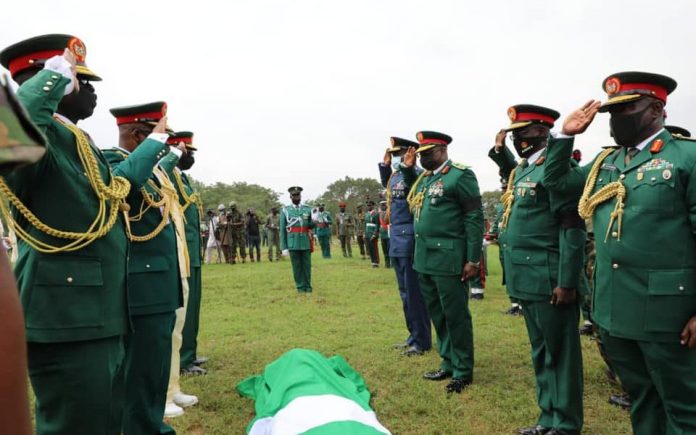
At least, 366 soldiers, policemen and members of the civilian joint task force were killed in ambushes laid by terrorists in the North-East and the North-West between 2019 and 2021.

A breakdown of the figures released by SBM Intelligence states that 337 soldiers, 29 cops and civilian JTF members were killed, while 111 others were eliminated by the terrorists.

The report added that 92 terrorists were eliminated, while in all, 569 persons were killed in several ambushes within the same period.

A breakdown of the statistics showed that the biggest single onslaught against the military was in the Goniri area of Yobe State on March 23, 2020, wherein about 70 soldiers were killed.

On July 7, 2020 in the Damboa Local Government Area of Borno State, 30 soldiers and 12 policemen were killed along with three terrorists.

Between September 16 and 24, a space of eight days, about 49 soldiers and two policemen were killed in the Monguno and Marte local government areas of Borno State.

The report added that 18 soldiers and six policemen and members of the civilian JTF were killed in the Kukawa Local Government Area of Borno State on September 2 and 3, 2020.

Despite the killing of soldiers, however, many of the terrorists are reported to have surrendered in recent times due to the attack on Boko Haram strongholds, while the sponsors of the terrorists remain unknown.

This is just as The PUNCH learnt that at least 15,000 terrorists, who surrendered to government forces had begun undergoing de-radicalisation.

The National Security Adviser, Maj, Gen. Babagana Moguno (retd.), had said last week, “In recent months, there has been an endless mass surrender of terrorists and their sympathisers in the North-Eastern part of Nigeria. Currently, over 15,000 people have been received.

“It is important to note that the combination of kinetic and non-kinetic measures largely contributed to this wave of surrender.”

The Head, Strategic Communications in the Office of the NSA, Mr Zakari Usman, told The PUNCH that all 15,000 persons, who surrendered, would be rehabilitated, including some who might be prosecuted.

He said, “Yes, everybody will undergo rehabilitation. Even those who are going through the criminal justice process undergo rehabilitation.

“At the state level, together with the MDAs that are involved, there is already a process on the ground. For everybody who surrenders, there is some form of rehabilitation.

“The rehabilitation, reintegration and de-radicalisation programme is for low-risk associates. That is women, children and conscripts.”

Meanwhile, human rights lawyer, Mr Femi Falana (SAN), says he will be suing the Office of the Attorney-General of the Federation for refusing to arraign 400 Boko Haram sponsors over six months after he promised to do so.

Falana, who had written a Freedom of Information request to Malami in August to know the state of the case, said the request was based on Malami’s claim of May 4, 2021 that the Federal Government had concluded arrangements to prosecute about 400 alleged sponsors and financiers of terrorism in Nigeria.

“I have not received any response from the AGF since I wrote the FoI. So, we are now constrained to go to court. The AGF said publicly that 400 terror sponsors would be arraigned once the court workers called off their strike. That was over four months ago,” he said.

Attempts to get a response from the AGF’s office proved abortive as his spokesman, Dr Umar Gwandu, did not respond to inquiries.

The Federal Government has come under fire in recent months for failing to name terror sponsors despite the assistance given to Nigeria by the United Arab Emirates and other countries, which provided lists of alleged terror sponsors

However, in a statement in September, Malami defended the decision of the government not to name the terror sponsors, saying doing so could jeopardise investigations.

Malami had said the Federal Government had been vigorously and intensively working to leave no stone unturned in the prosecution of Boko Haram financiers and win the fight against terrorism in the country.

The AGF had stated, “The time is not ripe for holistic disclosures so as not to pre-empt the investigation process. The prime objective remains the attainment of peace and security of our dear nation.

“As far as terrorism funding and financing is concerned, we have succeeded in identifying those that are allegedly responsible for funding same and we are blocking the leakages associated with funding, while embarking on an aggressive investigation that is indeed impacting positively in terms of the fight against terrorism.”

In October, the AGF had also linked the Yoruba Nation agitator, Sunday Adeyemo, aka Sunday Igboho, to a convicted Boko Haram financier.

The Punch

Continue Reading
Click to comment

Leave a Reply

Your email address will not be published. Required fields are marked *

Headline

Second Term for Tinubu Will Turn Governors into Total Slaves, Dele Momodu Warns

Published

on

By

Chairman, Ovation Media Group, and former presidential aspirant, Aare Dele Momodu, has expressed strong concern over what he described as growing political support for President Bola Ahmed Tinubu among state governors across the country.

Speaking during an interview on News Central TV, Momodu said he was shocked by the level of backing the president is reportedly receiving, warning that Nigeria’s democracy could face serious risks if the current political trend continues.

The media entrepreneur cautioned that allowing Tinubu to secure a second term in 2027 could, in his view, lead to excessive concentration of power. He particularly criticized what he described as a growing wave of opposition figures aligning with the ruling All Progressives Congress> (APC).

Momodu referenced reports of opposition governors, including Ahmadu Umaru Fintiri, allegedly moving closer to the ruling party, describing the development as politically troubling.

According to him, some governors are allegedly competing to demonstrate loyalty to the president ahead of future elections.

“The governors are fighting to ensure Tinubu wins a second term, fighting to be the biggest thug for him. If a man in his first term can capture the bodies and souls of Nigerians this way, imagine what he would do with a second term. It will be a full-blown dictatorship, and the governors will regret it as they become total slaves to him,” Momodu said.

He concluded by urging Nigerians to remain vigilant and actively protect democratic institutions, warning that unchecked consolidation of political power could threaten the nation’s democracy and future stability.

Gistmania

Continue Reading

Headline

Court Validates PDP 2025 Convention in Ibadan, Affirms Turaki-led NWC

Published

on

By

The Oyo State High Court sitting in Ibadan has affirmed the validity of the 2025 Elective Convention of the Peoples’ Democratic Party (PDP), which produced Dr. Kabiru Turaki as the substantive National Chairman of the party.

Delivering judgment on Friday, Justice Ladiran Akintola upheld the convention in its entirety, ruling that it was conducted in full compliance with the relevant constitutional and statutory provisions governing party elections in Nigeria.

The decision marked a significant legal victory for the party’s leadership and brought clarity to the dispute surrounding the convention’s legitimacy.

The ruling followed an amended originating summons filed by Misibau Adetunmbi (SAN) on behalf of the claimant, Folahan Malomo Adelabi, in Suit No. I/1336/2025.

In a comprehensive judgment, the court granted all 13 reliefs sought by the claimant, effectively endorsing the processes and outcomes of the Ibadan convention.

Justice Akintola held that the convention, organised by the recognised leadership of the party, satisfied all laid-down legal requirements as stipulated in the 1999 Constitution of the Federal Republic of Nigeria, the Electoral Act 2022 (as amended), and the relevant provisions of the Electoral Act 2026.

The court found no breach of due process or statutory non-compliance in the conduct of the exercise.

In the same proceedings, the court dismissed the Motion on Notice seeking a stay of proceedings and suspension of the ruling, filed by Sunday Ibrahim (SAN) on behalf of Austin Nwachukwu and two others. The applications were described as lacking merit.

Earlier in the proceedings, the court had also rejected a bid by Ibrahim to have his clients joined in the suit.

Justice Akintola ruled at the time that the joinder application was unsubstantiated and consequently dismissed it.

Continue Reading

Headline

Opposition Parties Reject 2026 Electoral Act, Demand Fresh Amendment

Published

on

By

Opposition political parties have rejected the 2026 Electoral Act recently passed by the National Assembly, which President Bola Tinubu swiftly signed into law.

The parties called on the National Assembly to immediately begin a fresh amendment process to remove what they described as “all obnoxious provisions” in the law.

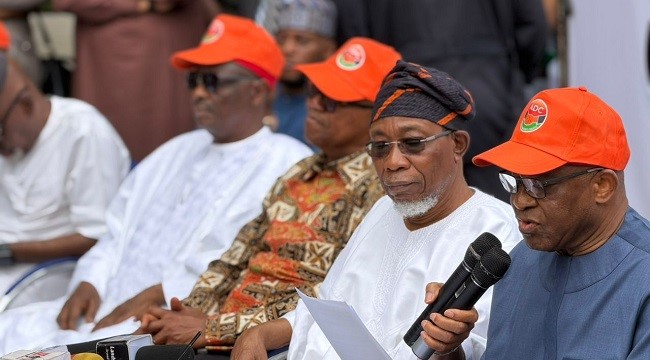
Their position was made known at a press briefing themed “Urgent Call to Save Nigeria’s Democracy,” held at the Transcorp Hilton Hotel in Abuja on Thursday.

In a communiqué read by the Chairman of the New Nigeria Peoples Party (NNPP) Ahmed Ajuji, the opposition leaders stated:

“We demand that the National Assembly immediately commence a fresh amendment to the Electoral Act 2026, to remove all obnoxious provisions and ensure that the Act reflects only the will and aspiration of Nigerians for free, fair, transparent and credible electoral process in our country. Nothing short of this will be acceptable to Nigerians.”

Some of the opposition leaders present in at the event include former Senate President David Mark; former Governor of Osun State, Rauf Aregbesola; former Vice President Atiku Abubakar; former Governor of Rivers State, Chibuike Rotimi Amaechi; and former Governor of Anambra State, Peter Obi, all from the African Democratic Congress (ADC).

The National Chairman of the New Nigeria Peoples Party (NNPP), Ahmed Ajuji, and other prominent members of the NNPP, notably Buba Galadima, were also in attendance.

The coalition said the amended law, signed by Bola Tinubu, contains “anti-democratic” clauses, which they argue may weaken electoral transparency and public confidence in the voting system.

At the centre of the opposition’s concerns is the amendment to Section 60(3), which allows presiding officers to rely on manual transmission of election results where there is communication failure.

According to the coalition, the provision weakens the mandatory electronic transmission of results and could create loopholes for manipulation.

They argued that Nigeria’s electoral technology infrastructure is sufficient to support nationwide electronic transmission, citing previous assurances by officials of the Independent National Electoral Commission (INEC).

The parties also rejected the amendment to Section 84, which restricts political parties to direct primaries and consensus methods for candidate selection.

They described the change as an unconstitutional intrusion into the internal affairs of parties, insisting that indirect primaries remain a legitimate democratic option.

The opposition cited alleged irregularities in the recent Federal Capital Territory local government elections as evidence of what they described as a broader pattern of electoral compromise.

They characterised the polls as a “complete fraud” and said the outcome has deepened their lack of confidence in the ability of the electoral system to deliver credible elections in 2027.

The coalition also condemned reported attacks on leaders of the African Democratic Congress in Edo State, describing the incidents as a serious threat to democratic participation and political tolerance.

They warned that increasing violence against opposition figures could destabilise the political environment if not urgently addressed.

In their joint statement, the opposition parties pledged to pursue “every constitutional means” to challenge the Electoral Act 2026 and safeguard voters’ rights.

“We will not be intimidated,” the leaders said, urging civil society organisations and citizens to support efforts aimed at protecting Nigeria’s democratic system.

On February 18, 2026, President Bola Tinubu signed the Electoral Act (Amendment) 2026 into law following its passage by the National Assembly. The Act introduced several reforms, including statutory recognition of the Bimodal Voter Accreditation System and revised election timelines.

However, opposition figures such as Atiku Abubakar and Peter Obi have also called for further amendments, particularly over the manual transmission fallback clause, which critics say leaves room for manipulation.

The president said the law will strengthen democracy and prevent voter disenfranchisement.

Tinubu defended manual collation of results, questioned Nigeria’s readiness for full real-time electronic transmission, and warned against technical glitches and hacking.

The Electoral Act sparked intense debate in the National Assembly over how election results should be transmitted ahead of the 2027 general elections.

Civil society groups under the “Occupy NASS” campaign demanded real-time transmission to curb manipulation.

In the Senate, lawmakers clashed during consideration of Clause 60, which allows manual transmission of results if electronic transmission fails.

Senator Enyinnaya Abaribe (ADC, Abia South) demanded a formal vote to remove the proviso permitting manual transmission, arguing against weakening real-time electronic reporting.

The move led to a heated exchange on the floor, with Senate President Godswill Akpabio initially suggesting the demand had been withdrawn.

After procedural disputes and a brief confrontation among senators, a division was conducted. Fifteen opposition senators voted against retaining the manual transmission proviso, while 55 supported it, allowing the clause to stand.

Earlier proceedings had briefly stalled during clause-by-clause review, prompting consultations and a closed-door session.

In the House of Representatives, a similar disagreement came up over a motion to rescind an earlier decision that mandated compulsory real-time electronic transmission of results to IReV.

Although the “nays” were louder during a voice vote, Speaker Tajudeen Abbas ruled in favour of rescinding the decision, triggering protests and an executive session.

Continue Reading

Trending