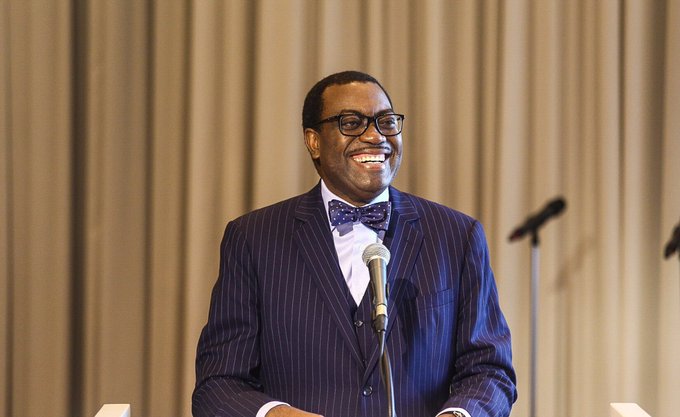
Convocation Lecture Delivered By Dr. Akinwumi A. Adesina, President, African Development Bank Group American University of Nigeria July 10, 2021
(PROTOCOLS).
Good morning everyone!
A very happy morning to you the Class of 2020 and Class of 2021!
Today is your big day. A day of joy, for you and your families, your lecturers and the University.
I wish to thank you Professor Margee Ensign, President of the American University of Nigeria for inviting me to deliver this commencement lecture.
I am most grateful to you, Madam President, the University Senate and the Governing Council for the great honor of being conferred with the University’s highest honorary degree: Doctor of Humane Letters. Thank you so very much!
I am very happy to be here today. This is the first time to be at this great University, established by H.E. Atiku Abubakar, GCFR, former Vice President of Nigeria, a revered national leader, and a visionary and respected African statesman. He is also a benefactor, mentor, big brother, and friend.
He loves education and its power to create transformation change.
I was joking with him recently and asked why at his age, he had gone back to study for a Masters’ degree in international relations in the UK. He told me that he wanted to obtain the degree, so that he could find out why he did the things he did while in government: In essence, a retrospective degree for the many successes he has had!
Congratulations to you all the class of 2020 and the class of 2021. You have done very well, and you have made your parents proud.
I love the diversity I see here: you have students from all parts of Nigeria, a reflection also of Nigeria’s diversity.
I also love the diversity that I see in the international students and faculty. You are all welcome in Nigeria. I gather that the international student body includes the nations of South Africa, Cote d’Ivoire, Rwanda, Cameroon, India and Romania.
I trust that in your respective ways and in the years ahead, you will all become honorary ambassadors of Nigeria. I trust that you will also look back in the not-too-distant future and say, “yes, Nigeria finally made it!”
I am proud to be a Nigerian. I know that for several people, this might sound like an old cliché, whose time has passed. I fully understand the challenges we face as a nation. Yet, I have a dream that we will arise, from our challenges, and build a more prosperous and united nation.
So, today, I want to speak to you about “Building a New Nigeria: Imperatives for Shared Prosperity”.
I speak to you today as a Nigerian. As I have quite often said, I will live as a Nigerian, die as a Nigerian, and on the resurrection morning I will ask God for permission to rise as a Nigerian, with the green-white-green flag in my hand!
Nigeria is blessed with incredibly rich diversity: of people, of cultures, of religions, of mineral resources, oil, and gas, an amazingly rich biodiversity, that should make us the envy of the world. We are blessed with abundantly diverse agro-ecologies, that should also make us a land of bountiful harvests with capacity to feed Africa.
We are a religious nation, so we should understand that God loves diversity. The diversity of rich and brilliant colours that we see in our forests, oceans, seas, and in flora and fauna, reflect the beauty of the Creator.
Therefore, our diversity is not our problem. Diversity is our strength.
But when mismanaged, diversity becomes divergence. Rather than unite, we become splintered, with each entity believing that, somehow, it is better without the other.
We must manage diversity for collective good.
Take Singapore as a case in point.
It is a very diverse, multi-ethnic, multi-cultural, multi-religious society, made up of Chinese, Malay, Indian and Eurasians. Singapore is a nation of diverse people and national origins.
Yet, this nation was able to forge a unified identity that has powered its extraordinary economic progress and development.
Think of it: Chinese represent 74%, Malay, 13.4%, Indian, 9.0%, and others, 3.2%.
Think of their religious diversity: Buddhism ((33%), Taoism and folk religion (10%), Christianity (18%), Catholicism (6.7%), Protestants and non-Catholics (12%), Not religious (18.5%), Muslims (14%), and Hinduism (5%).
There is religious harmony, not religious supremacy, or polarization.
The people see themselves first as Singaporeans!
At its independence in 1965, Singapore’s per capita income was just $517 compared to $1,400 for Nigeria at its independence in 1960.
Today, the story is different. The per capita income of Singapore is now $60,000. Today, the per capita income for Nigeria is $2,250.
This highly diverse nation now ranks 4th in the world in terms of GDP per capita, with massive wealth and prosperity for its people.
The evidence is clear.
Singapore managed its diversity to create wealth — shared wealth.
By better managing its diversity, Singapore has been able to forge an incredible economic growth, which benefits all in the country.
They have 100% access to electricity and 98% access to water and sanitation. Their schools rank among the best in the world.
Today, Singapore is a AAA-rated economy by the global credit rating agencies.
But Singapore did not have it easy either.
They faced challenges, just like we are facing in Nigeria today. They had very divisive ethnic and race riots in the 1960s that almost pulled the nation apart. But they overcame this by getting some things right.
They focused on fusion of national purpose and identity.
They put in place cultural policies that ensured no one ethnic group or the other dominates or assimilates others, but rather, promotes multiculturalism.
They put in place a constitution that reinforced national fusion. Article 12 of the constitution forbids discrimination based on race, descent or place of birth. It reads, “We the citizens of Singapore, pledge ourselves as one united people, regardless of race, language and religion, to build a democratic society based on justice and equality”.
It goes on to say, “there shall be no discrimination against citizens of Singapore on the grounds only of religion, race, descent or place of birth in any law or in the appointment to any office or employment under a public authority or in the administration of any law relating to the acquisition, holding or disposition of property or the establishing or carrying on of any trade, business, profession, vocation or employment”.
What is the lesson here?
The Singaporean society is based on meritocracy, not aristocracy or ethnocracy or religiocracy.
Any society where meritocracy is subjugated to aristocracy, ethnocracy or religiocracy eventually tends towards mediocrity.
Nigeria must learn from this experience and forge a new way of engaging among its diverse ethnic groups and religions.
Nigeria must start managing its diversity for prosperity.
We must drive for national cohesion, not ethnic nationalities.
We must address the fundamental reasons for agitations, by listening, understanding, removing prejudices, and allowing for open, national dialogues, without preconditions, but with one goal: build one cohesive, united, fair, just and equitable nation for all, not for a few or for any section of the nation or religion.
A nation, unified by a sense of common wealth, not a collage of ethnic nationalism. A nation driven my meritocracy, not ethnocracy, religiocracy or aristocracy.
One of the things that Singapore did well was to have four national languages: English, Malay, Mandarin and Tamil. Nigeria needs to put in place the compulsory teaching of its major languages in schools, from primary through universities, to ensure multilingualism, cross-cultural understanding, and to build a strong socio-cultural capital that unifies.
The National Youth Service Corps (NYSC) was a very good idea: it allowed graduates from tertiary institutions to have one year of national service, largely (ideally) outside of their places of origin.
The real test, however, of “national service” is that it often revealed the lack of diversity. After one year of service the NYSC graduates are often not able to gain employment in governments where they served, simply because they are not indigenes of those States.
That in itself, is an irony!
The young graduates are strangers in their own country. A country they pledged to serve. opportunity is denied just because they were not born in those states! Even if they were born in those states, they are told to return to the States of their origin.
Yet, their origin is Nigeria, not their States!
In Nigeria, regardless of how long you have resided in any place, you cannot run for political offices in those states or locations, just because you were not born there. State governments, therefore, largely reflect nativism not residency, which further sends a message to non-indigenes that they do not belong.
Over time, this has created greater insularism, splintering, a lack of inclusiveness, the promotion of ethnic and religious chauvinism, instead of promoting national cohesion, trust and inclusiveness.
This needs to change.
Governments must be open to representation based on nationality not on ethnicity, to build a society of mutual trust, where diversity is well managed.
Unless someone can live in any part of the nation, work within the laws and not be discriminated against, based on religion, race or culture, or place of birth, they will always be strangers in the nation.
I love the Nigerian National Anthem. My favourite stanza is the one that says, “to build a nation, where peace and justice shall reign”.
I get emotional whenever I sing it. I remember when I was a Federal Minister, each time we gathered at the Federal Executive Council and had to sing, or at any other function strong emotions would well up within me, for a nation I love, serve, and will always serve, selflessly.
I know that we can be better than we are. We have everything and every reason to be.
For Nigeria to be all that it can be, the youth of Nigeria must be all they can be.
The future of Nigeria depends on what it does today with its dynamic youth population. This demographic advantage must be turned into a first rate and well-trained work force, for Nigeria, for the region and for the world.
But 38.5% of Nigeria’s youth are unemployed. Lacking skills, economic opportunities, they are discouraged, angry and restless, as they look at a future that does not give them hope.
We should prioritize investments in the youth: in upskilling them for the jobs of the future, not the jobs of the past; by moving away from so called youth empowerment to youth investment; to opening up the social and political space to the youth to air their views and become a positive force for national development; and for ensuring that that we create youth-based wealth.
From the East to the West, from the North to the South, there must be a sea change in economic, financial, and business opportunities for young Nigerians.
The old must give way to the new. And there must be a corresponding generational transfer of power and wealth to the youth. The popular folk talk should no longer be “the young shall grow”, it should, rather, be: “the young have arrived”.
The young shoots are springing up in Nigeria. Today, Lagos has its own Silicon Valley. Yabacon Valley has emerged as one of the leading tech hubs in Africa with between 400 and 700 active start-ups worth over $2 billion, second only to Cape Town.
Andela, a global technology start-up based in Yabacon Valley, recently attracted $24 million in funding from Facebook founder Mark Zuckerberg. The $200 million investment by Stripe (a Silicon Valley firm) in the local payments company Paystack, and $400 million into three Fintech companies in just one week in 2019 signals the huge potentials of Nigeria to attract global digital commerce and financial services.
The African Development Bank is currently working on a $500 million program, Digital Nigeria, which is being designed to help further transform Nigeria’s digital competitiveness and build on the incredible entrepreneurship of Nigeria’s youth.
The Bank is also exploring the establishment of Youth Entrepreneurship Investment Banks — financial institutions for young people, run by first-rate young bankers and financial experts, to drive youth-wealth creation.
Nigerians deserve wealth, not poverty.
For all the abundant wealth of natural resources, Nigeria’s poverty situation is unacceptable.
Today, sadly, there are way too many poor people in Nigeria. The Government is implementing bold social programs to reduce the number of poor, through interventionist programs, but the fact of the matter is poverty is not just about money.
There is poverty of health, and yet we know that health is wealth.
The COVID-19 pandemic has further revealed the weaknesses of Nigeria’s health care systems. From diagnostic and testing centers, access to vaccines, and hospital infrastructure, the health care systems were overwhelmed.
I commend the spirited efforts of the Federal and State governments, and the private sector, in mobilizing resources to tackle the pandemic.
The African Development Bank provided $288.5 million to support the efforts of the Nigerian government in responding to the pandemic.
But we must go further. Nigeria must manufacture vaccines locally.
There is a lot to change to secure the health of the population.
Less than 5% of the population have access to insurance with the National Health Insurance Service. Over 90% of Nigerians have no health insurance.
You can see the effects on the lives of people.
Nigerians are not living long compared to other countries. Life expectancy in Nigeria is only 60 years (2020), compared to 70 years in India, 81 years in the UK, 80 years in the US, 82 years in Norway, and 86 years in Singapore.
Nigeria should build a comprehensive health care defence system, to secure its population against the impacts of the current pandemic and future pandemics. There must be equal opportunities for all. Health is wealth. We must ensure that all have access to health care, regardless of the levels of income.
And we must strongly support medical doctors, physicians, nurses and medical technologists, and remunerate them accordingly. They form the core of the health care system. We cannot have a situation where 56% of Nigeria’s medical doctors are working outside of Nigeria.
We need to stem the tide by prioritizing health of the people, and incentivizing professionals in the health care system, from rural health clinics to the surgeons and physicians in secondary and tertiary health systems.
Nigeria should put in place incentives to harness the knowledge, skills, and resources of Nigerians in the diaspora, and invest massively in building Nigeria’s health care infrastructure and systems.
There must be accountability for better lives for all Nigerians, regardless of their levels of income.
There cannot and should not be a Nigeria for the rich, and another Nigeria for the poor.
We must build one Nigeria, where every citizen has the right to a decent life.
We must build a better nation.
We must start building again, not splintering again.
We must re-build trust, equity, and social justice, to propel strong cohesiveness as a nation.
The tides are high, I know, and our boat rocks from time to time. Yet, I have hope. Hope for a better Nigeria … a renewed nation. Hope for a nation helped and healed by God. A nation, where the sacrifices of Nigerians past and present shall not be in vain.
I pray and long for a better Nigeria.
For a nation, built not on the division of its past, or the foundations of ethnicity, but on a new foundation, the foundation of equity, fairness, justice and unity, one Nigerian to the other.
For a new Nigeria, where one from the north shall be at home in the east; where one from the east shall break bread with one in the north; one where the one in the west shall eat from the same plate with one in the north; and wash hands in the same basin as one in the east.
They shall be one.
They shall not raise alarms against their neighbors, for we shall once again be renewed with a spirit of nationhood.
Our nation, buffeted on every side, flowing with the blood of the innocent, shall one day arise. The lion will lie with the lamb.
Our youth will once again rejoice in the hope of their future. A better future built on better days where governments work for them, not against them; when they shall stay in their lands, and none shall make them afraid; when they shall once again be the best they can be in the nation of their birth.
A nation where dreams are realized.
The youth — healthy, with decent incomes, and powered by policies to unleash their potential — shall be the strength of that nation.
They shall unite and work for a better future, their own future, not of those that have gone before them, nor of those who use them, instead of building them.
So today, I ask that you arise and build the nation we desire and deserve. A nation built by all, shared by all, prospering for all.
I see right here today, leaders of such a nation.
You have been well prepared. Do not learn the ways of the past. Renew your minds and work for the better future, your future, for a new Nigeria.
Correct the mistakes of our past.
Breakdown barriers of suspicion! Pull down walls that have divided us and caused us to war against each other. Pull down walls of fear and instead embrace and accept one another.
In the process, we will build together.
We will build a new Nigeria, where one will be respected and accepted, not according to the village of one’s birth, the state of one’s nativity, or one’s religion, but by the dignity within … the simple dignity of being a Nigerian.
The sufferings of the present cannot and should not dampen our hope in the future.
So today, turn to your right and whosoever you see say to them “I am Nigerian”.
Yes, you are “Nigerian”!
Now, wherever you go on from here, go out and make Nigeria proud … and work for a better Nigeria!
Wherever you find yourself, in your own little sphere, let the change begin with you!
Build bridges that connect, not walls that separate!
Together, in a better and just society, we will thrive.
And thrive we must, and thrive we will, as one united Nigeria.
So, say it again: “I am Nigerian!”
Yes, we are. Now, help us God!
Congratulations again! Go out there, change Nigeria, and change the world!








 News3 days ago