By Eric Elezuo
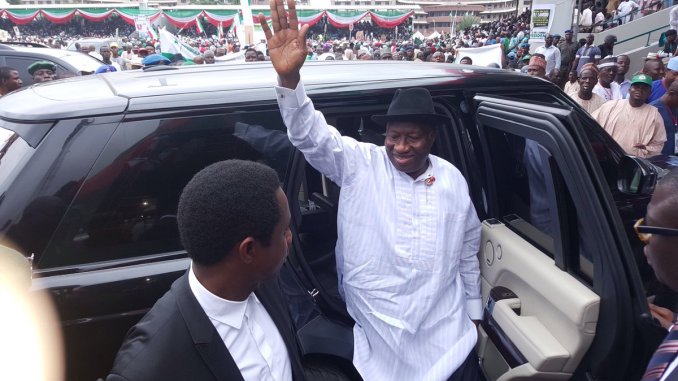
The story of the beautiful bride will no longer be complete without a mention to Nigeria’s immediate past President, Goodluck Jonathan. This is because the Bayelsa born politician, who nature has been treating as his name connotes, is in the news again. This time, as a subject of concern for the two major political parties in the Nigeria; the ruling All Progressives Congress (APC) and the opposition Peoples Democratic Party (PDP).
Recently, Jonathan has been inundated with visits from various political groups, chiefly among them, the ruling APC, seeking his consent and possible defection, to fly their party’s flag in the fast approaching 2023 Presidential Election. Jonathan is a member of PDP, on whose platform he became the president in 2011 having served in various political categories including deputy governor, governor and vice president at various times.
As the race for who occupies one of the most prestigious seats of national government in the world, the Aso Rock Villa, gains momentum, so is the soul of the most sought after candidate for 2023, Jonathan, is being canvassed for the exalted seat.
In the last couple of weeks, the ruling All Progressives Congress has continually buffeted the ex-president, whose ambition to continue in office, was truncated in 2015 via the ballot box, with visits. Observers have noted that the visits are aimed at wooing the former president into their party, and eventually fly their flag in the 2023 election.
In November, 2020, governors of the APC held a private meeting with ex-President Goodluck Jonathan, during his 63rd birthday, in Abuja. It was reported that no single member of the Peoples Democratic Party (PDP) was present. The APC delegate was led by the governor of Yobe State and acting National Chairman of the party, Mai Mala Buni.
The Governor of Ebonyi State, David Umahi, who recently defected to the APC from the PDP; Atiku Bagudu of Kebbi and chairman of the Progressives Governors’ Forum; Abubakar Badaru of Jigawa, and Kashim Ibrahim-Imam, former presidential liaison officer to the National Assembly were at the meeting.
The focus of their discussion, without mincing words, was based on “2023 permutations are taking shape”, according to a report by TheCable. Earlier, Jonathan had hosted the duo of Badaru and Bagudu at his Otuoke residence in Bayelsa.
The governors had visited Jonathan to thank him for his support in the victory of David Lyon, the APC candidate in the 2019 governorship election in Bayelsa. Unfortunately, Lyon was sacked by the Supreme Court while Douye Diri of the PDP was declared winner of the election.
The trail of visitations did not end as more APC leaders, including Ken Nnamani, a former senate president, visited Jonathan in commemoration of his 63rd birthday. Both men held a private meeting with the ex-president during the visit. This was shortly after the Northern Governors’ Forum warmly congratulated Jonathan on his birthday.
The Forum described Jonathan as a true democrat whose “passion for the growth of democracy is reflected not only in his records while in office but also of his current engagements where he has travelled round the world to monitor elections and also engage with stakeholders”. These were men who berated him in 2015 as clueless and a failure. What has changed?
President Muhammadu Buhari was not left out in the rush to curry favour to Jonathan as he had earlier felicitated with him, saying he has brought honour to Nigeria.
Everything being equal therefore, the immediate past President of the Federal Republic of Nigeria, Dr. Goodluck Ebele Jonathan, will be presenting himself again in 2023 for the highest office, which he vacated in 2015, after losing to the incumbent, Muhammadu Buhari, in a keenly contested election, marred by random victimisation and character assassination.
However, the former President may have to ditch his party, the Peoples Democratic Party (PDP), and decamp to the ruling All Progressives Congress (APC) to actualise this dream, according to findings by The Boss.
In the last couple of weeks, the media have been inundated with reports of the fact that the APC are wooing the former President to join their party, and run on its platform for the 2023 Presidential Election, to clinch the Presidency. Though Jonathan has continually maintained that he remained a PDP member, the plot of the APC to get him to their camp has remained alive.
Stakeholders and political observers, who spoke to The Boss on the condition of anonymity, said the plans of the APC, and by extension the North to lure Jonathan back to the Presidency is real, adding however, that the intentions are selfishly connected.
In their separate analyses, they maintained that the plans of the North is to pair Jonathan with the Kaduna State Governor, Mallam Nasir el-Rufai, as the Vice President. In so doing, the possibility of a northerner continuing after Jonathan will be secured.
Speaking, one of the sources said: “The North is not comfortable with staying out of presidential power for a whole eight years, and therefore, needs a decoy to hold forth for them for four years before they bounce back again.
“It’s obvious that Jonathan will not serve beyond four years or one term, having completed a first term in office before being ousted in 2015. This permutation is behind the North’s consistent wooing of the PDP stalwart, and they believe that Jonathan may not have the willpower to reject the offer, considering the trappings that come with being the number one citizen of Nigeria. More so, with el-Rufai as his deputy, there’s the possibility that he could be well checkmated while he runs his four years course as president.”
APC’s plans are made manifest by the announcement on Sunday by a chieftain of the party, Senator Abubakar Geiri, that the party has zoned the 2023 Presidency to the South-South; ostensibly to give Jonathan a leeway to make his decamping moves. Jonathan is from Bayelsa State, South-South, Nigeria.
Geiri, who is the Chairman of APC Registration and Revalidation Panel for Akwa Ibom State, made this known during the kick-off of the registration and revalidation exercise in Uyo, the state capital.
The party chieftain was quoted as saying that President Buhari and the Caretaker Chairman of the party, who is also the Yobe State Governor, Mai Mala Buni, are in the know of the decision.
He said: “In 2023, the presidency is coming back to the South. I am not saying this by myself. I have the authority of Mr President, I have the authority of the national chairman of the party, to tell you that the Presidency is coming back to the South. So, with this, the ball is now in your court.
“I am sure that very soon all of these mushroom parties would also copy us, and say their presidency would also come to the South. So, you can see that if you don’t come out en masse to register for APC, our candidate may still not win. So, come out and register, and vote for APC in all the elections that are coming.”
In the meantime, political observers are wondering why and how Jonathan will fall for the bait of defecting to the APC, a party that is unanimously believed to have damaged not only the country in all ramifications, but also his own reputation as an administrator and a person. Many have wondered what they would tell Nigerians during the campaigns. It would be another case of the Edo 2020 Election, where it was practically impossible selling Pastor Osagie Ize-Iyamu after he was thoroughly de-marketed in 2016 by the same party. A common denominator in the permutations is that Jonathan will not agree to such terms. Obviously, not with how the Economic and Financial Crimes Commission (EFCC) and security apparatuses have treated his wife, Patience Jonathan, in the days succeeding the loss of the 2015 election, among other issues.
Again, observers have also said that the possibility is rife, adding that the Aso Rock Villa, the seat of power, has in recent times been a second home for Goodluck Jonathan, as the former President has remained a regular visitor to the Villa in his capacity as the ECOWAS Special Envoy on Mali Crisis.
“Do you think it is only Mali they discuss whenever he is in the Villa,” a source asked rhetorically.
It would be recalled as well that in the past days, a former Minister of Aviation and PDP chieftain, Femi Fani-kayode, has been seen frolicking with the APC, in what many people termed the final steps to becoming a member of the APC.
A source told The Boss that Fani-kayode is another trump card the APC and the North are playing to get Jonathan into the party and fulfill their political arrangement. It is believed that Fani-kayode, a known loyalist of Jonathan, can convince the former President to dance to the tune of the APC. His visits to the Kogi State governor, Yahaya Bello, and APC Caretaker Committee Chairman, and Governor of Yobe State, Mai Mala Buni, seem to lend credence to the fact. And so, Bello was confident to publicly announce that Fani-kayode has finally joined the APC. Though he denied joining the APC, observers say there’s no smoke without fire.
But in a sudden twist, the PDP woke from its slumber, and sent a delegation to the Otuoke born politician. The high powered delegation said to be a reconciliation committee, which was set up in 2019, was led by former Senate President, Dr. Bukola Saraki. After what appears to be a heart to heart talk, the delegation declared that Jonathan is going nowhere. The team maintained that the former president is still a member of the PDP. In fact, Jonathan affirmed his membership of the PDP. Some of those at the meeting were ex-Secretary to the Government of the Federation, Pius Anyim; former governors Ibrahim Shema, Liyel Imoke and Ibrahim Dankwambo of Katsina, Cross River and Gombe states respectively. Also at the meeting was a former Majority Leader of the House of Representatives leader, Mulikat Adeola-Akande.
Jonathan remains one of the few who have not criticised Buhari or the APC despite their glaring failures, and this, some have said, endeared him in the hearts of Buhari and APC as a party.
As the APC continually cast their dragnet towards Jonathan and the South-South, it is difficult to say what will become of the Igbo, who majority of Nigerians believe should have a shot at the presidency, and of course the party’s National Leader, Asiwaju Bola Tinubu, whose supporters are already rolling out the drums in readiness for the coveted presidential seat.
But Buni denied that the APC was looking in the direction of Jonathan, saying, “Those peddling such information are afraid.
“Even if someone wants to base assumption on our recent visit to him during his birthday, we were there because of his capacity as a former President of Nigeria.
“Again, even if there is nothing when we are talking of peaceful coexistence, we must give credit to former President Jonathan on the issue of peace; how he accepted defeat in 2015 and resigned to fate. That has qualified him to be a statesman, and he is now among our fathers.”
On whether the APC would accept Jonathan should he indicate interest, Buni had said, “Even in America where we got this democracy, I’ve not seen where people are being confined to a limit,” Buni said according to Saharareporters report.
Whatever happens as the bells of 2023 chime, everyone agrees that it will surely be a paradigm shift.








 Adding Value6 days ago