Connect with us

Economy

Osinbajo urges Nigerians to be wary of media reports on security challenges

Published

on

Vice President Yemi Osinbajo has urged Nigerians in the Diaspora not to rely entirely on social media reports on the security challenges facing the country.

Speaking at a townhall meeting in New York on Sunday evening, Osinbajo said the social media “tends to be hysterical about practically everything”.

The News Agency of Nigeria (NAN) reports that the vice president spoke in response to several questions and comments on the security situation back home.

Many members of the audience had taken turns to express concern about the reported spate of killings and kidnapping back home, and wanted to know what the government is doing to address the situation.

He said, “With respect to general kidnapping which we have seen in parts of the country, again, this is not entirely new.

“In fact, some of the kidnapping stories you read or listen to are simply not true anywhere, some are fuelled by politics.

“There are cases of kidnapping, no question at all about that, but some of the more dramatic stories that you hear are simply not true.

“Every report of kidnapping we receive, we try to verify, and at the end of the day you find out that people just tell all sorts of stories,” he said.

The vice president said the Federal Government was working with the states to check kidnapping where it was actually taking place, using technology to track the perpetrators.

He said the efforts were already yielding results with several arrests made by security agencies in affected areas.

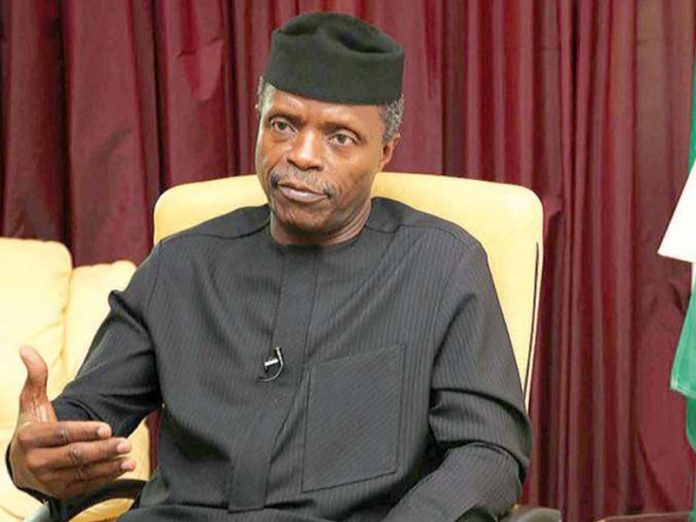
Vice President Yemi Osinbajo speaking at the townhall meeting [NAN]

Osinbajo said the government was capable of addressing the security challenges, assuring Nigerians that the news “will be a lot better very soon”.

Turning to banditry and farmers/herders clashes in the north west and central, the vice president described them as “resource conflicts”.

According to him, banditry especially in Zamfara and Katsina was more of a fight over the control of mining sites by armed groups.

He said the government was taking several measures, including shutting down the mines, to address the problem.

“In the north central, we have the livestock transformation plan to address the farmers/herders conflict.

“Ultimately, it is ranching that will solve the problem because you cannot have people wandering across the the country with their cattle.

“It is not helpful to them, this they know, because ranching is more convenient and profitable.

“So, we are building herd dams in the northern states so that people don’t necessarily come down south in search for water and green pastures for their herds.

“We are also trying to ensure we provide grazing areas before we come to cattle routes,” he added.

Osinbajo said in fairness to herders, the livestock sector had not enjoyed the kind of government’s funding and support accorded farmers over the years.

He stated that there was also need for government’s intervention in livestock, and solicited private sector support and investment in that area.

Continue Reading
Click to comment

Leave a Reply

Your email address will not be published. Required fields are marked *

Economy

Tinubu Seeks World Bank Support to Boost Agriculture, Economic Reforms

Published

on

By

President Bola Tinubu has called on the World Bank to support Nigeria’s ongoing economic reforms, with a focus on agriculture, youth employment, and private sector growth, as part of his administration’s strategy to strengthen the economy and expand opportunities for the citizens.

The president made the remarks on Tuesday while receiving a delegation from the World Bank led by Anna Bjerde, Managing Director of Operations, at the State House, Abuja.

“Since we went into this tunnel of reform, we have our hands on the power and we’re never going to look back. Initially, it was painful and difficult, but those who win are not the ones who give up in difficult times,” Tinubu said.

The president highlighted the importance of mechanization and modernization of agriculture to increase productivity and create opportunities for Nigeria’s large young population.

“We have mechanization centers to help farmers with improved seedlings and fertilizers to enhance their programs. The goal is to move farmers from small-scale holders to large cooperatives that can create opportunities for Nigerians,” he explained.

Tinubu also pointed to the petrochemical sector and other domestic industries as areas where the government is working to improve outputs and strengthen local markets. He stressed that reforms are continuous and must be grounded in transparency, accountability, and stability.

“The first reaction to reforms was high inflation, but it has come down dramatically, and the Naira is now stable. We want to help investors operate with ease, reduce bureaucracy, and develop the skills of our people,” he said.

Anna Bjerde commended Tinubu’s administration for its consistent and steady approach to reforms over the past two years. She highlighted that Nigeria has become a global example of reform implementation, giving confidence to investors and policymakers worldwide. “The results achieved in the last two years are commendable. Your steady communication of the importance of reforms has given confidence and clarity, and there is no turning back,” Bjerde said.

She emphasized the importance of job creation, particularly for Nigeria’s youth, noting that Africa’s young population is growing rapidly and that SMEs are central to employment generation.

“Agriculture is a huge part of the economy and a major employer. Innovations in mechanization, cooperatives, value-chain development, and infrastructure can be scaled to create more opportunities,” Bjerde said.

She also highlighted the World Bank’s financial support for Nigeria, including public sector financing of $17 billion, private sector support of $5 billion through the IFC, and investment guarantees exceeding $500 million. These instruments are aligned with Nigeria’s reforms, including trade, digital initiatives, and inflation management, to stimulate private sector growth and human development.

“We want to work with Nigeria to accelerate growth, improve access to finance for SMEs, and support early childhood development as part of a comprehensive human development strategy,” she added.

The meeting underscored Nigeria’s push to attract foreign support for strategic reforms, particularly in sectors that directly affect youth employment, food security, and overall economic growth.

Continue Reading

Economy

New Tax Laws: Presidential Committee Tackles KPMG over Criticisms of ‘Gaps’, ‘Errors’ and ‘Omissions’
Published

on

By

The Chairman of the Presidential Committee on Fiscal Policy and Tax Reforms, Taiwo Oyedele, has pushed back strongly against observations by KPMG on Nigeria’s new tax laws, saying the firm largely misunderstood the policy intent and misrepresented deliberate reform choices.

In a detailed statement shared on Saturday on X, Oyedele said the committee welcomed constructive feedback but argued that most of KPMG’s claims were flawed. “We welcome all perspectives that contribute to a shared understanding and successful implementation of the new tax laws,” he said. However, he added that “the majority of the publication reflected a misunderstanding of the policy intent, a mischaracterisation of deliberate policy choices, and, in several instances, repetitions and presentation of opinion and preferences as facts.”

According to Oyedele, several issues described by KPMG as errors or gaps were either based on “the firm’s own errors and invalid conclusions” or stemmed from “issues not properly understood by the firm.” He stressed that policy disagreements should not be framed as technical mistakes.

Addressing concerns about the taxation of shares and potential stock market sell offs, Oyedele said such fears were unfounded. “The fact is that the applicable tax rate on share gains is not a flat 30%,” he said, noting that “a significant majority of investors (99%) are entitled to unconditional exemption.” He added that market performance at an all time high showed investors understood the reforms.

On the commencement date of the new laws, Oyedele dismissed KPMG’s suggestion of aligning reforms strictly with accounting periods, describing it as “a narrow view of the complex transition issues” involved in wholesale tax reform.

He also defended provisions on indirect transfer of shares, saying they were aligned with global best practices. “The assertion that it may affect the country’s economic stability is disingenuous,” he said, explaining that the measure was designed to block long exploited tax loopholes.

Responding to claims of gaps in VAT exemptions, Oyedele said a specific exemption for insurance premiums was unnecessary. “If it is not broken, don’t fix it,” he stated, arguing that insurance premiums were not taxable supplies under existing law.

Oyedele further criticised proposals he said would undermine reform objectives, including calls to exempt foreign insurance companies from tax and allow deductions tied to parallel market foreign exchange. He said disallowing such deductions was “a critical fiscal policy choice designed to complement monetary policy, strengthen, and stabilise the Naira.”

On personal income tax, Oyedele rejected claims that higher rates would harm growth. He said the top marginal rate was competitive globally and ensured fairness without discouraging investment.

He also accused KPMG of factual errors, including references to the Police Trust Fund, noting that its taxing provisions expired in June 2025. “KPMG’s point that the new tax law should be amended to repeal the taxing section of the Police Trust Fund Act is needless,” he said.

While acknowledging clerical issues may arise in any major reform, Oyedele said these were already being addressed internally. He urged stakeholders to engage constructively. “We urge all stakeholders to pivot from a static critique to a dynamic engagement model,” he said, stressing that the reforms marked “a bold step toward a self sustaining and competitive Nigeria.”

Continue Reading

Economy

NANS Makes U-turn, Cancels Planned Nationwide Protest over Implementation of New Tax Laws

Published

on

By

The National Association of Nigerian Students (NANS) has expressed support for the recently enacted Tax Reform Laws, describing it as a well-intentioned fiscal policy aimed at strengthening Nigeria’s economy and protecting low-income earners.

Reports said the endorsement followed extensive deliberations at the maiden Expanded National Executive Council (ENEC) meeting of NANS under the theme; “National Executive Council and Structural Stakeholders’ Forum 2026 on the Tax Reform Act”, which brought together student leaders, policy experts, and key stakeholders from across the country.

The meeting, held amid public debate and controversy over the new tax law, was attended by members of the NANS National Executive Council, leaders of NAUS, NAPS, and NANCES, zonal coordinators, joint campus council chairpersons, female student associations, and other stakeholders.

Earlier concerns had prompted NANS to issue a 14-day ultimatum, threatening nationwide protests if implementation of the law was not suspended pending further investigations and public enlightenment.

However, following engagements with the National Assembly, the Department of State Services (DSS), and the Federal Inland Revenue Service (FIRS), as well as the publication of the National Assembly’s investigation report, student leaders reported being better briefed on the objectives and safeguards embedded in the law.

Chairman of the Communiqué Drafting Committee and NANS President, Comr. Olushola Oladoja, said students were satisfied with the explanations provided by the government. Tax experts from FIRS used the forum to clarify grey areas and respond to concerns raised by Nigerians, giving student leaders a clearer understanding of the reform’s intent and framework.

At the end of the meeting, ENEC resolved that the Tax Reform Law is designed to improve revenue generation, ensure fairness in taxation, and strengthen social protection for vulnerable citizens, while requiring higher-income earners to contribute more equitably. The council affirmed the authenticity of the law as released by the National Assembly and announced the cancellation of the nationwide protest that had been scheduled for January 14, 2025.

NANS also pledged to serve as ambassadors of public enlightenment, committing to educate Nigerians on the purpose and benefits of the reform to boost public confidence during its implementation.

The meeting further passed a vote of confidence in the former FIRS Chairman, Zacch Adedeji and commended President Bola Tinubu for his fiscal reforms and the NELFUND initiative, reaffirming support for his administration’s economic transformation agenda.

Continue Reading

Trending