Connect with us

Headline

Guatemala Follows Suit, Opens Embassy in Jerusalem After US

Published

on

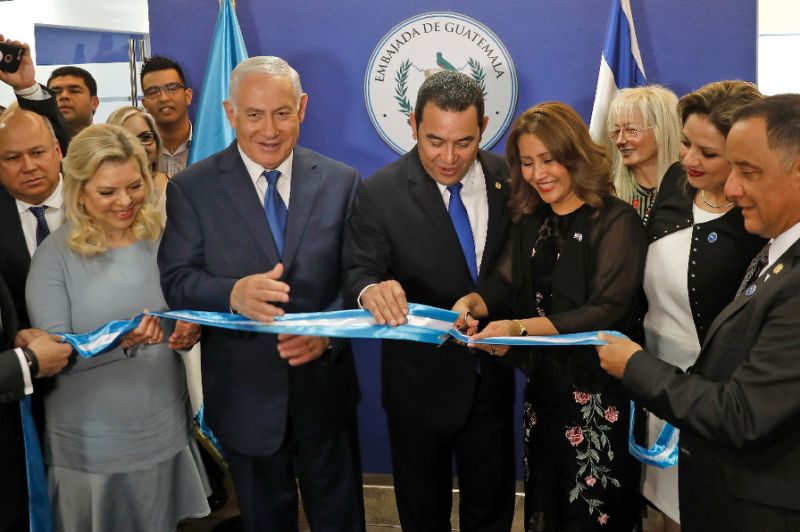
Guatemala inaugurated its Israel embassy in Jerusalem on Wednesday, becoming the first country to follow in the footsteps of the United States’ deeply controversial move that was accompanied by deadly violence on the Gaza border.

Israeli Prime Minister Benjamin Netanyahu and Guatemalan President Jimmy Morales were among officials who attended a ceremony inaugurating the new embassy at an office park in the disputed city, which is at the heart of the Israeli-Palestinian conflict.

The US and Guatemalan moves break with decades of international consensus. US ambassador to Israel David Friedman also attended Wednesday’s ceremony.

So far the only other nation with immediate plans to open an Israel embassy in Jerusalem is Paraguay, expected to do so before the end of the month.

Netanyahu profusely praised Guatemala for making the move and noted it came only two days after the United States opened its embassy in Jerusalem.

The Israeli premier spoke of Guatemala’s early recognition of the state of Israel after its creation in 1948 and said he would visit the country of 16 million on his next visit to Latin America.

“I look forward to assessing with you the practical ways… that we can advance this friendship and this alliance,” Netanyahu said.

“But today, I just want to say how delighted we are to have you.”

Morales called it a “transcendental moment for future generations” who will “remember that friendly countries took courageous decisions in favour of Israel and we do this because you have a special place in our hearts.”

– ‘To the fringes’ –

The US embassy move on Monday was accompanied by mass protests and clashes along the Gaza border that saw Israeli forces kill some 60 Palestinians.

Israel has faced international criticism over its use of live fire against demonstrators.

It says its actions are necessary to defend the border and stop mass infiltrations from the Palestinian enclave, which is run by Islamist movement Hamas.

On Monday, tens of thousands had gathered near the border while smaller numbers of stone-throwing Palestinians approached the fence and sought to break through, with Israeli snipers positioned on the other side.

Most of those killed were shot by Israeli snipers, the Gazan health ministry said, in the bloodiest day in the Israeli-Palestinian conflict since a 2014 Gaza war.

Israel’s army said “it appears that at least 24” of those killed were militants, mainly from Hamas and Islamic Jihad.

It said explosive devices and firebombs were used, while Israeli soldiers were also shot at.

But there were numerous calls for an independent investigation into the deaths, with Britain, Germany, Switzerland and Belgium among those supporting such action.

UN Secretary-General Antonio Guterres and the European Union have previously called for an independent probe, with 116 Palestinians killed by Israeli forces since a campaign of protests on the Gaza-Israel border was launched on March 30.

Morales’s decision to move Guatemala’s embassy has been seen as partly influenced by his evangelical religious beliefs.

Evangelicals want to see Jews rebuild their temple in Jerusalem, which according to their beliefs would facilitate the second coming of Christ.

The move is also seen by some as a gesture to elicit US support at a time when Morales stands accused by Guatemalan prosecutors of accepting illegal campaign contributions.

Former Guatemalan foreign minister Gabriel Orellana has said Morales’s embassy move has the effect of banishing his country “to the fringes of the United Nations”.

Jerusalem’s status is perhaps the thorniest issue in the Israeli-Palestinian conflict.

Israel considers the entire city its capital, while the Palestinians see east Jerusalem as the capital of their future state.

Israel occupied the West Bank and east Jerusalem in 1967 and later annexed east Jerusalem in a move never recognised by the international community.

(AFP)

Continue Reading
Click to comment

Leave a Reply

Your email address will not be published. Required fields are marked *

Headline

Insecurity: Akpabio Begs Tinubu to Reinstate Police Orderlies for NASS Members

Published

on

By

Senate President, Godswill Akpabio, has appealed to President Bola Tinubu to reconsider the directive withdrawing police orderlies from members of the National Assembly, citing safety concerns.

Akpabio made the appeal during the presentation of the 2026 budget to a joint session of the National Assembly, by President Tinubu, warning that some lawmakers fear they might be unable to return home safely following the withdrawal.

His said: “As we direct the security agencies to withdraw policemen from critical areas, some of the National Assembly said I should let you know they may not be able to go home today.

“On that note, we plead with Mr. President for a review of the decision.”

President Tinubu, on November 23, ordered the withdrawal of police officers attached to Very Important Persons (VIPs), directing that they be redeployed to core policing duties across the country.

According to Bayo Onanuga, Special Adviser to the President on Information and Strategy, Tinubu issued the directive after a security meeting with Service Chiefs and the Director-General of the Department of State Services (DSS) following heightened security issues in the country.

Under the order, VIPs requiring security are to seek protection from the Nigeria Security and Civil Defence Corps, as the Federal government seeks to boost police presence in communities, particularly in remote areas grappling with insecurity.

Tinubu later reaffirmed the directive on December 10, moments before presiding over the Federal Executive Council, expressing frustration over delays in implementation.

He instructed the Minister of Interior, Olubunmi Tunji-Ojo, to work with the Inspector-General of Police (IGP), Kayode Egbetokun, and the Civil Defence Corps to immediately replace withdrawn escorts to avoid exposing individuals to danger.

“I honestly believe in what I said…It should be effected. If you have any problem because of the nature of your assignment, contact the IGP and get my clearance,” Tinubu said.

“The minister of interior should liaise IG and the Civil Defence structure to replace those police officers who are on special security duties.

“So that you don’t leave people exposed,” he said.

Continue Reading

Headline

Defence Gulps Lion Share As Tinubu Presents N58.47trn 2026 Budget to NASS

Published

on

By

President Bola Tinubu has presented a budget of N58.47 trillion for the 2026 fiscal year to a joint session of the National Assembly, with capital recurrent (non‑debt) expenditure standing at N15.25 trillion.

Tinubu presented the budget on Friday, pegging the capital expenditure at N26.08 trillion and putting the crude oil benchmark at US$64.85 per barrel.

He said the expected total revenue is N34.33 trillion, projected total expenditure: N58.18 trillion, including N15.52 trillion for debt servicing. The budget is N23.85 trillion, representing 4.28% of GDP.

The budget was anchored on a crude oil production of 1.84 million barrels per day, and an exchange rate of N1,400 to the US Dollar for the 2026 fiscal year.

In terms of sectoral allocation, defence and security took the lion’s share with N 5.41 trillion, followed by infrastructure at N3.56 trillion.

Continue Reading

Headline

Mike Adenuga, Emmanuel Macron Hold High-Powered Meeting in Paris

Published

on

By

Accomplished billionaire businessman and Commander of the French Légion d’Honneur, Dr. Mike Adenuga Jr., GCON, CdrLH, has held a private meeting with the French President, Emmanuel Macron.

The two powerful citizens of the world held the meeting on Wednesday at the historic Élysée Palace in Paris.

The high-level engagement underscores the longstanding relationship between Dr. Adenuga and the French Republic, as well as his continued relevance in global business and diplomatic circles. 

A respected industrialist and philanthropist, Adenuga has been widely acknowledged for his contributions to economic development, telecommunications, energy, and humanitarian causes across Africa and beyond.

The meeting adds to Dr. Adenuga’s growing profile as a bridge between African enterprise and international leadership.

Continue Reading

Trending