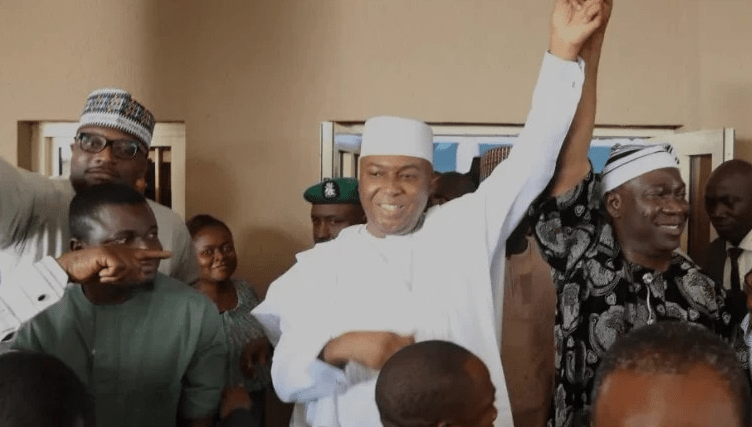
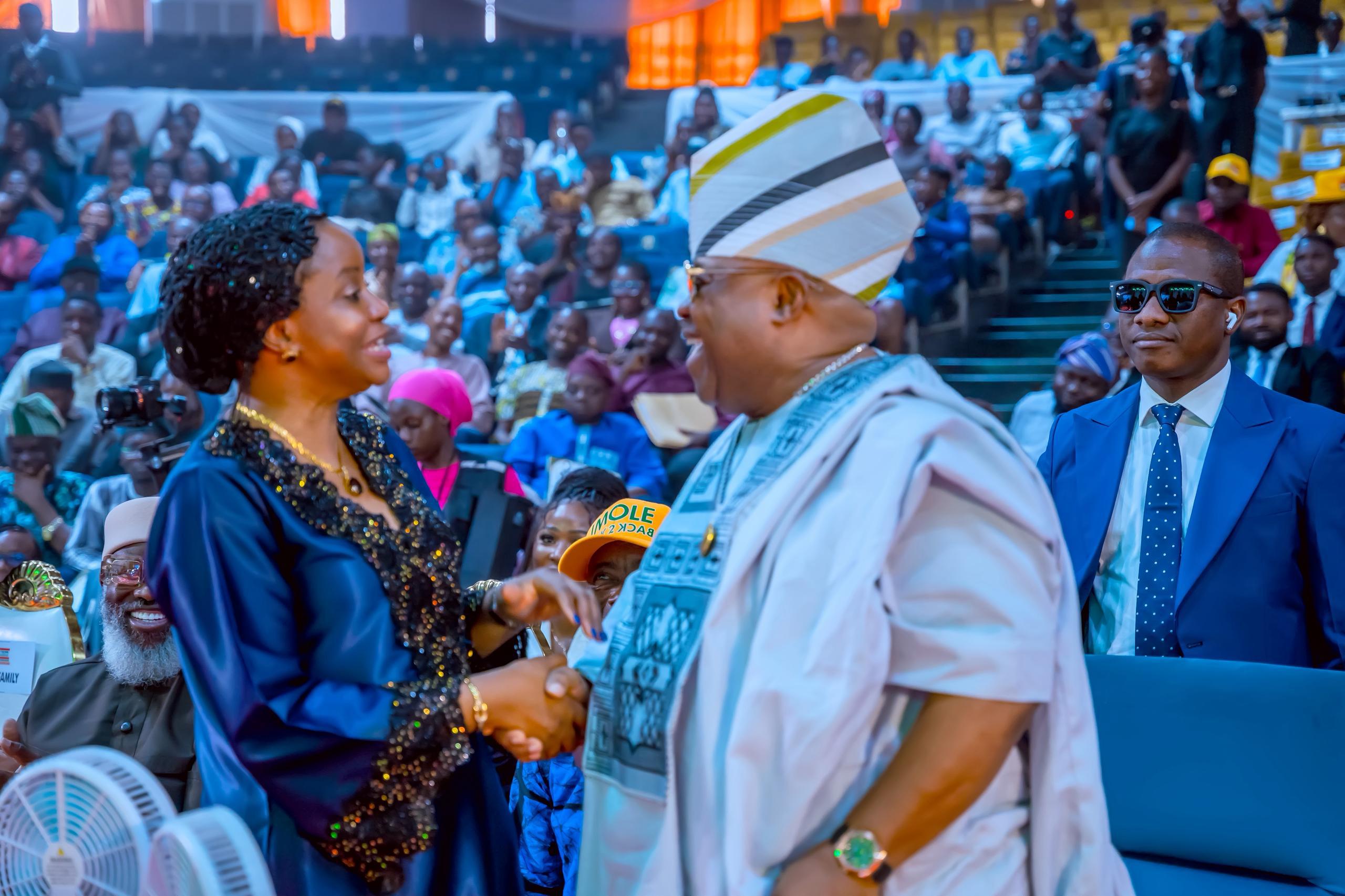
The Boss can exclusively reveal that Senate President, Dr. Abubakar Bukola Saraki may take the bold step and join the 2019 Presidential race.
If and when he does, tBhere is no doubt that he would be a formidable force that should not be ignored because only few politicians in Nigeria today have the pedigree, the experience, the clout and the connection of Senator Saraki.
Having risen to the enviable position of the number three citizen, the only place to go for the two-term Senator and former two-term governor is up! Indeed, Saraki is not new to the dynamics of power politics, he is the scion of a political dynasty that is well-known across the nation.
His father, the late Oloye, Dr. Olusola Saraki was a revered politician. He not only rose to become the Senate Leader of Nigeria under the National Party of Nigeria (NPN), but was the Chief Strategist and King Maker of Kwara Politics.
Born on December 19, 1962, Saraki went to Ivy League schools in Nigeria and United Kingdom. His parents certainly prepared him well for the tough task ahead. He attended Corona School, Victoria Island, Lagos, where he obtained a First School Leaving Certificate, attended King’s College, Lagos where he got his West African School Certificate, went to Cheltenham College in the United Kingdom for his High School Certificate. And then studied at the London Hospital Medical College of the University of London from 1982 to 1987, where he obtained his M.B.B.S (London).
He has all the criteria that a modern Nigerian president should have, he is tall, urbane, suave, charismatic, cool and collected. But behind this charm, is a man of steel who is never afraid to pursue causes that he feels are right and just.
Saraki is one of those rare breeds who is street smart as well as book smart. This was evident when he steered his political path away from his father, and triumphed without breaking up the family or the people’s faith in his leadership abilities.
That 2011 incident was a defining moment in the Senate President’s political career. Just when he was rounding off his second term as governor, his father openly endorsed his sister, Senator Gbemisola Saraki as the next Governor.
Maybe they had a discussion privately, but the matter came to a head publicly, when he refused to support his sister, forcing his father to leave the Peoples Democratic Party (PDP), a party he helped to form and nurture, into political wilderness.
The Senior Saraki banked on his past record to trounce his son in the political arena but during the gubernatorial election it was the Junior Saraki that triumphed. The candidate he backed, current Governor Abdulfatah Ahmed, eventually coasted to victory.
That singular moment told many stories. That Senator Saraki is a man of principles, that he is a fearless fighter and a grassroots political force whose opponents under estimate at their own peril.
Before politics, he was in the corporate world, working in the family-owned Societe-Generale Bank (SGBN) . Though his enemies will say he ran the bank aground and some even say, he emptied the bank vault to run for Governor, it was to his credit that after its demise, he insisted that the bank was solid and was closed down in error.
Facts showed that he left SGBN in 2000 and in 2001, he became a Special Assistant on Budget to former President Olusegun Obasanjo. He also served on the Economic Policy Coordination Committee, and was responsible for the formulation and implementation of several key economic policies for Nigeria.
He became Governor three years after leaving SGBN and his earlier believe that the closure of the bank was improper was proved right when the Central Bank of Nigeria eventually restored its licence.
As Governor, he had a clear vision to reduce extreme poverty, improve education, empower women and girls and unleash Kwara’s economic potential through investment in Agriculture and infrastructure.
Under his leadership, Kwara became the first state to complete the Nigeria Independent Power Project, as well as re-energised the Ganmo Power Station, Ilorin in collaboration with PHCN, connecting over 3750 rural communities to the national grid through the development and installation of 725 transformers and 7 substations.
Kwara also completed four electrification projects which meant power became stable 18–22 hours a day. 70% of people living in Kwara had access to electricity, compared to a national average in Nigeria of 30% at the time.
Dr Saraki introduced a scheme that utilized the agricultural expertise of the Zimbabwean farming industry, and worked with Zimbabwe’s Commercial Farmers’ Union.
This collaboration led to the establishment of the Shonga Farms programme in partnership with Zimbabwean white farmers. The instant success of the arrangement made the farming concept a model that is now being replicated by other states across the nation.
He designed a New Nigerian Farmers Initiative that improved the technical capability of farmers and ensured that farmers had a significant financial stake in new investment in agriculture.
He also created a commercial hub that was developed to build the capacity of the indigenous farming community of Kwara State.
During his tenure, he introduced new health programmes that included a statewide campaign in 2008 to reduce maternal and child mortality.
A statewide distribution of insecticide-treated nets and free malaria drugs were equally extended to pregnant mothers and children under the age of five in Kwara. Another statewide programme of hospital development was also implemented by Saraki which led to the redevelopment of hospitals in
Afon, Patigi and Lafiagi.
He also implemented improved training and re-training for medical staff; refurbishment of hospitals and staff living quarters. This effort was followed up with the employment of qualified medical doctors and other health workers in the state. Performance of Saraki encouraged WHO and UNICEF to sponsor many of the primary health care programmes in Kwara state. His government pursued and signed into law, the Kwara Community Health Insurance, Kwara Safe Maternity Service and Kwara Child Rights Acts.
Saraki founded Kwara Class of Honour, a programme aimed at awarding Post-Graduate scholarship to First Class students of the state to continue their study at any institution of their choice across the federation, over 71 First class were awarded during the first phase of the scholarship programme.
He began the Voluntary Teaching Service in which thousands of Kwara graduates were engaged and given allowances monthly after which ninety percent of them were absorbed into the state Civil Service, Teaching Service and SUBEB.
In addition, his administration started the Every Child Counts programme and other policies which were adopted by the Federal Ministry of Education.
Perhaps one of his greatest achievements as Governor was the establishment and funding of the Kwara State University which has since stood the test of time.
He superintended over improvements at the Ilorin International Airport Cargo Terminal, extensive road construction, and development of new sporting facilities such as Kwara Football Academy. He spent money on state-owned Kwara United Football Club and also went a step further to launch his own club, Abubakar Bukola Saraki FC, which is still in the Nigeria Professional Football League.
Dr. Saraki has no qualms about working with and giving youths opportunity to prove their mettle. He has that uncanny ability to spot and deploy good talents. For example, it was during his tenure that youths in their 30s and early 40s such as Mallam Bolaji Abdullahi, Governor Abdulfatah Ahmed, Zakari Mohammaed and Razak Atunwa flourished and showed their potentials.
As a result of his sterling achievements, it did not take his colleagues long to see that this was a charming gentleman with excellent leadership qualities, he was soon elected as Chairman of Nigerian Governors Forum. He was as influential as he was controversial.
The Forum under Bukola Saraki developed a better and more extensive polio immunisation in Nigeria. A key part of this was the introduction in 2011 of the Immunisation Leadership Challenge. The Challenge rewarded states that made significant improvement in polio and routine immunisation coverage by the end of 2012. This challenge was driven in partnership with the Bill and Melinda Gates The NGF under his chairmanship signed many Memorandum of Understanding (MOUs) which included but not limited to the World Bank , DFID, Bill & Melinda Gates Foundation, GAVI, UNICEF, UNDP. He increased the profile of the Forum and this did not go down with other political groupings.
It was not only the Governors that saw his abilities, in 2010, the nation applauded his good work when he became the first serving Governor to be bestowed with the National Honor of Commander of the Order of the Niger (CON).
Earlier he had won the following awards: Thisday Newspapers, Best Governor of the Year, 2004, Harvard Business School, Africa Club Award, 2005 and Nigeria Bar Association Award of Excellence, 2010.
It was after he completed his two terms that he decided to join the Nigerian Senate. He was first elected to the Senate in April 2011, representing Kwara Central Senatorial district.
In his first term at the Senate, he was appointed Chairman, Senate Committee on Environment and Ecology and a member of the Senate Committee on Capital Markets and Finance.
It was during this assignment that Saraki showed his patriotic, altruistic and audacious streak.
He was the senator that pushed a motion in the upper legislative chamber to end the fuel subsidy regime in Nigeria. The fuel subsidy regime had constituted an excessive drain on Nigeria’s national resources.
In what subsequently became known as the fuel subsidy scam, Saraki’s alarm which led to a thorough investigation by a panel headed by Access Bank Chairman, Aigboje Aig-Imoukhuede showed that he saved the nation billions of dollars that were going into private pockets.
Senator Saraki sponsored the National Oil Spill and Detection and Response Agency Amendment Bill to ensure that oil companies pay appropriate levels of compensation to communities affected by oil spills. He also intervened in the lead poisoning crisis in Zamfara Stateand supported the Global Alliance for Clean Cookstoves, which ensures safe and healthy methods of cooking for millions of Nigerians while conserving the environment through reduced deforestation.
On his return in 2015, Dr. Saraki put himself forward for the position of Senate President. Of course he had all the profile for the position but for some inexpliacble reasons, some apparatchiks of his party, the All Progressives Congress (APC) pitched their tent with another candidate, Senator, Ahmed Lawan.
When famous Russian Chess Champion and Grandmaster, Garry Kasparov said “If you’re already in a fight, you want the first blow to be the last and you had better be the one to throw it. ….Attackers may sometimes regret bad moves, but it is much worse to forever regret an opportunity you allowed to pass you by”. He was referring to the circumstances that faced Saraki at that period.
And that was when Saraki’s prowess as an astute politician, a consensus builder and like his father, a political strategist became public knowledge.
Against all odds, he beat his party’s candidate hands down-andin the past three years has won over even his most ardent of critics with his superb handling of his role.
Impeccable sources reveal that as he plots his move for the Presidency, he is said to be considering building alliances with all Nigerians of like minds.
He is also considering using the Deputy Senate President, Senator Ike Ekweremadu as his running mate. Having already exhibited the ability to work seamlessly with politicians from the two main political parties, it is a path he can easily thread.
In political circles, the story is that Dr. Saraki has been the one that has stopped the president from becoming a full blown dictator. That he has been able to stand firm, stare the president in the face, eyeball to eyeball on some key issues like the appointment of the EFCC Chairman, Ibrahim Magu. He has held firmly to the doctrine of Separation of Powers unlike the past Senate Leadership.
That is not all, his adept peoples’ skills has also helped him foster a smooth relationship with the Speaker of the House of Representatives, Rt. Hon, Yakubu Dogara.
Futhermore, those who know, say he is counting on his youthfulness and ability to connect with the youths and his strategy will be to spread the “I am one of you” message and show his track record of working with young technocrats and turning them into prolific achievers.
As at today, the 8th Senate which he heads has passed 201 bills and it prides itself as the best performing senate ever.
According to Saraki in a Tweet during the week“ we still have 15 months to go, yet, we have reached this milestone. I would like to thank my Distinguished Colleagues for their hardwork and cooperation over the last 33 months”
He had earlier stated “On the issue of opening the lawmaking process we have not been afraid to push the boundaries of convention, that is why the 8 Senate can be credited to initiated the first-ever National Assembly Joint Public Hearing on the Budget; the 8th Senate broke the 12year jinx on the PIB by passing the Petroleum Industry Governance Bill (PIGB) that will reform the NNPC and return accountability in the petroleum industry.
“The 8th Senate scored another first as it become the first Senate to unveil and pursue a self-developed economic reform agenda to aid the ease of doing business in Nigeria and create new frameworks for creating jobs and improving Nigeria’ ranking in the global competitiveness index.
“It can be said that the 8th senate has led the way in open government and transparency, aside opening our books to the public, we have also opened what we do to the world and we are the first to adopt live streaming of plenary and deliberations globally.
“Indeed we have become the most open arm of government in the history of Nigeria till date”
Apart from his unmatchable performance as head of the Legislative Arm of Government, he also has tremendous goodwill among many respected Nigerians, especially young businessmen as well as solid international connections.
A tip of his wide network came to fore at the wedding of his daughter, Oluwatosin late last year. The events were held in Ilorin, Lagos and Abuja. And the calibre of guests that turned out for the ceremonies showed that he was no run-of-the-mill personality. Even Asiwaju Bola Ahmed Tinubu who many say is one of his greatest detractors was at the Lagos ceremony!
Another good thing going for Dr Saraki is his wife, Oluwatoyin. She is an excellent partner, a strong pillar of support for a man of his stature. She is a first-rate upper crust.
Mrs Saraki is from the popular Ojora Royal Family of Lagos, and is the only daughter of The Otunba Adekunle Ojora and The Erelu Ojuolape. Her dad is a Corporate titan with interests in blue chip companies in Nigeria and across the globe. Her family has interests in companies from oil and gas, real estate, insurance, banking, ICT to Manufacturing.
She is well bred, highly educated, articulate and despite her privileged background, a passionate Maternal and Child Health Advocate.
Mrs Saraki is a better half in every sense of the word. She attended the School of Oriental and African Studies (SOAS), University of London, obtaining the Bachelor of Laws (LL.B) degree, she proceeded to King’s College, London for a Master’s degree (LL.M) in International Economic Law. She is a Barrister and Solicitor of the Supreme Court of Nigeria, having been called to the Nigerian Bar, about three decades ago.
In 2004, while still First Lady of Kwara State, She established the Wellbeing Foundation, unlike such pet projects by first ladies, many years she has been more passionate as ever before taking the foundation to very great heights.
It was as a result of her work that she became the inaugural Global Goodwill Ambassador for the International Confederation of Midwives (ICM). She is also the Save the Children Newborn Health Champion for Nigeria; a Fellow of the West African Academy of Public Health (WAAPH); the Chair of the National Assembly Primary Healthcare (PHC) Revitalisation Support Group; a Global Champion for the White Ribbon Alliance for Safe Motherhood and early this month was appointed special adviser to the Independent Advisory Group (IAG) of the World Health Organization’s (WHO) Regional Office for Africa (AFRO).
Of course, like everything in life, Saraki would have to navigate through thorny paths to reach the Presidential Villa, he surely has many challenges ahead.
The most important challenge, according to our source, is the perception that he is corrupt This has been a damaging blow to his profile, little wonder that Saraki has not taken this allegation lying down.
Angered by many false and spurious stories written by bloggers and news sites especially Sahara Reporters, he dragged the news organization to court to clear his name.
In June 2017, An Ilorin High Court judge, Justice Adeyinka Oyinloye of the Ilorin High Court, slammed a N4 billion judgment against the publisher of popular online newspaper, Sahara Reporters, Mr. Omoyele Sowore, over libellous stories published on Saraki.
But the corruption allegation keeps mounting, in 2015, he made history as the first Senate President to be issued a arrest of warrant and was eventually docked when he appeared at the Code of Conduct Tribunal.
Saraki was accused of offences ranging from anticipatory declaration of assets to making false declaration of assets in forms Saraki had filed with the Code of Conduct Bureau while he was Governor of Kwara state. He was also accused of failing to declare some assets he acquired while in office as governor, acquiring assets beyond his legitimate earnings, and accused of operating foreign accounts while being a public officer.
His counsel has put forward a no case submission and the case was squashed in June 2017 but the Federal Government challenged that judgment and the legal fireworks has now reached the Supreme court and is still raging.
As if that is not bad enough, his name also popped in the Panama Papers and Paradise Papers scandals that involved hiding of assets or evading taxes through offshore shell companies.
The Senate President however reacted to the allegations stating that he has not violated any law in the course of registering his company, Tenia Limited, adding that he has no property to hide.
Speaking though his Special Adviser on Media and Publicity, Yusuph Olaniyonu, Saraki said the company was incorporated in 2001, before he ventured into politics.
The Senate President noted that the company had remained dormant, held no assets and he was not a signatory to the company’s account.
Another major challenge is his state of origin, he is from Kwara State which is in Nigeria’s North Central. Though it can be said to be a part of the North, many see him as Yoruba because the capital of his state, Ilorin is predominantly Yoruba speaking.Besides, he also has a Yoruba name. Therefore, it is doubtful if the core North will accept him.
This seeming weakness can actually be a strength if we consider the political permutations that led to the defeat of President Goodluck Jonathan in 2015. A Saraki as Presidential Candidate has the ability to sweep his region, the North Central. He can take the South West based on his name, the South South will lean towards him easily and if he takes Deputy Senate President, Ike Ekweremadu as Running m
Mate like it is being alleged, he would coast in the South East. With his ability to build alliances, he may even make inroads in some North East States.
His choice of platform may pose a another problem as his party, the All Progressives Congress (APC) like it did when he vied for the Senate Presidency, may have a different preferred candidate. Saraki as the savvy politician that his, is likely to choose another platform to achieve his aim and from all indications, it may be the opposition Peoples Democratic Party (PDP).
The PDP may present a veritable platform for him because it already has a firm nationwide structure and the toughest person gunning for the same ticket is former Vice President, Atiku Abubakar who many pundits say is not only too old and weak but has a lot of baggage.
No doubt a candidate Saraki will bring youthful energy to the Presidential race and most importantly, it may just be the tonic Nigeria needs as a nation to get out of its labyrinth of under development.
For Saraki, his network and his name will take him far; whether it can take him the distance is far from clear. For now, however, he is the one of the top politicians to watch ahead 2019.
SENATE BILLS PASSED SINCE JUNE 9TH 2015 BY THE 8TH SENATE WITH SARAKI AS PRESIDENT
1. National Railway Corporation Act 1955 N129 LFN 2004 (Repeal & Re-enactment Bill 2015
2. Bankruptcy and Insolvency Act CAP B2 LFN 2011 (Repeal and Re-enactment) 2015
3. National Institute for Cancer Research and Treatment (est,etc) Bill 2015
4. Forestry Research Institute of Nigeria (est., etc) Bill 2015
5. Electronic Transaction Bill 2015
6. Agriculture Credit Guarantee Scheme Act (Amendment) Bill 2015
7. Commercial Agriculture Credit Scheme (Est,etc) Bill, 2015
8. Discrimination Against Persons with Disabilities (Prohibition) Bill 2015
9. National Poverty Eradication Commission (Est,etc)Bill 2015
10. North East Development Commission (NEDC) (Est,etc) Bill 2015
11. Erosion Control and Prevention Commission (Est, etc) Bill, 2015
12. Counterfeit and Fake Drugs and Unwholesome Processed Foods (Miscellaneous provision) Amendment Bill 2015
13. Federal University of Petroleum Resources Effuru (Est, etc) Bill 2015
14. Food Security Bill 2015
15. Nigerian Agricultural Quarantine Service (Establishment, etc) Bill 2015
16. Environmental Managers Registration Council of Nigeria (Establishment, etc) Bill 2015
17. Nigeria Institute of Soil Science (Establishment, etc) Bill 2015
18. Nigeria Football Federation (Establishment, etc) Bill 2015
19. National Sports Commission (Establishment, etc) Bill 2015
20. Federal Competition and Consumer Protection Bill 2015
21. Witness Protection Programme Bill 2015
22. Supplementary Appropriation Bill 2015
23. Defence Space Agency (Establishment, etc) Bill 2015
24. High Court of the Federal Capital Territory Abuja (Amendment) Bill 2015
25. Air Force Institute of Technology (Establishment, etc) Bill 2015
26. Credit Bureau Reporting Bill 2015
27. 2015 Appropriation Act (Amendment) Bill 2015
28. 2016 Appropriation Bill
29. Federal Roads Authority (Establishment, etc) Bill 2016
30. National Assembly Budget and Research Office (Establishment, etc) Bill 2016
31. Mutual Assistance in Criminal Matters Bill 2016
32. Federal Capital Territory Statutory Appropriation Act (Amendment) Bill 2016
33. Federal University of Petroleum Resources Effurun Bill 2016
34. National Lottery Act 2005 (Amendment) Bill 2016
35. Electoral Act №6 2010 (Amendment) Bill 2016
36. Public Procurement Act (Amendment) Bill 2016
37. Petroleum Industry Governance Bill 2016
38. National Inland Waterways Act Cap N47 LFN 2004 (Repeal and Re-enactment) Bill 2016
39. Nigerian Ports and Harbours Authority Act (Amendment) Bill 2016
40. JAMB Act (Amendment) Bill 2016
41. Nigerian Customs Service Bill 2016 and Nigerian Customs Service Act (Repeal and Re-enacment) Bill 2016
42. Warehouse Receipts Bill 2016
43. Secured Transactions in Movable Assets Bill 2016
44. Sexual Harassment in Tertiary Educational Institution Bill 2016
45. Federal University of Wukari (Establishment, etc) Bill 2016
46. Maritime University of Nigeria, Okerenkoko (Establishment, etc) Bill 2016
47. 2016 FCT Appropriation Bill
48. Appropriation Bill, 2017
49. Nigerian Peace Corps (Establishment, etc) Bill 2015 (SB 173)
50. National Unity and Peace Corps (Establishment, etc) Bill 2015 (SB 183)
51. National Open University of Nigeria Act (Amendment) Bill 2017
52. Federal University of Maritime Studies, Oron Bill, 2017
53. National Institute for Legislative Studies Act (Amendment) Bill 2017
54. National Research and Innovation (Est, etc.) Bill, 2017
55. Compulsory, Free Universal Basic Education Act 2004 (Amendment) Bill 2016 and Universal Basic Education Act 2003 (Amendment) Bill 2016
56. Nigeria Financial Intelligence Agency (Est, Etc.) Bill, 2017
57. Institute of Chartered Biochemist and Molecular Biologist Bill, 2016
58. Whistle Blowers Protection Bill 2015
59. Abduction, wrongful restraints and wrongful confinement for ransom bill 2017
60. Prohibition and Protection of persons from lynching, mob action and Extra Judicial Executions Bill, 2017
61. Nigerian Tourism Development Corporation Act (Repeal and Re-enactment) Bill 2017
62. Hydroelectric Power Producing Area Development Commission (Amendment) Bill 2015
63. Chartered Institute of Entrepreneurs (est., etc.) Bill 2015
64. Chartered Institute of Capital Market Registrars Bill 2017
65. Presidential Inauguration Bill 2016
66. National Institute for Hospitality and Tourism (Establishment, etc) Bill 2016
67. FCT Statutory Appropriation Bill 2017
68. Niger Delta Development Commission (NDDC) Act (Amendment) Bill, 2017
69. Federal University of Agriculture Kaaba (Establishment, etc) Bill 2016
70. Federal Colleges of Education Act (Amendment) Bill 2017
71. Niger Delta Development Commission (Amendment) Bill 2017
72. Nigeria Arabic Language Village, Ngala (Establishment, etc.) Bill, 2017
73. Nigeria French Language Village, Badagry (est., etc.) Bill, 2017
74. Demutualization Bill, 2017
75. The Revised Edition (Laws of the Federation of Nigeria) Bill, 2018
76. 2017 FCT Appropriation Act (Amendment) Bill, 2018
77. Arbitration and Conciliation act cap A18 LFN 2004(Repeal and re-enactment) Bill 2018
78. Emergency Powers (Repeal and re-enactment) Bill, 2018
79. Federal University Gashua (establishment, etc.) Bill, 2018 (SB459)
80. National Transport Commission (Est., etc.) Bill, 2018 (SB. 242)
81. Real Estate (Regulation and Development) Bill, 2018 (SB. 216)
82. River Basin Development Act CAP R9 LFN 2004 (Amendment) Bill, 2018 (SB. 358)
83. National Centre for Disease Control Prevention (Establishment, etc) Bill, 2018 (SB. 256)
CONCURRENCE BILLS PASSED BY THE SENATE SINCE JUNE 9TH 2015
1. Environmental Health Officers (Registration, etc.) Act (Amendment) Bill, 2016
2. Federal University of Petroleum Resources, Effurun Bill, 2016
3. National Judicial Institute Act (Amendment) Bill 2016
4. Prevention of Crimes Act (Amendment) Bill 2016
5. Water Resources Act (Amendment) Bill 2016
6. Endangered Species (Control of International Trade and Traffic) Act (Amendment) Bill 2016
7. Agricultural and Rural Management Training (Amendment) Bill 2016
8. Telecommunications and Postal Offences Act (Amendment) Bill, 2016
9. Treaty to Establish African Economic Community Relating to the Pan-African Parliament (Accession and Jurisdiction) Act (Amendment) Bill 2016
10. Utilities Charges Commission Act (Amendment) Bill 2016
11. Chartered Institute of Stockbrokers Act (Amendment) Bill, 2016
12. Petroleum Product Pricing Regulatory Agency Act (Amendment) Bill, 2016
13. Petroleum Training Institute Act (Amendment) Bill, 2016
14. Quantity Surveyors (Registration, etc.) Act (Amendment) Bill 2016
15. Bees (Import Control and Management) Act (Amendment) Bill 2016
16. Advertising Practitioners (Registrations, etc.) Act (Amendment) Bill 2016
17. World Meteorological Organization (Protection) Act (Amendment) Bill, 2016
18. Currency Conversion (Freezing Orders) (Amendment) Bill 2016
19. Builders (Registration, etc.) Act (Amendment) Bill 2016
20. Town Planners (Registration, etc.) Act (Amendment) Bill 2016
21. University of Abuja Act (Amendment) Bill, 2016
22. Corrupt Practice and other Related Offences Act (Amendment) Bill, 2016
23. Small and Medium Scale Enterprises Development Agency (Amendment) Bill 2016
24. National Agricultural Land Development Authority Act (Amendment) Bill 2016
25. Produce (Enforcement of Export Standards) (Amendment) Bill 2016
26. National Crop Varieties and Livestock Breeds (Registration etc.) Act (Amendment) Bill 2016
27. National Archives Act (Amendment) Bill, 2016
28. Value Added Tax Act (Amendment) Bill, 2016
29. Advance Fee Fraud and Other Fraud Related Offences Act (Amendment) Bill, 2016
30. Chartered Institute of Human Capital Development of Nigeria Bill 2016
31. Dangerous Drugs Act (Amendment) Bill, 2016
32. Chartered Institute of Loan and Risk Management of Nigeria Bill 2016
33. Veterinary Surgeons Act (Amendment) Bill, 2016
34. Federal Capital Territory Civil Service Commission Bill 2016
35. Chartered Institute of Public Management Bill 2016
36. Nigerians in Diaspora Commission (Establishment) Bill 2016
37. Oaths Act (Amendment) Bill, 2016
38. Institute of Local Government and Public Administration Bill 2016
39. Chartered Institute of Project Management of Nigeria (Establishment) Bill 2016
40. Nigerian Council for Social Work (Establishment, etc.) Bill 2016
41. Code of Conduct Bureau and Tribunal Act (Amendment) Bill, 2016
42. Mortgage Institutions Act (Amendment) Bill, 2016
43. National Film and Video Censors Board Act (Amendment) Bill, 2016
44. Official Secrets Act (Amendment) Bill, 2016
45. Federal Capital Territory Districts Courts Act (Amendment) Bill, 2016
46. Pensions Rights of Judges Act (Amendment) Bill, 2016
47. Anti-Torture Bill, 2016
48. Federal Capital Territory Hospitals Management Board (Establishment, etc.) Bill, 2016
49. National Child Protection and Enforcement 2016
50. Police Procurement Fund Bill, 2016
51. Federal Capital Territory Water Board Bill 2016
52. Senior Citizen Centre Bill, 2016
53. Animal Health and Husbandry Technologist (Registration, etc.) Bill 2016
54. Compulsory Treatment and Care of Victims of Gunshots, Bill 2016
55. Corporate Manslaughter Bill 2016
56. Railway Loan (International Bank) (Amendment) Bill, 2016
57. Legislative Houses (Powers and Privileges) Act (Amendment) Bill, 2016
58. Chartered Institute of Export and Commodity Brokers of Nigeria Bill, 2017
59. Avoidance of Double Taxation Between the Federal Republic of Nigerian and the Kingdom of Spain Bill, 2017
60. Avoidance of Double Taxation Between the Federal Republic of Nigerian and the Republic of South Korea Bill, 2017
61. National Postgraduate College of Medicine Laboratory Science Bill, 2017
62. Avoidance of Double Taxation Between the Federal Republic of Nigerian and the Kingdom of Sweden Bill, 2017
63. National intelligence Agency Pension Bill 2017
64. Nigeria Academy of Science (establishment etc.)
65. Chartered Institute of Treasury Management (Est, Etc.) Bill 2017
66. Federal School of Medical Laboratory Technology Science (Est, Etc.) Bill 2017
67. Franchise Bill
68. Federal College of Dental Technology and Therapy Bill, 2017 (HB1,018)
69. Federal Capital Territory Transport Authority (Establishment) Bill HB. 91
70. Nigerian Automotive Industry Development Plan (Fiscal Incentives Assurances and Guarantees) Bill, 2017 HB. 896
71. Chartered Institute of Customer Relationship Management Bill, 2017 HB. 69
72. Dishonoured Cheques (Offences) Act (Amendment) Bill, 2017
73. Vigilante Group of Nigeria (Est., etc.) Bill, 2017 HB718
74. Subsidiary Legislation (Legislative Scrutiny) Bill, 2017 HB13
75. Courts and Tribunal Fines and Financial Penalties Bill, 2017 HB 642
76. Radiographers (Registration, etc.) Act (Amendment) Bill, 2017 HB 676
77. Medical Residency Training Bill, 2017 (HB.982)
78. National Road Funds (Est, etc.) Bill, 2018
79. National Climate Change Bill (HB1020)
80. National Agricultural Seeds Council Bill, 2018 (HB. 472)
81. Chartered Institute of Logistics and Transport of Nigeria Bill, 2018 (HB. 973)
82. National Security Agencies Protection of Officers Identity Bill, 2018 (HB. 830)
83. Institute of Environmental Practitioners of Nigeria (HB. 1022)
84. National Biotechnology Development Agency (Est., etc.) Bill, (HB. 33)
85. Nigeria Aeronautical Search and Rescue Bill, 2018 (HB. 139)
86. Federal Audit Service Commission Bill (HB. 107)
87. Pharmacy Council of Nigeria (est., etc.) Bill, 2018 (HB 364 & 656)
88. Digital rights and freedom bill, 2018(HB490)
89. Energy Commission Act (Amendment) Bill, 2018(HB72 & 446)
CONSTITUTIONAL ALTERATION BILLS PASSED
1. Alteration of the Constitution to provide for time passage of laws (assent)
2. Alteration of the Constitution to provide for funding of the State Houses of Assembly directly from the Consolidated Revenue Fund.
3. Alteration of the Constitution to include former heads of the NASS in the council of state.
4. Alteration of the Constitution to reduce the period within which the President or Governor may authorise withdrawal from the CRF in absence of an appropriation act from 6 to 3 months.
5. Alteration of the Constitution to provide for immunity of legislature in respect of words spoken or written at plenary…
6. Alteration of the Constitution to abrogate the State Joint Local Govt Accounts and empower each local govt council to maintain its own special account.
7. Alteration of the Constitution to strengthen local govt administration in Nigeria
8. Alteration of the Constitution to provide the INEC with sufficient time to conduct bye-elections and grounds for de-registration of political parties.
9. Alteration of the Constitution to delete the public complaints commission Act from the constitution.
10. Alteration of the Constitution to delete the National Securities Agencies Act from the constitution.
11. Alteration of the Constitution to delete the National Youth Service Decree from the Constitution.
12. Alteration of the Constitution to delete state independent electoral commission from the constitution.
13. Alteration of the Constitution to specify the period within which the President or Governor shall present the Appropriation Bill before NASS or SHA
14. Alteration of the Constitution to reduce the age for the qualification for the offices of president, house of reps and state house of assembly.
15. Alteration of the Constitution to reflect the establishment of the ISA in the constitution.
16. Alteration of the Constitution to remove law making powers from the Executive Arm of Govt.
17. Alteration of the Constitution to provide for the procedure for passing a constitution alteration bill, where the president withholds assent.
18. Alteration of the Constitution to reflect the establishment and core functions of the Nigeria Security and Civil Defence Corps.
19. Alteration of the Constitution to provide time for the determination of pre-election matters.
20. Alteration of the Constitution to further strengthen the judiciary for speedy dispensation of justice.
21. Alteration of the Constitution to establish the AGF and separate the office from that of the minister for justice (likewise in the states).
22. Alteration of the Constitution to establish the office of the accountant general of the federal govt separate from the office of the accountant general of the federation
23. Alteration of the Constitution to make the office of the auditor general of the federation and states financially independent by placing them on the CRF (states).
24. Alteration of the Constitution to disqualify a person sworn-in as president or governor to complete the term of the elected person from being elected to the same office for more than a single term.
25. Alteration of the Constitution to change the name of the police from the Nigerian Police Force to the Nigerian Police
26. Alteration of the Constitution to provide for independent candidature in elections.
27. Alteration of the Constitution to provide for a change in the names of some local govt councils.
28. Alteration of the Constitution to provide for the appointment of a minister from the FCT to ensure FCT is represented in the FEC.
29. Alteration of the Constitution to require the President and Governor to submit names of nominated ministers or commissioners within thirty days of taking the oath of office for confirmation.