By Eric Elezuo
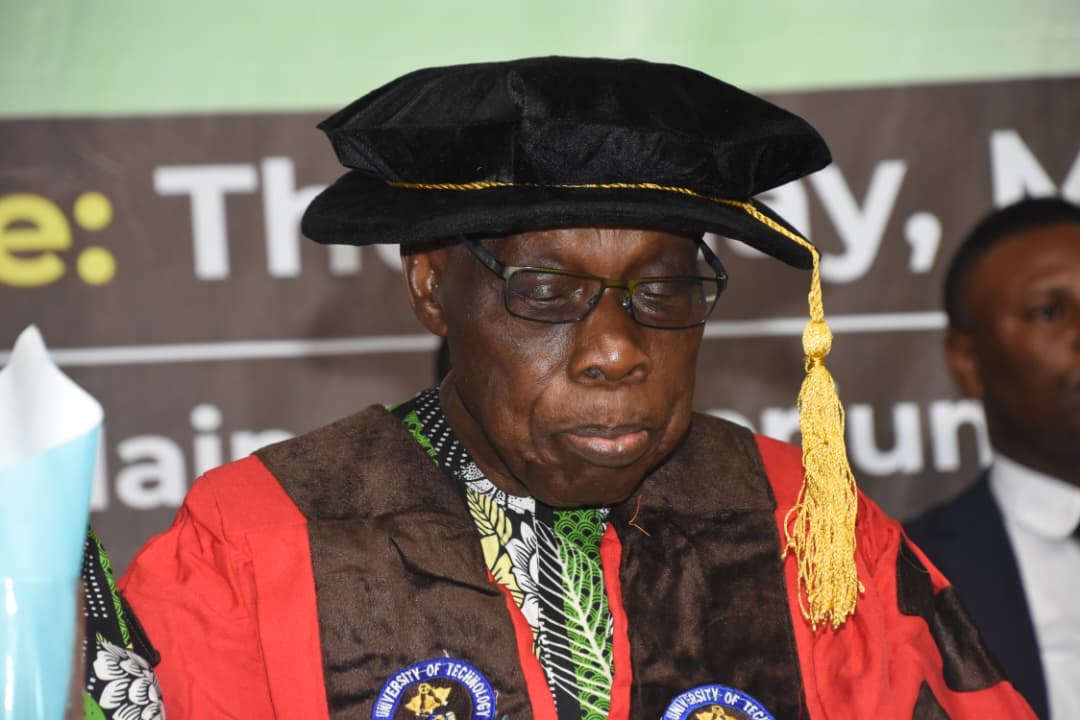
The 89th birthday celebrations of one of Africa’s most influential statesmen, and former two terms President of Nigeria, as well as former Military Head of State, Chief Olusegun Obasanjo, was filled with razzmatazz as usual, even as replied critics, with a cryptic message, saying that at 89 years, he won’t die anytime soon.
Obasanjo was condemning a fake letter making the rounds, in which he was quoted as speaking about his death, saying they were only wasting their time because “I dey Kampe,” a cliché he is known for and with
Obasanjo made the remarks while delivering a colloquium titled “Burden and Blessing of Leadership: Reflections from Global Africa to the World” held as part of his 89th birthday ceremonies in Abeokuta.
The former president said at 89 years he had no doubt that God did not make a mistake to keep him alive and reasonably healthy at his age.

He slammed those wishing him dead, saying he would remain on the earth surface agile and healthy for as long as his Creator wanted.
“For my final note in this address, I want to point your attention to the work of some never-do-well.
“They publish and circulate a fake paper credited to me that I am writing, giving notice of my death, pafuka.
“That is their wish and surely not God’s wish for me. God has assured me that He has more for me to do on earth, and He has given me the wherewithal to do it.
“And those who wish otherwise are going to be dealt with by God Himself. I dey kampe as usual,” the former President said.


Earlier, the former President had lamented the leadership crisis that he said had, for decades, stifled Africa’s development, growth, and economic prosperity.
“Africa is not a problem to be managed but a promise to be fulfilled through honest, courageous, selfless, incorruptible and transformational leadership,” he said.
He explained that genuine leadership carried immense burdens, citing his own incarceration and near execution under the military junta of the late Gen Sani Abacha as part of that burden.
Highlighting Africa’s unrealised potential, he said, “By every measure of natural endowment, Africa should be a continent of prosperity, stability, peace, security and global influence.
“Instead, a major part of the continent remains a theatre of preventable disease and suffering, starvation, conflict, insecurity and poverty.”
Obasanjo identified leadership failure, not geography or history, as the primary cause.
“The primary cause is the failure of those entrusted with power to lead for the people and serve them rather than against them; to build institutions rather than subvert them; to welcome accountability rather than flee from it, to ensure equity and justice rather than enthrone injustice, inequality and inequity.”
He warned that many leaders arrive with promises but soon govern for personal or familial gain, undermine democracy, and erode institutions.

“The same young reformer who promised accountability begins to silence the press, harass the judiciary, and intimidate civil society.
“All institutions become perverted only to serve the interest of the leader, his family, political accomplices and business interests,” he said.

To close the leadership gap, Obasanjo stressed the need for leadership formation, not just training.
“We must invest not only in teaching leaders what to do, but in forming leaders who are constituted and imbued with attributes and values to do the job the right way,” he said.
The former President urged young Africans to take democracy seriously and commit to governance that is accountable, transformational, transparent, and oriented toward the common good.
“A continent that fails its youth does not merely waste a generation; it plants the seeds of instability that will haunt the next several generations,” he said.
Reflecting on personal leadership experiences, Obasanjo described the loneliness and moral weight of decision-making, from commanding troops in the Nigerian Civil War to serving as Nigeria’s President from 1999 to 2007.

“The loneliness I speak of is the loneliness of final decision… your decision will affect millions of lives. That weight settles on one pair of shoulders – the leader’s shoulders,” he explained.
“I remember a few days before the Nigerian Civil War ended in January 1970. I was commanding the Third Marine Commando Division.
“My troops were positioned for the final push. Hundreds of thousands of Igbo civilians were trapped, starving, dying. On one side was the imperative of ending the war quickly to stop further suffering.
“On the other was the risk that a military advance would deepen the humanitarian catastrophe. No textbook told me what to do. No senior officer was going to make that call. It was mine alone. I made it. We saved lives by not shelling Owerri. History has rendered its verdict,” he said.
He stated that a leader also carried the burden of being the repository of other people’s hopes — hopes that are often larger than any human being can satisfy.
Obasanjo said that “When I was elected President in 1999, the Nigerian people had endured years of military dictatorship, economic stagnation, and institutional decay.


“They did not elect a president, some of them thought; they elected a miracle performer. And when the miracle did not arrive in full measure overnight — as it never can — I could hear the murmurs of some of them. This is the burden: to be elevated by hope and measured by time, often simultaneously.
The former President said that with leadership also comes the burden of principle, adding that “True leadership requires the willingness to hold a position when it is unpopular, to say no when yes would be more convenient, to name a truth that powerful interests wish suppressed.
“This costs friendships. It costs alliances. It sometimes costs your freedom — as I learned in the prison under Sani Abacha, where I was held for three and a half years, tried before a kangaroo tribunal, and very nearly executed.”
He also highlighted the blessings of leadership, citing achievements such as Paris Club debt relief and the establishment of the Economic and Financial Crimes Commission to recover stolen public funds.
“The blessing of having done the right thing when doing the wrong thing would have been easier. That is the first blessing of leadership: the opportunity for moral self-definition. Not who others say you are,” he said.
On his personal well-being, Obasanjo affirmed that he remained strong at 89 and condemned those spreading false news of his death.
“God has assured me He has more for me to do on earth, and He has given me the wherewithal to do it. I dey kampe as usual,” he added.
Arguably the most influential African alive in the absence of the Madiba Nelson Mandela, Chief Obasanjo was born on March 7, 1937.
Obasanjo has transcended generations of greatness ever since he joined the army as a career soldier, fighting in the Nigeria/Biafra Civil War before testing political power as the Chief of Staff Supreme Headquarters to the then Head of State, General Murtala Mohammed, and then becoming the Head of State in 1976 following the assassination of General Mohammed. He was in charge between 1976 and 1979 when he handed over to Alhaji Shehu Shagari.
Obasanjo has been described as one of the great figures of the second generation of post-colonial African leaders, and has received praise both for overseeing Nigeria’s transition to representative democracy in the 1970s and for his Pan-African efforts to encourage cooperation across the continent. He however, remains the most senior in Nigeria’s political leadership, behind General Yakubu Gowon.
A two-terms civilian president and former military head of state, Olusegun Obasanjo, has celebrated his 88th birthday, looking fit as a fiddle, and throwing banters among protégé, associates and leaders of thought, whobare his mentees.
As usual, Obasanjo’s birthday celebration was multi-faceted, and like every other year, accommodated praises and worship, get-together, colloquium and sumptuous dinner among others, all held at the Presidential Library, in Abeokuta, Ogun State.
Born on March 5, 1937, in Abeokuta, Obasanjo, who is arguably Nigeria and Africa’s biggest political brand, served as President of Nigeria from 1999 to 2007, during which time he played an instrumental role in bringing democracy back to the Nigeria.
His political and economic sagacity within the period has remained a reference point for subsequent administrations both in Nigeria and the African continent.
He was Chairperson of the African Union from July 2004 to January 2006, and was inducted by the UN as Special Envoy for Africa in 2008. Since then, he has overseen elections in countries across the African continent on behalf of the African Union and ECOWAS.
A man, who draws accolades, and sometimes criticisms as result of his fearless position on issues of both continental, regional and national importance, Obasanjo has received praise both for overseeing Nigeria’s transition to representative democracy in the 1970s and for his Pan-African efforts to encourage cooperation across the continent.
The Wikipedia captures Obasanjo’s personal life as follows:
Ethnically, Obasanjo is Yoruba, a cultural identification he reflected in his speech and choice of clothing. However, he always foregrounded his Nigerian identity above his Yoruba one, repeatedly stating that “I am a Nigerian who happens to be a Yoruba man. I am not a Yoruba man who happens to be a Nigerian.”
Throughout his life he expressed a preference for rural over urban life. He has been a lifelong teetotaller. He has been characterised as having a sense of discipline and duty, and emphasised what he saw as the importance of leadership. He was meticulous at planning, and Iliffe called him an “instinctively cautious man”. Obasanjo always emphasised the importance of deferring to seniority, a value he had learned in childhood. Iliffe described Obasanjo as a man with “great physical and intellectual energy” who “exercised power with skill and ruthlessness, sometimes unscrupulously but seldom cruelly”. Derfler similarly stated that, although Obasanjo could appear “boorish and dull”, he had a “sharply perceptive mind” and the capacity to be “tough and ruthless”. He had, according to Iliffe, a “remarkable capacity for work”. He was cautious with money, living modestly and seeking financial security by investing in property. He is softly-spoken.
In his sixties, Obasanjo would regularly work 18 to 20 hour days, getting very little sleep. He would start each day with prayers. Obasanjo suffers from diabetes and high blood-pressure. He enjoyed playing squash.
Obasanjo’s writings after his imprisonment reflected his commitment to Biblical literalism. He called the Darwinian theory of evolution a “debasing, devaluing and dehumanising” idea. After his release from prison his writings placed far less emphasis on traditional culture as a guide to morality, calling on fellow Nigerians to reject much of their pre-Christian “way of life”. Iliffe noted that Obasanjo’s born-again Christianity was “strikingly orthodox” and was aligned with Orthodox Pentecostal teaching. He rejected the prosperity gospel that was taught by some Pentecostalists in Nigeria.
Providentialism also became a key part of his worldview after his imprisonment.
In addition to a variety of other chieftaincy titles, Chief Obasanjo is the holder of the title of the Olori Omo Ilu of Ibogun-Olaogun.
A prolific writer and author of many books, Obasanjo is not a stranger to awards and honours as he has them in endless list.
A father to many children, including Iyabo Obasanjo, one of his children, Adeboye Obasanjo, took after him, and is presently a senior officer in the Nigerian Army.