By Eric Elezuo
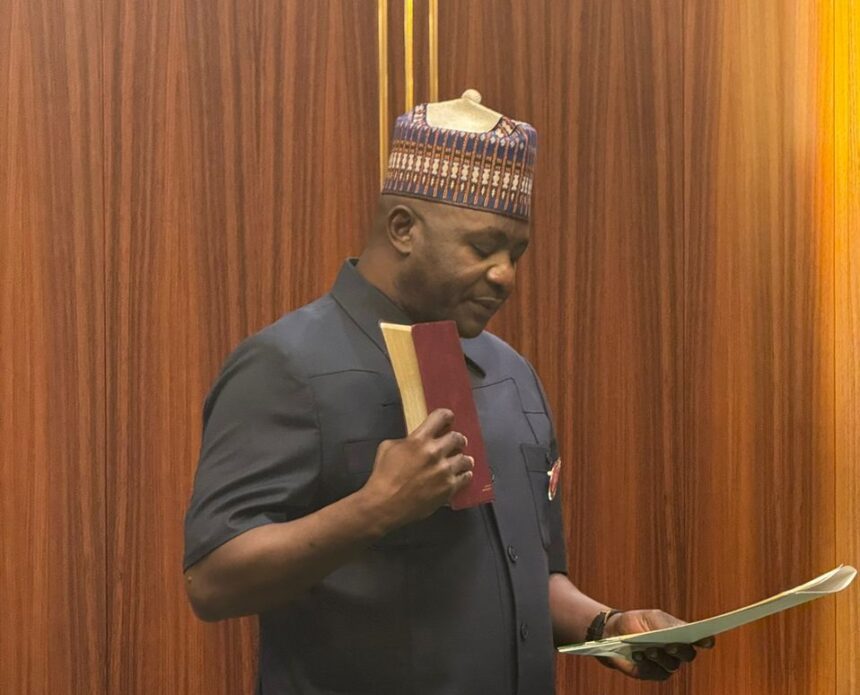
The confirmation by the Nigerian Senate of General Christopher Gwabin Musa as the new Minister of Defence, came as a welcome development to not a few Nigerians, just days after he was honorably retired from the army, having reached the pinnacle of his military career as the Chief of Defence Staff.
Musa’s appointment comes at a time of heightened insecurity in Nigeria with mass abductions, banditry, and kidnapping taking centre stage across parts of the country.
President Donald Trump of US had threatened military action in Nigeria over the killings and what he described as the mass slaughter of Christians, prompting the Federal Government to ramp up security measures, including a reshuffle of security chiefs, which also affected the new defence minister.
The confirmation followed a screening session that featured questions and answers, which lasted over three hours.
During the exercise, Musa criticised negotiations with bandits and assured lawmakers that, under his leadership, the Defence Ministry would intensify efforts to dislodge criminal groups terrorising the country.
He also faulted the deradicalisation of repentant Boko Haram members into society, insisting that terrorists should face stricter punitive measures.
The then minister-designate called for increased funding for military operations, noting that many essential fighting equipment are still being imported.
Recalled that on October 24, 2025, President Bola Tinubu replaced General Musa as the CDS with General Olufemi Oluyede, who was hitherto the Chief of Army Staff. But in a twist of fate, Musa, who had unceremoniously made plans for his retirement, was suddenly recalled to come and supervise the Defence Ministry to sustain the fight against insurgency and terrorism. It would also be recalled that Tinubu’s documented reason for removing Musa, was to give the fight against insurgency a new lease of life.
Nigerians are still wondering what changed just weeks after the President’s announcement through his media aide, Bayo Onanuga as follows:
President Bola Ahmed Tinubu has nominated General Christopher Gwabin Musa as the new Minister of Defence.
In a letter to Senate President Godswill Akpabio, President Tinubu conveyed General Musa’s nomination as the successor to Alhaji Mohammed Badaru Abubakar, who resigned on Monday.
General Musa, 58, on December 25, is a distinguished soldier who served as Chief of Defence Staff from 2023 until October 2025. He won the Colin Powell Award for Soldiering in 2012.
Born in Sokoto in 1967, General Musa received his primary and secondary education there before attending the College of Advanced Studies in Zaria. He graduated in 1986 and enrolled at the Nigerian Defence Academy the same year, earning a Bachelor of Science degree upon graduation in 1991.
General Musa was commissioned into the Nigerian Army as a Second Lieutenant in 1991 and has since had a distinguished career. His appointments include General Staff Officer 1, Training/Operations at HQ 81 Division; Commanding Officer, 73 Battalion; Assistant Director, Operational Requirements, Department of Army Policy and Plans; and Infantry Representative/Member, Training Team, HQ Nigerian Army Armour Corps.
In 2019, he served as Deputy Chief of Staff, Training/Operations, Headquarters Infantry Centre and Corps; Commander, Sector 3, Operation Lafiya Dole; and Commander, Sector 3 Multinational Joint Task Force in the Lake Chad Region.
In 2021, General Musa was appointed Theatre Commander, Operation Hadin Kai. He later became Commander of the Nigerian Army Infantry Corps before being appointed Chief of Defence Staff by President Tinubu in 2023.
In the letter to the Senate, President Tinubu expressed confidence in General Musa’s ability to lead the Ministry of Defence and further strengthen Nigeria’s security architecture
Much as the reappointment of General Musa into the defence architecture was much applauded by a large number of Nigerians across ethnic and political divide, many are wondering why he had to be removed in the first place, and posited such inquiries as if the threats of the United States and President Donald Trump form the reason behind the second coming of the the General.
In as many years, especially in the last 10 years, and more especially during the last two years of the Tinubu administration, Nigerians, in their numbers have had reasons to fault any appointments made by the government, considering it as a loyalty based, compensation or outright placeholding, but with the appointment of General Musa, Nigerians witnessed an appointment everyone can agree on. Many described it as round peg in round hole, or square peg in square hole depending on the individual’s choice of grammar.
But Musa’s return will be to a great personal sacrifice as his life out of the military was beginning to take just before the national recall on December 2.
Among some of the assignments the retired General had set out to begin was his appointment as a member of the board of directors of Midlothian Angel Network (Midlo Angels), one of North America’s fastest-growing angel investment networks.
Described as a decorated veteran, who previously served as Chief of Defence Staff of the Federal Republic of Nigeria, leading the Armed Forces with a focus on strategic modernisation, inter-agency coordination, and international security partnerships, Musa received one of his post-retirement assignments.
Announcing the appointment, Board Chair of Midlothian Angel Network, Tomie Balogun, said the appointment of Musa marks another milestone in Midlo’s mission to foster cross-border investment between the United States and Africa through disciplined governance, visionary leadership, and global collaboration.
But for those wondering what next Musa has to offer, having served in one of the security aparachnik, the officer said:
“It is that synergy that we need to build on and work on, and that’s what we are going to do. I can assure you, within the shortest possible time, Nigerians will see results.
“I want to use this medium to appreciate all Nigerians. Nigerians have shown me love, and I will guarantee them that I am going to work, whatever it takes, to ensure that Nigeria is secured.”
A promise, no doubt, but that falls within the ranks of what Nigerians wish to hear at a time like this when insecurity lamented in kidnapping, banditry, terrorism and genocide are practiced with impunity, and the government seems helpless.
The second coming of Musa may trigger an era where ransom payment will become a thing of the past as he noted while addressing the Senate during his confirmation that the act “compromises security” and undermines the fight against criminals.
He also hinted that “The use of technology is very important. Like I said, if we are able to have a database – every Nigerian has a number linked to everything you have electronically – we can monitor everything”
A general analysis of Musa’s agenda for the next era of Nigeria’s security reorganization points to the following:
- A rigorous review of all theatre commands and inter-service operations.
- Zero tolerance for corruption, indiscipline, and indolence in the ministry.
- Emphasis on troop welfare is for morale boosting.
- Leveraging on technology and intelligence to drive defence operations and minimize civilian casualties.
- Use of data, not conjecture, to guide military decisions and accountability.
- Loyalty to the President with commitment to a balanced kinetic and non-kinetic approach.
Sometime in August 2025, Musa hinted on the possible arrest of terrorism kingpins, during a television interview, saying ‘we know them’.
He assured that the process of identifying and prosecuting terrorism financiers in Nigeria is ongoing, stressing that the matter involves legal complexities.
“I think the process is on, I can speak for this government … and because it has to do with a lot of legal issues and because again, it has to do with international connections. Some of them have funds coming from outside, we cannot do anything from within.
“We know them. The local ones, what they do normally is to employ a few individuals, provide motorcycles for them and those ones are remitting funds daily into some accounts. So, it’s being tracked. They try to circulate these monies and that’s why it’s important for us to be able to track the funds.
“The NFIU has been doing so much, apart from the intelligence set up, the financial links are also being followed through and through and arrests have been made. I can assure you the Attorney-General of the Federation, the NSA (Nuhu Ribadu) are all working seriously to ensure that we address those issues.
“You know criminals work together. They synergise their efforts together, both the bandits and terrorists, because one, a common goal, they want to make money, they want to make sure communities are suffering for whatever reason. And again, some part of politics, when there is peace, it shows the government is doing well and when there is no peace it shows the government is not doing well.
“You realise that last year, we had the least number of deaths, then, how come suddenly everything has gone up? Because politics has come in, elections are coming in. You cannot rule out the fact that some individuals are making sure there is no peace. The funny thing is that how do you want to kill the people you want to govern? What do you gain from it?” Musa had said.
However, Nigerians are no longer interested in much talks, but need actions that would guarantee sleeping with both eyes closed, travel to any part of the country with fear of being kidnapped and send children to school rest assured. These are, and should be the priorities of Musa on his second coming!
DEFENCE MINISTER CHRIS MUSA’S BRIEF BIO
Christopher Gwabin Musa (Retd.) is a distinguished Nigerian military officer who served as Chief of Defence Staff from June 2023 until his retirement on October 31, 2025, after 39 years and four months of dedicated service.
His career spans over three decades of strategic leadership, operational excellence, and national service across various theatres of operation, notably in counter-terrorism, national security, and peacekeeping. He was previously Theatre Commander of Operation Hadin Kai, Nigeria’s counter-insurgency mission in the North East, where he was recognised for operational discipline, collaborative leadership, and his focus on civilian protection.
A graduate of the Nigerian Defence Academy (NDA), General Musa also completed senior-level training at the Armed Forces Command and Staff College (Jaji) and the National Defence College. He holds advanced certifications in defence strategy, national security, and management and has completed executive education programmes both locally and internationally, demonstrating his lifelong commitment to service and excellence.









 Featured4 days ago