By Eric Elezuo
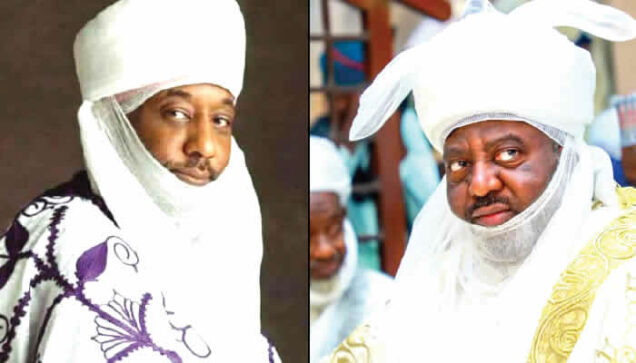
The uneasy calm that reared its ugly head in the ancient city of Kano since May 23, 2024, when Governor Yusuf Kabir sacked the sitting Emir, Aminu Ado Bayero, replacing him with Sanusi Lamido Sanusi, also known as Muhammadu Sanusi II, has yet to abate as the two prominent personalities have consistently laid claim to the emirship of the emirate, and operating from different palaces in the town.
The bitter rivalry between the two royalties has caused division not only in the emirate, but the entire Kano State, and spiraling into national politics, leaving the political parties, especially the New Nigerian Peoples Party, which is the governor’s party, the Presidency, alleged to be giving backing to the immediate past governor, Umar Ganduje, who is also the National Chairman of the All Progressives Congress (APC), and the security agencies, who receive instructions from the Presidency, taking sides.
Sanusi Lamido Sanusi also known as Muhammadu Sanusi II and Aminu Ado Bayero are the parties embroiled in the bitter rivalry in a bid to outwit each other for the exalted Emir of Kano position. This was since Sanusi was reinstated as the 16th Emir, having been dethroned and exiled on March 9, 2020 by the former administration of Abdullahi Umar Ganduje.
Sources close the two notable figures, and the palace told The Boss that it is not unlikely that both men are being supported by powerful entities.
“While Sanusi has the backing of the Kano State government as visibly manifested in the reinstatement process, Ado Bayero is being backed by the Federal Government of Nigeria,” one of the sources said.
The furore has consequently attracted the wrong commentaries from stakeholders within and outside the Kano Emirate, resulting in heated arguments, threats and possibly outbreak of direct and indirect confrontations. But six months into the leadership quagmire, none of the two has shifted ground, or is willing to shift ground as more and more intrigues of power play and desire for recognition continue to be the order of the day.
The ‘two emirs’, who continue to claim legitimacy, have variously been trying to outdo each other in the quest to be relevant in the scheme of things.
The rivalry between the two emirs and their loyalists has resuscitated with weddings and counter weddings.
Just this weekend, a former governor of Kano State, Alhaji Rabiu Kwnakwaso hosted the wedding of his daughter, Dr. Aisha Rabiu Kwankwaso, and her husband, Fahad Dahiru Mangal, at the palace of Emir Sanusi Lamido Sanusi, which attracted prominent national citizens including former President Olusegun Obasanjo and Vice President Kashim Shettima, Waziri Adamawa Atiku Abubakar among others. Fahad is the son of Nigerian business magnate, Dahiru Mangal, founder of MaxAir, one of the country’s leading private airlines.
In what looked like a counter affair, the palace of Aminu Ado Bayero, in Nasarawa Local Government Area of the state, will on December 13, 2024 hosts a double wedding involving Jibrin Barau Jibrin and Aisha Barau Jibrin, the children of the Senate Deputy President, Barau I. Jibrin, to their spouses.
Some stakeholders told The Boss that the whole thing is a case of seeking relevance and originality.
Meanwhile, former Governor Kwankwaso has blamed President Bola Tinubu for the crises that have failed to abate in the state.
While speaking at the convocation ceremony of Skyline University in Kano on Sunday, Kwankwaso accused Tinubu and the political forces from Lagos of attempting to impose their influence on Kano’s leadership, particularly in the selection of the Emir.
“Today, we can see very clearly that there are significant efforts from the Lagos axis to colonise this part of the country. Lagos wouldn’t allow us to choose even our Emir; instead, they want to impose their own Emir on Kano,” he stated.
HOW IT ALL BEGAN…
The Kano State House of Assembly, as widely speculated, repealed the 2019 Law, which was instrumental in removing Sanusi from office, and balkanise the Kano emirate into five jurisdictions.
The Assembly, in the new emirate law stipulated the sack of all the Emirs in the jurisdictions and a restoration of the old order, where only one Emir will be overseeing all of Kano.
As a result, the Governor of Kano State, Abba Yusuf, appended his signature on the bill, giving it the backing of the law, in the presence of the deputy governor, Aminu Abdulsalam, Speaker, Isma’il Falgore, and the SSG, Abdullahi Bichi. and thereafter, proceeded to sacking the emirs with a 48 hours ultimatum to vacate their palaces.
While the Emirs of Bichi, Rano, Karaye, and Gaya complied with the directive, the Emir of Kano, Aminu Ado Bayero, had gone to court to stop the process.
Both by native ordinance and law, every dethroned Emir is banished or expected to leave Kano for good. Recall that in 1965 when Muhammadu I, Sanusi’s grandfather resigned, having got wind of his possible dethronement, he abdicated to Bauchi, and never returned to Kano.
It was therefore, a surprise that on Saturday, Bayero, who was dethroned, returned to the city of Kano, and moved into a palace in Nasarawa LGA of the state; a move that proved that he has not relinquished power. While Sanusi is operating in the main palace, Bayero is operating from the Nasarawa Palace, creating two full blown emirs for one throne.
The Boss learnt that a squad of soldiers that had been protecting Bayero before he was dethroned, rode with him from the airport to the palace. The same report has it that the National Security Adviser (NSA), Nuhu Ribadu, has been behind Bayero’s moves, especially his flight and residency in the city. The NSA denied the allegation, threatening legal action againat the deputy governor, who made the claim.
Responding after the deposed monarch arrived in Kano to a hero’s welcome from a horde of his supporters, the Deputy Governor of the state, Aminu Gwarzo, blamed Ribadu, for allegedly facilitating the return of Bayero to the palace by providing him with two private jets.
Ribadu, in a letter by his legal team, Aliyu & Musa Chambers, said that Gwarzo should retract his claim, tender apology, or face legal action.
The letter reads: “The attention of our client was drawn to a video clip being shared on different social media platforms wherein you granted an interview at Emir’s Palace in Kano on Saturday, the 25th day of May 2024, in a very calm atmosphere, and without any provocation whatsoever, falsely accusing our client of using his office to kill the people of Kano State and maim their properties.
“In the clip, you were shown to be speaking in Hausa.
“Your false accusations against our client portraying his office as an appendage of a political party and a willing tool to cause chaos in Kano is false and done to damage the hard-earned reputation of our client in the eyes of the right-thinking members of the society and indeed it has succeeded in doing so.
“In all the places he has served, our client has never been accused of any wrongdoing.
“Given this illustrious background, it is inconceivable that someone would harbour the thought that our client would descend his exalted office so low as to interfere in the local tussle of the Kano Emirate.
“The wide coverage you gave your interview has caused serious embarrassment to our client and his family.
“Since the publication, our client has been receiving a barrage of telephone calls both within and outside Nigeria from friends and associates who felt disappointed in him because of the false allegation owing to the fact that it came from a person occupying the office of Deputy Governor of Kano State.
“Our client and his office take your allegations seriously and by this letter, our client is demanding that you provide irrefutable evidence to substantiate your claims.
The return of Bayero consequently prompted the governor to order his arrest.
In a counter, a federal high court in Kano ordered the state government not to enforce the Emirate Council Repeal Law 2024, and desist from from issuing Sanusi appointment letter.
STAND OF SECURITY OPERATIVES
The Kano State Police Command refused to arrest Bayero, saying he would only enforce the court order restraining the state government from dissolving five newly created Emirates in the state, and restatement of Sanusi.
The state Commissioner of Police, Muhammad Hussain Gumel, while making a broadcast, flanked by representatives of other security agencies, vowed to maintain law and order, assuring that security agencies won’t spare anyone trying to temper the peace across the state.
He said: “Let me also remind you that the position of the law is very clear as whoever, under whatever guise is found to be planning to disrupt the peace being enjoyed in the State or feel that he or she can jeopardize the existing security settings in the State will be arrested and made to face the full wrath of the law.
“Therefore, as the Police Command is leading other security agencies to sustain the peace and peaceful coexistence for overriding interests, miscreants should steer clear of violence in all its ramifications and should not take advantage or hijack the current situation to launch an unprovoked attack on people, property and infrastructure of the State. Any person found with such a tendency will be ruthlessly dealt with according to the law of the land
“The combined security agencies in the State have set out all machinery in place to ensure no breakdown of law and order as the safety and security of all the inhabitants in the State remain sacrosanct,” Gumel said.
NBA TAKES A STAND, URGES CAUTION
The Nigerian Bar Association (NBA) has called for caution in the legal fireworks playing out in Kano, stressing that it is deeply “deeply concerned about these developments in many ways”.
In a statement, NBA chairman in Kano, Sagir Gezawa, said it is the constitutional duty of a state assembly to legislate and once passed, it remains the prerogative of a governor to assent to such law.
“Once assented to by the governor, it has become a Law and its implementation is to be done by state apparatus and of course enforced by a competent court of law,” Gezawa said.
“It’s further within the purview of courts to interpret such law to be in tandem with other existing laws or the constitution.
“In doing so, we urge our members to act responsibly in approaching courts with competent jurisdiction.
“A court order, once given, is sacrosanct and must be obeyed.
“However, it must be noted that while the court has its own mechanism of enforcing its order, it’s not within the powers of the Nigerian Army to deploy troops to enforce court order. This is a sad reminder of the military dictatorship and must be condemned.
“Anyone found wanting or in disobedience of a court order (which is declaratory in nature) must first be proved to have been notified of the existence of the said court order by issuance of Form 48 and subsequently Form 49 notifying such person of the consequences of his or her actions.
“This is in line with the Sheriff and Civil Processes Act and Laws of the various States for enforcing court judgments.
“Engaging security apparatus without the officers of the Deputy Sherriff’s Department of the relevant court that made the order may appear to be self-help which must also be condemned.
“As an association therefore, we call on all state actors, to be mindful of their oaths of office and for the security agencies, their scope of duties so as not to make mockery of our judicial system.”
The NBA said the actions of the state actors “may breach the security and peace” in Kano and “they shall be held accountable in this life or the next,” the statement said.
But some notable personalities including former Vice President, Alhaji Atiku Abubakar has blamed the Bola Tinubu-led federal government for being behind the crisis in Kano.
Atiku made accusation via a statement by his spokesperson, Mr. Paul Ibe on Saturday.
“The action of the Federal Government in deploying soldiers in Kano in the tussle over the throne of the ancient city is an upset to the peace and security of the state, and also in breach of the 1999 Constitution as Amended.
“In performing their constitutional duties of law making, the Kano State House of Assembly (KSHA) passed the amended Kano State Emirate Council (Repeal) Bill 2024 in consonance with the provision of Section 4 of the Constitution 1999 as Amended whereas the Governor of Kano State, Engr. Abba Kabir Yusuf subsequently signed into law the said bill. The law therefore repealed the 2019 version which balkanized the ancient Kano Emirate into five.
“The foregoing circumstances happened within the confines of the law and in compliance with the powers conferred on the Governor as provided by Section 5(2) of the 1999 Constitution as amended; and also in consultation with the Kingmakers of Kano, reappointed Sanusi Lamido Sanusi (also known as Muhammadu Sanusi II) as the 16th Emir of Kano State and accordingly handed him a letter of appointment.
It is surprising that in the early hours of today, exactly at about 5:30 am the former Emir of Kano, His Majesty Aminu Ado Bayero backed by Federal might made their way into the Nasarawa Palace of the Kano Emirate while the reappointed Emir, Muhammadu Sanusi II was at the Gidan Dabo, which is the main residence of the Emir of Kano.
“In this wise, the former Emir could not have made his way into the Nasarawa Palace without the support of the Federal Government having done so with the support of the Army and other security personnel in his company. The deployment of soldiers in extra constitutional matters such as this undermines the integrity of the Nigerian military.
“We need to remind the Tinubu administration that Kano State is known for peace and harmony spanning thousands of years and any attempt to destablise the peace of the Land of Commerce shall be resisted. Recall that Muhammadu Sanusi II was dethroned on 9th March, 2020 dethroned, Kano forged on in peace without any fracas.
“We wish to state unequivocally that if for any reason, law and order breaks down in Kano State, particularly Kano Municipal, the Federal Government should be held responsible as the act of providing security cover to the former Emir, Aminu Ado Bayero to come back to Kano is an invitation to anarchy,” he said.
In the same vein, the Council of Ulamas, has President Bola Tinubu against plunging Kano into chaos. The group said, the crisis, if not well managed, could escalate and degenerate into chaos.
With the state backing the reinstatement of Sanusi, the path looks smooth for Muhammadu Sanusi II to repossess the emirship of Kano, but all will depend on how the politics of superiority is played in the coming days.
While Tinubu watches without lifting a finger of settlement, the ancient city of Kano, like Rivers State, is slowly burning down.









 National3 days ago