Connect with us

Featured

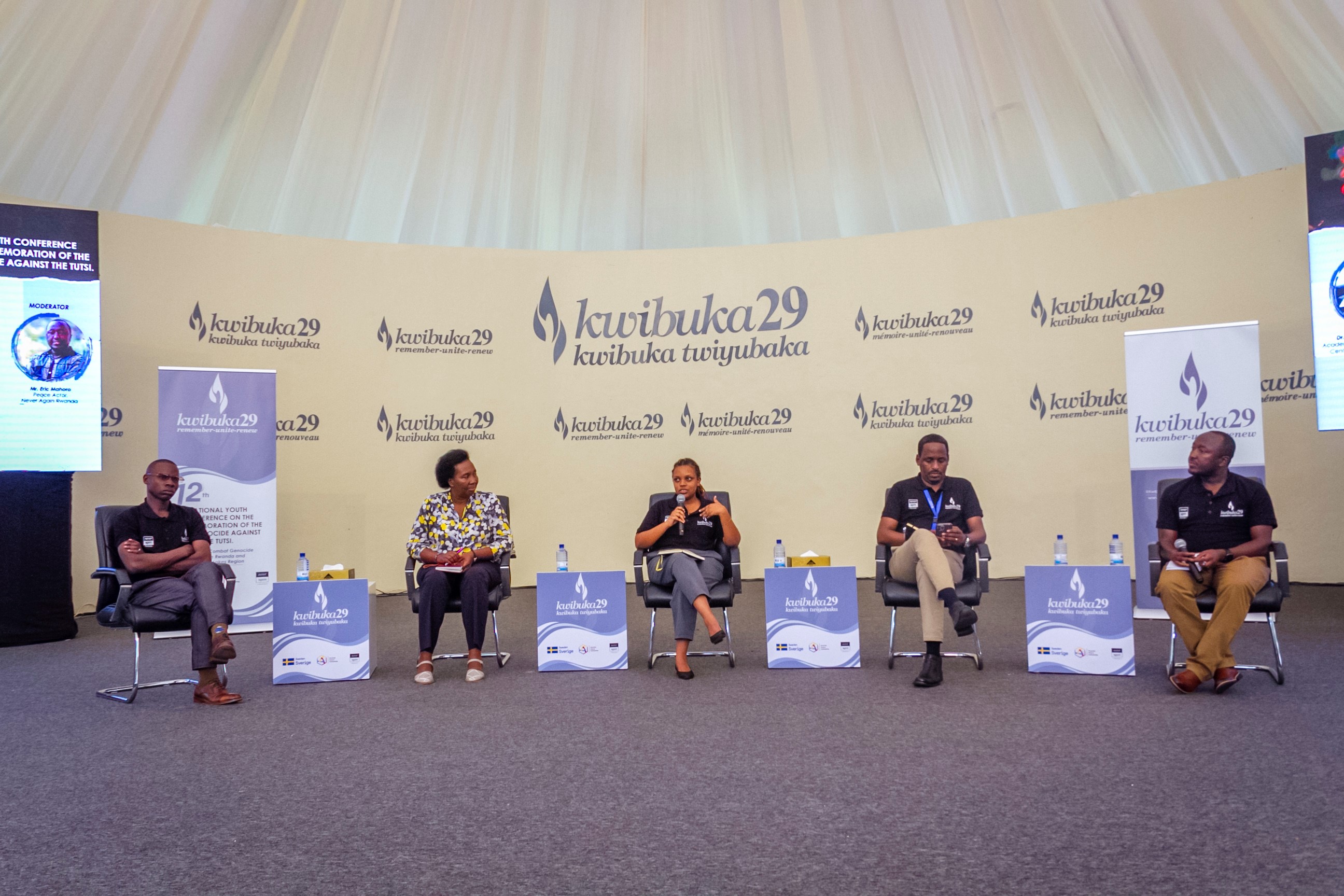
Kwibuka 29: NAR Holds 12th National Youth Conference

Published

on

By Dolapo Aina

For the past 12 years, Never Again Rwanda has been organising the national youth conference on the commemoration of the 1994 Genocide Against The Tutsi and 2023 was no different.

NAR is a Rwandan peacebuilding and social justice non-governmental organisation that was established in 2002 in response to the 1994 Genocide Against the Tutsi. The organisation aims to empower citizens of diverse backgrounds from Rwanda and the Great Lakes region with opportunities to become active citizens for a peaceful society.

The 12th National youth conference on the commemoration of the 1994 Genocide Against The Tutsi with the theme: Strategies to combat Genocide ideology in Rwanda and the Great Lakes region, took place at the amphitheatre situated at the Kigali Genocide Memorial in Gisonzi. The gathering was unique for several reasons; one of which was that majority of the attendees and those in the audience were young people from within and outside Kigali.

The 12th edition commenced with a visit to the memorial, paying tributes to the victims and laying flowers on the graves. Back at the amphitheatre, the objectives of the conference and agenda were previewed and a minute of silence followed. The executive director of Never Again Rwanda, Dr. Joseph Ryarasa Nkurunziza commenced proceedings thus, “Today, I speak with much humility as I pay tribute to the more than 250,000 victims of the genocide against the Tutsi who have found their final resting place here at this Kigali Genocide Memorial and all those in multiple memorial sites across the country who have been subject to the commission of the most heinous of crimes, genocide, and whose memory we have an obligation to preserve. Throughout history, there have been countless examples of genocide ideology and its horrific consequences. From the genocide of indigenous peoples in the Americas, to the Holocaust and systematic torture and murder of six million Jews, and finally our own history which led to the loss of more than one million lives.”

Dr. Joseph Ryarasa Nkurunziza continued, “For almost three decades, Rwanda continues to inspire the rest of the world, having shown what’s possible if we work vigorously to address the root causes that undermine social cohesion and create conditions for hatred and intolerance. And today, this event gives us the opportunity to reaffirm NAR’s dedication to the peacebuilding and development efforts of this remarkable country. I say this knowing that these days it is not possible to look at any type of social media platform and sometimes news platform without confirming the fact of people continuing to perpetrate atrocities, discrimination, hate speech globally. This is why the commemoration is so important as not only must we remember the 1994 Genocide Against The Tutsi, but we must also draw lessons for the present and future and continuously express commitment to prevent them from happening in future.”

Furthermore, Dr. Nkurunziza said, “In the recent years, given the rise of and easy accessibility to social media, there has been constant bombardment of violent images, texts and audios which have picked up traction through social media and non-traditional media. The sheer speed of circulation of this content and the practice of sharing extreme views by social media users, have led to exacerbating tensions and polarizing people’s opinions on current issues in our region. YouTube, Twitter, Facebook, among many others have become spaces for genocide deniers to spew their hate and propagate genocide ideology.”

He reminded the audience that, “Denial or distorting the facts of the genocide against the Tutsi in Rwanda is an extreme form of hate speech that could itself constitute preparation for another genocide. Let us not forget that these revisionists and deniers are often diverting attention with these claims from their own responsibility in these crimes and that many perpetrators of these genocides including those who planned, ordered, and committed them, remain at large even as their victims and survivors wait for justice. As the next generation of leaders and decision-makers, the youth have the power to shape attitudes and beliefs about other groups of people and to promote a culture of peace, respect, prosperity and reconciliation. In the context of our region, we should be mindful as we cannot prosper alone if our neighbours are at war. History has proven us that cross border hate exists, and we should be careful in how we address it. So what can we, and especially the youth, do to combat genocide ideology and hate speech in Rwanda and the region?

“First, we must recognize the existence of genocide ideology and speak out against it whenever we encounter it. As youth, you have the power in your hands to actively challenge dehumanizing rhetoric and hold those who promote it accountable for their actions. Educate yourselves on the history of the 1994 Genocide against the Tutsi and the factors that contributed to its occurrence and raise awareness about the impact of genocide and hate speech on individuals and communities,” said Dr. Joseph Ryarasa Nkurunziza.
The Never Again Rwanda director, further buttressed his speech, “Additionally, you should use your voices and platforms to speak out against hate speech and discriminatory attitudes. Take opportunities to challenge harmful stereotypes and promote more positive messages and values. Use your voice to advocate for peace, promote policies and practices that promote peace and prevent genocide. Work alongside the government, civil society organizations, and other stakeholders to promote human rights and social justice. Preventing genocide requires our constant engagement and vigilance. To the victims and survivors, I have this to say to you. We are here. We continue to do everything possible to ensure the world does not forget the crime of genocide against the Tutsi in Rwanda, we support peace and reconciliation initiatives.”

Ms. Martina Fors Mohlin who is the head of development cooperation at the embassy of Sweden in Rwanda gave a summary of the 1994 Genocide Against The Tutsi. According to her: “I am a relatively newcomer to Rwanda and I have witnessed how Rwanda tries to remember, unite and renew. Remarkable how the Government of Rwanda and civil agencies have been able to work together to keep the stories alive.”

Speaking to the youth, the representative from the embassy of Sweden further posited that: ”The labours of the parents of young people is remarkable and it is up to the young people to carry on the torch. To be aware of how easy ideologies can take control of anyone.” She continued; “The best way to honour the victims, is to make a collective pledge to always say no to ethnic hatred and ethnic cleansing. Engage with one another, ask questions, ask questions to your leaders, think innovatively, think outside the box.”

Ms. Mohlin stated that the participants should remember the role of the media in Rwanda leading up to the 1994 Genocide against The Tutsi. She said; “Let us remember the role of the receivers (the listeners) of the media: did they have the enlightenment and tool to question what they were been fed?”

She also talked about the positive and negative roles of social media in today’s world and concluded that, “We need to ensure young people are critical thinkers and are able to question norms online and in public.”

A documentary on the effects of the 1994 Genocide on the youth, the youth who survived and what must be done to stop the spread of Genocide ideologies amongst the young generation on all media platforms was aired for those in attendance. One of the those featured in the documentary summarised the documentary with a poignant statement; “We should all try to see ourselves as one Rwanda.”
A Ted Talk-like presentation was anchored by Tristan Murenzi who is the founder of Rwanda We Want and Christian Intwari who is the founder of Our Past; where they talked about their initiatives and how their initiatives are impacting their immediate society and spheres of influence.

The panel discussion comprising Dr. Aggee Shyaka Mugabe (Academician and Acting Director of the Centre for Conflict Management); Mr. Bahati Hakizimana Bosco; Dr. Madeleine Ndegeya Kazindu; (medical doctor and human rights activist) and Mrs. Assumpta Mugiraneza (socio-psychologist and director of Iriba Center for multimedia heritage), all discussed and analysed on the theme: Strategies to combat Genocide ideology in Rwanda and the Great Lakes region.

Mrs Assumpta Mugiraneza: talked about how youth can and should use social media to counter genocide ideologies by using facts to counter denials and not to engage in abusive spats but to counter ideologists with facts and figures. Also, she talked about the responsibility of the other generation to guide the younger generation in/on the right path with historical oral and written documentation on how to counter falsehoods by genocide ideologists.
Mr. Bahati Hakizimana Bosco (a businessman who fled Congo and returned to Rwanda in 2011) talked about his experience of how parents consciously or unconsciously transmute hate and genocidal ideologies to their children. In a nutshell, until he came back to Rwanda (as he left with his family at a tender age in 1994), he was brainwashed by what his family members fed him with as a youngster. He talked about what he saw and experienced; like the lawlessness of the FDLR, how his siblings were part of the FDLR (as some trained youngsters to become militia), the militia trained young people and making them believe they were fighting for a good cause by training to fight the Government in Rwanda. The brainwashing of the young people; that to get a better life, they had to fight the government in Rwanda.

Mr Bosco gave an example and paraphrasing him; “When the top officials of the FDLR were captured, a majority of the young people who were under their tutelage were disoriented and confused. And a lot of them didn’t know what to do with their lives. I began to listen to the state radio station in Rwanda and when I began to hear of the Government’s programmes for the citizens via radio jingles, I began to see a different Rwanda from what myself and other youngsters had been fed in the camps in Congo.” He returned home but a lot of people he knows cannot return to Rwanda because of the fact that no one has been able to guide them and educate them (unlearn and relearn) about the decades-hold brainwashing of the FDLR.

A woman in the audience buttressed what Mr. Bosco stated by giving her testimony of how her parents had a hand in some atrocities during the 1994 Genocide Against The Tutsi and they fled to Congo. They lived in the camps that had FDLR and the genocide ideology campaign was widespread. Those who wanted to return were dissuaded by the repeated comments and opinions of “Rwanda wasn’t safe for all and that they would be arrested and not seen anymore.” She and her siblings decided to return in 1997 and when they did, they began their new life. She stated that their school fess from high school to tertiary level were paid for by the Government of Rwanda. She also stated that if she and her siblings had not returned, they would probably be in one of the large forests in Congo controlled by the FDLR.

Another man in the audience buttressed the fact earlier stated of parents who try to cover up the truth or engage in genocide ideology. He stated that young people must be equipped with the appropriate storytelling techniques and armed with the right historical facts and contexts to counter and dissuade such approaches from elders and parents.
Another young female participant stated by observing that in secondary schools, most of the history teachers are non-Rwandans (teachers from Uganda, Kenya etc) and when it comes to topics relating to Rwanda and the 1994 Genocide Against The Tutsi, their knowledge is very limited. She suggested that the Government of Rwanda should have Rwandan teachers for history classes.
In conclusion, Dr. Aggee stated that critical thinking, peace building and genocide prevention which are usually taught to elderly people (who already have a formed mindset) should be introduced to youth clubs in primary and high schools, since these young ones’ minds are not yet fully formed. Theis way, they are more equipped to present and state historical facts the way they are. Also, they would be in a better position to counter genocide ideologies.

Dr. Madeliene concluded by highlighting transgenerational trauma which she said, acknowledging it is the first step to healing. She also stated that genocide ideology which is still in existence took decades to form and actualise, therefore, Rwandans should be steadfast in countering such ideologies with historical facts realising that it is not a sprint but a marathon.

Mr. Bosco concluded by highlighting the fact that the participants should not forget that Genocide ideology cannot and should not only be countered in Rwanda but also outside the shores of the country, as there are those who still are neck-deep in the doctrine of Genocide ideology. He also stated there has to be a personal and inner soul reflection to believe that all people from Rwanda are Rwandans and not viewed from any other perspective or prism.
Mrs Assumpta concluded by stating that the Genocide ideology took decades to be part of the ideologists’ thinking, so it would take a long time to eradicate Genocide ideologies but Rwandans have to be patient and keep on denouncing such thinking. for it would take several generations for such to be eradicated. She also stated that documentation and archiving are very important and should begin to be implemented and taught to young people from an early age.

Dolapo Aina writes from Kigali, Rwanda

Continue Reading
Click to comment

Leave a Reply

Your email address will not be published. Required fields are marked *

Featured

Trump’s Envoy, Riley Moore: There’re over 600,000 Christians Languishing in Benue IDP Camps

Published

on

By

United States Congressman Riley Moore has alleged that more than 600,000 Christians are currently living in internally displaced persons’ camps across Benue State, following years of violent attacks that have forced communities from their homes.

In a post on X on Wednesday, Moore recounted testimonies he said were shared with him during a visit to several camps in the state.

The congressman said he met “dozens of Christians” who had survived deadly assaults and were now seeking refuge in makeshift shelters.

According to him, the displaced residents described “horrific violence” that wiped out families and emptied entire villages. Moore cited the account of a woman who, he said, “was forced to watch as they killed her husband and five children,” escaping with her unborn child.

Another woman, he added, told him her family “was murdered in front of her and her baby was ripped from her womb.”
He also referenced a survivor who claimed “his family was hacked to death in front of his eyes,” leaving him permanently injured.

Moore described the scale of displacement as alarming and accused “genocidal Fulani” of driving indigenous Christian communities from their ancestral lands. He said the situation demands heightened international attention.

“There are more than 600,000 Christians in IDP camps in Benue State alone.

“These Christians should be able to live in their ancestral homeland without fear of genocidal Fulani,” he said.

During his visit, Moore also met Tiv and Catholic leaders, including Bishop Wilfred Anagbe, Bishop Isaac Dugu, and Tiv traditional ruler, His Royal Highness James Ioruza. He said discussions centred on what he called an “ongoing genocidal campaign” in Benue.

The congressman noted that his trip to Nigeria included meetings with National Security Adviser Nuhu Ribadu and other senior officials. He said the talks focused on terrorism in the North-East, the killings in the Middle Belt, and security priorities he shares with President Donald Trump.

Moore added that both sides reviewed possible steps to improve security cooperation, pointing to what he described as an already established joint Nigeria–US task force as a sign of progress. But he emphasised that “openness has to translate to concrete action,” insisting there is still significant work to be done.

Ribadu confirmed meeting the US delegation, noting that the discussions followed earlier engagements in Washington and covered counter-terrorism, regional stability, and efforts to strengthen the strategic partnership between both countries.

President Donald Trump had on November 30 redesignated Nigeria a Country of Particular Concern over alleged religious freedom violations, while warning of possible US military intervention.

The Nigerian government has repeatedly rejected claims of systemic persecution of Christians, arguing that insecurity affects Nigerians of all faiths and ethnic groups.

Moore, meanwhile, commended recent security operations, including the rescue of more than 100 abducted Catholic schoolchildren, and said US concerns had been “positively received” in Abuja.

He maintained that the experiences shared by displaced communities “will not be ignored,” and vowed to brief the White House as ordered by President Trump.

Continue Reading

Featured

There’s No Govt in Nigeria, Tinubu is the Person in Power – Dele Momodu

Published

on

By

Media entrepreneur and former presidential aspirant, Chief Dele Momodu, in this interview by SAM NWAOKO, does a thorough examination of the Nigerian polity and comes to the conclusion that the country is on the cusp of a one-man rule.

Some people have said that the issue involving Nigeria’s First Lady, Senator Oluremi Tinubu and the governor of Osun State, Senator Ademola Adeleke, was a convivial episode between two former colleagues in the Senate. Do you agree with this contention by some observers of the matter?

You know that spin doctors will spin anything no matter how unreasonable it is. Everybody, including Mrs Tinubu, acknowledged that what happened was wrong. Whether she now apologised or not, I am not aware, but she herself said it was a minor misstep and that we should not escalate it. So let us not debate what is not debatable.

When my favourite writer, Uncle Dare Babarinsa, said that the video of the incident in Ile-Ife was AI-generated on Facebook, I replied to him and said it was not. I gave them the original video that was shot by Ovation TV and said: “This is an original video that was shot by Ovation TV and not AI-generated, Sir. The governor was clearly disrupted and momentarily lost composure.”

The whole saga looks like it is not going away. What would you advise the First Lady to do at a time like this?

It is not going away because we are all prone to mistakes – nobody is perfect, I am not perfect, the First Lady is not perfect and when we are wrong either knowingly or unknowingly, we should just apologise. That is all. The thing would have gone down immediately. However, the thing is that her spin doctors are busy trying to window-dress the incident which is ordinarily a scandal because you embarrassed Governor Adeleke in his own state because you momentarily got him confused. If you look at the video, you will see that she disrupted him and the governor was momentarily confused. The governor was flustered because he was not expecting such an intrusion during his speech. Even if you were in a hurry to leave the palace and all that, you could have sent someone or just asked someone to write something on a small paper that ‘We are running late, please hurry up’. It is not that you will now stand up on your own. The First Lady stood up, and we saw her conversing with the Ooni of Ife before then, reporting that ‘I want to go and tell this man to stop singing’.

However, I know the reason she is angry, because she used to enjoy his singing and music when they used to dance together in Osogbo and all that. I have video evidence of that. She is angry because the governor refused to join the All Progressives Congress (APC). You know, APC has this entitlement syndrome afflicting it. APC believes that every governor should be in APC. The only thing that will give them joy and comfort is for every governor in Nigeria whether from the North, or from the East or from the West – wherever – should join APC. Then Tinubu can become an emperor in word and indeed. That is what they seek to do. They succeeded in Lagos and they wish to succeed at the national level. That is what is going on. Anybody who does not join them is considered an enemy.

Don’t you think that he has succeeded in doing that in many other places too because we only have one governor of PDP left in the South, so to say?

To me, this does not matter. Some people will choose to be voluntary slaves while some people will choose to act like freeborn. Everybody has a choice, that is what democracy is all about. Some people are coerced; some people are cajoled. When they get there, I hope they get whatever they are looking for.

Could this thinking be the reason Governor Ademola Adeleke did not go to APC but chose to go to Accord instead?

They tried to woo him into APC but he decided that he would rather leave his fate in the hand of God instead the hand of man. He didn’t get to where he is today by himself, it is God that made it possible. In his first attempt, he claimed that they stole his votes. He went away quietly. He didn’t destroy Nigeria, he didn’t destroy anything. He didn’t even fight Tinubu. He went away and he came back stronger. In fact, this Mrs. Tinubu incident has played to his favour because he has been trending since Sunday. Governor Adeleke has been trending because of this “little mishap” according to Mrs. Tinubu. And, can you imagine that it coincided with the time he was joining his new political party, Accord. Everything in life works perfectly once God has a hand in it. I see Governor Adeleke as a very lucky man and that is why he is always singing. He said nobody can stop him from singing and praising his God.

Now that the PDP has all its flanks broken, what would you advise the party as an observer, when you remember what it used to be in the Peoples Democratic Party?

I left the party much earlier because we already saw where it was headed. It is not the fault of the party, it is the fault of the fifth columnists within the party who sought to keep the party in ICU and hope to switch off the ICU machine and kill the party if it is no longer useful to them, or keep it alive in the ICU until the day they will need the party. So, what those people have been doing is to gradually kill the party on behalf of Tinubu, because it is Tinubu that has that kind of power. It is not people like Nyesome Wike that are wielding that kind of power.

From your thinking, you seem to agree with Nigerians who are of the opinion that the problem with PDP and the other opposition political parties is the handiwork of the government, Tinubu himself and his people?

There is no government in power. Tinubu is the person in power, no other person is in power. Tinubu does not share power with anybody. I had predicted in 2022 that if he gets power we have a potential dictator in our hands. This was in October 2022, I said it on a TV programme and it has come to pass. When I speak, people would react and abuse me but I don’t mind. My body is that of a porcupine, nothing worries me that much, I don’t even bother. I saw this because I was trained in Ife on how to conduct research and I am conversant with how to go about postulations, permutations and all that. I might not be able to use it effectively for myself to win elections because I don’t have the resources, but I can tell you what will happen in 2027 and give you different scenarios.

So that is what is going on right now. Tinubu is a one-man mafia and all the other people under him are afraid because of that. Paulo Freire, a Brazilian author, wrote “The Pedagogy of the Oppressed,” in which he contends that the oppressed man respects and loves only one man: his oppressor. So, it is a theory in political psychology. So, all the people you see rushing to Tinubu are doing so out of fear in advance. Tinubu does not even need to tell them that if you don’t join me something is going to happen to you because of the reputation of Tinubu as a one-man mafia. So nobody wants to cross the line and even dare to try. So, it is in the nature of the oppressed to be fearful in the presence or in front of the oppressor. The oppressor does not need to say anything, just his eye-look alone is enough to scare them, so they are all scared and you know that the average Nigerian does not joke with power, position and wealth.

So, this second term nonsense is as if, if you don’t have a second term, you will die. That is the attitude of an average politician. But Donald Trump was defeated by Joe Biden. He went away. Is he not back today? President John Mahama was defeated by Nana Akufo-Addo in Ghana. Is he not back today? So, I don’t know why people are so desperate. If Tinubu will not allow you to come back, for as long as you have life there is hope. You can go away and come back later.

So, the fear of a one-party Nigeria is real – the fear that Nigeria is drifting into a one-party state is not unfounded?

We are not drifting, we are there already. The situation in which the entire South-South has been captured by one man… and a lot of them who didn’t even need to go there are running into the APC. Look at Akwa Ibom State. Akwa Ibom has no business in APC, Akwa Ibom is a traditional PDP state. It can survive on its own, it does not even need the Federal Government. Akwa Ibom is so blessed with resources that every governor of the state has always been considered very important in Nigeria. But when you have a man who was brought in by PDP and he ran away from the PDP even by the second year… What is chasing him? And now he is saying that only APC people can get jobs in Akwa Ibom, it is unprecedented. History is awaiting all of us. Was it APC that worked for him to become governor? If he wanted to give everything to APC, then he should have waited for APC to vote him for a second term then he can transfer everything to APC. But for, what he is enjoying is from PDP, it is not from APC, so why are you now shutting out those who brought you to power? And he is a pastor, he knows that God will judge him. I know it is his democratic right to go wherever he chooses but he cannot use what you have gained from someone else to give to another person.

Look at my home state, Edo State. There, if you are not a member of APC, you are declared a persona non grata. That is not right. The governor is free to choose his friends and so on, at least there the APC brought him to power unlike Akwa Ibom, where PDP brought him to power and suddenly you want to kill PDP in your state. I think that is ungodly.

The contention out there is that you are for Atiku Abubakar and not for any political party, including the ADC. How true is this and can you throw light on this assumption sir?

I have always chosen candidates that I admire and believe can deliver. I am not one of those who would do otherwise because of some parochial considerations. I have been very fortunate because God brought me from different backgrounds, my father came from Edo State while my mother came from Osun State. So I am very detribalised and I am a full Nigerian. I fought the military alongside other people for Nigeria to remain one. So, I would not allow any politician to brainwash me into seeing any Nigerian as my enemy. This is a ploy by some politicians to use us, and use divide and rule to continue to dominate the country and dominate our life, I am not involved in it. If I like you, I like you. I see Atiku as a shining star and I saw it from 1993 when he stepped down for Chief Abiola at the SDP convention, I have always admired him since then in 1993, it is not because of today. To me, whether he becomes president or not is not the issue, if I wanted a president as my friend then I would have chosen Bola Tinubu because I am one million times closer to him than to Atiku. But I am a principled man, I have chosen to support Atiku. If you don’t like him, support your own candidate. I cannot force anybody to support Atiku. There are democratic traits which I see in him, he is a thorough democrat, a man who will never promote thuggery, a man who had been Vice President and delivered outstandingly and spectacularly. When he was the Vice President, he was able to assemble some of the brightest stars in Nigeria wherever they came from. He did not populate his office with Fulani or Hausa or any tribe in particular. A man who left governance in 2007 and till today he is successful as a businessman investing in education, in agriculture, in health and so on and so forth. If every politician has a job or a business like Atiku, we will not be where we are as a country today. An average Nigerian politician has no job, has no business, and has nothing doing other than to feed on the government. That is part of my admiration for Atiku. Atiku has been able to elevate and upgrade himself intellectually by going back to school as a student. He has been able to maintain and carry himself gracefully at his age. So, Atiku’s experience is not something that we can throw away and he is one of those people who have contributed to the growth and development of Nigeria. So, why should I not express my support for him if he chooses to run?

Is he going to run in 2027 or is he going to back a candidate?

Definitely, he will run if he gets the ticket of the party. If he doesn’t get the ticket of the party then he will have to join someone else and support the person. He has always been a very forthright person and he was the first person to bring Peter Obi on the national platform, but people forget that.

But the ADC seems to have been largely quiet. It might be strategic, but the party is seeing the onslaught on the PDP and has been quiet. What would you say has been happening in the ADC and what should Nigerians expect in the near future?

ADC has not been quiet. They are working from state to state. Even in Edo State where the governor did not expect any opposition, we have worked hard in Edo State and we are gaining ground. In Adamawa, and I saw how people from different walks of life are joining ADC. Recently, Alhaji Atiku Abubakar went to Jalingo to launch ADC with them there. So, we are working and I am sure a lot of people who are leaving PDP now to join APC, when they finally get frustrated by especially Tinubu, they will come over to ADC. ADC is the only national platform that is available and it offers Nigerians better and credible options.

So what would be your advice to Nigerians considering the changing political landscape of the country?

They must resist a one-party dictatorship in the country and they must resist Tinubu. Tinubu’s ambition to have Nigeria entirely to himself the same way he has Lagos should not be allowed. I assure Nigerians that if he is allowed to get away with it then we shall all end up in servitude.

But he is said to be managing the economy better, and that the security situation is improving under his administration. Don’t you see these?

When people love you they will love you blindly; that is what is happening with those saying that Tinubu is performing and that the economy has improved. The situation in Nigeria now is far worse. What we have seen are statistics; statistics that do not have effect on the people or reflect in their standard of living. We have removed the petroleum subsidy which has thrown most homes in Nigeria into the worst poverty, yet we are not seeing what they have done with the money and they said the economy is improving. They should come out and tell us what they are doing with the money. Now, we have incurred unprecedented debts globally and we are still acquiring more almost on a daily basis. What exactly are we doing with the money? So, those who are talking about the economy improving don’t know what they are saying, they are just talking for the sake of talking or because, maybe they hope they will also benefit from the largesse of the government.

Culled from The Trubune

Continue Reading

Featured

2027: Nigeria Sliding into ‘Fanatical Governance’, Momodu Blasts APC, Submissive Legislature and Weak Opposition

Published

on

By

By Eagle Radio

Journalist and politician Aare Dele Momodu has raised alarm over what he calls Nigeria’s drift into “a fanatical, unrestrained form of governance” where oversight institutions have become subordinate to the executive.

Momodu made the remarks during an exclusive interview on Frontline, a current afairs programme on Eagle 102.5 FM Ilese, Ijebu, on Wednesday, where he discussed national security, the wave of defections to the APC, internal party crises and the build-up to the 2027 elections.

Momodu reviewed recent political events including the Senate’s swift approval of President Bola Ahmed Tinubu’s request to deploy Nigerian troops to Benin Republic, the removal of police escorts from some VIPs, the widespread collapse of opposition structures and the ongoing tug-of-war within the PDP and Labour Party.
Momodu said the chamber’s unanimous and speedy approval of the president’s request did not surprise him, arguing that the National Assembly now operates as an extension of the presidency.

“There is no request President Bola Ahmed Tinubu sends to the National Assembly that they will not promptly approve. Even if it goes against national interest, they will approve it. Nigeria is virtually running a fanatical government the way we operate today. Checks and balances are gone. “I wasn’t expecting anything new from the Senate. They are not confrontational to a ruler. Some people are coerced, some cajoled, and some just cannot place the interests of the country above their own personal interests.”

He noted that while some Nigerians worry that the military is overstretched due to internal security operations, he disagrees.

“Our military is not overstretched. I’ve seen them in action in different countries from Liberia to Zimbabwe. We have some of the best officers on the continent. What is troubling is the politicisation of their work at home. That is the real danger.”

Gale of Defections: ‘Opposition is in the ICU’

Speaking on the wave of defections that has hit opposition parties, including the high-profile defection of Rivers State Governor Siminalayi Fubara to the APC, Momodu said the ruling party has strategically crippled rival platforms.

“I cannot blame all the people defecting. Some of them did not leave voluntarily. They were coerced. The ruling party made sure the PDP was crippled, tied down and kept in the ICU. The Labour Party is battling factions everywhere. The opposition has never been this weak.”

According to him, this systematic collapse is part of a grand strategy for the 2027 elections.

“The plan is simple: keep the opposition in a permanent coma. If the PDP or Labour tries to rise, another crisis will erupt. You can see the pattern.”

“I Am ADC Not Official Yet”

Momodu confirmed that although he has not completed his formal registration, he now aligns politically with the ADC.

“Yes, I am ADC. Not officially yet, but I am with the party. I still need to go to my village to register formally. But politically, that is where I am standing now.”

He explained that the current political reality makes the APC the most dominant platform heading into 2027.

ADC’s Internal Strength and Why He Believes APC Will Lose Members Soon

Responding to a caller who asked whether the African Democratic Congress (ADC) is facing internal crises similar to the PDP and Labour Party, Momodu disagreed.

ADC is growing stronger every day. Some of the most seasoned politicians in Nigeria are part of it. Once it becomes obvious that there are no more appointments in government, you will see politicians leaving the ruling party in droves.”

“The interest of the president now is all about him. We are frustrated because this is not the democracy we envisaged. Leaders are too focused on their image and position rather than serving the nation.”

He suggested that the defections into APC are largely transactional and may reverse as soon as people realise appointments are limited.

Insecurity: ‘Our Military Can End Banditry If Allowed to Work’

On Nigeria’s worsening security situation, Momodu insisted that political interests, not military weakness, hinder progress.

“The Nigerian military can end this insecurity in months if allowed. They know where the bandits are. We have videos of bandits riding on motorcycles in convoys. Why can’t they be stopped?”

He referenced Nigeria’s successful peacekeeping records abroad.

“In Liberia, our soldiers controlled 10 of the 15 regions under ECOMOG. They were called the backbone of the mission. How can the same military now be helpless at home? Something is wrong.”

“Everything is politically motivated. Our army can enter forests, flush out bandits, and achieve results in days or weeks. I’ve seen them operate in Sierra Leone and Liberia. The challenge at home is politics, not military weakness.”

He accused government officials of playing politics with national security.

Ambassadorial List, Global Perception and the President’s Legacy

On questions about President Tinubu’s international reputation, especially following debates over the ambassadorial list and restructuring of foreign missions, Momodu said he is not convinced the president prioritises global perception.

“I don’t know if the president cares about perception or legacy right now. The focus seems to be proving political strength, not building institutions. But the world is watching.”

He expressed concern that Nigeria’s diplomatic system is losing credibility due to political interference.

‘Politicians Have Abandoned Service for Personal Luxury’
Momodu criticised political elites for living extravagantly while ordinary citizens struggle.

“Politicians behave as if they are in a permanent entertainment state. Someone who had nothing yesterday suddenly flies jets and lives in luxury. People will naturally ask questions.”

He said Nigerians feel deeply betrayed by leaders who appear disconnected from the reality of poverty.

“People are bitter because leaders are not serving them. They lord over them. When citizens are hungry and insecure, leaders shouldn’t be gallivanting everywhere.”

‘Silence from Leaders Is Killing Democracy’
Momodu noted that prominent elders who once spoke boldly now remain silent due to fear or personal interest.

“During Obasanjo’s time, Yoruba leaders criticised him. They were not afraid to speak truth to power. Today, many people are too scared or too benefitted to say anything. That silence is dangerous.”

He warned that history will judge those who fail to speak up.

“Tomorrow will come. What will we say we stood for? This is not the democracy we fought for.”

A Call for Courage and National Renewal
Momodu urged citizens, elites and opposition politicians to find the courage to rebuild democratic values.

“Nigeria needs courage right now. Courage to criticise. Courage to correct. Courage to rebuild institutions. If we lose that courage, we will lose our democracy.”

Continue Reading

Trending