Opinion
The Oracle: Dictatorship: Antithesis to Democracy (PT 3)
Published
4 years agoon
By
Eric
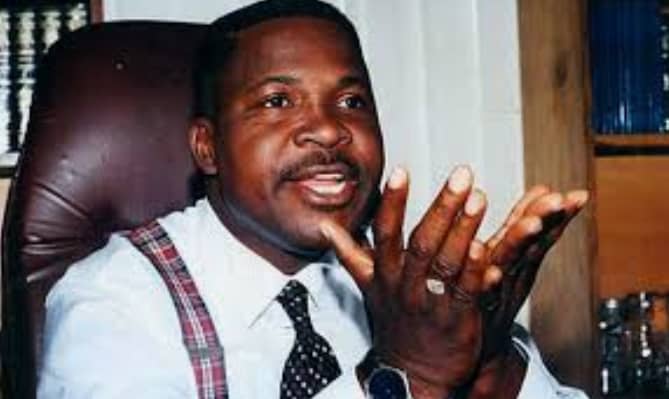
By Mike Ozekhome
INTRODUCTION
Last week, we concluded our discourse on democracy as a form of government. Today, we shall x-ray the meaning, concept, causes and the possibility of having elective dictatorship in governance.
MEANING OF DICTATORSHIP
In all countries of the world, you won’t find a dictator who calls himself a dictator. Instead, dictators bear ordinary titles such as president, emperor, great leader and similar monikers. That’s because ‘dictator’ is a pejorative term assigned to certain rulers by other nations, particularly the developed nations of the West – that is, countries with thriving economies – such as the United States, Canada, the United Kingdom and many others.
To be considered a dictatorship means that a country is known to be run by one person without any checks and balances on his/her power. Dictators make unilateral decisions that affect their countries without having to consult any other branch of government. That is because there is no other branch of government that is not controlled by the dictator. Human nature being what it is, dictators do not rise to power for the good of their nations (though, they usually claim otherwise). They seize power to benefit themselves, their families and their close political allies.
Dictators usually come to power through some kind of violent struggle, rather than the peaceful passage of power that we take for granted in the United States. In cases such as the late Kim Jong-il in North Korea, the ruler is even worshiped as a demi-god.
CONCEPT OF DICTATORSHIP
The concept of dictatorship, in its origin and evolution, may be better appreciated both as a complementary and protective constitutional device and as a complete antithesis to the democratic constitutional state. Thus, Carl J. Friedrich (1937), in referring to the ancient Roman model, makes a distinction between constitutional and unrestricted dictatorship. Franz L. Neumann (1957, p. 248) comments that dictatorship may arise and function as “implementation of democracy,” “preparation for democracy,” or the “very negation of democracy.” Plato and Aristotle saw the origin of tyranny in the weaknesses and degeneration of democracy, and political theory has been based on the polarity of democracy and dictatorship ever since. However, the view that a revolutionary dictatorship necessarily presupposes the existence or the counterpart of a democratic constitution is disputed. Answers may be provided by the recent sociological and political research into the historical process of transition from a constitutional, restricted dictatorship to an unrestricted, total dictatorship.
CAUSES OF DICTATORSHIP
The inability to function and the internal weakness of democracy are undoubtedly among the main causes of the establishment of dictatorial rule. The totalitarian communist system of the Soviet Union arose in consequence of the crumbling away of tsarist autocracy, hastened along by a mass movement. In general, it can be shown that unresolved social tensions and economic crises, together with the undermining of constitutional order and the development of undemocratic power aggregates, are among the conditions that give rise to dictatorial regimes.
POSSIBILITY OF HAVING AN ELECTIVE DICTATORSHIP IN GOVERNANCE
Over the years, the executive arm of government has always been seen as the primary source of tyranny, and in Britain the Parliament was developed to control its power. After centuries of struggle, this control was finally achieved in the nineteenth century by making the executive government responsible to the Parliament.
The growth of disciplined political parties in the twentieth century has reversed this responsibility, and the executive government can now often control the parliament, resulting in a form of elective dictatorship.
There is nothing new about the concept of an elective dictatorship. After all, nearly 2500 years ago, the Roman Commonwealth instituted the office of dictator, the incumbent to be chosen by the Senate to deal with crises such as war, sedition and crime, which were too difficult for the two annually-elected and often mutually antagonistic consuls to deal with. The dictator initially held office for six months.
The Nazi government of Adolf Hitler is an extreme example of a modern elective dictatorship, but Hitler was elected and his dictatorship was legal under the Weimar Constitution. The Weimar Republic had responsible government, with a Chancellor as head of government. The president-the aged Field Marshal Hindenburg at the time of Hitler’s accession-had considerable authority, including dictatorial power if public order and security were threatened.
The Weimar Parliament was elected by proportional representation, with consequent difficulty in forming stable governments.
The constitutional tradition and the rule of law are much more firmly established there than they were in the Weimar Republic. Nevertheless there are disturbing common patterns in all elective dictatorships.
In modern times, attention was first called to the new elective dictatorships by Lord Hailsham, in a famous address on the BBC in 1976. He later wrote:
Disregard the fundamental human values of justice and morality and you will soon turn majority rule into unprincipled tyranny. But in practice, human nature being what it is, every human being and every human institution will tend to abuse its legitimate powers unless these are controlled by checks and balances, in which the holders of office are not merely encouraged but compelled to take account of interests and views which differ from their own.
In pointing to the dangers of an elective dictatorship, Lord Hailsham was in fact echoing the views of a long tradition of political theorists, dating back to the times of ancient Greece. Even the expression ‘elective dictatorship’ was similar to Thomas Jefferson’s description of a type of government as elective despotism.
He wrote: The concentrating [of all the powers of government] in the same hands is precisely the definition of despotic government. It will be no alleviation, that these powers will be exercised by a plurality of hands, and not by a single one. One hundred and seventy-three despots would surely be as oppressive as one … An elective despotism was not the government we fought for.
The founders of the United States of America, particularly Jefferson and Madison, brought remarkable intellectual rigour and imagination to the problems of creating a new democracy. They may have been somewhat misled by the French philosopher Montesquieu, who thought that the separation of the executive, legislative and judicial powers was the secret of the success of the English system after 1688, and the American system was modeled on that principle. ‘The Americans of 1787’, wrote Bagehot, ‘thought they were copying the English Constitution, but they were contriving a contrast to it.’ In fact what Montesquieu was emphasising was the importance of the independence of the judicial system from political forces (unlike the situation in France), and this separation of powers is common to both the British and American systems.
As Lord Acton put it: ‘Power tends to corrupt and absolute power corrupts absolutely.’ Edmund Burke was also aware of the dangers of untrammeled power. Two hundred years ago he wrote that ‘in a democracy the majority of citizens is capable of exercising the most cruel oppression upon the minority.’ His views were echoed nearly a century later by J.S. Mill when he wrote of:
‘the evil effect produced upon the mind of any holder of power, whether an individual or an assembly, by the consciousness of having only themselves to consider … A majority in a single assembly easily becomes despotic and overweening, if released from the necessity of considering whether its acts will be concurred in by another constituted authority. One of the most indispensable requisites in the practical conduct of politics, especially in the management of free institutions, is conciliation: a readiness to compromise; a willingness to concede something to opponents, and to shape good measures so as to be as little offensive as possible to persons of opposite views.’
He went on to say that, to control a government, it was essential to:
‘throw the light of publicity on its acts; to compel a full exposition and justification of all of them which anyone considers questionable’.
This attitude was totally different to that of Dicey three decades later. Dicey believed that the true source of the life and growth of the British Constitution was ‘the absolute omnipotence, the sovereignty of parliament’. It must be admitted, though, that when this sovereign Parliament was prepared to take action with which Dicey disagreed-as in Home Rule for Ireland, his respect for the Constitution seemed to vaporize. He recommended a referendum (so much for the sovereignty of Parliament) and, if a majority voted for Home Rule, he was prepared to see armed insurrection (so much for respect for the British Constitution).
None of the countries above has anything approaching responsible government in Bagehot’s sense, though all pretend they have. What they have is party government, where the party which wins the majority of seats in the lower house forms the government and its leader become prime minister. The government is responsible, not to the parliament, but to the caucus of the government party MPs. The lower house merely registers the laws proposed by the government, after discussions with the government party caucus. The caucus relies for its electoral success on the party organization, which in some of the parliaments may give orders to the parliamentary party.
There are also other constraints. The doctrine of the sovereignty of parliament, under which its enactments cannot be struck down by any court, now applies only in New Zealand. Canada and Australia are federations, with entrenched constitutions. The powers are divided between the federal and state governments, and any disputes are decided by the courts. The UK is a de facto provincial member of the European Federation, with laws enacted by its Parliament liable to be overridden by European Union laws on certain designated subjects, and disputes resolved by a Union court.
These restraints still leave formidable and effectively unreviewable powers in the hands of a government which controls the lower house. The only remaining barriers to party despotism are upper houses, but these barriers are of very uncertain strength. If the government party has the numbers in the upper house it is really no barrier at all for, except in the UK, where party members of both houses meet in a common caucus where the upper house members are usually heavily outnumbered by those from the lower house. The decisions of this caucus are usually binding on upper house members, even in cases where most of them actually oppose the decision. Cross voting is rare; it is effectively non-existent among Labor members in Australia. The House of Lords was a special case, for most of the peers did not accept party discipline. The answer was inevitable. Exploiting the non-elective character of the House of Lords, governments managed to reduce its power to a mere delaying role.
However, if the government party does not have the majority in the upper house-and this is becoming increasingly common, with four of the six elected upper houses using proportional representation-the upper house can be a formidable obstacle to an elective despotism, reviewing legislation thoroughly, and amending and sometimes rejecting it. Government activities may be closely and critically scrutinized and inquiries held into matters the government does not want investigated. If elected by proportional representation, upper houses can reasonably claim to be more reflective of actual community opinion than a lower house elected by single member constituencies. This claim should be slightly qualified, if only part of an upper house-usually half-retires at each election. This is deliberately done to make the upper house a continuing body, without violent fluctuations in balance caused by temporary changes in public opinion. (To be continued).
FUN TIME
There are two sides to every coin. Life itself contains not only the good, but also the bad and the ugly. Let us now explore these.
“Yesterday, I attended a burial of a friend’s grandfather. But their tradition is that at every burial ceremony, an old man would come out and announce the next person to die. So this old man said the first person to leave the burial ground will be the next person to die. Since yesterday, we are still at the burial. Even one elderly man that is over 95years is asking me if my parents won’t be looking for me.
THOUGHT FOR THE WEEK
“Dictatorship naturally arises out of democracy, and the most aggravated form of tyranny and slavery out of the most extreme liberty.” (Plato).
Related
You may like
Opinion
How Dr. Fatima Ibrahim Hamza (PT, mNSP) Became Kano’s Healthcare Star and a Model for African Women in Leadership
Published
1 day agoon
December 6, 2025By
Eric
By Dr. Sani Sa’idu Baba
My dear country men and women, over the years, I have been opportune to watch numerous speeches delivered by outstanding women shaping the global health sector especially those within Africa. Back home, I have also listened to towering figures like Dr. Hadiza Galadanci, the renowned O&G consultant whose passion for healthcare reform continues to inspire many. Even more closer home, there is Dr. Fatima Ibrahim Hamza, my classmate and colleague. Anyone who knew her from the beginning would remember a hardworking young woman who left no stone unturned in her pursuit of excellence. Today, she stands tall as one of the most powerful illustrations of what African women in leadership can achieve when brilliance, discipline, and integrity are brought together.

Before I dwell into the main business for this week, let me make this serious confession. If you are a regular traveler within Nigeria like myself, especially in the last two years, you will agree that no state currently matches Kano in healthcare delivery and institutional sophistication. This transformation is not accidental. It is the result of a coordinated, disciplined, and visionary ecosystem of leadership enabled by Kano State Governor, Engr Abba Kabir Yusuf. From the strategic drive of the Hospitals Management Board under the meticulous leadership of Dr. Mansur Nagoda, to the policy direction and oversight provided by the Ministry of Health led by the ever committed Dr. Abubakar Labaran, and the groundbreaking reforms championed by the Kano State Primary Health Care Management Board under the highly cerebral Professor Salisu Ahmed Ibrahim, the former Private Health Institution Management Agency (PHIMA) boss, a man who embodies competence, hard work, honesty, and principle, the progress of Kano’s health sector becomes easy to understand. With such a strong leadership backbone, it is no surprise that individuals like Dr. Fatima Ibrahim Hamza is thriving and redefining what effective healthcare leadership looks like in Nigeria.
Across the world, from top medical institutions to global leadership arenas, one truth echoes unmistakably: when women lead with vision, systems transform. Their leadership is rarely about theatrics or force; it is about empathy, innovation, discipline, and a capacity to drive change from the inside out. Kano State has, in recent years, witnessed this truth firsthand through the extraordinary work of Dr. Fatima at Sheikh Muhammad Jidda General Hospital.
In less than 2 years, Dr. Fatima has emerged as a phenomenon within Kano’s healthcare landscape. As the youngest hospital director in the state, she has demonstrated a style of leadership that mirrors the excellence seen in celebrated female leaders worldwide, women who inspire not by occupying space, but by redefining it. Her performance has earned her two high level commendations. First, a recognition by the Head of Service following a rigorous independent assessment of her achievements, and more recently, a formal commendation letter from the Hospitals Management Board acknowledging her professionalism, discipline, and transformative impact.
These acknowledgements are far more than administrative gestures, they place her in the company of women leaders whose influence reshaped nations: New Zealand’s Jacinda Ardern with her empathy driven governance, Liberia’s Ellen Johnson Sirleaf with her courageous reforms, and Germany’s Angela Merkel with her disciplined, steady leadership. Dr. Fatima belongs to this esteemed lineage of women who do not wait for change, they create it.
What sets her apart is her ability to merge vision with structure, compassion with competence, and humility with bold ambition. Staff members describe her as firm yet accessible, warm yet uncompromising on standards, traits that embody the modern leadership model the world is steadily embracing. Under her stewardship, Sheikh Jidda General Hospital has transformed from a routine public facility into an institution of possibility, demonstrating what happens when a capable woman is given the opportunity to lead without constraint.
The recent commendation letter from the Hospitals Management Board captures this evolution clearly: “Dr. Fatima has strengthened administrative coordination, improved patient care, elevated professional standards, and fostered a hospital environment where excellence has become the norm rather than the exception”. These outcomes are remarkable in a system that often battles bureaucratic bottlenecks and infrastructural limitations. Her work is proof that effective leadership especially in health must be visionary, intentional, and rooted in integrity.
In a period when global discourse places increasing emphasis on the importance of women in leadership particularly in healthcare, Dr. Fatima stands as a living testament to what is possible. She has demonstrated that leadership is never about gender, but capacity, clarity of purpose, and the willingness to serve with unwavering commitment.
Her rise sends a powerful message to young girls across Nigeria and Africa: that excellence has no gender boundaries. It is a call to institutions to trust and empower competent women. And it is a reminder to society that progress accelerates when leadership is guided by competence rather than stereotypes.
As Kano continues its journey toward comprehensive healthcare reform, Dr. Fatima represents a new chapter, one where leadership is defined not by age or gender, but by impact, innovation, and measurable progress. She is, without question, one of the most compelling examples of modern African women in leadership today.
May her story continue to enlighten, inspire, and redefine what African women can, and will achieve when given the opportunity to lead.
Dr. Baba writes from Kano, and can be reached via drssbaba@yahoo.com
Related
Opinion
Book Review: Against the Odds by Dozy Mmobuosi
Published
3 days agoon
December 4, 2025By
Eric
By Sola Ojewusi
Against the Odds is an ambitious, deeply personal, and unflinchingly honest memoir that traces the remarkable rise of Dozy Mmobuosi, one of Nigeria’s most dynamic and controversial entrepreneurs. In this sweeping narrative, Mmobuosi reveals not just the public milestones of his career, but the intimate struggles, internal battles, and defining moments that shaped his identity and worldview.
The book is both a personal testimony and a broader commentary on leadership, innovation, and Africa’s future—and it succeeds in balancing these worlds with surprising emotional clarity.
A Candid Portrait of Beginnings
Mmobuosi’s story begins in the bustling, unpredictable ecosystem of Lagos, where early challenges served as the furnace that forged his ambitions. The memoir details the circumstances of his upbringing, the value systems passed down from family, and the early encounters that sparked his desire to build solutions at scale.
These foundational chapters do important work: they humanize the protagonist. Readers meet a young Dozy not as a business figurehead, but as a Nigerian navigating complex social, financial, and personal realities—realities that millions of Africans will find familiar.
The Making of an Entrepreneur
As the narrative progresses, the memoir transitions into the defining phase of Mmobuosi’s business evolution. Here, he walks readers through the origins of his earliest ventures and the relentless curiosity that led him to operate across multiple industries—fintech, agri-tech, telecoms, AI, healthcare, consumer goods, and beyond.
What is striking is the pattern of calculated risk-taking. Mmobuosi positions himself as someone unafraid to venture into uncharted territory, even when the cost of failure is steep. His explanations offer readers valuable insights into:
• market intuition
• the psychology of entrepreneurship
• the sacrifices required to build at scale
• the emotional and operational toll of high-growth ventures
These passages make the book not only readable but instructive—especially for emerging
African entrepreneurs.
Triumphs, Crises, and Public Scrutiny
One of the book’s most compelling strengths is its willingness to confront controversy head-on.
Mmobuosi addresses periods of intense scrutiny, institutional pressure, and personal trials.
Instead of glossing over these chapters, he uses them to illustrate the complexities of building businesses in emerging markets and navigating public perception.
The tone is reflective rather than defensive, inviting readers to consider the thin line between innovation and misunderstanding in environments where the rules are still being written.
This vulnerability is where the memoir finds its emotional resonance.
A Vision for Africa
Beyond personal history, Against the Odds expands into a passionate manifesto for African transformation. Mmobuosi articulates a vision of a continent whose young population, natural resources, and intellectual capital position it not as a follower, but a potential leader in global innovation.
He challenges outdated narratives about Africa’s dependency, instead advocating for
homegrown technology, supply chain sovereignty, inclusive economic systems, and investment in human capital.
For development strategists, policymakers, and visionaries, these sections elevate the work from memoir to thought leadership.
The Writing: Accessible, Engaging, and Purposeful
Stylistically, the memoir is direct and approachable. Mmobuosi writes with clarity and intention, blending storytelling with reflection in a way that keeps the momentum steady. The pacing is effective: the book moves seamlessly from personal anecdotes to business lessons, from introspection to bold declarations.
Despite its business-heavy subject matter, the prose remains accessible to everyday readers.
The emotional honesty, in particular, will appeal to those who appreciate memoirs that feel lived rather than curated.
Why This Book Matters
Against the Odds arrives at a critical moment for Africa’s socioeconomic trajectory. As global attention shifts toward African innovation, the need for authentic narratives from those building within the system becomes essential.
Mmobuosi’s memoir offers:
• a case study in resilience
• an insider’s perspective on entrepreneurship in frontier markets
• a meditation on reputation, legacy, and leadership
• a rallying cry for African ambition
For readers like Sola Ojewusi, whose work intersects with media, policy, leadership, and social development, this book offers profound insight into the human stories driving Africa’s new generation of builders.
Final Verdict
Against the Odds is more than a success story—it is a layered, introspective, and timely work that captures the pressures and possibilities of modern African enterprise. It challenges stereotypes, raises important questions about leadership and impact, and ultimately delivers a narrative of persistence that audiences across the world will find relatable.
It is an essential read for anyone interested in the future of African innovation, the personal realities behind public leadership, and the enduring power of vision and resilience
Related
Opinion
Redefining Self-leadership: Henry Ukazu As a Model
Published
4 days agoon
December 3, 2025By
Eric
Related


Soldiers Strike in Benin Republic, Removes Talon, Takes over Govt
The Incredible World of Capt. Segun Sotomi @45
Adding Value: Heal and Move On by Henry Ukazu
Open Letter to Global Leadership: Forging New Intergenerational Partnership for Sustainable Governance
Meet Muhammad Ashfaq Hussain, CEO at Profound Realtors
How Dr. Fatima Ibrahim Hamza (PT, mNSP) Became Kano’s Healthcare Star and a Model for African Women in Leadership
Era of Nationwide Fuel Queues Has Come to An End, Says Dangote
Alex Otti Pays Solidarity Visit to Nnamdi Kanu in Sokoto Prison
After Weeks of Incarceration, Cameroon Opposition Leader Dies in Detention
US Moves to Impose Visa Restrictions on Sponsors, Supporters of Violence in Nigeria
Just In: Defence Minister Abubakar Badaru, Resigns, Tinubu Accepts
Redefining Self-leadership: Henry Ukazu As a Model
US Lawmakers Meet Today over Reported Christian Genocide
Tinubu Names Immediate Past CDS Chris Musa As New Defence Minister
Trending
-
Featured6 days agoAlex Otti Pays Solidarity Visit to Nnamdi Kanu in Sokoto Prison
-
Featured6 days agoAfter Weeks of Incarceration, Cameroon Opposition Leader Dies in Detention
-
World4 days agoUS Moves to Impose Visa Restrictions on Sponsors, Supporters of Violence in Nigeria
-
News6 days agoJust In: Defence Minister Abubakar Badaru, Resigns, Tinubu Accepts
-
Opinion4 days agoRedefining Self-leadership: Henry Ukazu As a Model
-
USA5 days agoUS Lawmakers Meet Today over Reported Christian Genocide
-
National5 days agoTinubu Names Immediate Past CDS Chris Musa As New Defence Minister
-
Featured4 days agoDavido Hails Uncle, Gov Adeleke on Resignation from PDP