Connect with us

Featured

US Election: Biden Overtakes Trump in Pennsylvania

Published

on

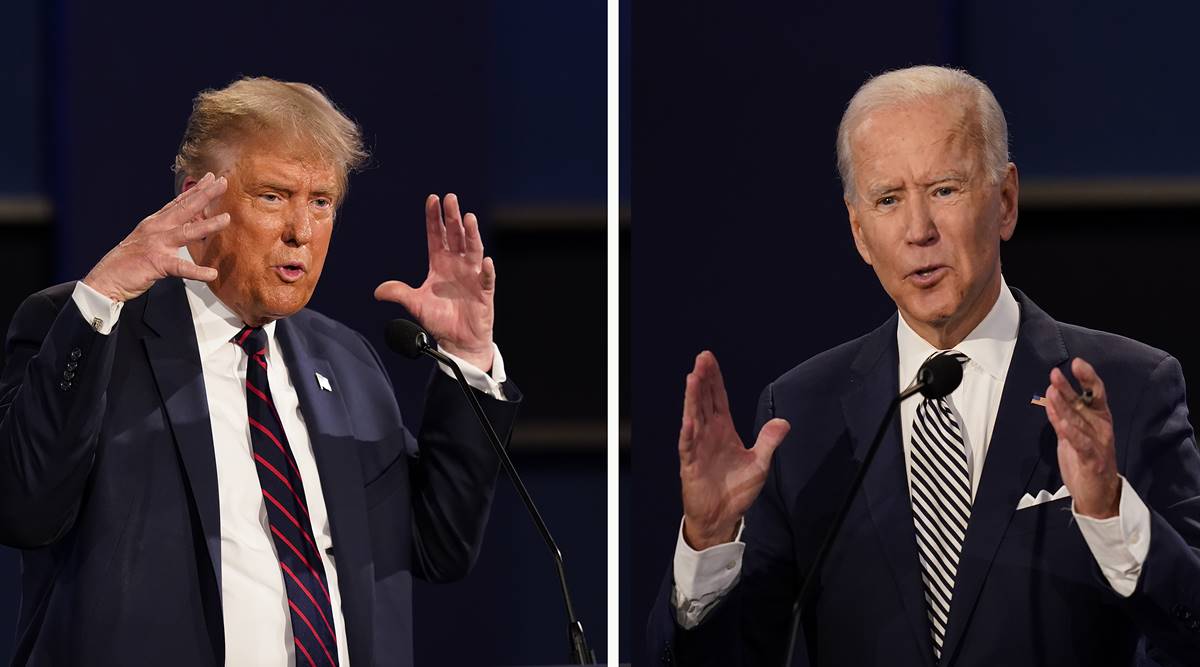
Democrat Joe Biden has taken the lead in key battleground state Pennsylvania, where a victory for the former vice president would push him past the threshold of electoral votes needed to win the White House, US media said Thursday.

More ballots are yet to be counted, but shortly before 1400 GMT, CNN and The New York Times reported that Biden had moved ahead of incumbent President Donald Trump by more than 5,500 votes.

Biden currently has at least 253 electoral votes. The magic number is 270. If he wins Pennsylvania — a state won by Trump in 2016 — and its 20 electoral votes, he would pass that threshold.

Biden is also currently in the lead in key states Georgia and Nevada.

AFP

Continue Reading
Click to comment

Leave a Reply

Your email address will not be published. Required fields are marked *

Featured

Resign by March 31, Tinubu Tells Political Appointees Seeking Elective Offices in 2027

Published

on

By

President Bola Tinubu has directed all political appointees in his administration who intend to contest elective offices in the 2027 general elections to resign their positions on or before March 31, 2026.

The directive, according to the Presidency, is in line with Section 84(12) of the Electoral Act and the timetable released by the Independent National Electoral Commission (INEC) for party primaries ahead of the 2027 polls.

The directive was conveyed on Tuesday through a statement from the Office of the Secretary to the Government of the Federation (OSGF).

The statement was signed by the Permanent Secretary, General Services Office, Dr. Ibrahim Abubakar Kana, on behalf of the Secretary to the Government of the Federation, Senator George Akume.

According to the statement, the directive applies to all categories of presidential political appointees who plan to participate in party primaries or seek nomination for any elective office in the forthcoming elections.

Those affected include Ministers, Ministers of State, Special Advisers to the President, Senior Special Assistants, Special Assistants and Personal Assistants to the President.

It also covers Directors-General and Chief Executive Officers of Federal parastatals, agencies, commissions and government-owned companies, as well as other political appointees appointed by the President.

The government stated that all affected officials are required to submit their formal resignation letters through the Office of the Secretary to the Government of the Federation on or before the March 31, 2026 deadline.

“Accordingly, all affected officials are required to submit their formal resignation letters through the Office of the Secretary to the Government of the Federation not later than March 31, 2026,” the statement said.

The Presidency explained that the directive is intended to ensure strict compliance with electoral laws and promote fairness in the political process ahead of the elections.

President Tinubu emphasised that the measure is aimed at upholding transparency and providing a level playing field for all aspirants preparing to participate in party primaries and the 2027 general elections.

The administration also reiterated its commitment to strengthening democratic institutions and ensuring credible electoral processes in the country.

Continue Reading

Featured

Electoral Umpires in Nigeria and Its Miasma of Failures

Published

on

By

By Hon. Femi Kehinde

Elections in Nigeria since 1923 had been bedeviled with hiccups, brouhaha, frustration, suspicion, lack of trust, and untrustworthy umpires, who were usually placed into such positions by perhaps equally untrustworthy men of power. Nigeria does not stand in isolation in this instance. However, its peculiarities of electoral failures have definitely impacted its growth and development, and stunted the eminence of its position in the Committee of Nations.

Sir Hugh Clifford assumed the office of Governor of Nigeria on August 8, 1919 and served until 1925, succeeding Sir Frederick Lugard, the apparent founder of a country called “Nigeria”- after the Amalgamation of the Southern and Northern Protectorate he had established in 1900 and 1903 respectively. He had consequently amalgamated these two uncommon people on the 1st of January, 1914 into a union called “Nigeria”- a name suggested to him by his British Journalist-wife, Flora Shaw, whom he married on 10th of June, 1902.
Perhaps as a soothsayer, the British Secretary of the Colonies, Lord Harcourt, the man whom Port-Harcourt was named after, in a formal “Instruments of Instruction” Cablegram dispatch to Sir Frederick Lugard on the 26th of December, 1913, sanctioning the creation of a new Nigeria on the 1st of January, 1914, and the appointment of Sir Lugard as its first Governor-General, said: “…May the Union be fruitful…May the Parties remain constant”.

In 1919, Sir Lord Frederick Lugard left office as Governor-General of Nigeria and was succeeded by Sir Hugh Clifford – a hugely prominent and highly experienced British Colonial Officer, who had hitherto, been Governor of the Gold Coast (present day Ghana).

Subsequently in 1922, to administer Nigeria within his own conception and to govern its people in strict adherence to the Rule of Law and democratic tenets and principles, Sir Hugh Clifford created Nigeria’s first Constitution ably tagged the “Clifford Constitution of 1922”. Interestingly, Britain has never operated a written constitution.

To herald democracy in accordance to this Constitution, he conducted an election into a talk-shop like Legislative Council, where only four (4) members were elected; three (3) from Lagos and one (1) from Calabar.

Infact, Lagos and Calabar were then referred to as British Crown Colonies. The four elected members were Egerton Shyngale, Eric Olawolu Moore, Crispin Adeniyi-Jones, Kwamina Ata-amonu. The three (3) successful candidates from Lagos were elected on the platform of Herbert Macaulay’s Nigerian National Democratic Party (NNDP), while the Calabar candidate emerged as an independent candidate.

There was no Electoral Commission to organize the election. It was personally organized and supervised by the Office of the Governor of Nigeria – Sir Hugh Clifford, who was completely apolitical (non-partisan).

However, in 1959, the tide changed. The 1959 General Election was the most significant, as it determined who would lead the country into independence. In 1958, Ronald Edward Wraith, a highly consulate British Administrative Officer, was appointed as the first Electoral Umpire by the British Governor-General in Nigeria, Sir James Wilson Robertson. His task was to design the framework for the country’s first major elections. He was appointed to oversee the 1959 General Elections, which were the most critical elections prior to Nigeria’s independence in 1960. Wraith is often credited with introducing the concept of the Secret Ballot to Nigeria. He spent years traveling round the country to educate Nigerians on how to register and vote, ensuring the transition from colonial rule to the First Republic, had a structured, albeit imperfect, foundation.

The 1959 elections, despite being organized by a British expert and Colonial Officer, was still bedeviled with irregularities. The Parties; NCNC, NPC, and AG, held dominant controls of their Regions. Elections were even won before contest, due to non-availability of Nomination Forms for opposition party members.

Right from the 1959 elections, participatory democracy began to fumble and wobble. The massive riggings of the Federal Elections of 1964 and Regional Elections of 1965 respectively, ultimately led to the collapse of the First Republic on the 15th January, 1966.

In 1960, Chief Eyo Esua was the first indigenous Chairman of the Federal Electoral Commission (FEC) during Nigeria’s First Republic. He was a veteran trade unionist and teacher. Before entering the electoral space, he was a founding member and long-time General Secretary of the Nigeria Union of Teachers (NUT). He was appointed by the Balewa government to oversee the 1964 and 1965 elections. His tenure was defined by the extreme political volatility of the 1960s. The 1964 federal election was marred by boycotts and allegations of massive fraud.

Esua was known for his personal integrity, famously admitting publicly that the 1965 Western Region elections were riddled with irregularities. This admission, while honest, highlighted the powerlessness of the Commission against the political giants of the time, shortly before the 1966 coup. He did not however admit that the 1964 Federal Election which he superintended, was equally marred with irregularities, and was infact a precursor of the 1965 Regional electoral riggings in all the regions of the federation.

In the 1965 Regional Elections in the Western Region, Chief Obadiah Ojerinola, a seasoned Senior Civil Servant in the Government of the Western Region, was appointed by the Ladoke Akintola government as the Electoral Umpire.

Obadiah Ojerinola was a high-ranking Civil Servant in the Western Region of Nigeria. Unlike the figures he worked alongside (like Chief S.L. Akintola, Chief Remi Fani-Kayode), he was not a “party man” by trade but an official within the regional bureaucracy. His appointment to lead the Electoral Body suggests he held a position of significant seniority and perceived stability within the Western Region’s Civil Service at the time.

Obadiah Ojerinola, served as the Chairman of the Western Region Electoral Commission during the highly controversial 1965 Western Region election, a period considered as one of the darkest chapters in Nigerian political history, often referred to as the era of “Wild Wild West” (Wetie).

As the “electoral umpire,” Ojerinola was at the center of the storm between the two major warring factions: NNDP (Nigerian National Democratic Party), led by Chief Samuel Ladoke Akintola (the incumbent Premier), and UPGA (United Progressive Grand Alliance), an alliance including the Action Group (AG) led by Chief Mrs. H.I.D Awolowo and Hon. Dauda Soroye Adegbenro (standing in for the imprisoned Obafemi Awolowo).

Ojerinola’s Commission was accused of extreme bias in favor of Akintola’s government. The election is remembered for several systemic failures. Before the first vote was even cast, the Commission declared many NNDP candidates “unopposed” by refusing to accept the nomination papers of opposition candidates.

On election day, there were reports of widespread ballot box stuffing and the physical intimidation of voters by “party thugs”. In a bizarre turn of events, Ojerinola’s Commission announced Akintola as the winner, while the opposition (UPGA) simultaneously announced their own victory via a pirate radio broadcast.

The conduct of the Ojerinola-led Commission sparked a total breakdown of law and order. Protesters began dousing political opponents and their property with petrol and setting them on fire, hence the term ‘Wetie’, meaning “douse it”. The Western Region became ungovernable, with widespread rioting and killings.

This electoral crisis is widely cited as the primary “trigger” for Nigeria’s first military coup on January 15, 1966, which ended the First Republic and led to the deaths of Akintola and other top leaders like Tafawa Balewa (Prime Minister of Nigeria), Festus Okoti-Ebo (Minister of Finance), Ahmadu Bello (Premier of the Northern Region).

Ojerinola is often studied as a cautionary tale of what happens when an electoral body loses its perceived neutrality. His tenure proved that without a credible ‘umpire’, the Democratic process can collapse into violence.

Similarly, the Electoral Umpires in the Eastern Regional Elections and the Northern Regional Elections in 1965, were Barrister Anthony Aniagulu (later Justice Anthony Aniagulu of the Supreme Court of Nigeria Rtd.) and Alhaji Bello Makaman Kano respectively. They performed similar feats like Ojerinola, to ensure the success of their regional gladiators in the NCNC and NPC respectively.

On 15th November, 1976, Michael Ani was appointed to the role of the Chairman of the Federal Electoral Commission (FEDECO) by General Olusegun Obasanjo’s military administration. Prior to entering the electoral arena, Michael Ani was a seasoned Civil Servant, who was known for his administrative discipline.

His primary responsibility was to oversee the transition from military rule to civilian government, which eventually led to the 1979 general elections. He led a 24-man commission tasked with organizing the return to democracy. His mandate included the registration of political parties, the delimitation of electoral constituencies, and the general conduct of the voting process.
Though he was appointed in 1976, he is most famously remembered for his legal interpretation during the 1979 presidential election. He ruled that Alhaji Shehu Shagari had met the requirement of winning one-quarter of the votes in “at least two-thirds of all the states,” despite the mathematical ambiguity of what constituted two-thirds of Nigeria’s then 19 states. His tenure is often remembered for this “Twelve Two-Thirds” legal dispute regarding the spread of votes required for a presidential winner; a case that eventually went to the Supreme Court.
However, despite Michael Ani’s famed integrity, urbane and cosmopolitan disposition, FEDECO which he presided may still not pass the crucibles of a free and fair election. In late June or early July 1979, through a nationwide State Broadcast before the elections held on August 11, 1979, the Head of State, General Olusegun Obasanjo, addressed the nation on radio and television where he said amongst several others that: “The best candidate may not necessarily win an election”.

Whatever that may mean.

In 1980, Justice Victor Ovie-Whiskey was appointed as the Chairman of the Federal Electoral Commission (FEDECO) during the Second Republic, succeeding Michael Ani, by President Shehu Shagari. He was a distinguished Jurist who served as the Chief Judge of the High Court of the defunct Bendel State. He presided over the 1983 General Elections, which were incredibly contentious due to the “landslide” victories claimed by the ruling National Party of Nigeria (NPN).

He is famously remembered for his defense of his integrity. When accused of taking bribes to rig the 1983 election, he famously quipped that if he saw a bribe of a million naira, he would “faint” because he had never seen such an amount of money.

Despite his background as a fair-minded Judge, the 1983 elections were so disputed that they served as a primary justification for the military coup led by Muhammadu Buhari on 31st December, 1983.

In-parenthesis, Oyo and Ondo States suffered massive electoral riggings, violence and manipulations in the Gubernatorial and Presidential Elections of 1983.

In Ondo State, Hon. Justice (Dr.) Lateef Oladepo Aremu, served as the Resident Electoral Commissioner (REC) for the Federal Electoral Commission (FEDECO). He was a distinguished Nigerian Jurist and later, a pioneer in the judiciary of Osun State.

As the Resident Electoral Commissioner for Ondo State, Justice Aremu was at the center of one of the most disputed Gubernatorial elections in the Second Republic.

FEDECO declared Chief Akin Omoboriowo of the National Party of Nigeria (NPN) as the winner over the incumbent Governor, Chief Michael Adekunle Ajasin of the Unity Party of Nigeria (UPN). The announcement sparked widespread riots, arson, and violence across Ondo State, as many citizens believed the results had been manipulated. The election results were eventually contested in court. In a landmark decision, the judiciary (up to the Supreme Court) overturned the FEDECO declaration, ruling that Chief Michael Ajasin was the actual winner and had been “robbed” of his mandate.

Justice Aremu’s role during this time is often cited in political and legal studies regarding the independence of electoral bodies.
While the FEDECO of 1983 faced massive criticism for “collusion” with the ruling party, Aremu’s later career as a pioneer Judge in Osun State (starting in 1992) saw him rebuild a reputation for intellectual depth and judicial integrity. His transition from the high-pressure electoral environment of 1983 to the Osun State High Court bench in 1992 is viewed as a significant paradigm shift from the Administrative side of the law back to the Adjudicatory side, where he spent the remainder of his distinguished career.

In the 1983 Elections in Ondo State, successful businessman, Chief Agbayewa, and serving member of the Federal House of Representatives, Hon. Olaiya Fagbamigbe who had both decamped from the UPN to the NPN, were killed and burnt to ashes by irate mob in Akure.

In Oyo State, Stephen Sunmiboye Ajibade (commonly cited as S.S. Ajibade) was a prominent Civil Servant and Administrator who served as the Resident Electoral Commissioner (REC) for the Federal Electoral Commission (FEDECO) during the 1983 General Elections. His tenure is historically significant due to the intense political climate of the Nigerian Second Republic and the controversial nature of the elections in the “Wild West.”

As the head of FEDECO in Oyo State, Ajibade was the primary official responsible for the logistical execution and the final announcement of election results in what was then one of Nigeria’s most politically sensitive and volatile states. Under his supervision, FEDECO declared Dr. Victor Omololu Olunloyo of the National Party of Nigeria (NPN) as the winner of the Governorship race. This was a seismic shift in Oyo politics, as it meant the defeat of the incumbent Governor, Chief Bola Ige of the Unity Party of Nigeria (UPN).

Ajibade’s stint as Resident Electoral Commissioner was marked by extreme pressure and allegations of electoral malpractices that characterized the 1983 polls nationwide. The UPN and Chief Bola Ige accused the Oyo State FEDECO office of inflating figures in favor of the NPN. This led to a period of significant tension and sporadic violence across Ibadan and other parts of the state.

The results announced by Ajibade’s office were challenged in the landmark case of Ige v. Olunloyo. While the lower Courts, and eventually the Supreme Court upheld the results (unlike in neighboring Ondo State), the conduct of the election remained a point of heavy criticism by political analysts and historians.

Beyond his role in FEDECO, S.S. Ajibade, a native of Modakeke in present day Osun State, was a Career Administrator. Interestingly, Sam Mbakwe’s name was found on the voters register in Modakeke despite being sitting Governor of Imo State.

In the years following the 1983 elections and the subsequent military coup, he continued to serve in various administrative capacities within the Nigerian Civil Service. He is often remembered in Nigerian political history as an official who stood at the center of one of the most litigated and debated electoral cycles in the country’s history.

The “Transition Years” (1987–1998) represent the most unstable yet fascinating and intriguing period in Nigeria’s electoral history. This era was characterized by a tug-of-war and maradonic styles between military rulers (specifically Generals Ibrahim Babangida and Sani Abacha) and the Chairmen tasked with returning the country to civil rule.

Professor Eme Awa was appointed by General Babangida in 1987 to lead the newly formed National Electoral Commission (NEC). He was a highly respected Professor of Political Science at the University of Nigeria, Nsukka. He was seen as an intellectual heavyweight with a deep understanding of federalism, and also known for his uncompromising integrity. He reportedly fell out with the military government because he refused to be dictated to, regarding the conduct of local government elections. He resigned in 1989. His departure was a signal to many that the military was not yet ready for a truly independent electoral body.

Prof. Humphrey Nwosu, a former student of Eme Awa, took over the NEC in 1989 with a mission to innovate. He is also a Professor of Political Science. He was energetic, vocal, and deeply committed to “homegrown” democracy. He introduced the Option A4 voting system (Open Ballot System), where voters queued behind the poster of their preferred candidate. This was meant to eliminate ballot-box snatching and ghost voting.

Nwosu conducted the June 12, 1993, Presidential Election, widely regarded as the freest and fairest in Nigeria’s history. As results showing M.K.O. Abiola in the lead were being announced, the military government annulled the election. Nwosu was famously silenced, and disappeared from the public eye for years.

Following the chaos of the June 12, 1993 annulment and the removal of Nwosu, Prof. Okon Uya was appointed by the short-lived Interim National Government (ING). He was a distinguished Professor of History and former Ambassador to Argentina. Prof. Uya was tasked with conducting a fresh presidential election to “correct” the June 12 impasse. His tenure was cut short when General Sani Abacha seized power in a coup in November 1993, dissolving all democratic structures, including the NEC.

Under the Abacha regime, the Commission was renamed the National Electoral Commission of Nigeria (NECON), and Chief Sumner Dagogo-Jack was appointed as its Chairman in 1994. Chief Dagogo-Jack was an Administrator from Rivers State. His tenure is often criticized because the five registered Political Parties at the time all nominated General Sani Abacha as their sole presidential candidate; a move popularly described by late Chief Bola Ige as “five fingers of a leprous hand”. The transition process he was overseeing ended abruptly when General Abacha died in June 1998.

This era proved that no matter how brilliant the Chairman was (like Nwosu or Awa), the “Independence” of the Commission was always at the mercy of the military’s willingness to vacate power.

In 1998, the Independent National Electoral Commission (INEC) was established by the military administration of General Abdulsalami Abubakar, replacing NECON. The formation of INEC was a foundational step in the transition program that eventually ended decades of military rule and ushered in the Nigerian Fourth Republic on the 29th May, 1999. Justice Ephraim Akpata was appointed as the first Chairman of the newly formed Independent National Electoral Commission (INEC). He was a retired Justice of the Supreme Court of Nigeria.

Justice Akpata is credited with the successful conduct of the 1999 elections, which ended decades of military juntas and ushered in the Fourth Republic. He was widely respected for his integrity and for standing his ground against political pressure during a very fragile transition period.

In the year 2000, following the death of Justice Ephraim Akpata, President Olusegun Obasanjo appointed Dr. Abel Guobadia to succeed the deceased INEC Chairman. He became the second Chairman of the Fourth Republic’s INEC. He was a distinguished Physicist and diplomat. He served as the Executive Secretary of the National Universities Commission (NUC) and was Nigeria’s Ambassador to South Korea.
He oversaw the first civilian-to-civilian transition in Nigeria’s history. While successful in keeping the Republic moving, the 2003 election was heavily trailed by allegations of “ballot-box stuffing”, logistical chaos and failures.

As at then, Dr. Guobadia was the first Chairman in Nigerian history to successfully complete a full five-year term of office from 2000 to 2005, without being sacked or resigning. Though his tenure was controversial due to the “landslide” victories of the ruling party, he maintained a calm, “by-the-book” judicial approach to electoral disputes, always advising critics to seek redress in Court.

In 2005, Prof Maurice Iwu succeeded Dr. Abel Guobadia as INEC’s Chairman. He was in office between 2005 and 2010. Professor Iwu’s tenure is perhaps one of the most debated in Nigerian history. He was a Professor of Pharmacognosy (the study of medicines derived from natural sources).
He oversaw the 2007 General Elections, which were widely criticized by international observers and even the winner, Umaru Musa Yar’Adua, for being deeply flawed. Despite the criticism, Prof Iwu introduced several technological concepts, like the initial electronic voting machine designs, though they were not fully implemented during his time.

Prof Attahiru Jega succeeded Maurice Iwu as INEC’s Chairman, and was in office between 2010 and 2015. Prof. Jega is often regarded as the man who restored the image of INEC. He was a former Vice-Chancellor of Bayero University, Kano and a prominent academic activist (former President of ASUU).

Prof. Jega is notably known for introducing the Permanent Voter Card (PVC) and the Smart Card Reader, which significantly reduced “over-voting” and ballot stuffing. He presided over the 2015 election, the first time in Nigerian history that an incumbent president (Goodluck Jonathan) lost to an opposition candidate (Muhammadu Buhari) and conceded.

Prof. Mahmood Yakubu succeeded Prof. Attahiru Jega in 2015. He was in office as the longest serving INEC Chairman in Nigerian history, serving from 2015 to October 7, 2025, when his tenure extinguished. He was a Professor of History and former Executive Secretary of the Tertiary Education Trust Fund (TETFund).

He pushed for the Bimodal Voter Accreditation System (BVAS) and the INEC Result Viewing Portal (IReV). These tools were designed to upload polling unit results directly to the internet in real-time.
While Prof Yakubu successfully managed the 2019 and 2023 elections, his tenure has faced intense scrutiny over technical glitches during the 2023 presidential result uploads.

Following his departure from INEC in October 2025, Prof. Mahmood Yakubu was appointed by President Bola Ahmed Tinubu as the Nigeria Ambassador-designate to Qatar.

The incumbent Chairman of the Independent National Electoral Commission (INEC) is Professor Joash Ojo Amupitan (SAN). He was sworn in by President Bola Ahmed Tinubu on October 23, 2025, succeeding Professor Mahmood Yakubu. He is a distinguished Professor of Law and a Senior Advocate of Nigeria (SAN). Prior to his appointment, he served as the Deputy Vice-Chancellor (Administration) at the University of Jos.

However, would the electoral land-mines and the labyrinths of systemic failures allow this Ayetoro Gbede-born, highly regarded Scholar and Administrator, be truly independent and perhaps etch his name in gold as an apostle of electoral credibility in Nigeria, which had for so long remained a forlorn hope and mirage?

Fair play is lost in a football match, between shooting stars of Ibadan and Rangers International of Enugu, when you asked the shooting stars of Ibadan to choose the referee.

Wishing this former Pro-Chancellor and Chairman of the Governing Council of a faith-based University – Joseph Ayo Babalola University (JABU), Ikeji-Arakeji, a successful voyage.

Hon. (Barr.) Femi Kehinde, MHR is a
Former Member of the House of Representatives, National Assembly, Abuja (1999-2003), representing Ayedire, Iwo, Olaoluwa Federal Constituency of Osun State, and Principal Partner, Femi Kehinde & Co. Solicitors, Ibadan, Oyo State

Continue Reading

Featured

2027: ADC Cries Out over Alleged Plot to Make Tinubu Sole Candidate

Published

on

By

The African Democratic Congress (ADC) has raised the alarm over what it described as a plot to make Bola Tinubu the sole presidential candidate in the 2027 general elections.

The party also accused the All Progressives Congress (APC) of attempting to impose an expelled member as its national chairman in a move it said was aimed at weakening the opposition.

Specifically, the ADC alleged that the APC is plotting to pressure the Independent National Electoral Commission (INEC) to recognise Mr. Nafiu Bala Gombe, an expelled member of the party, as the ADC National Chairman.

According to the party, the alleged move forms part of a wider strategy to destabilise the ADC and ensure that President Tinubu emerges as the only serious contender in the 2027 presidential election.

In a statement issued in Abuja and signed by its National Publicity Secretary, Bolaji Abdullahi, the ADC described the alleged plot as a calculated attempt by elements within the ruling establishment to create confusion within the party and weaken what it called a viable opposition platform.

The party insisted that there is no ambiguity about its leadership, maintaining that its affairs are firmly under the control of former Senate President, David Mark, following a combined meeting of its National Working Committee (NWC) and National Executive Committee (NEC) witnessed by INEC officials in July 2025.

The ADC said it would employ all legitimate means to resist what it described as attempts by anti-democratic forces within the ruling party to undermine competitive democracy in Nigeria.

The statement alleged that powerful figures within the APC were behind efforts to pressure INEC into recognising Nafiu Bala Gombe as the party’s national chairman.

It claimed that the move was being driven by an APC governor in collaboration with a senior security official based in Abuja as part of a broader scheme to weaken the opposition ahead of the 2027 elections.

According to the party, Gombe, who once claimed to be Deputy National Chairman under former ADC National Chairman, Ralph Nwosu, had been expelled from the party for actions inconsistent with its constitution and leadership decisions.

The ADC said it is, therefore, alarming that certain political interests were allegedly attempting to use him to destabilise the party and forcibly take over its leadership.

The party further argued that the objective of the alleged plot was to manufacture internal crisis within the ADC, sponsor illegitimate leadership claims and cripple what it described as the only credible opposition platform available to Nigerians.

Reiterating its position, the party said a properly constituted joint meeting of its NWC and NEC, witnessed by INEC officials, had transferred the party’s leadership to a coalition led by David Mark and former Osun State governor, Rauf Aregbesola, in July 2025.

It added that INEC formally recognised the leadership in September 2025.

The party also cited a Federal High Court ruling delivered on March 6, which dismissed a suit challenging Mark’s leadership of the party, affirming that leadership issues within political parties are internal matters.

The ADC warned that Nigeria’s democracy could be undermined if ruling parties attempt to infiltrate or manipulate opposition platforms for political advantage.

It said such actions would constitute a serious threat to democratic pluralism and the constitutional right of Nigerians to organise and support credible political alternatives.

Continue Reading

Trending